My breakfast took 1100 litres (290 gal) of water to make – how much was yours?

meat sample

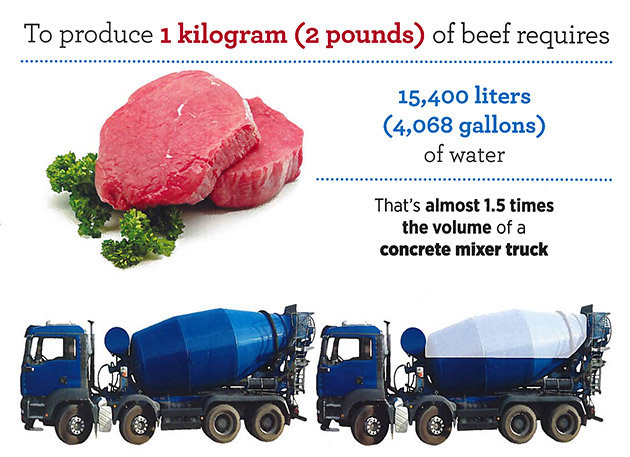
( Graphic from  ‘Your Water Footprint’) 

I have a confession: I used 1100 litres of water to make my breakfast today. It was nothing special, just a small glass of orange juice, a cup of coffee, two eggs, toast and two pieces of bacon. But it did take 1100 litres of water to grow and process the ingredients. Thats a whole lot of water considering the average bathtub only holds about 80 litres.

Even after 20 years of covering environmental issues in two dozen countries I had no idea of the incredible amounts of water needed to grow food or make things. Now, after two years working on my book Your Water Footprint Im still amazed the T-shirt Im wearing needed a whopping 2500 litres to grow and process the cotton. Or that 140 litres was needed to grow and process the coffee beans to make my morning coffee. Since a litre of water weighs a kilogram, thats 140 kilos of water, imagine having to haul that much in a bucket every morning!

Your Water Footprint wins Lane Anderson award as best Canadian Science book for general public

Water more valuable and useful than oil

Researching all of this I soon realized were literally surrounded by a hidden world of water. Although we cant see it, there is water in everything we eat, everything we use and buy. Almost anything you can think of – cars, furniture, books, dishes, TVs, highways, buildings, jewelry, toys and even electricity would not exist without water.

Its no exaggeration to say water is far more valuable and useful than oil.

Unfortunately, water is often taken for granted and undervalued, resulting widespread misuse and waste. The idea behind my book is to increase awareness of huge quantities of the hidden water our entire way of life depends on. Your Water Footprint uses colourful infographics to illustrate the size of the water footprints of a wide range things from shoes to whiskey. A water footprint is the amount of water consumed’ to make, grow or produce something. I use the word consumed to make it clear this is water that can no longer be used for anything else. Water can often be cleaned or reused, so those amounts of water are not included in the water footprints in the book.

For example, when you drink a half-litre of bottle water youre actually consuming 5.5. litres. Why so much? Making the plastic bottle consumed 5 litres of water.

After poring through many studies on water footprints, I was really surprised to see how tiny my direct use of water for drinking, cooking, showers and so on was by comparison. Each day the average North American uses 300 to 400 litres. (FYI: Flushing toilets is the biggest water daily use, not showers.) Now, 400 litres is not a trivial amount of water, and we can all get by using less by employing some water-savings tips.


How big is your water footprint? Take a quick test


However, compared to the hidden water, also known as virtual water, thats in the things we eat, wear and use for a day averages an incredible 7500 litres. That means our daily water footprint is almost 8,000 litres (direct + hidden freshwater use). Carrying all this water would be like trying to haul the weight of four mid-size cars every day.

Peak water is here

Water scarcity is a reality in much of the world. About 1.2 billion people live in areas with chronic scarcity, while two billion are affected by shortages every year. That’s two in seven people. And as the ongoing drought in California proves, water scarcity is increasing reality for many of us in the US and Canada. Water experts estimate that by 2025, three in five people may be living with water shortages.

While low-flow shower heads and toilets are great water savers, the water footprint concept can lead to even bigger reductions in water consumption. If a family of four replaced beef with chicken in all their meals, they would reduce their water use an astonishing 900,000 litres a year. That’s enough to fill an Olympic-sized pool to a depth of two feet. The reason is the water footprint of beef is four times larger than chicken.

Vegetables have an even smaller water footprint. If the average family liked the idea of “Meatless Mondays,” they’d save 400,000 litres of water a year.

My hope with Your Water Footprint is to give you enough information to make water-wise choices to reduce your water use which will help you save money, be prepared for shortages and ensure our children and grandchildren will have abundant fresh water. This is all about smart substitutions and changes, rather than sacrifice and self-denial.

To do this we need to know how much we are currently using. We can’t make the water-wise choices unless we begin to see and understand the invisible ways in which we rely on water.

Stephen Leahy is an award-winning environmental journalist based in Uxbridge, Ontario, Canada. He is the author ofYour Water Footprint: The Shocking Facts About How Much Water We Use to Make Everyday Products.

(First published Yahoo Canada News – Mon, 8 Sep, 2014)

Your Water Footprint: The Shocking Facts About How Much Water We Use to Make Everyday Products 

Only $19.95 paperback; 160 pages, 125 unique infographics,

also available as Kindle and in other ebook formats

In US:  AmazonPowell’s Books; Barnes&NobleIndiebound

Canada:  Chapters-Indigo Signed copies avail at Blue Heron Books – Stephen’s home town bookstore; In Ottawa visit the legendary Octopus Books

UK:  WH SmithAmazonWaterstones

Australia: Angus & RobertsonBooktopia

New Zealand: Mighty Ape
You’d be shocked to see how your jewellery is made

The Sickest Places in the World

Parts of Indonesia, Argentina and Nigeria are among the top 10 most polluted places on the planet, according to a new report by U.S. and European environmental groups.


The Agbogbloshie e-Wasteland in Ghana. Fires are set to wires and other electronics to release valuable copper and other materials. The fires blacken the landscape, releasing toxic fumes. Credit: Blacksmith Institute

The Agbogbloshie e-Wasteland in Ghana. Fires are set to wires and other electronics to release valuable copper and other materials. The fires blacken the landscape, releasing toxic fumes. Credit: Blacksmith Institute

UXBRIDGE, Canada, Nov 5 2013 (IPS) Parts of Indonesia, Argentina and Nigeria are among the top 10 most polluted places on the planet, according to a new report by U.S. and European environmental groups.

They are extraordinarily toxic places where lifespans are short and disease runs rampant among millions of people who live and work at these sites, often to provide the products used in richer countries.

“People would be shocked to see the conditions under which their lovely jewelry is sometimes made,” said Jack Caravanos, director of research at the New York-based Blacksmith Institute, an independent environmental group that released the list Monday in partnership with Green Cross Switzerland.

Full story: The Sickest Places in the World

Stop All Investments in Fossil Fuel Infrastructure or All Will Suffer IPCC warns


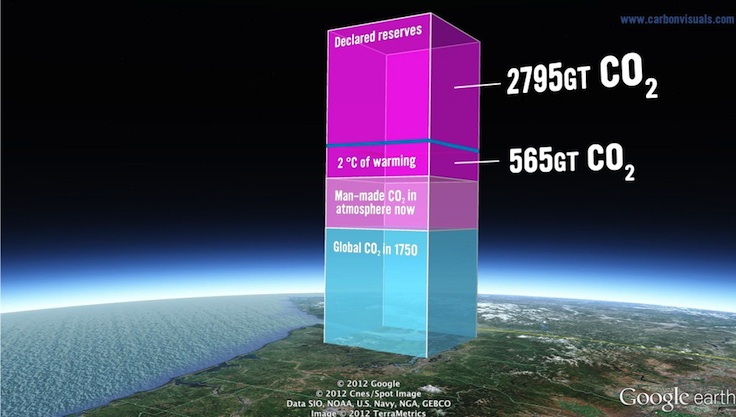
Carbon overload - have to stop expanding
Carbon overload – have to stop expanding

By Stephen Leahy

UXBRIDGE, Canada, Apr 22 2014 (IPS) 

Hopefully, on Earth Day today, high-level ministers from all countries are thinking about what they can bring to the table at a key set of meetings on climate change in early May.

This will be the first opportunity for governments to discuss their proposed climate action plans in light of the finalIntergovernmental Panel on Climate Change (IPCC) report released last week.

“There is a clear message from science: To avoid dangerous interference with the climate system, we need to move away from business as usual.” — Professor Ottmar Edenhofer 

That report warned that carbon dioxide (CO2) emissions from burning fossil fuels are still rising far too fast, even with more than 650 billion dollars invested in renewable energy in the last three years. However, over the same time period even more money was invested in getting more fossil fuels out of the ground.

The latter investment is keeping humanity and the planet locked onto a devastating path of a global temperature increase of four to five degrees C, the IPCC’s Working Group III report warned.

Scientists and economists say that unlocking ourselves from disaster will require a massive reduction in emissions – between 40 percent and 70 percent – by midcentury. This is can be readily accomplished without inventing any new technology and at a reasonably low cost, reducing global economic growth by a comparatively tiny 0.06 percent.

“It doesn’t cost the world to save the planet,” economist Professor Ottmar Edenhofer, who led the IPCC team, said at a press conference.

It does mean an end to investments in expanding fossil fuel infrastructure as the annual growth in CO2 emissions from burning oil, coal and gas must peak and decline in the next few years. The atmosphere already has 42 percent more CO2 than it did prior to 1800.

This extra CO2 is trapping more heat from the sun, which is heating up the oceans and land, creating the conditions that spawn super storms and extreme weather. And it will do so for the next 1,000 years since CO2 is a very durable molecule.

“There is a clear message from science: To avoid dangerous interference with the climate system, we need to move away from business as usual,” Edenhofer said.

Continue reading

Nano Worry: Big Concern for Very Small Things

Buckyball Molecule C320, Artwork Laguna Design

By Stephen Leahy

First published 04.07.04 at WIRED.COM

(I wrote this 10 years ago and was one of the first articles about environmental risks of nano techI have not been able to update it )

Nanoparticles called fullerenes — aka buckyballs — are extremely stable arrangements of carbon atoms that look like soccer balls. Eva Oberdörster, an aquatic scientist at Southern Methodist University, has conducted a study that looks at the potential risks of nanomaterials.

The nascent nanotechnology industry collectively cringed last week after a study showed that fish exposed to nanoparticles suffered brain damage. Critics say the much-hyped multibillion-dollar nano industry has a dark side few want to talk about.

“How many more studies showing toxicity are needed before regulators step in?” asks Kathy Jo Wetter of the Winnipeg-based ETC Group. ETC and other environmental groups are calling for a moratorium on the commercial production of nanoparticles.

Nano products are not subject to any special regulations, in part because little is known about the environmental and health implications of nanotechnology, says Kevin Ausman, executive director of the Center for Biological and Environmental Nanotechnology at Rice University in Houston.

Nanotechnology is a catchall term for an enormous range of research and technology measured at the scale of one-thousandth the width of a human hair. At this very small scale, ordinary materials have extraordinary properties promising the semi-fantastic — supercomputers that fit on the head of a pin and fleets of cancer-fighting nanobots — and the more mundane — better paint and eye shadow.

Stain-resistant nanopants and sunscreens and cosmetics using nanosized titanium dioxide particles are already on the market. And the Nanodesu bowling ball is one of the first consumer products that uses nanoparticles called fullerenes — aka buckyballs — which are extremely stable arrangements of carbon atoms that look like soccer balls.

To see what might happen if buckyballs got into the environment, Eva Oberdörster, an aquatic scientist at Southern Methodist University, put some into a fish tank at a concentration of 0.5 parts per million, along with nine largemouth bass. The buckyball-breathing fish experienced significant brain damage after 48 hours. Brain-cell membranes were disrupted, an affliction that has been linked to illnesses such as Alzheimer’s disease in humans.

Oberdörster’s unpublished study, which was released last week, is one of the few completed studies looking at the potential risks of nanomaterials. There is some cause for concern. Two recent studies documented lung damage in animals after they inhaled a type of buckyball called a carbon nanotube. Another showed that nanoparticles can get into the brain if inhaled.

They’re also small enough to cross cell walls and leak into the nucleus, the home of an organism’s DNA. And, in the case of titanium dioxide nanoparticles, they can kill bacteria. That’s good news in a hospital, but bad news in the environment, where bacteria are extremely important for maintaining soil fertility, among other things.

Understanding how nanomaterials and the environment interact is a complex, interdisciplinary problem, says Ausman.

“Some of the ways we normally measure environmental toxicity aren’t applicable to nanotechnology. And there aren’t many researchers who really understand these novel materials.”

One who does is John Bucher, director of federal toxicology research at the National Institute of Environmental Health Sciences. His group will soon begin a series of studies on the environmental health effects of three types of nanoparticles.

“There are so many different types of nanomaterials, some are likely toxic,” says Bucher.

Sorting out the impacts of nanotech won’t be easy, since the properties of nanomaterials are not well-defined yet. Something such as gold — which is normally biologically inert — is highly reactive and likely to disrupt biological processes when it’s nanosized.

And then there’s the problem of trying to detect particles of such a tiny size, says Bucher. Microscopes powerful enough to identify nanoparticles are just being developed.

It will be several years before the National Institute of Environmental Health Sciences toxicology studies are completed.

Ausman thinks regulations will be needed to guide future applications, but not enough is known to establish these yet. In the meantime, the nano industry and the benefits it can bring society shouldn’t be held back over toxicity fears, he says.

“I’m not concerned at this point.”

UN Climate Talks End In Dramatic Showdown But Little Progress

COP 19 Final Showdown between US and Fiji

By Stephen Leahy

WARSAW, Nov 24 2013 (IPS)

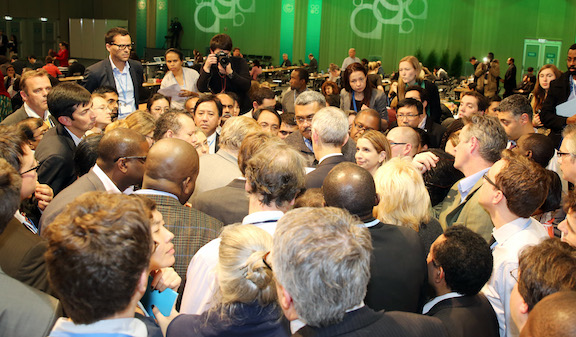
The U.N. climate talks in Warsaw ended in dramatic fashion Saturday evening in what looked like a schoolyard fight with a mob of dark-suited supporters packed around the weary combatants, Todd Stern of the United States and Sai Navoti of Fiji representing G77 nations.

It took two weeks and 36 straight hours of negotiations to get to this point.

At issue in this classic North versus South battle was the creation of a third pillar of a new climate treaty to be finalised in 2015. Countries of the South, with 80 percent of the world’s people, finally won, creating a loss and damage pillar to go with the mitigation (emissions reduction) and adaptation pillars.

Super-typhoon Haiyan’s impact on the Philippines just days before the 19th Conference of the Parties (COP19) amply illustrated the reality of loss and damages arising from climate change.  Philippines lead negotiator Yeb Saño made an emotional speech announcing “fast for the climate” at the COP19 opening that garnered worldwide attention, including nearly a million YouTube views

Click for complete story


The Bigger Canada’s Energy Sector Gets the Poorer People Become

By Stephen Leahy

Thu, 2013-03-21 05:00 DeSmog Canada

Blame Canada is a four part series revealing how Canada has become a wealthy, fossil-fuelled energy superpower and an international climate pariah. For Part 1, click here. Part 2 here

Few are aware Canada’s GDP shot up from an average of $600 billion per year in the 1990s to more than $1.7 trillion in 2012. This near tripling of the GDP is largely due to fossil fuel investments and exports.

However not many Canadians are three times wealthier. For one thing GDP is only a measure economic activity. The other reason is that little of this new wealth stayed in Canada. And what did stay went to a small percentage of the population, worsening the gap between rich and poor.

One of the hallmarks of a “petro-state” is that while a country’s energy industry generates fantastic amounts of money, the bulk of its citizens remain poor. Nigeria is a good example. Canada’s poverty rates have skyrocketed in step with the growth of the energy sector. One Canadian child in seven now lives in poverty, according to the Conference Board of Canada, the country’s foremost independent research organization.

Income inequality increased faster than the US, with the rich getting richer and poor and middle class losing grounds over the past 15 to 20 years, the Conference Board also reported January 2013.

“Most of Canada’s increase in wealth went to the big shareholders in the resource industries,” says Daniel Drache, a political scientist at Toronto’s York University. “It mainly went to the elites.”

Full Story: http://desmog.ca/2013/03/20/blame-canada-part-3-bigger-canada-s-energy-sector-gets-poorer-people-become_

Unseen World of Water and the Water Crisis

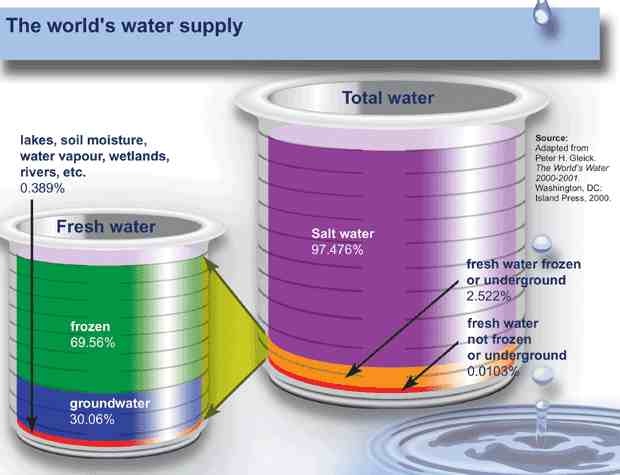
world water supply

By Stephen Leahy

UXBRIDGE, Canada, Mar 22 2013 (IPS)

How much water does it take to turn on a light? It took 10,000 litres to make your jeans. Another three big bathtubs of water was needed for your two-eggs-toast-coffee breakfast this morning.

We are surrounded by an unseen world of water: furniture, houses, cars, roads, buildings – practically everything we use and make needs water.

“There is no way to generate energy without water,” said Zafar Adeel, co-chair of the UN-Water Task Force on Water Security and director of the Institute for Water, Environment and Health in Canada.

Even solar panels need regular washing to perform well. Wind energy might be an exception, Adeel told IPS from a water conference in Beijing being held during World Water Week.

There is growing recognition that peak oil is nowhere near as important as peak water because there is no substitute for water. The growing shortage of water — 1.2 to 1.7 billion people face scarcity — has alarmed many. Water has been identified as an “urgent security issue”, by a group that last year included both former U.S. Secretary of State Hillary Clinton and the InterAction Council, an association of 37 former heads of state and government.

It’s important that “water security” be recognised by the U.N. Security Council as either as a trigger, a potential target, or a contributing factor to insecurity and potential conflict in many parts of the world, said Adeel.

Canada’s Plan to Get Rich by Trashing the Climate

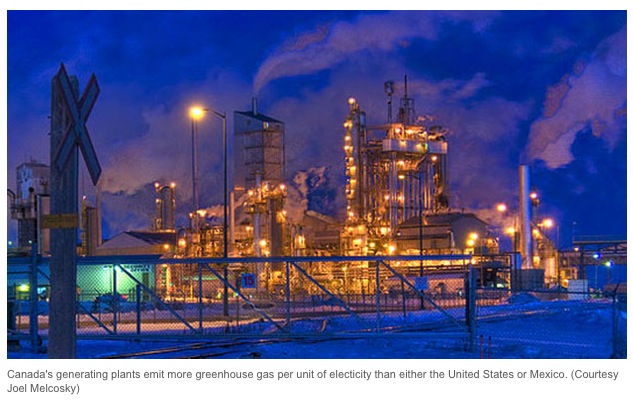
Canada's fossil fuel electricity has highest carbon emissions

By Stephen Leahy

Blame Canada is a four part series revealing how Canada has become a wealthy, fossil-fuelled energy superpower and an international climate pariah. For Part 1, click here.

Like every other country in the world, Canada has promised to help keep global warming to less than 2 degrees C. However Canada’s political and corporate leadership are committed to turning the country into a fossil-fuelled “energy superpower.”

With a drug lord’s just-providing-a-service hypocrisy Canada has openly declared it’s future is tied to the profits from dumping hundreds of millions of tonnes of climate-heating carbon into the atmosphere every year.

And the world’s new energy superpower plans to grow those annual emissions to 1.5 billion tonnes by 2020 giving one of the least populated countries a gigantic carbon bootprint.

Most of this climate-wrecking carbon energy will come from Canada’s tar sands located just underneath the pristine boreal forest and wetlands of northern Alberta. The oil industry likes to call them “oil sands,” although there is no liquid oil only a tarry bitumen mixed deep in the sandy soil.

With an estimated 170 billion barrels, the tar sands are the third largest crude oil reserves. Extraordinary efforts involving colossal amounts of water, heat, chemicals and machinery are needed to get the bitumen out of the ground and into pipelines. This the world’s largest industrial project with more than $300 billion invested since 2001 by the oil industry.

Nowhere has fossil energy expansion or investment been faster or larger. Environmental activists call it “Canada’s Mordor.”

Public Pays for Fukushima Clean Up While Nuclear Industry Profits

Japan Fukushima Dai-ichi nuclear power plant March 31 2011

By Stephen Leahy

UXBRIDGE, Canada, Mar 12 2013 (IPS)

Two years after Japan’s Fukushima Daiichi nuclear disaster, the country faces 100 to 250 billion dollars in cleanup and compensation costs, tens of thousands of displaced people and widespread impacts of radiation.

The nuclear industry and its suppliers made billions from building and operating Fukushima’s six reactors, but it is the Japanese government and its citizens who are stuck with all the costly “fallout” of the disaster.

“People’s lives were destroyed and we will be paying trillions of yen in tax money because of the Fukushima disaster,” said Hisayo Takada, an energy campaigner with Greenpeace Japan.

“The nuclear industry, other than Tepco (Tokyo Electric Power Co), has paid nothing as they are specially protected by the law,” Takada told IPS.

On Mar. 11, 2011, Japan experienced a 9.0 magnitude earthquake and resulting tsunami that badly damaged Tepco’s Fukushima Daiichi nuclear plant. Three of six reactors suffered a meltdown, and reactor unit four was damaged. The Fukushima accident has been rated at the highest level (7) of the International Atomic Energy Agency scale, the same as the Chernobyl accident.

A year after the disaster, Tepco was taken over by the Japanese government because it couldn’t afford the costs to get the damaged reactors under control. By June of 2012, Tepco had received nearly 50 billion dollars from the government.

The six reactors were designed by the U.S. company General Electric (GE). GE supplied the actual reactors for units one, two and six, while two Japanese companies Toshiba provided units three and five, and Hitachi unit four. These companies as well as other suppliers are exempted from liability or costs under Japanese law.

Full story here

Pollution as big a health problem as malaria or TB, finds report

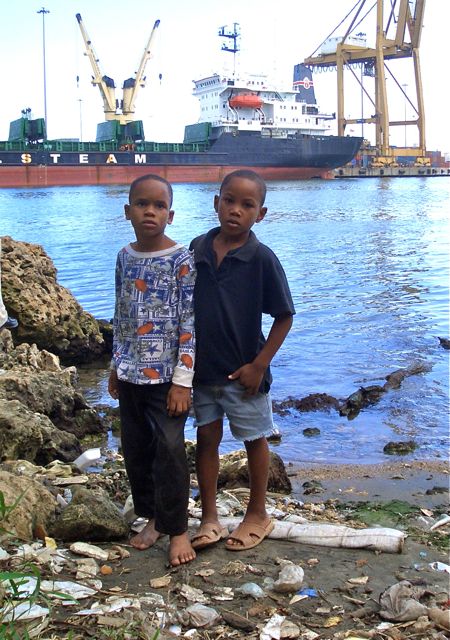
Haina, Dominican Republic - Children are developmentally impaired as a result of lead poisoning
Haina, Dominican Republic – Children are developmentally impaired as a result of lead poisoning

Industrial pollutants harm the health of 125 million people,

many of whom live in the developing world and work in mining

Stephen Leahy

guardian.co.uk, Wednesday 24 October 2012 12.30 BST

Waste from mining, lead smelters, industrial dumps and other toxic sites affects the health of an estimated 125 million people in 49 low- and middle-income countries. This unrecognised health burden is on the scale of malaria or tuberculosis (TB), a new report has found.

This year’s World’s worst pollution problems (pdf) report was published on Tuesday by the Blacksmith Institute in partnership with Green Cross Switzerland. It documents, for the first time, the public health impact of industrial pollutants – lead, mercury, chromium, radionuclides and pesticides – in the air, water and soil of developing countries.

“This is an extremely conservative estimate,” said Bret Ericson of the Blacksmith Institute, a small international NGO based in New York City. “We’ve investigated 2,600 toxic sites in the last four years, [but] we know there are far more.”

The US has an estimated 100,000-300,000 toxic sites, mainly factories or industrial areas, but toxic sites in the low- and middle-income countries assessed in the report are often in residential areas. “We see a lot of disease when we go into these communities,” said Ericson. “But we were surprised the health burden was so high – as much as malaria.”

Click to read full story:  Pollution as big a health problem as malaria or TB, finds report | Global development | guardian.co.uk.