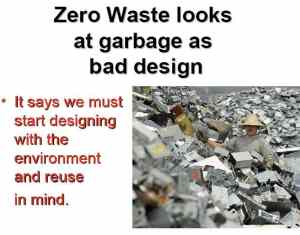
Do Incinerators Kill Goal of Zero Waste?

zero-waste-conceptby Stephen Leahy

The Uxbridge Cosmos Apr 30 2009

Shawn Williamson took out 2.4 bags of trash last year. Williamson hopes to trim that to 1.6 bags of garbage this year from his family of three living in a typical newer home in nearby Brooklin.

“It’s easy,” says Williamson, a consultant and Director at Durham Sustain Ability, who also uses his home as an office. The secret is buying in bulk and “not buying crap”. The family buys 50lb bags of rice, uses glass jars for storage of other bulk food items and does its own backyard composting. [living zero waste – you tube video]

“It makes more sense to compost food waste in your backyard than transport it all over the Region.”

Uxbridge and Durham Region residents may not realize there is a looming garbage crisis. Virtually all of the Region’s more than 100,000 tonnes of trash goes to Michigan. But those landfills will be closed to Ontario’s garbage in 2010. In response Durham Region Council voted last year to build an estimated $230 million incinerator, or energy-from-waste (EFW) facility in Clarington near Lake Ontario.

“No incinerator is clean. Why let the Region blow toxic smoke into your lungs?” Dr. Sean Godfrey, Chief of Pediatrics, Lakeridge Health Oshawa asked about 80 people attending an information session in Whitby in early April. The event was part of a series of sessions organized by a group of Durham residents called ZeroWaste4ZeroBurning who oppose Durham’s proposed incinerator. Continue reading

Plastic Bottles Leach Estrogen – ‘Healthy’ Mineral Water Contaminated by Plastic

churning-ocean-sml1An analysis of commercially available mineral waters in Germany reveals estrogenic compounds leaching out of the plastic packaging into the water. What’s worse these chemicals are potent and affected the development of  invertebrate embryos. Estrogen contamination was found in  78% of waters in plastic bottles and waters bottled in composite packaging.

“We must have identified just the tip of the iceberg in that plastic packaging may be a major source of xenohormone* contamination of many other edibles. Our findings provide an insight into the potential exposure to endocrine-disrupting chemicals due to unexpected sources of contamination.” — write the study authors in the journal of Environmental Science and Pollution Research.

*man-made substance that has a hormone-like effect

See also:  A Mar 27/09 discovery that two commonly used food additives are estrogenic has led scientists to suspect that many ingredients added to the food supply may be capable of altering hormones–Environmental Health News

My Related Articles/Posts:
Male Infertility Linked to Pesticides

30 Million Lead-laden TVs Dumped on Poor Countries

Top Ten Worst Pollution Problems That Kill Millions – Including Ones You’ve Never Heard Of

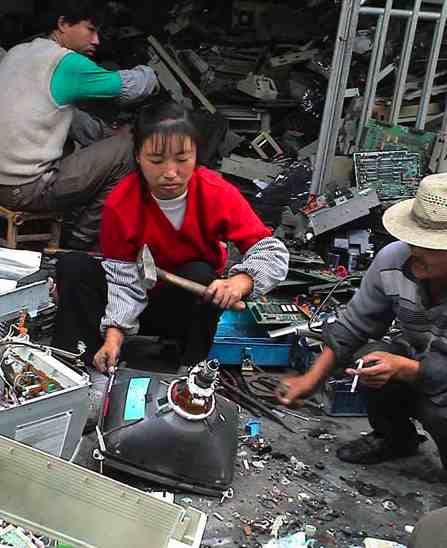
Is Your Old TV Poisoning a Child in China? Where Your e-waste Goes

guiyu-china-breaking-open-monitor-exposes-toxic-dust-basel-action-network-smlBy Stephen Leahy
UXBRIDGE, Canada, Nov 14 (IPS)

Is your old TV poisoning a child in China? Or your old computer contaminating a river in Nigeria?

Without a law banning export of toxic electronic waste in the United States, there has been no way to know if old cell phones, computers or televisions originating there didn’t end up in some poor village in the developing world, where desperate people pull them apart by hand to recover some of the valuable metals inside.

A small group of people have now allied with a few responsible recyclers to ensure e-waste can be treated responsibly by creating an e-Stewards certification programme. Announced this week, e-Stewards are electronics waste recyclers that are fully accredited and certified by an independent third party.

Such accreditation is crucial in an industry that often makes fraudulent claims. Currently even when e-waste (electronic trash) goes to a “green” recycler, the chances are high that toxic stuff from the developed world ended up in a huge pile in the middle of some village. Continue reading

Top Ten Worst Pollution Problems That Kill Millions – Including Ones You’ve Never Heard Of

By Stephen Leahychromium-a-carcinogenic-commonly-used-in-the-tanning-industry-noraiakheda-kanpur-india-photo-by-blacksmith-institute-sml

UXBRIDGE, Canada, Oct 23 (IPS)

Gold mining and recycling car batteries are two of the world’s Top 10 most dangerous pollution problems, and the least known, according a new report.

The health of hundreds of millions of people is affected and millions die because of preventable pollution problems like toxic waste, air pollution, ground and surface water contamination, metal smelting and processing, used car battery recycling and artisanal gold mining, the “Top Ten” report found.

“The global health burden from pollution is astonishing, and mainly affects women and children,” said Richard Fuller, director of the New York- based Blacksmith Institute, a independent environmental group that released the list Tuesday in partnership with Green Cross Switzerland.

“The world community needs to wake up to this fact,” Fuller told IPS.

Continue reading

Arctic Oil and Gas Rush Alarms Scientists

By Stephen Leahy

[See also more recent story: Arctic Ice Gone in 5 Years – First Time in One Million Years; see also other Arctic and oil stories below. US and Canada to start offshore drilling in the Arctic summer 2010 – your support is needed to investigate and report on this. ]

UXBRIDGE, Canada, Sep 8 2008 (IPS)

As greenhouse gas pollution destroys Arctic ecosystems, countries like Canada are spending millions not to halt the destruction but to exploit it.

Late last August, Canada announced a 93.7-million-dollar prospecting programme to map the energy and mineral resources of the region. There are “countless other precious resources buried under the sea ice and tundra,” Prime Minister Stephen Harper said during the announcement. The government’s mapping effort is expected to trigger 469 million dollars in private sector resource exploration and development.

“It is estimated that a quarter of the world’s undiscovered oil and gas lies under the Arctic,” Harper said.

This scramble to exploit some of the most environmentally delicate regions of Earth has alarmed international experts who are meeting this week in Iceland to make recommendations to the United Nations and world governments on how to protect the polar regions.

“Many experts believe this new rush to the polar regions is not manageable within existing international law,” says A.H. Zakri, director of the United Nations University’s Yokohama-based Institute of Advanced Studies (UNU-IAS), co-organisers of the conference with Iceland’s University of Akureyri. Continue reading

Male Infertility Linked to Pesticides

Pesticide exposure is widespread in North America and has long been associated with human health impacts. Here’s yet more proof: A June 2008 review of scientific studies on pesticide exposure shows a decline in semen quality and reduced male fertility.

“The conclusion can be drawn that pesticide exposure may affect spermatogenesis leading to poor semen quality and reduced male fertility.” — Current Opinion in Obstetrics & Gynecology

Related posts:
Organic Cure for Brain-damaging Pesticides Found in US Children
Cancer Rates Soaring – Common Toxic Chemicals Responsible
The Real Cost of US Strawberries
Coke Spraying with Roundup Damages DNA in Ecuador/Colombia
GM Crops Creating Pest Problems Around World

30 Million Lead-laden TVs Dumped on Poor Countries

“The US has an appalling system that makes it easy to dump e-waste on the developing world.”Barbara Kyle, Electronics TakeBack Coalition.

By Stephen LeahyCopyright EMPA, Switzerland

Nov 21 (IPS) – U.S. citizens will buy 30 million new digital televisions this year alone, sending their old lead-laden TVs to the dump, or more likely, overseas to China or India.

“It’s an astonishing number that will send millions of pounds of lead to landfills or overseas,” said Barbara Kyle, national coordinator of the Electronics TakeBack Coalition.

Non-digital TVs contain up to eight pounds of lead, which is a potent neurotoxin. While new digital flat screen TVs don’t have lead, they do contain mercury, another neurotoxin.

“It’s no longer illegal in the U.S. to export e-waste (electronic waste) to developing countries,” Kyle said.

Changes in rules and regulations in recent years to the Resource Conservation and Recovery Act, administered by the U.S. Environmental Protection Agency, have created an “appalling system that makes it easy to dump e-waste on the developing world”, she said. Continue reading

The Real Cost of US Strawberries

The Chemical That Must Not Be Named
By Stephen Leahy

MONTREAL, Canada, Sep 20 (IPS) – Delegates from 191 nations are on the verge of an agreement under the Montreal Protocol for faster elimination of ozone-depleting chemicals, but the United States insists it must continue to use the banned pesticide methyl bromide.

Even as another enormous ozone hole forms over the Antarctic this week, the rest of the world appears to be giving in to U.S. demands despite the fact that the use of methyl bromide in developed countries was supposed to have been completely phased out by Jan. 1, 2005 under the Montreal Protocol on Substances that Deplete the Ozone Layer.

“It’s a black mark on this meeting. It is the chemical that must not be named,” said David Doniger, climate policy director at the Natural Resources Defence Council, a U.S. environmental group.

“There is a powerful lobby group of strawberry and vegetable growers in Washington,” Doniger told IPS.

Methyl bromide is a highly toxic fumigant pesticide which is injected into soil to sterilise it before planting crops. It is also used as a post-harvest decontaminant of products and storage areas. Although it is highly effective in eradicating pests such as nematodes, weeds, insects and rodents, it depletes the ozone layer and poses a danger to human health.

While alternatives exist for more than 93 percent of the applications of methyl bromide, some countries such as the U.S., Japan and Israel claimed that because of regulatory restrictions, availability, cost and local conditions, they had little choice but to continue its use as a pest control. And so despite the ban, the Montreal Protocol allows “critical use exemptions” for countries to continue to use banned substances for a short period of time until they can find a substitute.

In 2006, the United States received an exemption to use 8,000 tonnes of methyl bromide, compared to 5,000 tonnes for the rest of the developed world combined. Continue reading

Ozone Treaty Best Bet to Slow Climate Change

Ozone Treaty Could Slow Climate Change
By Stephen Leahy


Credit:Nasa image

Blue represents the Antarctic ozone layer in 2006.


MONTREAL, Sep 17 (IPS) – Delegates from 191 nations are in Montreal, Canada this week to celebrate and extend the world’s most successful environmental treaty, the Montreal Protocol to protect the ozone layer.

With 95 percent of the target chemicals now eliminated, there is strong support to accelerate the phase-out of newer ozone-depleting chemicals that are also powerful greenhouses gases.

In fact, many experts believe this meeting could do more to reduce greenhouse emissions than the more widely-publicised Kyoto Protocol.

Challenges do remain — the United States continues to use large amounts of methyl bromide, an ozone-depleting substance (ODS), and the economic booms in China and India have rapidly increased the numbers of air conditioners using replacement chemicals.

Continue reading

Facebook: Last Hope for Environment?

facebook-header.png

Global trends indicate a looming environmental catastrophe, and engaging high school students around the world may be the only hope.

By Stephen Leahyvital-signs.png

Sept 14’07 (IPS)
Governments, the corporate sector and media continue to champion industrial and economic growth at the cost of escalating impacts on the environment, concludes the latest report from the Washington-based Worldwatch Institute, “Vital Signs 2007-2008“.

For a number of years, the “Vital Signs” report has tracked 44 trends that are shaping the future, and they document a record level of industrial growth, says Erik Assadourian, Vital Signs project director.

“‘Vital Signs’ also documents the escalating impacts of such growth on the environment,” Assadourian told IPS in an interview from Barcelona.

The scale of the environmental crisis, in which catastrophic climate change is just one of many, is undermining the ecosystems that support life on Earth.

“Climate change and other environmental problems are symptoms of the root problem, which is the obsession with consumerism,” he said.

Vital Signs reports that in 2005, more wood was removed from forests than in any previous year. Fossil fuel usage dumped 7.6 billion tonnes of carbon emissions into the atmosphere. Meat production hit a record 276 million tonnes (43 kilogrammes per person) in 2006. Rising meat consumption is driving rising soybean demand to feed cattle, which in turn is a driver of deforestation as tropical forests are turned into soy fields.

And on it goes: global seafood consumption breaks records, steel and aluminium production too. None of this is sustainable — another three or four or five planets would be needed to maintain these levels of production and consumption. Continue reading