Overweight? Hungry? Blame ‘Hollow Food’


wheat harvest sml

Conventional agriculture produces “hollow food”, with low levels of nutrients and vitamins studies show

By Stephen Leahy

TORONTO, Canada, Mar 4, 2006 (Tierramérica)

(Originally published in 2006)

Organic foods protect children from the toxins in pesticides, while foods grown using modern, intensive agricultural techniques contain fewer nutrients and minerals than they did 60 years ago, according to two new scientific studies.

A U.S. research team from Emory University in Atlanta analysed urine samples from children ages three to 11 who ate only organic foods and found that they contained virtually no metabolites of two common pesticides, malathion and chlorpyrifos. However, once the children returned to eating conventionally grown foods, concentrations of these pesticide metabolites quickly climbed as high as 263 parts per billion, says the study published Feb. 21 (2006).

Organic crops are grown without the chemical pesticides and fertilisers that are common in intensive agriculture. There was a “dramatic and immediate protective effect” against the pesticides while consuming organically grown foods, said Chensheng Lu, an assistant professor at the Rollins School of Public Health at Emory University.

These findings, in addition to the results of another study published in Britain earlier this month, have fueled the debate about the benefits of organically grown food as compared to conventional, mass-produced foods, involving academics, food and agro-industry executives and activists in the global arena.

According to the new British analysis of government nutrition data on meat and dairy products from the 1930s and from 2002, the mineral content of milk, cheese and beef declined as much as 70 percent in that period.

“These declines are alarming,” Ian Tokelove, spokesman for The Food Commission that published the results of the study, told Tierramérica.

The Commission is a British non-governmental organisation advocating for healthier, safer food. The research found that parmesan cheese had 70 percent less magnesium and calcium, beef steaks contained 55 percent less iron, chicken had 31 percent less calcium and 69 percent less iron, while milk also showed a large drop in iron along with a 21 percent decline in magnesium.

Copper, an important trace mineral (an essential nutrient that is consumed in tiny quantities), also declined 60 percent in meats and 90 percent in dairy products.

“It seems likely that intensive farming methods are responsible for this,” Tokelove said from his office in London.

Continue reading

Stop All Investments in Fossil Fuel Infrastructure or All Will Suffer IPCC warns


Carbon overload - have to stop expanding
Carbon overload – have to stop expanding

By Stephen Leahy

UXBRIDGE, Canada, Apr 22 2014 (IPS) 

Hopefully, on Earth Day today, high-level ministers from all countries are thinking about what they can bring to the table at a key set of meetings on climate change in early May.

This will be the first opportunity for governments to discuss their proposed climate action plans in light of the finalIntergovernmental Panel on Climate Change (IPCC) report released last week.

“There is a clear message from science: To avoid dangerous interference with the climate system, we need to move away from business as usual.” — Professor Ottmar Edenhofer 

That report warned that carbon dioxide (CO2) emissions from burning fossil fuels are still rising far too fast, even with more than 650 billion dollars invested in renewable energy in the last three years. However, over the same time period even more money was invested in getting more fossil fuels out of the ground.

The latter investment is keeping humanity and the planet locked onto a devastating path of a global temperature increase of four to five degrees C, the IPCC’s Working Group III report warned.

Scientists and economists say that unlocking ourselves from disaster will require a massive reduction in emissions – between 40 percent and 70 percent – by midcentury. This is can be readily accomplished without inventing any new technology and at a reasonably low cost, reducing global economic growth by a comparatively tiny 0.06 percent.

“It doesn’t cost the world to save the planet,” economist Professor Ottmar Edenhofer, who led the IPCC team, said at a press conference.

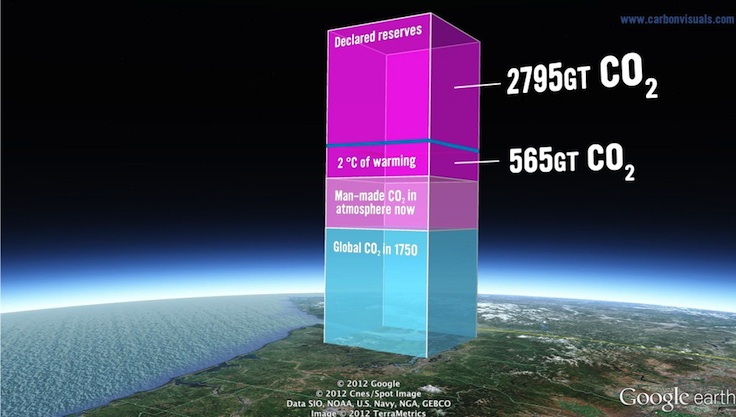
It does mean an end to investments in expanding fossil fuel infrastructure as the annual growth in CO2 emissions from burning oil, coal and gas must peak and decline in the next few years. The atmosphere already has 42 percent more CO2 than it did prior to 1800.

This extra CO2 is trapping more heat from the sun, which is heating up the oceans and land, creating the conditions that spawn super storms and extreme weather. And it will do so for the next 1,000 years since CO2 is a very durable molecule.

“There is a clear message from science: To avoid dangerous interference with the climate system, we need to move away from business as usual,” Edenhofer said.

Continue reading

Nano Worry: Big Concern for Very Small Things

Buckyball Molecule C320, Artwork Laguna Design

By Stephen Leahy

First published 04.07.04 at WIRED.COM

(I wrote this 10 years ago and was one of the first articles about environmental risks of nano techI have not been able to update it )

Nanoparticles called fullerenes — aka buckyballs — are extremely stable arrangements of carbon atoms that look like soccer balls. Eva Oberdörster, an aquatic scientist at Southern Methodist University, has conducted a study that looks at the potential risks of nanomaterials.

The nascent nanotechnology industry collectively cringed last week after a study showed that fish exposed to nanoparticles suffered brain damage. Critics say the much-hyped multibillion-dollar nano industry has a dark side few want to talk about.

“How many more studies showing toxicity are needed before regulators step in?” asks Kathy Jo Wetter of the Winnipeg-based ETC Group. ETC and other environmental groups are calling for a moratorium on the commercial production of nanoparticles.

Nano products are not subject to any special regulations, in part because little is known about the environmental and health implications of nanotechnology, says Kevin Ausman, executive director of the Center for Biological and Environmental Nanotechnology at Rice University in Houston.

Nanotechnology is a catchall term for an enormous range of research and technology measured at the scale of one-thousandth the width of a human hair. At this very small scale, ordinary materials have extraordinary properties promising the semi-fantastic — supercomputers that fit on the head of a pin and fleets of cancer-fighting nanobots — and the more mundane — better paint and eye shadow.

Stain-resistant nanopants and sunscreens and cosmetics using nanosized titanium dioxide particles are already on the market. And the Nanodesu bowling ball is one of the first consumer products that uses nanoparticles called fullerenes — aka buckyballs — which are extremely stable arrangements of carbon atoms that look like soccer balls.

To see what might happen if buckyballs got into the environment, Eva Oberdörster, an aquatic scientist at Southern Methodist University, put some into a fish tank at a concentration of 0.5 parts per million, along with nine largemouth bass. The buckyball-breathing fish experienced significant brain damage after 48 hours. Brain-cell membranes were disrupted, an affliction that has been linked to illnesses such as Alzheimer’s disease in humans.

Oberdörster’s unpublished study, which was released last week, is one of the few completed studies looking at the potential risks of nanomaterials. There is some cause for concern. Two recent studies documented lung damage in animals after they inhaled a type of buckyball called a carbon nanotube. Another showed that nanoparticles can get into the brain if inhaled.

They’re also small enough to cross cell walls and leak into the nucleus, the home of an organism’s DNA. And, in the case of titanium dioxide nanoparticles, they can kill bacteria. That’s good news in a hospital, but bad news in the environment, where bacteria are extremely important for maintaining soil fertility, among other things.

Understanding how nanomaterials and the environment interact is a complex, interdisciplinary problem, says Ausman.

“Some of the ways we normally measure environmental toxicity aren’t applicable to nanotechnology. And there aren’t many researchers who really understand these novel materials.”

One who does is John Bucher, director of federal toxicology research at the National Institute of Environmental Health Sciences. His group will soon begin a series of studies on the environmental health effects of three types of nanoparticles.

“There are so many different types of nanomaterials, some are likely toxic,” says Bucher.

Sorting out the impacts of nanotech won’t be easy, since the properties of nanomaterials are not well-defined yet. Something such as gold — which is normally biologically inert — is highly reactive and likely to disrupt biological processes when it’s nanosized.

And then there’s the problem of trying to detect particles of such a tiny size, says Bucher. Microscopes powerful enough to identify nanoparticles are just being developed.

It will be several years before the National Institute of Environmental Health Sciences toxicology studies are completed.

Ausman thinks regulations will be needed to guide future applications, but not enough is known to establish these yet. In the meantime, the nano industry and the benefits it can bring society shouldn’t be held back over toxicity fears, he says.

“I’m not concerned at this point.”

Carbon Emissions: Most Important Number in Human History

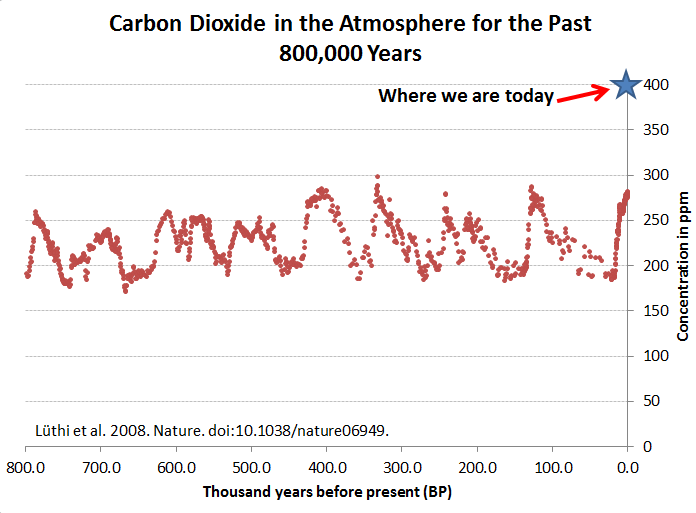
terrifying co2 graph

By Stephen Leahy

UXBRIDGE, Canada, Dec 17 2012 (IPS) (Re-posted)

The most important number in history is now the annual measure of carbon emissions. That number reveals humanity’s steady billion-tonne by billion-tonne march to the edge of the carbon cliff, beyond which scientists warn lies a fateful fall to catastrophic climate change.

With the global total of climate-disrupting emissions likely to come in at around 52 gigatonnes (billion metric tonnes) this year, we’re already at the edge, according to new research.

To have a good chance of staying below two degrees C of warming, global emissions should be between 41 and 47 gigatonnes (Gt) by 2020, said Joeri Rogelj, a climate scientist at Switzerland’s Institute for Atmospheric and Climate Science in Zurich.

Only when we see the annual global emissions total decline will we know we’re making the shift to climate protection,” Rogelj told IPS.

Making the shift to a future climate with less than two degrees C of warming is doable and not that expensive if total emissions peak in the next few years and fall into the 41-47 Gt “sweet spot” by 2020, Rogelj and colleagues show in their detailed analysis published Sunday in the journal Nature Climate Change.

The study is the first to comprehensively quantify the costs and risks of emissions surpassing critical thresholds by 2020.

This shift means 65 percent of existing coal power plants will have to be shut down in the next decade or two. Continue reading

Oil, Coal and Gas Industry Destroying Our Childrens’ Future

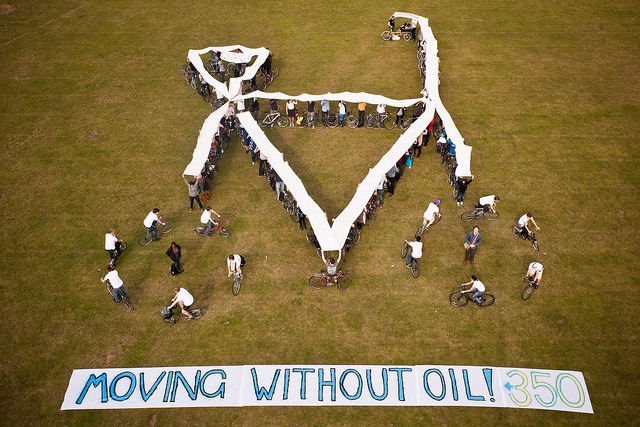
“moving aerial” of a bike sml

By Stephen Leahy

UXBRIDGE, Canada, Jan 4 2013 (IPS)

Around the world, 2012 was the year of extreme weather, when we unequivocally learned that the fossil fuel energy that powers our societies is destroying them. Accepting this reality is the biggest challenge of the brand new year.

Re-engineering our societies and lifestyles to prosper on green alternatives is the penultimate challenge of this decade. There is no more important task for all of us to engage in because climate change affects everything from food to water availability.

A number of scientific analyses have demonstrated we already have the technology to re-engineer our society to thrive on green alternative energy. The newest of these was published Wednesday in the prestigious journal Nature. It plainly states that politics is the real barrier, not technology nor cost. (It is far cheaper to act than not.)

Keeping global warming to less than two degrees C is mainly dependent on “when countries will begin to take serious action to reduce greenhouse gas emissions”, according to the study “Probabilistic cost estimates for climate change mitigation”.

Climate change has already pushed global temperatures up 0.8 degrees C, with significant consequences. No climate scientist thinks two degrees C will be “safe”. Many countries, especially least-developed countries and small island states, want the global target to be less than 1.5C of heating. Even then large portions of the Arctic and Antarctic will continue to melt raising sea levels, albeit at a slower rate.

Delay in making the shift to non-fossil fuel energy sources will be very costly. Waiting until 2020 to curb global emissions will cost twice as much compared with peaking emissions by 2015, the Nature analysis shows.

Serious action to reduce greenhouse gas emissions means 65 percent of current coal power plants will have to be shut down in the next decade or two, a previous Nature study reported by IPS shows.

US Fossil Emissions now and how much they need to decline

Instead of serious action, global emissions continue to break new records, rising about three percent per year. It appears 2012 will be about 52 gigatonnes (billion metric tonnes of CO2 equivalents). This is our annual climate scorecard, the most important number in human history. That number needs to fall to be between 41 and 47 gigatonnes (Gt) by 2020 to have a reasonable chance of staying below two degrees C of warming. Continue reading

2013 Carbon Emissions On Deadly Path to 5C

global-carbon-budget-2010-e1371236101998

By Stephen Leahy

WARSAW, Nov 19 2013 (IPS)

Burning of fossil fuels added a record 36 billion tonnes of CO2 to the atmosphere in 2013, locking in even more heating of the planet.

Global CO2 emissions are projected to rise 2.1 percent higher than 2012, the previous record high, according to a new report released Tuesday by the Global Carbon Project.

“Going beyond two degrees C is very risky, it’s completely unknown territory.” — Corinne Le Quéré

This increase is slightly less than the 2000-2013 average of 3.1 percent, said lead author Corinne Le Quéré of the Tyndall Centre for Climate Change Research in the UK.

“This is the second year in a row of below average emissions. Perhaps this represents cautious progress,” Le Quéré told IPS.

Still, these hard numbers demonstrate that the U.N. climate talks have failed to curb the growth in emissions. And there is little optimism that the latest talks known as COP19 here in Warsaw will change the situation even with the arrival of high-level ministers Wednesday.

Global emissions continue to be within the highest scenario of the Intergovernmental Panel on Climate Change (IPCC), she said.

“This is a five-degree C trajectory. It’s absolutely tragic for humanity to be on this pathway,” Le Quéré said.

For full story

UN Climate Talks End In Dramatic Showdown But Little Progress

COP 19 Final Showdown between US and Fiji

By Stephen Leahy

WARSAW, Nov 24 2013 (IPS)

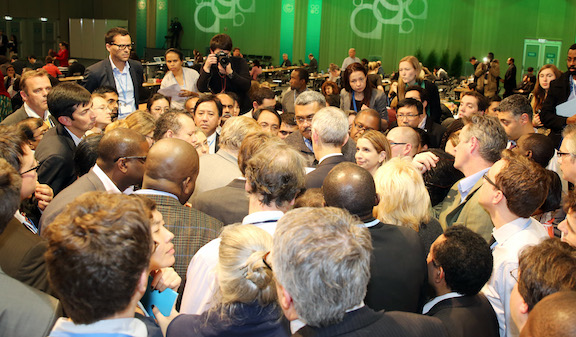
The U.N. climate talks in Warsaw ended in dramatic fashion Saturday evening in what looked like a schoolyard fight with a mob of dark-suited supporters packed around the weary combatants, Todd Stern of the United States and Sai Navoti of Fiji representing G77 nations.

It took two weeks and 36 straight hours of negotiations to get to this point.

At issue in this classic North versus South battle was the creation of a third pillar of a new climate treaty to be finalised in 2015. Countries of the South, with 80 percent of the world’s people, finally won, creating a loss and damage pillar to go with the mitigation (emissions reduction) and adaptation pillars.

Super-typhoon Haiyan’s impact on the Philippines just days before the 19th Conference of the Parties (COP19) amply illustrated the reality of loss and damages arising from climate change.  Philippines lead negotiator Yeb Saño made an emotional speech announcing “fast for the climate” at the COP19 opening that garnered worldwide attention, including nearly a million YouTube views

Click for complete story


Japan Bails Out on CO2 Emissions Target

cop presidentBy Stephen Leahy

WARSAW, Nov 15 2013 (IPS)   Japan announced Friday that it will renege on its carbon emissions pledge, likely ending any hope global warming can be kept to 2.0 degrees C.

The shocking announcement comes on the fifth day of the U.N. climate talks in Warsaw known as COP19, where more than 190 nations have agreed to a 2.0 C target and are trying to close the carbon emission gap to get there.

“It’s like a slap in the face of those suffering from the impacts of climate change such as the Philippines.” — Wael Hmaidan

Japan will increase that gap three to four percent with its new 2020 reduction target, according to the Climate Action Tracker (CAT). It amounts to a three-percent increase compared to a 1990 baseline. Japan’s 2009 Copenhagen Accord pledge was a 25 percent reduction by 2020.

“Japan is taking us in the opposite direction,” Marion Vieweg of Climate Analytics, a German climate research organisation, told IPS here in Warsaw.

“Their revision shows the bottom up approach is not working if countries can simply drop their pledges at any time,” Vieweg said.

Climate scientists have long maintained that the 2020 target for industrialised countries should be to reduce emissions 25-40 percent compared to a 1990 baseline. However, even if nations meet their current climate pledges under the Copenhagen Accord, CO2 emissions in 2020 are likely to be eight to 12 billion tonnes higher than what’s needed, according to the U.N. Environment Programme’sEmissions Gap Report 2013.

Japan, the fifth largest emitter of CO2, is just the latest to abandon its international commitments.

Who Wants a Sustainable, Pollution-Free New York by 2030?

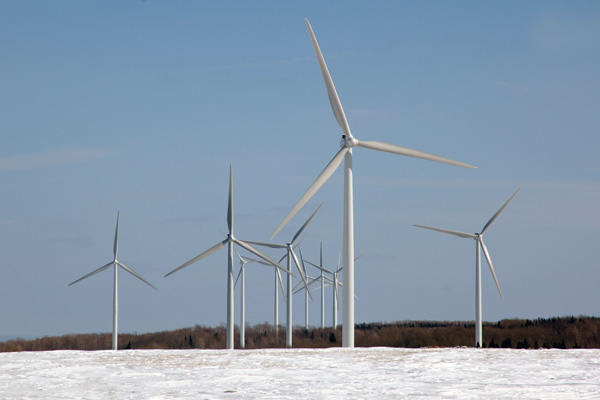
Wind turbines on the Tug Hill plateau in upstate New York

By Stephen Leahy

UXBRIDGE, Canada, Mar 19 2013 (IPS)

As usual, midtown Manhattan is packed with whisper-quiet cars and trams while thousands walk the streets listening to the birds of spring sing amongst the gleaming, grime-free skyscrapers in the crystal-clear morning air.

Welcome to New York City in April 2030.

I think the public will be 100 percent behind this, if they know about it.

This is not a fantasy. It is a perfectly doable goal, said Stanford University energy expert Mark Jacobson. In fact, the entire state of New York could be powered by wind, water and sunlight based on a detailed plan Jacobson co-authored.

It’s not only doable, powering New York on green energy is “sustainable and inexpensive” and would save lives and health costs, Jacobson told IPS.

Each year, air pollution kills 4,000 people in New York State and costs the public 33 billion dollars in health costs, according to the study Jacobson co-authored with experts from all over the U.S. It will be published in the journal Energy Policy.

Full Story

Public Pays for Fukushima Clean Up While Nuclear Industry Profits

Japan Fukushima Dai-ichi nuclear power plant March 31 2011

By Stephen Leahy

UXBRIDGE, Canada, Mar 12 2013 (IPS)

Two years after Japan’s Fukushima Daiichi nuclear disaster, the country faces 100 to 250 billion dollars in cleanup and compensation costs, tens of thousands of displaced people and widespread impacts of radiation.

The nuclear industry and its suppliers made billions from building and operating Fukushima’s six reactors, but it is the Japanese government and its citizens who are stuck with all the costly “fallout” of the disaster.

“People’s lives were destroyed and we will be paying trillions of yen in tax money because of the Fukushima disaster,” said Hisayo Takada, an energy campaigner with Greenpeace Japan.

“The nuclear industry, other than Tepco (Tokyo Electric Power Co), has paid nothing as they are specially protected by the law,” Takada told IPS.

On Mar. 11, 2011, Japan experienced a 9.0 magnitude earthquake and resulting tsunami that badly damaged Tepco’s Fukushima Daiichi nuclear plant. Three of six reactors suffered a meltdown, and reactor unit four was damaged. The Fukushima accident has been rated at the highest level (7) of the International Atomic Energy Agency scale, the same as the Chernobyl accident.

A year after the disaster, Tepco was taken over by the Japanese government because it couldn’t afford the costs to get the damaged reactors under control. By June of 2012, Tepco had received nearly 50 billion dollars from the government.

The six reactors were designed by the U.S. company General Electric (GE). GE supplied the actual reactors for units one, two and six, while two Japanese companies Toshiba provided units three and five, and Hitachi unit four. These companies as well as other suppliers are exempted from liability or costs under Japanese law.

Full story here