Geoengineering on a Desperate Planet — UN Declares Global Moratorium

By Stephen Leahy

NAGOYA, Japan, Oct 25, 2010 (Tierramérica)

[Update 30 October 2 am. Global moratorium passes.]

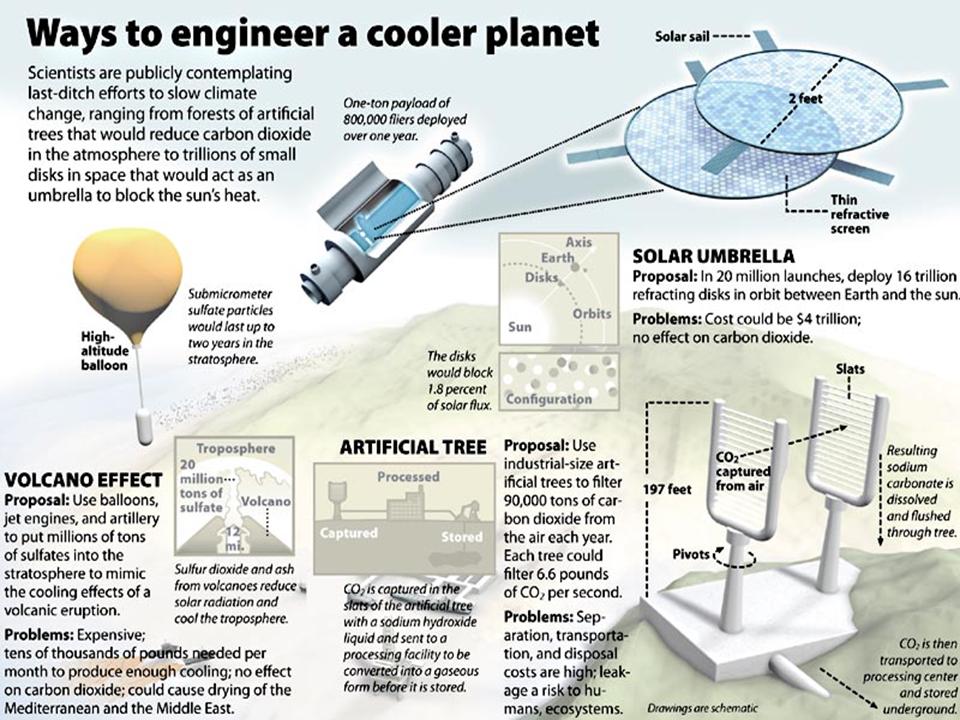
Delegates to the world summit on biodiversity here are calling for a moratorium on climate engineering research, like the idea of putting huge mirrors in outer space to reflect some of the sun’s heating rays away from the planet.

Climate engineering or geoengineering refers to any large-scale, human- made effort to manipulate the planet to adapt to climate change.

Representatives from Africa and Asia expressed concern about the negative impacts of geoengineering during the opening week of the 10th Conference of Parties (COP 10) to the United Nations Convention on Biological Diversity (CBD), Oct. 18-29. They were joined by civil society organisations in calling for a moratorium on geoengineering experiments.

The geoengineering proposals include installing giant vertical pipes in the ocean to bring cold water to the surface, pumping vast amounts of sulphates into the stratosphere to block sunlight, or blowing ocean salt spray into clouds to increase their reflectivity.

The geoengineering proposals include installing giant vertical pipes in the ocean to bring cold water to the surface, pumping vast amounts of sulphates into the stratosphere to block sunlight, or blowing ocean salt spray into clouds to increase their reflectivity.

Broadly speaking, there are two main geoengineering approaches: solar radiation management and carbon sequestration, in other words, absorbing carbon dioxide from the atmosphere to reduce the concentration of this greenhouse-effect gas.

Is this article of interest? It exists thanks to contributions from readers. Please click here to learn more about Community Supported Journalism.

To manage the sun’s rays, there are ideas like releasing sulphates into the atmosphere or placing giant mirrors in outer space. For absorbing carbon, the possible approaches include ocean fertilisation, in which iron or nitrogen is added to seawater to stimulate the growth of phytoplankton to sequester the carbon deep in the ocean.

“Some of the proponents of these technologies think it’s easier to ‘manage the sun’ than get people to take a bus” to reduce carbon in the atmosphere, said Pat Mooney, executive director of the ETC Group, an international environmental organisation headquartered in Canada. [etc “Geopiracy” report]

“Politicians in rich countries see geoengineering as ‘Plan B’ so they don’t have to make the hard choices of reducing emissions causing climate change,” Mooney told Tierramérica.


Continue reading

Dams Come At a Price of Hi-Quality Food — Hard to Put a Price-tag on Healthy Rivers

By Stephen Leahy

NAGOYA, Japan, Oct 22, 2010 (IPS)

Damming a river may bring electric power, but it often comes at the price of high-quality food fisheries, experts say. When dams are proposed for power, flood control or irrigation, the often devastating impacts on fisheries in rivers and lakes are ignored or discounted.

“It is very difficult to put a dollar value on what inland fisheries represent because it is much more than the landed value of the fish at the dock,” says Yumiko Kura of the WorldFish Center office in Phnom Penh, Cambodia.

Kura is co-author of a new report, “Blue Harvest: Inland Fisheries as an Ecosystem Service”, which highlights the wide-ranging importance of inland fisheries in diets, especially among children, and not just in terms of protein but in supplying micronutrients, notably vitamin A, calcium, iron and zinc.

“Detailed studies in Bangladesh for example have shown that daily consumption of small fish contributes 40 percent of the total daily household requirement of vitamin A and 31 percent of calcium,” according the report released Friday at a side event at the 10th Conference of the Parties to the Convention on Biological Diversity.

In addition, it notes there are more than 60 million full- and part-time jobs in fishing and other activities such as processing, with over half these jobs carried out by women.

Is this article of interest? It exists thanks to contributions from readers. Please click here to learn more about Community Supported Journalism. Continue reading

Locally-Run Protected Areas Could Reverse Fisheries’ Death Spiral


Great Barracuda and Jacks, Diamond Rock, Saba,...
Image via Wikipedia


One third of all species of sharks, rays and reef-building corals are facing extinction while governments spend $27 billion subsidizing overfishing

By Stephen Leahy

UXBRIDGE, Canada, Sep 15, 2010 (IPS)

Local fishers objected to the creation of a new no-fishing marine protected area off the coast of Belize in 1996. Today they are benefiting from the bounty of fish spilling out of the Laughing Bird Caye National Park. Tourism has also boomed, illustrating the multiple benefits and value of marine protected areas, according to a new series of reports released Wednesday by Conservation International (CI).

“The ocean is in crisis but we can’t see it with our own eyes so we’re not aware of what is happening,” said Leah Bunce Karrer, co-author and director of the Marine Management Area Science Programme at CI.

“Marine managed areas offer a solution which could significantly reduce ocean degradation while benefiting local communities,” Karrer told IPS.

Is this article of interest? It exists thanks to contributions from readers. Please click here to learn more about Community Supported Journalism.

One third of all species of sharks, rays and reef-building corals are facing extinction. “Most people don’t realise that,” said Gregory Stone, chief ocean scientist at CI.

“As species disappear, entire ecosystems are altered in negative ways we don’t even want to imagine,” Stone said.

Only a fraction of one percent of the world’s oceans are effectively protected even though there is growing scientific consensus of the need to protect at least 20 percent of the seas. Continue reading

Europeans stopped Canada’s Slaughter of Baby Seals – Can They Stop Canada’s Tar Sands?

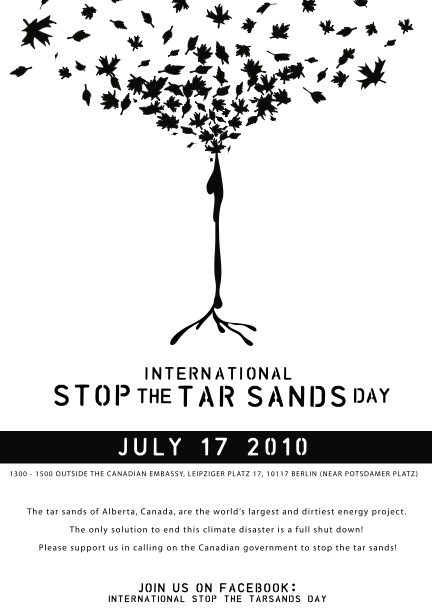
On July 17th Berliners and other Europeans will take to the streets to stop the worst environmental disaster on the planet:

Canada’s “Dirty Oil” Tar Sands

[UPDATE: See pix and story on the Stop Tar Sands “demo-fest”]

“The tar sands of Canada constitute one of our planet’s greatest threats” — James Hansen, Director of NASA’s Goddard Institute for Space Studies

“Extracting oil from Alberta’s tar sands jeopardizes the survival of our species” — Al Gore

Warning of the global environmental disaster represented by Canada’s production of oil from its western tar sands, protesters will gather in front of the Canadian Embassies in Berlin, London and Copenhagen on Saturday, July 17 to mark International Stop the Tar Sands Day.

[Download poster international tar sands day A3]

The goal of International Stop the Tar Sands Day is to raise awareness in Europe that oil made from Canada’s tar sands has “two-to-three times the global warming pollution of conventional oil,” according to eminent scientist James Hansen, Director of NASA’s Goddard Institute for Space Studies. “But the process also diminishes one of the best carbon-reduction tools on the planet: Canada’s Boreal Forest.”

Similar protests are planned at Canadian embassies in London, Paris and Vienna.

“Ultimately only Canadian people can stop the expansion of the tar sands. Through our demonstrations we want to show Canadians there is international support for a moratorium,” says first-time organizer Derek Leahy, a Canadian living in Berlin.

“We believe Canadians will make the right decision,” Leahy said

“Although European companies and banks are profiting from Canada’s tar sands few Europeans have heard about the tar sands. We intend to change that ,” he said

[Full disclosure: this is copied from a press release and Derek is my son — Steve] Continue reading

Turning Forests Into Carbon Profits To Protect The Global Climate?

By Stephen Leahy*

MONTPELLIER, France, Apr 7, 2010 (Tierramérica)

Billions of dollars are being mobilised to protect and increase the world’s forests under a climate protection mechanism known as REDD (Reduced Emissions from Deforestation and Degradation). But many experts are unsure that it will work, and some fear it could end in disaster.

According to Anne Larson, who works in Nicaragua as an associate at the Indonesia-based Centre for International Forestry Research (CIFOR), “REDD presents lots of risks.”

“Most countries are simply not ready. They do not have policies to protect the rights of local and indigenous peoples, to determine land tenure or even work out who owns the ‘carbon rights’ to a forest,” Larson told participants at an international conference on smallholder and community forestry in Montpellier, France, in late March.

Under the REDD initiative, richer countries would pay to maintain forests in tropical regions to offset their own carbon emissions. Carbon dioxide from human activities is one of the main gases that produce the greenhouse effect.

The wealthy countries would be granted “carbon credits” towards achieving their carbon reduction commitments to combat climate change. Continue reading

Is Privatizing Air & Water Only Way to Save the Planet? — Copenhagen Talks

By Stephen Leahy*

COPENHAGEN, Dec 17 (Tierramérica)

In the last two years, the conclusion among decision-makers has been that the only way to solve the climate crisis is to turn carbon into a commodity and privatise the atmosphere.

Similar market-based solutions will be used to “solve” the growing water crisis, warned experts at the Klimaforum09, a parallel meeting a few kilometres away from the official 15th Conference of Parties (COP15) to the United Nations Framework Convention on Climate Change, held Dec. 7-18 in Copenhagen.

“Corporations do not want regulations and have convinced governments that they can deliver continued economic growth and save the planet,” said Maude Barlow, chair of the Council of Canadians, the largest citizens group in Canada and author of several books about water issues.

“It shows the power of the corporate lobby that nearly everyone, including many big NGOs, all see the market as the solution to climate change,” Barlow told Tierramérica.

Meanwhile, the climate justice movement is fighting against carbon trading and carbon offsets and advocating for real emissions cuts, while recognising that the commons – air and water – are a public trust, she said

See No Water in Copenhagen Talks

Learn About Community Supported Journalism

Canada’s “Mordor” Ensures Climate Treaty Failure in Copenhagen

[Hello from snowy and cold Copenhagen. Tensions have ramped up as political leaders arrived but are mainly meeting in secret.

Ashamed to say Canada is a widely acknowledged as a public embarrassment here. And called a climate criminal by some. Several protests like the one I covered below and a smaller one earlier have focused on the Athabasca Tar Sands perhaps the world’s biggest source of carbon emissions.

Outside the artificial reality of the Bella Center ordinary people get it. Here is good video summary of what happened on Wed as civil society were gradually banned from the conference. It accords with my son’s version who was in the middle of all this as an observer. — Steve]


By Stephen Leahy

COPENHAGEN (IPS/TerraViva) Dec 14 2009

Climate activists jammed a small square near the police-barricaded Canadian Embassy here Monday for the second day of protests over the country’s tar sands development.

Simultaneous protests were held at the Canadian Embassy in London because British oil companies and financial institutions are deeply invested in the Canadian mega-project.

“As indigenous people, we are here at the international climate negotiations to speak about threats to our cultural survival and the direct life-threatening impacts of climate change in our communities,” said Clayton Thomas Muller, tar sands campaigner for the Indigenous Environmental Network.

“Canada has been blocking the climate negotiations and hasn’t kept Kyoto commitments…because of the tar sands,” he told a crowd of 75 to 100 people surrounded by four squads of riot police.

Boreal forests and wetlands the size of Greece are been destroyed in northern Alberta in an industrial project that turns millions of tonnes of sand and earth into oil, mainly for the U.S. market he said.

“All the efforts by Canadians to reduce their carbon emissions are undone by the tar sands,” said Canadian writer and activist Naomi Klein.

The tar sands are Canada’s largest single source of carbon dioxide (CO2) emissions and the major reason why Canada has refused to live up to its commitments to reduce emissions and is blocking negotiations, Klein told protesters.

“Canada is making a mockery of international law and of developing countries’ need for urgent emission reductions in rich countries,” she said.

Canadian Prime Minister Stephen Harper is here at the Dec. 7-18 U.N.-sponsored climate summit under false pretences, Klein charged.

Harper does not have the Canadian people’s permission to promote the tar sands or to favour Canadian interests over those of the planet,” she said.

The tar sands are “Canada’s Mordor”, said Maude Barlow, head of the Council of Canadians, the largest citizens’ group in Canada. She was referring to the devastated land of rock and fire in the “Lord of the Rings” trilogy.

“What else can you call a project that leaks 11 million litres of toxic waste a day into rivers and groundwater?” Barlow said in this very un-Mordor upscale shopping district of downtown Copenhagen.

The tar sands project has the largest toxic waste containment ponds on the planet – easily visible from space. Last week, a report revealed the extent of the leaks to be an estimated 11 million litres a day.

Shockingly, this is based on the oil companies’ own self-reported data, says Environmental Defence, the Canadian advocacy, research and education group that compiled the report.

It calculated that four billion litres of leakage a year will grow to 25 billion in a decade based on current growth of the tar sands and aging of the enormous dams that hold back the waste.

“There is no question Harper will stand up for  the oil sector [in the climate talks here],” Barlow said.

Their [oil industry] footprints are all over this negotiation and that is why it will fail.”

-30-

Corrected 2/2/12

For more on the Tar Sands see:

Oil Stains in the Boreal Forest: The Environmental Cost of Canada’s Oil Sands – Revised V2.1Oil Stains in the Boreal Forest: The Environmental Cost of Canada’s Oil Sands – Revised V2.1

Conserve Nature – Best Way We Have To Cope With Climate Change & Survive This Century

“….nature is sick, which threatens the survival of the human species”

“Conservation of nature is the first order strategy for climate change and carbon capture sequestration”

The only way forward is that “we must learn to live a simple life that is spiritually based”

By Stephen Leahy

MÉRIDA, Mexico, Nov 12 (IPS)

Lawrence Amos travelled from the Arctic at the top of the world to the tropical middle to recite in a soft voice the ongoing destruction of his home by climate change.

The ice is rougher and not as thick, and melts in May instead of June. There is less snow, more coastal erosion, and permafrost is melting, threatening to swallow homes, said Amos, an Inuit who lives in Sachs Harbour in Canada’s High Arctic, one of the remotest communities on the planet.

Amos was speaking here on Memorial Day at the 9th World Wilderness Congress from Nov. 6-13, where many other indigenous peoples, scientists and conservationists from more than 50 countries documented the escalating impacts of climate change on the land and in the oceans.

Like the roll call of the names of those fallen at Memorial or Remembrance Day ceremonies, Amos’ list of impacts experienced by the people of the western Arctic was tragically long.

Insects, birds and fish never seen before are now appearing in the region. “Grizzly bears are mating with polar bears… Our traditional knowledge about the land is becoming worthless,” he told IPS.

“Mother Nature does not use language. We must be aware of the signs, the changes in species, the melting of glaciers to inform us that nature is sick, which threatens the survival of the human species,” said Bittu Sahgal, founder of Sanctuary Asia, India’s leading environmental conservation magazine and book publisher.

“Nature will not talk to us, it will give us consequences,” he told more than 1,500 participants at the WILD9 congress, a partnership between the WILD Foundation, an international, non-governmental non-profit based in the United States, and Unidos para la Conservación, a conservation organisation in Mexico. Continue reading

Climate Survival Means Anticipating and Adapting

Alberto Cesar AraujoBy Stephen Leahy

GENEVA, Sep 8 (IPS)

Imagine being able to know months in advance when and where floods or droughts may occur.

That is what over 150 countries participating in the third World Climate Conference, which concluded last Friday in Geneva, pledged to achieve through the creation of a Global Framework for Climate Services.

Today is a landmark day for making climate services available to all people,” said Michel Jarraud, secretary-general of the World Meteorological Organisation (WMO), convener of the conference, told over 2,000 climate scientists, sectoral experts and decision-makers.

“Climate services” is the long-distance cousin to weather services or weather forecasting. New technology and better climate science has opened the window to very long range forecasting of climate events like droughts weeks and months in advance.

This year, scientists were able to anticipate unprecedented flooding of the Red River Valley in the United States Midwest months in advance, enabling local communities to prepare and avoid the worst consequences, said Jane Lubchenko, a noted ecologist, administrator of the National Oceanographic and Atmospheric Administration (NOAA) and head of the U.S. delegation.

“Imagine farmers able to determine what to plant and where, based on drought forecasts three to five years in the future, or coastal communities able to plan for sea level rise and storm intensity,” Lubchenco told IPS.

The proposed Global Framework for Climate Services will “strengthen production, availability, delivery and application of science-based climate prediction and services”.

Continue reading

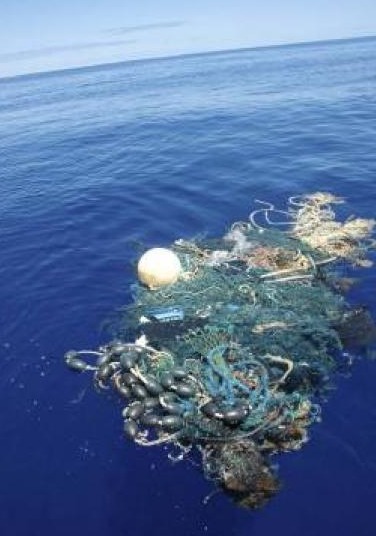
Drowning the Oceans in Plastic Trash (Pacific Garbage Patch)

plastic trash - pacific gyre By Stephen Leahy

UPDATE: The “Pacific Garbage Patch” is really a “plastic soup” where the plastic is distributed throughout the water column in area more than twice the size of Texas. See here for more

[FYI: I’m an independent journalist who supports his family and the public interest writing articles about important environmental issues. ]

Wired 06.05.04

Marine trash, mainly plastic, is killing more than a million seabirds and 100,000 mammals and sea turtles each year, said U.N. Secretary-General Kofi Annan in a statement.

Plastic bags, bottle tops and polystyrene foam coffee cups are often found in the stomachs of dead sea lions, dolphins, sea turtles and others. The implications have many at the conference concerned. Last April, Dutch scientists released a report on litter in the North Sea and found that fulmars, a type of seagull, had an average of 30 pieces of plastic in their stomachs.

In the sea, big pieces of plastic look like jellyfish or squid, while small pieces look like fish eggs, says Bill Macdonald, vice president of the Algalita Marine Research Foundation, a Long Beach, California-based nonprofit environmental organization.

Macdonald, who is also an underwater filmmaker, said he has seen albatross parents fly huge distances to feed their young a deadly diet of plastic bottle caps, lighters and light sticks.

“The sheer volumes of plastic in oceans are staggering,” he said. In recent years Algalita researchers have sampled a huge area in the middle of the North Pacific, and found six pounds of plastic for every pound of algae.

Do you like this article? It is funded by contributions from readers like you. Please click here to make a donation.

Continue reading