Dams Come At a Price of Hi-Quality Food — Hard to Put a Price-tag on Healthy Rivers

By Stephen Leahy

NAGOYA, Japan, Oct 22, 2010 (IPS)

Damming a river may bring electric power, but it often comes at the price of high-quality food fisheries, experts say. When dams are proposed for power, flood control or irrigation, the often devastating impacts on fisheries in rivers and lakes are ignored or discounted.

“It is very difficult to put a dollar value on what inland fisheries represent because it is much more than the landed value of the fish at the dock,” says Yumiko Kura of the WorldFish Center office in Phnom Penh, Cambodia.

Kura is co-author of a new report, “Blue Harvest: Inland Fisheries as an Ecosystem Service”, which highlights the wide-ranging importance of inland fisheries in diets, especially among children, and not just in terms of protein but in supplying micronutrients, notably vitamin A, calcium, iron and zinc.

“Detailed studies in Bangladesh for example have shown that daily consumption of small fish contributes 40 percent of the total daily household requirement of vitamin A and 31 percent of calcium,” according the report released Friday at a side event at the 10th Conference of the Parties to the Convention on Biological Diversity.

In addition, it notes there are more than 60 million full- and part-time jobs in fishing and other activities such as processing, with over half these jobs carried out by women.

Is this article of interest? It exists thanks to contributions from readers. Please click here to learn more about Community Supported Journalism. Continue reading

Blame Canada: Seeks to Drop Native Peoples from New Biodiversity Pact

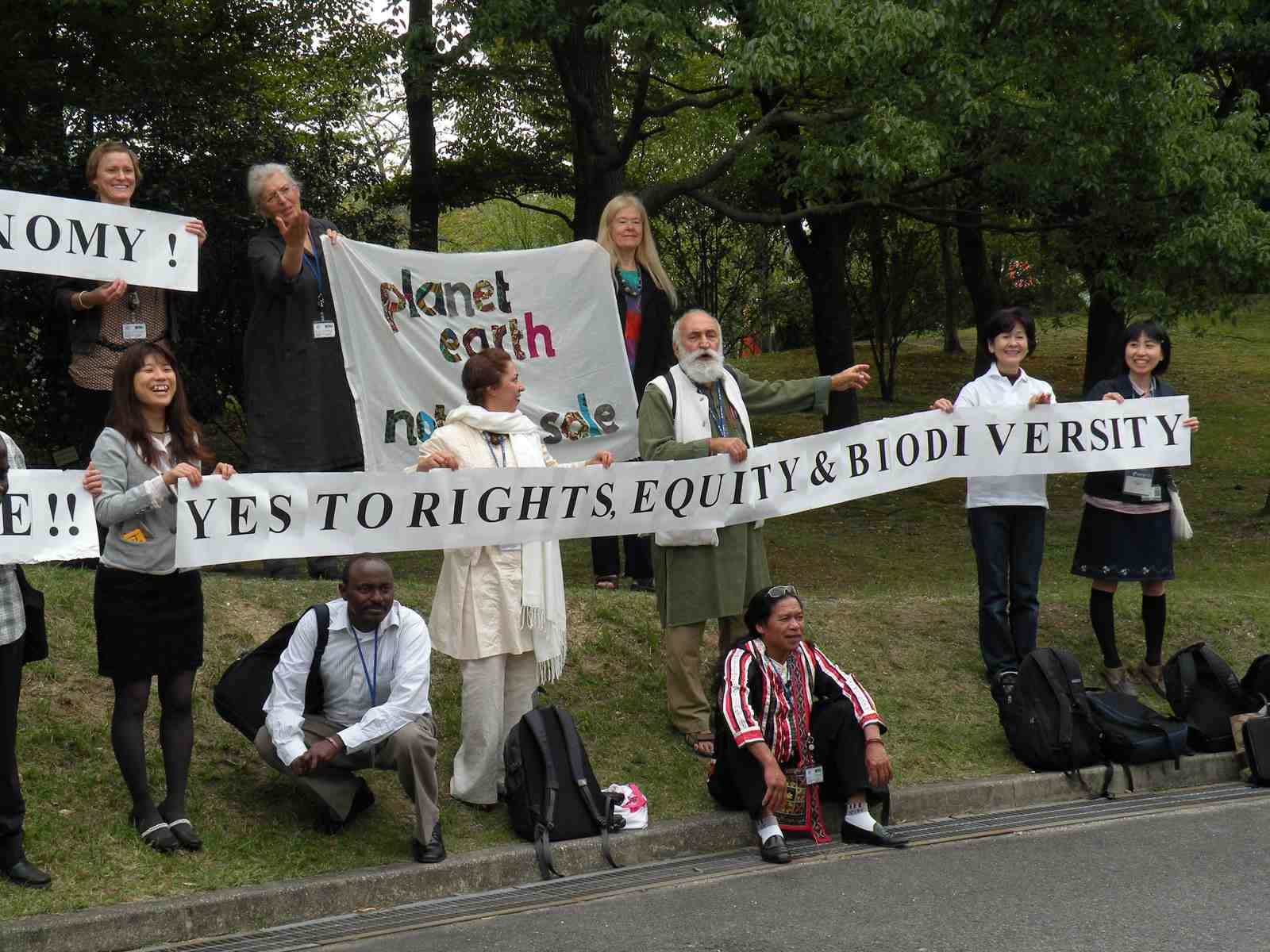
Awarding Winner Poster - CBD COP 10 Nagoya - Copyright Stephen Leahy

By Stephen Leahy

NAGOYA, Japan, Oct 21, 2010 (IPS)

Blame Canada if countries fail to agree to a new binding treaty to curb the rapid loss of plant, animal and species that form the intricate web of life that sustains humanity.

That is the view of indigenous representatives from Canada in response to a late night move by the Canadian delegation to strike a reference to indigenous peoples’ rights at the U.N. Convention on Biological Diversity (CBD) members’ conference here.

“Canada is stalling progress here, weakening our rights and fighting against a legally-binding protocol on access and benefit sharing,” said Armand MacKenzie, executive director of the Innu Council of Nitassinan, the indigenous inhabitants in northeastern Canada.

“Their opposition threatens global biodiversity… people need to speak out,” MacKenzie told IPS.

A protocol on access and benefit sharing (ABS) without a guarantee of the rights of indigenous people and local communities “would be totally void”, said Paulino Franco de Carvalho, head of the Brazilian delegation.

“Brazil will not accept any agreement on biodiversity without a fair ABS protocol…. We are not bluffing on that, I must be very clear,” Franco de Carvalho said in a press conference.

Is this article of interest? It exists thanks to contributions from readers. Please click here to learn more about Community Supported Journalism. Continue reading
North-South Divide Again Clouds Biodiversity Talks


By Stephen Leahy

NAGOYA, Japan, Oct 19, 2010 (IPS)

The accelerating destruction of natural habitats will take millions of years to recover from, scientists have warned.

This may be the last chance to apply the brakes, Achim Steiner, executive director of the U.N. Environment Programme, reminded delegates representing the 193 member countries of the U.N. Convention on Biological Diversity (CBD).

“This meeting is being held to address a very simple fact: we are destroying life on this Earth,” Steiner said at the opening plenary meeting Monday. “It is absolutely essential that nations work together here.”

Ryu Matsumoto, Japan’s environment minister, warned that the world was about to reach a threshold where the loss of biodiversity would become irreversible.

“We’re now close to a tipping point on biodiversity,” he said. “We may cross that in the next 10 years.”

With 16,000 participants, the Oct. 18-29 gathering is by far the biggest international meeting on biodiversity. The term biodiversity refers to the variety of plants, animals and other species that provide a wide range of services to humanity.

Is this article of interest? It exists thanks to contributions from readers. Please click here to learn more about Community Supported Journalism. Continue reading

Biodiversity at the Cliff’s Edge – Nature’s ‘Free Services’ In Sharp Decline

By Stephen Leahy*

NAGOYA, Japan, Oct 18, 2010 (Tierramérica)

What nature gives us is often taken for granted, but if its basic elements disappear, human life on Earth would not be possible. The mission of the biodiversity summit under way in Nagoya is to reverse the headlong rush towards the precipice.

The 10th Conference of Parties (COP 10) to the Convention on Biological Diversity (CBD), Oct. 18-29 in this southern Japanese city, seeks to create a new set of international agreements to halve the rate of loss of natural habitat, end overfishing, achieve zero net deforestation, eliminate harmful subsidies, and ensure that agriculture is sustainable by 2020, among other goals.

Without a successful meeting in Nagoya, achieving the United Nations Millennium Development Goals (MDGs) will be impossible, Janez Potočnik, of the European Union’s Commission for the Environment, told a high-level UN meeting last month in New York.

“Biodiversity” is term used to describe the wide variety of the living things that comprise the planet’s biological infrastructure and provide us with health, wealth, food, water, fuel and other vital services.

Many people fail to understand how dependent humanity is on the many natural services provided by nature, says Hal Mooney, an environmental biologist at Stanford University, in California.

“Those services are considered ‘free’ and not valued under the current economic structures,” Mooney told Tierramérica.

Is this article of interest? It exists thanks to contributions from readers. Please click here to learn more about Community Supported Journalism.

via Biodiversity at the Cliff’s Edge – IPS ipsnews.net.

‘Don’t Worry Be Happy’ Canada Sees Global Warming “Prosperity” Instead of Calamity

By Stephen Leahy

UXBRIDGE, Canada, Oct 8, 2010 (IPS)

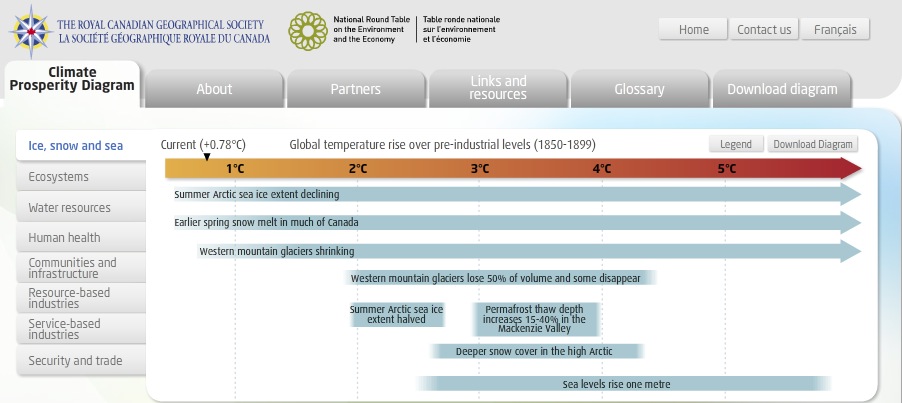
The first comprehensive look at the expected impacts of climate change on Canada offers an embarrassing and misleading “don’t worry, be happy” vision, citing more golf days and better access to northern deposits of oil and gas courtesy of global warming, critics say.

“The chart needs to be withdrawn,” said climate scientist Danny Harvey of the University of Toronto. “It is full of bad science and utterly downplays the serious impacts of climate change.”

The chart Harvey referred to is the “Degrees of Change” interactive diagram released this week as part of a national educational initiative called “Climate Prosperity” by the prestigious Royal Canadian Geographical Society and the National Round Table on the Environment and the Economy (NRTEE).

How can we (Canada) talk about profiting from climate change when most of the world will suffer devastating impacts, in part because of our emissions?” Harvey said.

“It is disgusting.”

In a release about the Climate Prosperity initiative, David McLaughlin, NRTEE president and CEO, said, “Adapt and prosper will be increasingly central to Canadian governments, communities, and businesses as these effects become more and more evident.”

NRTEE officials did not respond to IPS requests for an interview.

Is this article of interest? It exists thanks to contributions from readers. Please click here to learn more about Community Supported Journalism.

Continue reading

Rich Countries Trash Their River Systems and Make Things Worse With Expensive Engineering Fixes — Global Study in Nature

Jaw-dropping fact: Rivers in US and Europe in Worst Shape

By Stephen Leahy

UXBRIDGE Canada, Oct 5, 2010 (IPS)

Failure to protect and invest in nature has left the world’s rivers in crisis, threatening the water supply of more than five billion people according to a new study.

Pollution, dam building, agricultural runoff, conversion of wetlands, and water-works engineering have severely impacting global river systems, the first- ever health assessment of the planet’s riverine ecosystems reported in Nature last week (subscription req’d).

What made our jaws drop is that some of the highest threat levels in the world are in the United States and Europe,” says Peter McIntyre, a co-author of the report who is a zoologist at the University of Wisconsin-Madison in the U.S.

“Our study reveals, that on average, the richer the country the greater the threat to river systems,” McIntyre told IPS.

Is this article of interest? It exists thanks to contributions from readers. Please click here to learn more about Community Supported Journalism.

Expensive water-works engineering to control freshwater quality and quantity in rich countries decimate rivers’ natural abilities to control and clean water the Nature study found. River systems provide an estimated six to seven trillion dollars in services to humanity every year, but the hundreds of billions of dollars spent on engineering systems impairs those services for short-term gain, says co-author Charles Vörösmarty of the City University of New York, an expert on global water resources.

“We need to take another approach, to join hands with nature and work together,” Vörösmarty said in an interview. “If we do humanity will get a far better payback in the future.” Continue reading

Post Climatic Stress Disorder – Climate Psychology on Radio Ecoshock

Vancouver, Canada’s Alex Smith has an excellent podcast program on the psychology of why we are not dealing with climate change. Perhaps it is a crisis in slow motion — too slow for us to get excited about some think. Let’s hope not.  – Stephen

From his Sept 29 show Alex begins:

“Friends did a month of rain that fall last night? Did rivers flood in the Fall? Did you know 214 all-time heat records were set in the U.S. September 24th? It was 30 degrees in Toronto, feeling like 37 with the humidity – the heat of the human body. And just lately, Los Angeles hit an all-time high of 113 degrees – in late September!

Worried about your kids? You might have Post Climatic Stress Disorder. PCSD is a serious condition. But don’t worry, professional help is on the way….

Post Climatic Stress Disorder on Radio Ecoshock

“Do you want an economy, or a planet we can all live on? I don’t want my future compromised by inaction on climate” — 16 year old from India

Children begged world leaders to craft a new climate treaty and left Copenhagen empty-handed. Their story.

By Stephen Leahy

COPENHAGEN, Dec 5 2009 (IPS/TerraViva)

Young people from 44 countries are demanding that world leaders take decisive action on climate change. The time for talk is over, they declared at the end of a weeklong Children’s Climate Forum here.

“Our plates are empty due to drought. Our future is at risk, and we demand that something be done,” they wrote in a declaration titled “Our World, Our Future” signed by 164 participants aged 14 to 17 at the conclusion of the forum.

I don’t want my future compromised by inaction on climate,” said Bipra Biswambhara, 16, of India.

Biswambhara and many of her fellow delegates were “shocked to learn how many people and parts of the world are already affected by climate change”, she told TerraViva. “We youth are committed to taking action in our home communities,” she said.

“We must have pity for future generations to come,” said Mohamed Axam Maumoon, 15, of the Maldives, a low-lying chain of islands that will likely vanish under rising oceans if temperatures rise two degrees C.

Is this article of interest? It exists thanks to contributions from readers. Please click here to learn more about Community Supported Journalism.

“We are not alone, everyone is being affected,” Maumoon said. As a result there was a strong feeling of cooperation and common cause throughout the week, he said. “If we all work together we can have a bright future.” Continue reading

“We’re Here to Insert Some Reality into an Unreal Situation” — 350.org Founder Bill McKibben

Bill McKibben is a U.S. journalist, writer and environmentalist and the founder of 350.org. Credit: Stephen Leahy

Stephen Leahy

COPENHAGEN (IPS/TerraViva) Dec 2009

Bill McKibben is a U.S. writer, environmentalist and the founder of 350.org, an international climate campaign. His first book, “The End of Nature”, was published in 1989 and is regarded as the first book written for a general audience about climate change.

350.org is credited with organising the most widespread political action in history when more than 5,200 public demonstrations were held on Oct. 24 in 181 countries. The organisation’s goal is to raise public awareness about the dangers of climate change and the need to return carbon concentrations in the atmosphere to 350 parts per million (ppm). Currently, concentrations are 387 ppm and increasing at 2.0 to 3.0 ppm per year.

Recent science suggests that a maximum of 350 ppm may be what is needed to keep overall global temperatures below 2.0 degrees C.

TERRAVIVA: Why are you here?

BILL MCKIBBEN: I wrote a book on climate change 20 years ago and you could say I’m just following the trail to its end. We’ve also brought 350 young people from all over the world to make sure negotiators hear their voice and insert a little reality into an unreal situation. Continue reading

Locally-Run Protected Areas Could Reverse Fisheries’ Death Spiral


Great Barracuda and Jacks, Diamond Rock, Saba,...
Image via Wikipedia


One third of all species of sharks, rays and reef-building corals are facing extinction while governments spend $27 billion subsidizing overfishing

By Stephen Leahy

UXBRIDGE, Canada, Sep 15, 2010 (IPS)

Local fishers objected to the creation of a new no-fishing marine protected area off the coast of Belize in 1996. Today they are benefiting from the bounty of fish spilling out of the Laughing Bird Caye National Park. Tourism has also boomed, illustrating the multiple benefits and value of marine protected areas, according to a new series of reports released Wednesday by Conservation International (CI).

“The ocean is in crisis but we can’t see it with our own eyes so we’re not aware of what is happening,” said Leah Bunce Karrer, co-author and director of the Marine Management Area Science Programme at CI.

“Marine managed areas offer a solution which could significantly reduce ocean degradation while benefiting local communities,” Karrer told IPS.

Is this article of interest? It exists thanks to contributions from readers. Please click here to learn more about Community Supported Journalism.

One third of all species of sharks, rays and reef-building corals are facing extinction. “Most people don’t realise that,” said Gregory Stone, chief ocean scientist at CI.

“As species disappear, entire ecosystems are altered in negative ways we don’t even want to imagine,” Stone said.

Only a fraction of one percent of the world’s oceans are effectively protected even though there is growing scientific consensus of the need to protect at least 20 percent of the seas. Continue reading