The REAL Amazon-gate: On the Brink of Collapse Reveals Million $ Study


By Stephen Leahy

PARIS, Feb 2, 2010 (Tierramérica)

The Amazon jungle “is very close to a tipping point,” and if destruction continues, it could shrink to one third of its original size in just 65 years, warns Thomas Lovejoy, world-renowned tropical biologist.

[UPDATE Sept 6’10: The Amazon River is at its lowest level in 40 years — in 2005 devastating dry spell damaged vast swaths of South American rainforest Amazon May Be Headed For Another Bad Drought]]

Climate change, deforestation and fire are the drivers of this potential Amazonian apocalypse, according to Lovejoy, biodiversity chair at the Washington DC-based Heinz Centre for Science, Economics and the Environment, and chief biodiversity adviser to the president of the World Bank.

Amazonian rainforest, upper Amazon basin, Lore...
Image via Wikipedia

Lovejoy laid out the scenario for participants at the Biodiversity Science Policy Conference in Paris last week, sponsored by UNESCO (United Nations Educational, Scientific and Cultural Organisation), and marking the beginning of the U.N.’s International Year of Biodiversity.

“The World Bank released a study that finally put the impacts of climate change, deforestation and fires together. The tipping point for the Amazon is 20 percent deforestation,” and that is “a scary result,” Lovejoy told Tierramérica in an interview.

The study, “Assessment of the Risk of Amazon Dieback,” released Jan. 22, drew on the expertise of several international research institutions, including Japan’s Meteorological Research Institute, Britain’s Exeter University, Brazil’s Centre for Weather Forecasting and Climate Change (CPET/INPE), Germany’s Potsdam Institute and Earth3000.

Do you find this article interesting? It exists thanks to contributions from readers. Please click here to learn more about Community Supported Journalism.

The results and analysis were reviewed by an international blue-ribbon panel of scientists. Continue reading

Keeping Wetlands from Becoming Wastelands

By Stephen Leahy

VICTORIA, Seychelles, Feb 5, 2010 IPS

Swamps, marshes and other wetlands are beginning to be recognised as a countrys green jewels, even in a tropical paradise like Mahé Island here in the Seychelles, with its stunning beaches and dramatic granite outcrops.

“Wetlands are one of the worlds richest ecosystems on the planet,” said Joel Morgan, minister for environment, natural resources and transport, Republic of Seychelles.

“We islanders live closer to nature than many others and we have long understood the importance of wetlands and environmental services and resources they provide us with,” Morgan said at the first-ever World Wetlands Week.

Normally, World Wetlands Day is Feb. 2, but this year the Ramsar Convention, an intergovernmental treaty on conservation and wise use of wetlands and their resources, is celebrating wetlands around the world throughout the entire week.

The Seychelles were chosen for the global launch of World Wetlands Week because they exemplified the Ramsar principle of wise use successfully balancing tourism, development, food security and biodiversity, said Anada Tiega, secretary general of the Ramsar Convention.

“The Seychelles has done a good job implementing the Ramsar Convention,” Tiega said in the opening ceremony.

The Seychelles Islands are a tropical archipelago 1,800 kilometres off the east coast of Africa with a population of just 85,000 people. They comprise 115 islands – the Inner Islands are tall and granitic and the outer low-lying comprise coralline cays, atolls and reef islands. Although generally small in size, wetlands of various kinds can be found on most islands.

For complete article please see:  Keeping Wetlands from Becoming Wastelands

Helping Haiti – What You Can Do

[When I wrote about the 4 hurricanes that pounded Haiti over 2 months in 2008, experts said things couldn’t get any worse….  There was emergency aid in 2008, people were fed but little was done in the months after the storms to help Haiti up off its knees, to be able to feed itself. This is the last chance Haiti and for the world. There were many trillions for financial sector and many billions for the auto industry: surely the world can spare a billion or two for Haiti? Surely we all can spare $50 or $100 for Haiti. — Steve]

Haiti needs our help – here are easy and safe ways for you to do something important

Breaking: On the ground report from IPS  Jan 15 HAITI: As Aid Efforts Flounder, Haitians Rely on Each Other

[From the good folks at Alternative Channel]

The best way to help is by donating through one of these high-rated effective and financially stable charities.

The Canadian Red Cross and the International Committee of the Red Cross (ICRD) are accepting donations to support Red Cross relief efforts in Haiti. Donations can be earmarked to the Haiti Earthquake fund. The Red Cross response includes evacuation support, search and rescue efforts and providing shelter and first aid. Local Red Cross volunteers continue to work around the clock to help the many people affected by this disaster.

Medecins Sans Frontieres/Doctors without Borders

The humanitarian organization delivers medical care to people caught in crisis. Donations to its Haiti relief efforts will go toward repairing the obstetrics and trauma hospitals in Haiti that were damaged in the earthquake. They also will go to transporting an additional 70 doctors and medical supplies to the island in an effort to set up makeshift emergency medical response centers. To donate, go to doctorswithoutborders.org or call 1-888-392-0392.

UNICEF

The national committee for UNICEF is responsible for the organization’s fundraising. UNICEF uses the money for health care, clean water, nutrition, education and emergency relief. The organization has issued a statement that “Children are always the most vulnerable population in any natural disaster, and UNICEF is there for them.” 64% of Haiti’s population is less than 18 years old. UNICEF requests donations for relief for children in Haiti via their Haiti Earthquake Fund. You can also call 1-800-4UNICEF.

More pictures from Haiti

On the ground report Jan 15 HAITI: As Aid Efforts Flounder, Haitians Rely on Each Other

My previous article on Haiti following 4 Hurricanes/Tropical Storms pounded the island in Sept 2008

Haiti: “The Most Desperate Enviromental Crisis on the Planet”

What if our air was 30% more acidic like the Oceans? May be 120% more acidic by 2060

Bleached coastal corals. Bantry Bay, Australia. R Leahy 2006

[2°C is a death sentence for corals scientists agree due to ocean acidification and bleaching resulting from emissions of carbon dioxide into the atmosphere. However the developed nations of the world have set 2 degrees C as the climate stabilization target not that any of them have figured out how to reach this target. It is as if the oceans don’t matter. This reflects a fundamental ignorance about life on Earth, an assumption that we can lose or seriously damage entire ecosystems without suffering any consequences.

This story shows we need to get serious about tackling emission reductions (below 2C) and preserving anything that sequesters or traps carbon because these will be tremendously valuable in a climate-changed world . — Steve

By Stephen Leahy*

COPENHAGEN, Dec 11 (IPS/TerraViva)

What would it be like if the air we breathe was 30 percent more acidic? The oceans are already 30 percent more acidic, and on their way to becoming 120 percent more acidic in 50 years at the current rates of carbon dioxide emissions.

Acidification is already affecting coral reefs, algae and plankton, the base of many marine food chains, according to a new report released here by the International Union for Conservation of Nature (IUCN).

“In the last 10 years, the growth of coral reefs in many areas has declined 15 percent,” said Carl Gustaf Lundin, head of the IUCN’s Global Marine Programme.

“That’s a dramatic shift,” Lundin told TerraViva.

The oceans absorb some carbon dioxide (CO2) from the atmosphere, but the vast quantity being emitted – mainly from the burning of fossil fuels – has altered basic ocean chemistry, turning it sour. That’s also affecting shell-forming plankton and disrupting the growth rates of other species, Lundin said.

The stated goal of many countries to stabilise global temperatures within an increase of no more than 2.0 degrees C. is still “a death sentence for most coral reefs”, he said. The 2.0 C. target implies a level of CO2 in the atmosphere of 450 parts per million (ppm), well up from the historical average of 280 ppm. Continue reading

Small Farmers Can Feed AND Cool the World – Industrial Agriculture Emits Almost 50% of Greenhouse Emissions

Agriculture and Food System Change needed to combat Climate Change

Women need to part of the solution

[UPDATE: Feb 2010. Small farmers can cool and feed the world according to Via Campesina. They may be right. After all industrial food production is about making profits not feeding the world nor is it concerned about carbon emissions. Shockingly the GRAIN study in this article did NOT include methane emissions from livestock, so the impact of big ag on climate is likely greater still.

Industrial agriculture is widely acknowledged to be unsustainable — check out this three-year international scientific assessment I covered in 2008 that will revolutionize farming as we know it. The food system is broken but the only reforms I hear about from governments, agribusiness and big NGOs are the same old solutions: new seeds and hi-tech equipment, more GMOs and maybe throw in some nanotech. Small farmers can already deliver what we need if we let them. — Stephen.]

By Stephen Leahy

COPENHAGEN, Dec 12’09 (IPS/TerraViva)

Industrial agriculture may emit nearly half of climate-heating greenhouse gases, but that reality has gone unrecognised by negotiators at the climate treaty talks here, say farmers with La Via Campesina, an international movement of hundreds of millions of small-scale peasant farmers.

“Small-scale farmers use 80 percent less energy than large monocultures,” said Chavannes Jean-Baptiste, a Haitian farmer with Mouvement de Paysan, through a translator.

“Peasant farmers from La Via Campesina and others can help cool the planet,” Jean-Baptiste told a press conference at the Klimaforum09, the alternative climate action talks being held here in Copenhagen Dec. 7-18.

Chavannes Jean-Baptiste, a Haitian farmer with Mouvement de Paysan

Unlike the official talks, set in a remote location surrounded by police and razor wire, Klimaforum09 is being held in the city’s community centre and is free and open to the public.

System Change for Climate Change” – that’s the phrase most often heard at the Klimaforum09 and in parts of Copenhagen.

La Via Campesina’s claim that industrial agriculture is by far the biggest source of carbon emissions is based on a recent study that looked at all emissions from the global food system.

This includes oil-dependent industrial farming, together with the expansion of the meat industry, the destruction of world’s savannahs and forests to grow agricultural commodities, the use of fossil fuel energy to transport and process food, and the extensive use of chemical fertilisers.

This independent environmental journalism depends on public support. Click here learn more.

The study was conducted by GRAIN, an international non-governmental organisation that promotes the sustainable management and use of agricultural biodiversity to support local communities. Continue reading

Honduras Hit Hardest by Extreme Weather From Global Warming – experts say

[ Climate change has already resulted in trillions of dollars of losses due to extreme weather events over the past two decades. While no single hurricane, flood or drought can be directly attributed to global warming, one of the most solid findings of climate science is that extreme weather events will increase dramatically as a result of more heat being trapped in our atmosphere.

Countries like Honduras, Haiti and others are already struggling to recover from one extreme event after another in recent years. Without substantial global reductions in emissions the number of extreme weather events will continue to rise turning these countries into permanent disaster zones. This story only documents the easy-to-measure impacts not  no less devestating impacts like crop failures from droughts etc. — Steve]

By Stephen Leahy*

COPENHAGEN (IPS/TerraViva)

Honduras has been hit harder by extreme weather events than almost any other country over the last 18 years, says a study of weather-related losses, released here as the climate summit continues this week.

Around the world, storms, floods and heat waves have resulted in 1.7 trillion dollars in losses and 600,000 deaths, the Global Climate Risk Index 2010(pdf) reported.

On the same day, the World Meteorological Organisation announced in Copenhagen that the decade 2000-2009 is very likely to be the warmest since records began in 1850.

India, northern China and Australia saw extreme heat waves this year. Warm weather was also more frequent and intense in southern South America in 2009, according to the WMO report.

“Our analyses show that, in particular, poor countries are severely affected” by extreme weather events, said Sven Harmeling, author of the Index at Germanwatch, a non-governmental organisation based in Germany that has promoted global equity and the preservation of livelihoods since 1991. Continue reading

“We Are a Harbinger of What Is to Come” – Global Warming is Already Affecting Millions – Video

[Those living closest to the land – small farmers, pastoralists, indigenous peoples — are already suffering from impacts of climate change. They have made a series of short videos to show people like you and me who are insulated from these impacts how our emissions of carbon are changing the world.

This is both a plea for help and a warning of what’s coming for all of us.

I found it remarkable those I spoke with are not angry. They simply want us to understand what is happening to them because if we understand, if we know what we are doing to them, then we will act. I hope they are right. — Steve]

By Stephen Leahy

COPENHAGEN, Dec 3 (IPS)

A small group of indigenous people have travelled here to the historic Copenhagen climate talks to show negotiators dramatic documentary videos they made about the immediate impacts of climate change on their homelands and way of life.

“We want to show policymakers what the three-year long drought in my country is doing to our communities,” said Stanley Selian Konini, a Maasai from Oltepesi in Kajiado district, Kenya.

“Our animals are all dead. The zebras and the monkeys are dying even in the forests,” Konini told IPS. “Leaders need to change policies to help us.”

The Kenyan video documents the impact of an intense drought hitting the Maasai community. During these extremely hard times, pastoralists have been losing their cattle – their main and sometimes only livelihood.

“It’s affecting our culture. There can be no dowry payments because we have no animals,” said Konini, one of the young Maasai who made the video.

“The elders say they have never seen anything like this drought. It is something beyond their understanding and experience of the Maasai people,” he said. Continue reading

Is Privatizing Air & Water Only Way to Save the Planet? — Copenhagen Talks

By Stephen Leahy*

COPENHAGEN, Dec 17 (Tierramérica)

In the last two years, the conclusion among decision-makers has been that the only way to solve the climate crisis is to turn carbon into a commodity and privatise the atmosphere.

Similar market-based solutions will be used to “solve” the growing water crisis, warned experts at the Klimaforum09, a parallel meeting a few kilometres away from the official 15th Conference of Parties (COP15) to the United Nations Framework Convention on Climate Change, held Dec. 7-18 in Copenhagen.

“Corporations do not want regulations and have convinced governments that they can deliver continued economic growth and save the planet,” said Maude Barlow, chair of the Council of Canadians, the largest citizens group in Canada and author of several books about water issues.

“It shows the power of the corporate lobby that nearly everyone, including many big NGOs, all see the market as the solution to climate change,” Barlow told Tierramérica.

Meanwhile, the climate justice movement is fighting against carbon trading and carbon offsets and advocating for real emissions cuts, while recognising that the commons – air and water – are a public trust, she said

See No Water in Copenhagen Talks

Learn About Community Supported Journalism

Canada’s “Mordor” Ensures Climate Treaty Failure in Copenhagen

[Hello from snowy and cold Copenhagen. Tensions have ramped up as political leaders arrived but are mainly meeting in secret.

Ashamed to say Canada is a widely acknowledged as a public embarrassment here. And called a climate criminal by some. Several protests like the one I covered below and a smaller one earlier have focused on the Athabasca Tar Sands perhaps the world’s biggest source of carbon emissions.

Outside the artificial reality of the Bella Center ordinary people get it. Here is good video summary of what happened on Wed as civil society were gradually banned from the conference. It accords with my son’s version who was in the middle of all this as an observer. — Steve]


By Stephen Leahy

COPENHAGEN (IPS/TerraViva) Dec 14 2009

Climate activists jammed a small square near the police-barricaded Canadian Embassy here Monday for the second day of protests over the country’s tar sands development.

Simultaneous protests were held at the Canadian Embassy in London because British oil companies and financial institutions are deeply invested in the Canadian mega-project.

“As indigenous people, we are here at the international climate negotiations to speak about threats to our cultural survival and the direct life-threatening impacts of climate change in our communities,” said Clayton Thomas Muller, tar sands campaigner for the Indigenous Environmental Network.

“Canada has been blocking the climate negotiations and hasn’t kept Kyoto commitments…because of the tar sands,” he told a crowd of 75 to 100 people surrounded by four squads of riot police.

Boreal forests and wetlands the size of Greece are been destroyed in northern Alberta in an industrial project that turns millions of tonnes of sand and earth into oil, mainly for the U.S. market he said.

“All the efforts by Canadians to reduce their carbon emissions are undone by the tar sands,” said Canadian writer and activist Naomi Klein.

The tar sands are Canada’s largest single source of carbon dioxide (CO2) emissions and the major reason why Canada has refused to live up to its commitments to reduce emissions and is blocking negotiations, Klein told protesters.

“Canada is making a mockery of international law and of developing countries’ need for urgent emission reductions in rich countries,” she said.

Canadian Prime Minister Stephen Harper is here at the Dec. 7-18 U.N.-sponsored climate summit under false pretences, Klein charged.
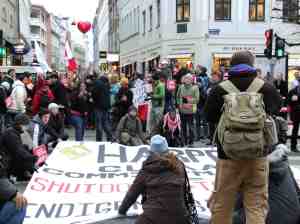
Harper does not have the Canadian people’s permission to promote the tar sands or to favour Canadian interests over those of the planet,” she said.

The tar sands are “Canada’s Mordor”, said Maude Barlow, head of the Council of Canadians, the largest citizens’ group in Canada. She was referring to the devastated land of rock and fire in the “Lord of the Rings” trilogy.

“What else can you call a project that leaks 11 million litres of toxic waste a day into rivers and groundwater?” Barlow said in this very un-Mordor upscale shopping district of downtown Copenhagen.

The tar sands project has the largest toxic waste containment ponds on the planet – easily visible from space. Last week, a report revealed the extent of the leaks to be an estimated 11 million litres a day.

Shockingly, this is based on the oil companies’ own self-reported data, says Environmental Defence, the Canadian advocacy, research and education group that compiled the report.

It calculated that four billion litres of leakage a year will grow to 25 billion in a decade based on current growth of the tar sands and aging of the enormous dams that hold back the waste.

“There is no question Harper will stand up for  the oil sector [in the climate talks here],” Barlow said.

Their [oil industry] footprints are all over this negotiation and that is why it will fail.”

-30-

Corrected 2/2/12

For more on the Tar Sands see:

Oil Stains in the Boreal Forest: The Environmental Cost of Canada’s Oil Sands – Revised V2.1Oil Stains in the Boreal Forest: The Environmental Cost of Canada’s Oil Sands – Revised V2.1

Tar Sands, Riot Police & Hope in Copenhagen

By Stephen Leahy

COPENHAGEN, Dec 12 (IPS/TerraViva)

A small group of protesters stood outside the Canadian Embassy in the cold Saturday night in Copenhagen to  shine a small spotlight of attention on the fact that Canada is home to the Alberta tar sands, the world’s largest and possibly most
polluting industrial project on the planet.

“It’s not just the huge CO2 emissions, it’s the water pollution, destruction of the forests, impacts on the food supply and all of the cancers the native people are getting,” said Janet Payne, an activist from the United Kingdom. “It’s dirty, toxic and huge.

Thousands of square kilometers of tar-laden soil and sands underlying Canada’s boreal forests are being mined, and then boiled with millions of liters of steaming water to extract the tar to produce 2.7 million barrels a day, mostly to feed the insatiable appetite for oil in the US.

“I feel strongly Canada is getting away with this Payne had participated in the day’s big march saying it was like a music festival but with a strong message to the world. “Everyone should be here. Climate change is affecting everything in the world; we all should be standing up.”

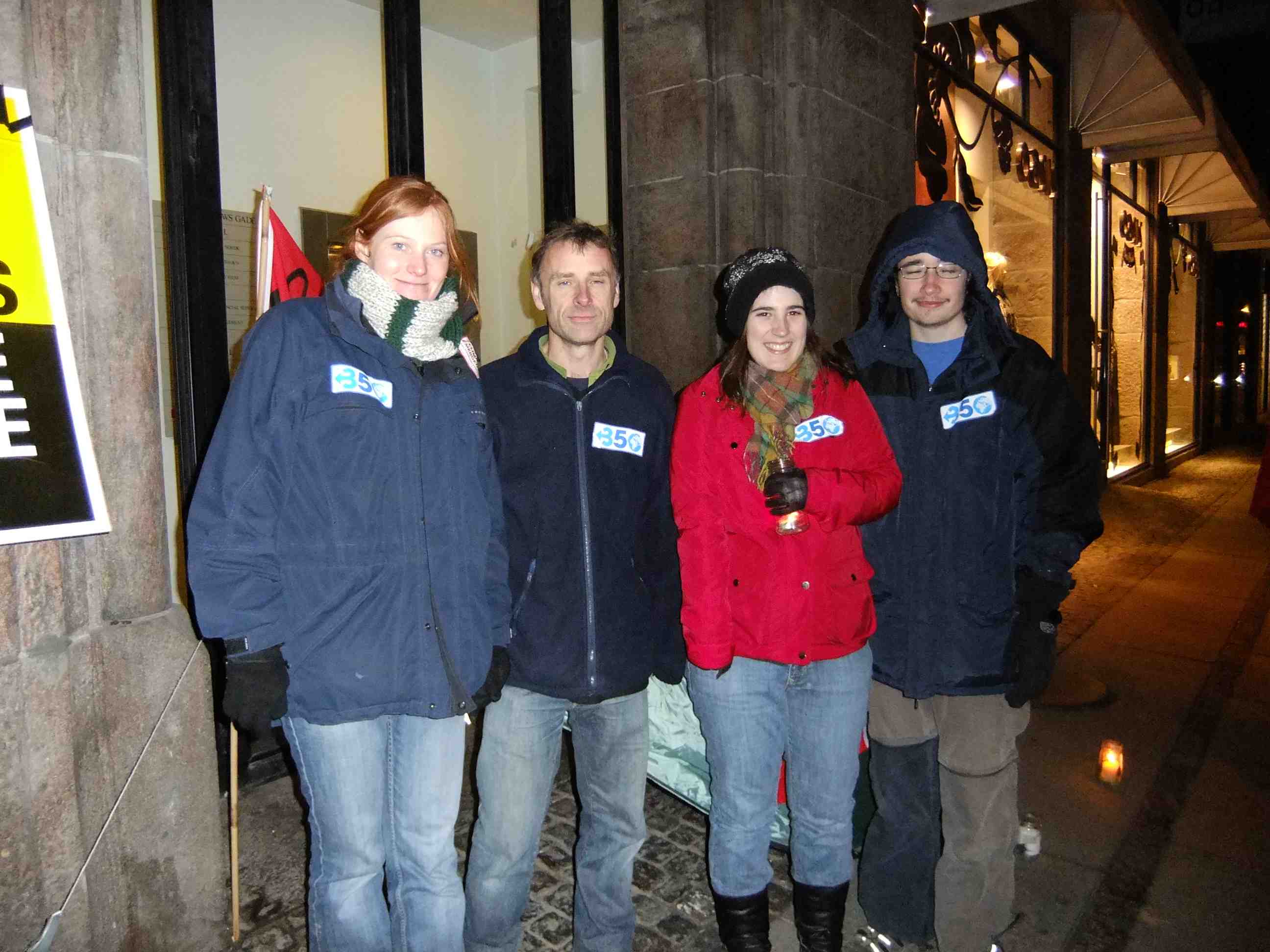
At the end of the interview three vans of Danish riot police pulled up and surrounded the group of eight protesters who were simply shivering on the sidewalk holding two small banners. The group was surrounded by police in full riot gear demanding to know what was going on.

Assuming this reporter was the leader, they asked me to explain what the protest was about, and I told them about the tar sands project. After the mandatory ID checks, permission was given to continue the protest and two officers said they’d join in once their shift was finished.

Maybe there is hope in Copenhagen.