Paris Climate Talks – Breaking: Options for Global Target 1.5C

Final President’s Draft  Just Released

At 3pm CET Dec 9 the President’s draft was released. It’s much shorter at 29 pages. A quick glance reveals perhaps two dozen brackets down from 800 a few days ago.

Parties will review this new next and reconvene the plenary at 8 pm CET to figure out how to resolve the remaining contested issues.


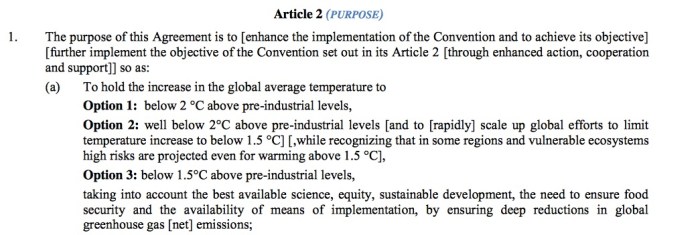
 On the Contentious Issue of 1.5 vs 2.0C

— 3 options still to debate — see below

Screen Shot 2015-12-09 at 9.47.40 AM.jpg

Paris Climate Talks – Peak CO2 Already?

Screen Shot 2015-12-07 at 3.32.09 PM
Have We Reached the Crucial Peak in Global CO2 Emissions?
New report released today says CO2 emissions will likely decline this year for the first time after growing 2-3% per year for last 15 years.

“Whether a slower growth in global emissions will be sustained depends on the use of coal in China and elsewhere, and where new energy will come from. In 2014, more than half of new energy needs in China were met from renewable sources such as hydro, nuclear, wind, and solar power.” — Corinne Le Quéré, Director of the Tyndall Centre

  • cop21 logo sml

Paris Climate Talks – Most Countries Want 1.5C Target not 2.0C


Wrapping Day 2 of COP 21
 

Majority of Countries want 1.5 C target not 2.0C

Leaders of 30 nations began the Paris climate negotiations with a call to cut CO2 emissions dramatically to keep the global average temperature rise below 1.5C. These countries are part of Climate Vulnerable Forum (CVF) — countries highly vulnerable to impacts of climate change.

The call for a global target of 1.5C is supported by 106 of the 195 countries in Paris this week. They also call for 100 percent renewable energy and a full decarbonization of the global economy by 2050.

Important to note that 2.0C is a political target not a scientific one. Moreover climate science does support 1.5C as a safer level of climatic change than 2.0. Currently global warming is 1.0C.cop21 logo sml 

Leaders Inspired Speeches but BAU for Negotiators
Monday saw 150 leaders making speeches about the need for urgent action. However in the negotiating rooms today it was business as usual crawling along at a snail’s pace with negotiators apparently oblivious to their leaders impassioned speeches and pleas for urgent action said Saleemul Huq is the Director of the International Centre for Climate Change & Development (ICCCAD) in Bangladesh.

Renewables Everyone’s Favorite Energy Technology

Billions and billions of dollars are being promised for renewables:
U.S. President Barack Obama, French President Francois Hollande and 18 other world leaders launched Mission Innovation, a $20-billion commitment to accelerate public and private clean energy innovation worldwide.

Bill Gates and other tech billionaires unveiled the Breakthrough Energy Coalition, to bring billions of dollars to help new, clean energy technologies come to market.

India’s prime minister announced an international solar alliance of over 120 countries. 

Tuesday also featured a focus on forests


Deforestation accounts for at least 12 percent of CO2 emissions and among developing countries it’s often the largest source of emissions. Today the Lima-Paris Action Agenda “Forest Focus” launched a number of forest protection initiatives including a commitment Germany, Norway and the United Kingdom, to provide $5 billion from 2015 to 2020, if forest countries demonstrate measured, reported and verified emission reductions.

First posted on Climate News Mosaic Live Blog

Road to Paris: Plain Talk Briefing on the UN Climate Treaty Negotiations

What:    A candid, 15 minute explanation on why the UN climate negotiations are so difficult and the likely result in Paris. Intended for a general audience.

Who:     Stephen Leahy is an independent, environmental journalist who has covered climate negotiations around the world. He is co-winner of the 2012 Prince Albert/United Nations Global Prize for reporting on Climate Change.

Where: Part of a public forum in Toronto June 2014 titled CLIMATE CHANGE EMERGENCY.

Thanks to Peter Biesterfeld for making the recording.

Global Experts Call for Moratorium New Tarsands Development Until Climate, Environmental Impacts Assessed

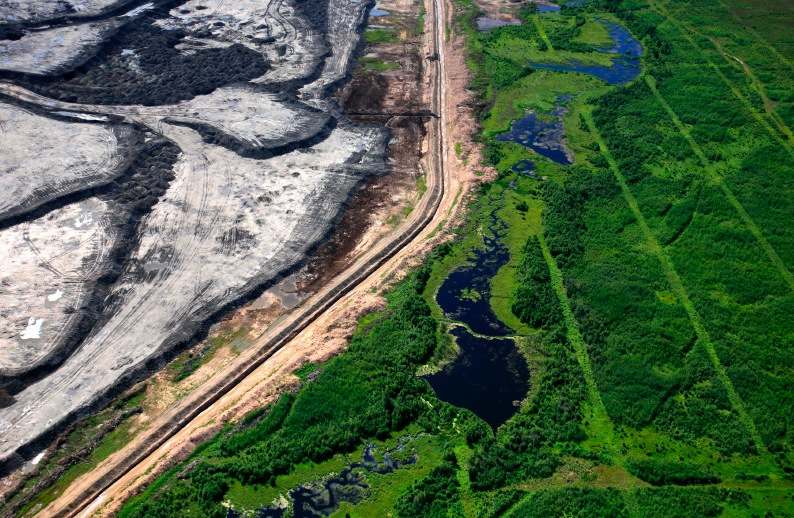
Canada's tar sands projects visible from space
Canada’s tar sands projects visible from space

By STEPHEN LEAHY  Stephen Leahy's picture

A moratorium on any new oilsands expansion is imperative given Canada’s failure to properly assess the total environmental and climate impacts Canadian and U.S. experts say in the prestigious science journal Nature.

Even with a moratorium it will be very difficult for Canada to meet its international promise to reduce CO2 emissions that are overheating the planet according to government documents as previously reported by DeSmog.

Continuing to approve pipelines and new projects guarantees Canada will not meet the Harper government’s Copenhagen emissions reduction target,” said Wendy Palen, an ecologist at Simon Fraser University.

These are the plain facts Canadians need to be aware of,” Palen, a co-author of the Naturecommentary, told DeSmog.

Canadians also have no idea of the overall ‘big picture’ of the impacts of oilsands production and transport because each project is assessed in isolation.

In total more than 280 square kilometres of boreal forest and peatlands have already been eliminated to make way for oilsands development. That amounts to an area more than twice the size of the City of Vancouver.

According to a 2012 study the destruction of this region of the boreal forest – a natural carbon sink –released about 100,000 tonnes of CO2 that had been safely stored underground. And it also meant the end of the region’s ability to absorb some 58,000 tonnes of CO2 every year. Over a 20-year time span that’s 1,161,000 tonnes of CO2 that stays in the atmosphere – close to half the annual emissions of the City of Vancouver.

This does not include CO2 emissions from developing oilsands projects themselves nor the emissions from burning millions of barrels of oil produced there each year.

This piecemeal approach is like determining the risk of cigarette smoking by only looking at the potential harm from smoking one cigarette, environmental economist Mark Jaccard said.

As critics have pointed out during recent pipeline review processes, regulators like the National Energy Board do not consider the climate impacts of pipelines and oilsands projects. It’s considered ‘out of bounds’ Jaccard, another coauthor of the report, said.  Each project is presented as an ultimatum: approve the project or lose an economic opportunity, he said.

This approach artificially restricts discussion to only a fraction of the consequences of oil development,” Jaccard and 7 co-authors argued in the report. The authors represent an interdisciplinary group of experts in environmental science, economics, policy development and decision science.

What Canada and the U.S. need is a “more coherent approach” to evaluate all oilsands projects and pipelines in the “context of broader, integrated energy and climate strategies.”

But first Canada and the U.S. need to impose an immediate halt to new oilsands developments and related pipeline construction, the authors write. (The U.S. is considering developing its own oilsands in Utah and elsewhere). Then the two countries can jointly develop a strategy that allows energy developments to proceed only if they are within environmental limits and respect other national commitments to human health, social justice and biodiversity protection.

However this strategy would need a formal, legislated acknowledgement of the reality that oilsands development impacts the climate. It also should create either a carbon tax or cap-and-trade mechanism to ensure the oil industry absorbs “the full social costs of carbon combustion.”

Finally this strategy should assess the full range of potential impacts compared to alternatives. And it should include the options of saying ‘no’ to a project.

Former Secretary of State Hillary Clinton said Canada and the U.S. need to co-ordinate their climate policies in an interview on the CBC’s The National last week. She acknowledged we need to get beyond project-by-project approvals.

With new regulations on power plants, the U.S. may be on its way to meeting its Copenhagen emission reduction target, which is identical to Canada’s.

While Prime Minister Harper “clearly doesn’t care about climate change,“ Jaccard told DeSmog,  President Obama does and could make approval of the Keystone XL pipeline contingent on Canada meeting its 2020 target.

Economists around the world now agree the costs of carbon pollution far outweigh the benefits,” Jaccard said.

First published by DeSmog Blog Canada Thu, 2014-06-26 12:19


Film Exposes Slick US Industry Behind Climate Denial

Robert Kenner’s forthcoming documentary lifts the lid on the ‘professional deceivers’ manipulating US debate on climate change

OPENS MARCH 6 in US

Shot from Merchants of Doubt film.
 Merchants of Doubt looks at professionals working for the fossil fuel industry to sow doubt in the US climate change debate.    Photograph: Sony Pictures Classics

By  for the Guardian

Who remembers that climate change was a top priority early in George W Bush’s first term as US president? 

Six months later everything changed. The film shows Republican party leader John Boehner calling the idea of global warming “laughable”, said Merchants of Doubt director Robert Kenner.

Framing Climate Science as Attack on Personal Freedoms

With the 9/11 attacks on the World Trade Center occupying attention, Americans For Prosperity, a powerful, fossil-fuel lobby group founded by the billionaire Koch Brothers, launched a decade-long, multi-pronged campaign to sow doubt about the reality of climate change.Screen Shot 2015-03-01 at 5.34.47 PM

By equating the findings of climate scientists as an attack on personal freedoms, they cleverly shifted the focus away from science to political opinion. “Creating a focus point away from what is actually going on is how magicians pull off their tricks,” said Kenner who directed the Oscar-nominated documentary Food Inc.

The deception has worked well. Few Americans know 97% of scientists agree climate change is caused by human activity and is happening now.

Inspired by the 2010 book of the same name, Kenner’s film is about deception and profiles many of the charming and always smiling professional deceivers who work for the tobacco, chemical, pharmaceutical, and fossil fuel industries. The tobacco industry knowingly and successfully deceived the public for 50 years about the connection between smoking and cancer, the 1988 tobacco lawsuit settlement revealed.

In a pattern of manipulation clearly evident today in the manufactured ‘debate’ over climate change, the tobacco industry used media-friendly pseudo-experts, doctored ‘science’ studies and attacked the credibility of scientists or experts who said otherwise, Kenner said.

If you can sell tobacco you can sell anything

Peter Sparber, one the tobacco industry’s most successful deceivers, told Kenner that he could get the public to believe a garbage man knew more about science than prominent climate scientist James Hansen.

“If you can sell tobacco you can sell anything,” Sparber tells Kenner.

Selling confusion and doubt around a complex issue like climate change was far easier than selling tobacco. Nearly all of those well-paid climate misinformers have no science background and often clear ties to industry lobby groups and yet are treated as expert commentators on climate science by media. It’s not just Fox News. Serious news outlets like CNN and the New York Times are complicit by featuring misinformers in news articles and on discussion panels, he said.

The film also focuses on the many self-described “grassroots” organisations that are actually promoting specific corporate and political interests. These organisations are often aided by, and passionately supported by, ordinary citizens who believe they are fighting for personal freedoms and libertarian or conservative values.

Kenner is hoping audiences “will realise they’ve been lied to” and develop better “bullshit detectors”.

First published at the Guardian

For an Ailing Planet, the Cure Already Exists

Measure of concentration of CO2 in the atmosphere by year

By Stephen Leahy

UXBRIDGE, Canada, Jun 1, 2012 (IPS)

The planet’s climate recently reached a new milestone of 400 parts per million (ppm) of carbon dioxide in the Arctic.

The last time Earth saw similar levels of climate-heating carbon dioxide (CO2) was three million years ago during the Pliocene era, where Arctic temperatures were 10 to 14 degrees C higher and global temperatures four degrees C hotter.

Research stations in Alaska, Greenland, Norway, Iceland and even Mongolia all broke the 400 ppm barrier for the first time this spring, scientists reported in a release Thursday. A global average of 400 ppm up from the present 392 ppm is still some years off.

If today’s CO2 levels don’t decline – or worse, increase – the planet will inevitably reach those warmer temperatures, but it won’t take a thousand years. Without major cuts in fossil fuel emissions, a child born today could live in a plus-four-degree C superheated world by their late middle age, IPS previously reported. Such temperatures will make much of the planet unliveable.

In a four-degree warmer world, climate adaptation means “put your feet up and die” for many people in the world, said Chris West of the University of Oxford’s UK Climate Impacts Programme in 2009.

This week the International Energy Agency reported that the nations of the world’s CO2 emissions increased 3.2 percent in 2011 compared to 2010. This is precisely the wrong direction: emissions need to decline three percent per year to have any hope of a stable climate.

By 2050, in a world with more people, carbon emissions must be half of today’s levels.

Impossible? No. A number of different energy analyses show how it can be done. Continue reading

Oil, Coal and Gas Industry Destroying Our Childrens’ Future

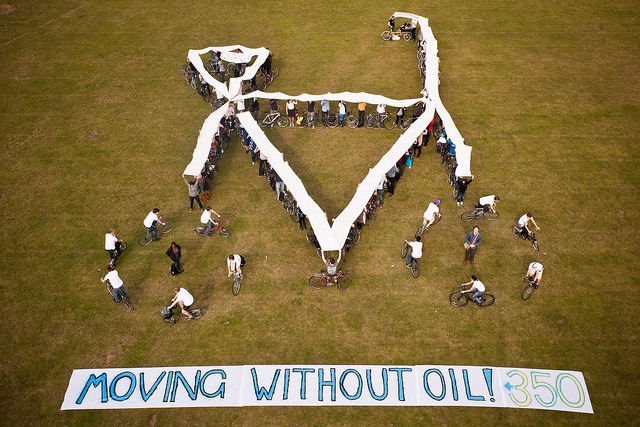
“moving aerial” of a bike sml

By Stephen Leahy

UXBRIDGE, Canada, Jan 4 2013 (IPS)

Around the world, 2012 was the year of extreme weather, when we unequivocally learned that the fossil fuel energy that powers our societies is destroying them. Accepting this reality is the biggest challenge of the brand new year.

Re-engineering our societies and lifestyles to prosper on green alternatives is the penultimate challenge of this decade. There is no more important task for all of us to engage in because climate change affects everything from food to water availability.

A number of scientific analyses have demonstrated we already have the technology to re-engineer our society to thrive on green alternative energy. The newest of these was published Wednesday in the prestigious journal Nature. It plainly states that politics is the real barrier, not technology nor cost. (It is far cheaper to act than not.)

Keeping global warming to less than two degrees C is mainly dependent on “when countries will begin to take serious action to reduce greenhouse gas emissions”, according to the study “Probabilistic cost estimates for climate change mitigation”.

Climate change has already pushed global temperatures up 0.8 degrees C, with significant consequences. No climate scientist thinks two degrees C will be “safe”. Many countries, especially least-developed countries and small island states, want the global target to be less than 1.5C of heating. Even then large portions of the Arctic and Antarctic will continue to melt raising sea levels, albeit at a slower rate.

Delay in making the shift to non-fossil fuel energy sources will be very costly. Waiting until 2020 to curb global emissions will cost twice as much compared with peaking emissions by 2015, the Nature analysis shows.

Serious action to reduce greenhouse gas emissions means 65 percent of current coal power plants will have to be shut down in the next decade or two, a previous Nature study reported by IPS shows.

US Fossil Emissions now and how much they need to decline

Instead of serious action, global emissions continue to break new records, rising about three percent per year. It appears 2012 will be about 52 gigatonnes (billion metric tonnes of CO2 equivalents). This is our annual climate scorecard, the most important number in human history. That number needs to fall to be between 41 and 47 gigatonnes (Gt) by 2020 to have a reasonable chance of staying below two degrees C of warming. Continue reading

UN Climate Talks End In Dramatic Showdown But Little Progress

COP 19 Final Showdown between US and Fiji

By Stephen Leahy

WARSAW, Nov 24 2013 (IPS)

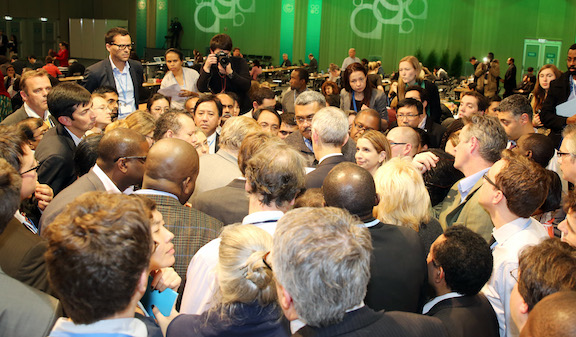
The U.N. climate talks in Warsaw ended in dramatic fashion Saturday evening in what looked like a schoolyard fight with a mob of dark-suited supporters packed around the weary combatants, Todd Stern of the United States and Sai Navoti of Fiji representing G77 nations.

It took two weeks and 36 straight hours of negotiations to get to this point.

At issue in this classic North versus South battle was the creation of a third pillar of a new climate treaty to be finalised in 2015. Countries of the South, with 80 percent of the world’s people, finally won, creating a loss and damage pillar to go with the mitigation (emissions reduction) and adaptation pillars.

Super-typhoon Haiyan’s impact on the Philippines just days before the 19th Conference of the Parties (COP19) amply illustrated the reality of loss and damages arising from climate change.  Philippines lead negotiator Yeb Saño made an emotional speech announcing “fast for the climate” at the COP19 opening that garnered worldwide attention, including nearly a million YouTube views

Click for complete story


Japan Bails Out on CO2 Emissions Target

cop presidentBy Stephen Leahy

WARSAW, Nov 15 2013 (IPS)   Japan announced Friday that it will renege on its carbon emissions pledge, likely ending any hope global warming can be kept to 2.0 degrees C.

The shocking announcement comes on the fifth day of the U.N. climate talks in Warsaw known as COP19, where more than 190 nations have agreed to a 2.0 C target and are trying to close the carbon emission gap to get there.

“It’s like a slap in the face of those suffering from the impacts of climate change such as the Philippines.” — Wael Hmaidan

Japan will increase that gap three to four percent with its new 2020 reduction target, according to the Climate Action Tracker (CAT). It amounts to a three-percent increase compared to a 1990 baseline. Japan’s 2009 Copenhagen Accord pledge was a 25 percent reduction by 2020.

“Japan is taking us in the opposite direction,” Marion Vieweg of Climate Analytics, a German climate research organisation, told IPS here in Warsaw.

“Their revision shows the bottom up approach is not working if countries can simply drop their pledges at any time,” Vieweg said.

Climate scientists have long maintained that the 2020 target for industrialised countries should be to reduce emissions 25-40 percent compared to a 1990 baseline. However, even if nations meet their current climate pledges under the Copenhagen Accord, CO2 emissions in 2020 are likely to be eight to 12 billion tonnes higher than what’s needed, according to the U.N. Environment Programme’sEmissions Gap Report 2013.

Japan, the fifth largest emitter of CO2, is just the latest to abandon its international commitments.