Global Temperatures Rising on a Devastating Trajectory

Global temperatures are only 0.7C warmer — on pace for +4C!

By Stephen Leahy

UXBRIDGE, Canada, May 25, 2012 (IPS)

Climate-heating carbon emissions set a record high in 2011, in a 3.2 percent increase over the previous year, the International Energy Agency reported this week. The main reason for this dangerous increase is that governments are failing to implement policies to prevent catastrophic increases of global temperatures.

A new report released on the last days of international climate talks in Bonn, Germany this week reveals that the planet is heading to a temperature rise of at least 3.5 degrees Celsius, and likely more, according to the Climate Action Tracker (CAT), despite an international agreement to keep global temperature rise below two degrees Celsius.

Not only are pledges inadequate, but countries are unable to fulfill even those pledges, a new CAT analysis shows. CAT is a joint project of Dutch energy consulting organisation Ecofys, Germany’s Climate Analytics, and the Potsdam Institute for Climate Impact Research.

“When we compared the emission reduction pledges of countries like Brazil, Mexico and the U.S., we found they did not have the policies in place to meet those pledges,” said Niklas Höhne, director of energy and climate policy at Ecofys.

Höhne told IPS that they looked only at the policies of a few countries, but no country’s policies were enough to meet their targets. Continue reading
Global Forest Decline with Warming Temperatures Scientists Warn

Image

Forests diebacks are taking place all around the world. The evidence is quite sobering,” said tropical biologist Daniel Nepstad of IPAM in Belem, Brazil.

This reinforces the urgent need to reduce emissions of fossils fuels and to develop a global land strategy to turn sources of CO2 into sinks for CO2, he said.

“Most of the evidence shows climate change is speeding up. Meanwhile political action on climate is slowing down,” Nepstad added.

–From a previous post on how the loss of trees to deforestation, drought and disease is accelerating climate change.

Standing Up for the Planet and the Future: Time to Stop Using Fossil Fuels

Coal power plant – Alberta

+15,000 temperature records already broken in the US this year 

By Stephen Leahy

UXBRIDGE, Canada, May 4, 2012 (IPS)

What are you doing on Saturday? Peter Nix, a retiree, will be standing on a railway track on Canada’s west coast blocking a coal train destined to ship U.S. and Canadian coal to Asia.

Nix will be joined by dozens of people near White Rock, British Columbia on May 5. They will be in good company as tens of thousands of people around the world participate in global day of action to “connect the dots” between climate change and extreme weather.

“There will be at least 1,200 actions in more than 100 countries,” says Jamie Henn, communications director for 350.org, a U.S.-based environmental group.

Please throw something in the tip jar before reading on. This is how I make my living.
There’s been a general perception that climate change is a future problem but with all the extreme weather disasters and weather records the public is being to realise that climate change is here, says Henn.

“Recent opinion surveys show the more than 60 percent of the U.S. public are connecting extreme weather to climate change,” Henn told IPS.

The U.S. public is not wrong, say scientists. 

“All weather events are affected by climate change because the environment in which they occur is warmer and moister than it used to be,” Kevin Trenberth, senior scientist at the U.S. National Center for Atmospheric Research, told IPS previously.  Continue reading

Wisdom of Elders Better Than Science or the Internet: “They Still Know How to Cook Mammoth”

Petr Kaurgin, a Chukchi reindeer herder from Siberia. Photo: Citt Williams

by Stephen Leahy

First published at National Geographic’s NewsWatch

 “Our elders are the best source of information. Better than science or the internet,” said Petr Kaurgin, a Chukchi reindeer herder from the remote Turvaurgin nomadic tribal community in north-eastern Siberia.
Kaurgin delivered his message to climate scientists from Intergovernmental Panel on Climate Change (IPCC) and other Indigenous peoples at the closing of the Climate Change Mitigation with Local Communities and Indigenous peoples workshop here in Cairns, Australia.

“We need to listen to the wisdom of the elders. We can use everything in nature. But we must not break or destroy things, ” he said through a translator.

It was -45C when Kaurgin left his home to bring his people’s message to climate experts here in the hot, wet tropical part of Australia. The IPCC is the world authority on the science of climate change. And along with the United Nations University (UNU) organized the workshop to figure out how to incorporate Indigenous peoples’ traditional knowledge.

“When we love the land where we live only then we are happy,” he said.

Kaurgin’s people and other local Siberian communities have been experiencing the impacts of climate change such as melting permafrost for the last 20 years said Tero Mustonen, Head of the Village of Selkie in North Karelia, Finland.

For complete article see Nat Geo’s NewsWatch

As World Warms, Southern Africa Will Cook In Coming Decades

“A four-degree C world would be horrendous and must be avoided at all costs”

By Stephen Leahy*

MEXICO CITY, Dec 7, 2010 (IPS/TerraViva)

Africa will be amongst the hardest hit regions of the world as the climate heats up, threatening the continent’s food security, experts agree. If global temperatures rise 2.0 degrees C, southern Africa will warm an additional 1.5 degrees to a 3.5-degree increase on average.

Such temperatures could be reached as early as 2035. The Hadley Centre for Climate Prediction and Research in Britain recently advised that a 4.0-degree C rise in the global average temperature could be reached as soon as 2060 if the ever-increasing emissions of carbon dioxide and other greenhouse gases are not curbed.

The prognosis for agriculture and food security in SSA (Sub-Saharan Africa) in a 4°C+ world is bleak,” write the authors of a special issue of the Philosophical Transactions of the Royal Society to be published next month.

“A four-degree C world would be horrendous and must be avoided at all costs,” said Philip Thornton of the International Livestock Research Institute in Nairobi, Kenya and co-author of a paper in the Royal Society special issue “Four degrees and beyond”.

“This special issue is a call to action so we can avoid such a future,” Thornton told TerraViva.

Even if a new climate treaty came out of the final week of the 16th meeting of the Conference of Parties (COP) of the U.N. Framework Convention on Climate Change in Cancún, 2.0 degrees C looks inevitable, he said. No one is realistically expecting a comprehensive climate treaty for several years. This means southern Africa can expect to be 3.5 degrees C hotter and much drier in future, he said.

“It is going to get very difficult for rain-fed agriculture in this region,” Thornton warned.

This article was made possible by a contribution from Brewster Kneen of Canada

Due to the high costs of covering such important events, support is needed from readers like you. Please consider making a small automatic monthly contribution as a fair exchange for these articles – for more information.

Continue reading

Will Year of Climate Extremes End Without Progress on Tackling Climate Change?

By Stephen Leahy*

CANCÚN, Mexico, Nov 29, 2010 (IPS/TerraViva)

This year will likely be the warmest ever recorded, with soaring ocean temperatures resulting in a near record die-off of tropical corals, extreme heat and drought in Russia and massive flooding in Pakistan – all signs that climate change has taken hold.

But despite the ever more compelling science regarding the urgency and risks of climate change and growing public support for action, representatives from nearly 200 countries meeting here in Cancún for the next two weeks are unlikely to produce a new binding agreement.

At best, matters such as forestry, climate finance and mitigation commitments will be further developed in the faint hope that the next big meeting in South Africa might produce some kind of deal.

“Carbon emissions continue to climb despite the economic recession and yet I have never seen such low expectations for a COP (Conference of the Parties),” said Richard Somerville, an eminent climate scientist at the Scripps Institution of Oceanography in California.

“The science is quite compelling regarding the need for urgent action. We don’t have another five years to reach an agreement,” Somerville told TerraViva.

In 2009, Somerville and others co-authored an update on the latest climate science called ‘The Copenhagen Diagnosis’ which concluded that global carbon emissions had to peak and begin to decline before 2020 to have any hope of keeping global warming to less than 2.0 degrees C.

However, the negotiators in Cancún will mostly not be acting on the science but on their national interests as directed by their political leadership, who largely do not understand climate change, he said.

“Developed countries think they can adapt to warmer temperatures. I don’t see how we can keep warming below 2.0 degrees C.,” Somerville said.
Continue reading

Why Are We Looking for More Oil & Coal? We Already Have Enough to Cook the Planet 4X

Proven reserves of oil, gas and coal represent four times the amount of carbon that would blow through the 2-degree C climate target (which no one really thinks is ‘safe’).  Burning just one quarter of those proven reserves will bring humanity to the 50-50 point of tipping into dangerous climate change said leading climate scientists in 2009. We need a plan to phase out emissions of carbon entirely they said in my article for IPS. — Stephen

“Only a fast switch away from fossil fuels will give us a reasonable chance to avoid considerable warming,” said Malte Meinshausen, climate researcher at the Potsdam Institute for Climate Impact Research.

See full article based on studies published in Nature:

Heading for +2 degrees C (3.6 degrees F) Carbon Use Must Peak by 2015 Scientists Warn

“We’re Here to Insert Some Reality into an Unreal Situation” — 350.org Founder Bill McKibben

Bill McKibben is a U.S. journalist, writer and environmentalist and the founder of 350.org. Credit: Stephen Leahy

Stephen Leahy

COPENHAGEN (IPS/TerraViva) Dec 2009

Bill McKibben is a U.S. writer, environmentalist and the founder of 350.org, an international climate campaign. His first book, “The End of Nature”, was published in 1989 and is regarded as the first book written for a general audience about climate change.

350.org is credited with organising the most widespread political action in history when more than 5,200 public demonstrations were held on Oct. 24 in 181 countries. The organisation’s goal is to raise public awareness about the dangers of climate change and the need to return carbon concentrations in the atmosphere to 350 parts per million (ppm). Currently, concentrations are 387 ppm and increasing at 2.0 to 3.0 ppm per year.

Recent science suggests that a maximum of 350 ppm may be what is needed to keep overall global temperatures below 2.0 degrees C.

TERRAVIVA: Why are you here?

BILL MCKIBBEN: I wrote a book on climate change 20 years ago and you could say I’m just following the trail to its end. We’ve also brought 350 young people from all over the world to make sure negotiators hear their voice and insert a little reality into an unreal situation. Continue reading

State of Denial: The Real Global Warming Fantasy

What ever happened to common sense?
(based on a true story)

By Stephen Leahy

Two guys were sitting in a bar one evening. The first one says: “Climate change is a complete hoax you know. There’s lots information on the internet proving that.”

“No it’s not” the second guy replies. “I’ve talked to dozens and dozens of climate scientists around the world and read hundreds of reports and studies.”

The first guy responds saying: “All my friends agree with me. This global warming thing was just scam to make money for Al Gore.”

“But I’ve seen the vanishing glaciers, melting Arctic ice, rising temperatures and sea levels and extreme weather events with my own eyes,” says the second.

The first guy, pauses for a few seconds and says: “Well, I guess you’re entitled to your opinion. So let’s just say the jury is still out on global warming.”

The two fall silent for awhile. Finally the second asks: “Let’s say I’m driving you home and it’s foggy out. You tell me to slow down a bit because there’s a sharp curve in the road coming up. Now I’ve never been on this road before and could acknowledge you might know the road well but instead of slowing down I say: ‘you’re entitled to your opinion, but the road looks straight enough to me’ and then step on the gas.”

The first guy gets up and puts on his coat saying: “You’d have to be crazy not to slow down just in case. I don’t think we’re talking about the same thing now.”

“But we are,” says the second as the first guy walks out the door.

Even if the world’s best scientists are wrong about climate change taking action now will create new jobs, save money, clean the air and water, improve energy efficiency, boost the health of our children, reduce our dependency on big oil companies, create more sustainable communities and many more benefits to all.

So you have to wonder why people oppose this.

And should 30 years of climate research done in dozens of countries be correct, the “bonus” in taking action is keeping rising temperatures to no more than 2 degrees C hopefully ensuring our children and grandchildren have a reasonable climate system to live with.

My wish for the new decade is that common sense will come back in fashion.

Related:

Denial & Delay: Global Warming B.S. Detector Tips

Greed Stalls 21st Century Bio-Economy

Interview With One of the Last Environmental Journalists Left Standing

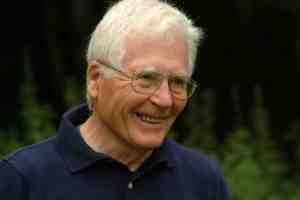
James Lovelock: “there will be a sudden shift to a new global climate … 5 or 6C warmer”

Lovelock_James credit Sandy Lovelock

Stephen Leahy interviews JAMES LOVELOCK the scientist who first proposed the Gaia Hypothesis

TORONTO, June 5 2009 (Tierramérica)

“When the first great climate disaster strikes, I hope we will all pull together just as if our nation were being invaded,” says British scientist James Lovelock in this exclusive Tierramérica interview.

Please throw something in the tip jar before reading on.
This is how I make my living.

As the world marksInternational Environment Day Friday, Lovelock argues that as the climate warms and the carbon content of the atmosphere soars, humanity is facing a far grimmer future that will be upon us sooner than any of the projections made by the Intergovernmental Panel Climate Change (IPCC).

A chemist, physician and biophysicist, Lovelock is one of the world’s foremost environmental scientists and founder of the Gaia Hypothesis, which describes the planet as a living organism, a complex system in which the components of the biosphere and atmosphere interact to regulate and sustain life.

Although his ideas often feed controversy, Lovelock has wide-ranging scientific credentials. As an inventor, he holds more than 50 patents, including the first devices for detecting the presence of ozone-depleting CFCs (chlorofluorocarbons) and pesticide residues in the environment.

He is also the author of many books. The most recent, “The Vanishing Face of Gaia: A Final Warning”, was published in April. Lovelock spoke with Tierramérica’s Stephen Leahy in Toronto.

TIERRAMÉRICA: Why are you critical of the IPCC? Continue reading