Film Exposes Slick US Industry Behind Climate Denial

Robert Kenner’s forthcoming documentary lifts the lid on the ‘professional deceivers’ manipulating US debate on climate change

OPENS MARCH 6 in US

Shot from Merchants of Doubt film.
 Merchants of Doubt looks at professionals working for the fossil fuel industry to sow doubt in the US climate change debate.    Photograph: Sony Pictures Classics

By  for the Guardian

Who remembers that climate change was a top priority early in George W Bush’s first term as US president? 

Six months later everything changed. The film shows Republican party leader John Boehner calling the idea of global warming “laughable”, said Merchants of Doubt director Robert Kenner.

Framing Climate Science as Attack on Personal Freedoms

With the 9/11 attacks on the World Trade Center occupying attention, Americans For Prosperity, a powerful, fossil-fuel lobby group founded by the billionaire Koch Brothers, launched a decade-long, multi-pronged campaign to sow doubt about the reality of climate change.Screen Shot 2015-03-01 at 5.34.47 PM

By equating the findings of climate scientists as an attack on personal freedoms, they cleverly shifted the focus away from science to political opinion. “Creating a focus point away from what is actually going on is how magicians pull off their tricks,” said Kenner who directed the Oscar-nominated documentary Food Inc.

The deception has worked well. Few Americans know 97% of scientists agree climate change is caused by human activity and is happening now.

Inspired by the 2010 book of the same name, Kenner’s film is about deception and profiles many of the charming and always smiling professional deceivers who work for the tobacco, chemical, pharmaceutical, and fossil fuel industries. The tobacco industry knowingly and successfully deceived the public for 50 years about the connection between smoking and cancer, the 1988 tobacco lawsuit settlement revealed.

In a pattern of manipulation clearly evident today in the manufactured ‘debate’ over climate change, the tobacco industry used media-friendly pseudo-experts, doctored ‘science’ studies and attacked the credibility of scientists or experts who said otherwise, Kenner said.

If you can sell tobacco you can sell anything

Peter Sparber, one the tobacco industry’s most successful deceivers, told Kenner that he could get the public to believe a garbage man knew more about science than prominent climate scientist James Hansen.

“If you can sell tobacco you can sell anything,” Sparber tells Kenner.

Selling confusion and doubt around a complex issue like climate change was far easier than selling tobacco. Nearly all of those well-paid climate misinformers have no science background and often clear ties to industry lobby groups and yet are treated as expert commentators on climate science by media. It’s not just Fox News. Serious news outlets like CNN and the New York Times are complicit by featuring misinformers in news articles and on discussion panels, he said.

The film also focuses on the many self-described “grassroots” organisations that are actually promoting specific corporate and political interests. These organisations are often aided by, and passionately supported by, ordinary citizens who believe they are fighting for personal freedoms and libertarian or conservative values.

Kenner is hoping audiences “will realise they’ve been lied to” and develop better “bullshit detectors”.

First published at the Guardian

For an Ailing Planet, the Cure Already Exists

Measure of concentration of CO2 in the atmosphere by year

By Stephen Leahy

UXBRIDGE, Canada, Jun 1, 2012 (IPS)

The planet’s climate recently reached a new milestone of 400 parts per million (ppm) of carbon dioxide in the Arctic.

The last time Earth saw similar levels of climate-heating carbon dioxide (CO2) was three million years ago during the Pliocene era, where Arctic temperatures were 10 to 14 degrees C higher and global temperatures four degrees C hotter.

Research stations in Alaska, Greenland, Norway, Iceland and even Mongolia all broke the 400 ppm barrier for the first time this spring, scientists reported in a release Thursday. A global average of 400 ppm up from the present 392 ppm is still some years off.

If today’s CO2 levels don’t decline – or worse, increase – the planet will inevitably reach those warmer temperatures, but it won’t take a thousand years. Without major cuts in fossil fuel emissions, a child born today could live in a plus-four-degree C superheated world by their late middle age, IPS previously reported. Such temperatures will make much of the planet unliveable.

In a four-degree warmer world, climate adaptation means “put your feet up and die” for many people in the world, said Chris West of the University of Oxford’s UK Climate Impacts Programme in 2009.

This week the International Energy Agency reported that the nations of the world’s CO2 emissions increased 3.2 percent in 2011 compared to 2010. This is precisely the wrong direction: emissions need to decline three percent per year to have any hope of a stable climate.

By 2050, in a world with more people, carbon emissions must be half of today’s levels.

Impossible? No. A number of different energy analyses show how it can be done. Continue reading

We Have Five Years to Stop Building Coal Plants and Gas-Powered Cars

Measurement of CO2 levels in atmosphere

By Stephen Leahy

[Authors note: One of the most difficult and important articles I’ve written in 20 years of environmental journalism. Originally published Sept 6 2014 @Vice Motherboard]


Here’s the frightening implication of a landmark study on CO2 emissions:

By 2018, no new cars, homes, schools, factories, or electrical power plants should be built anywhere in the world, ever again, unless they’re either replacements for old ones or carbon neutral. Otherwise greenhouse gas emissions will push global warming past 2˚C of temperature rise worldwide, threatening the survival of many people currently living on the planet.

Every climate expert will tell you we’re on a tight carbon budget as it is—that only so many tons of carbon dioxide (CO2) can be pumped into the atmosphere before the global climate will overheat. We’ve already warmed temperatures 0.85˚C from pre-industrial levels, and the number rises every year. While no one thinks 2˚ C is safeper se, it’s safer than going even higher and running the risk that global warming will spiral out of our control completely.

Last year, the latest Intergovernmental Panel on Climate Change (IPCC) report established a global carbon budget for the first time. It essentially stated that starting in 2014, the carbon we can afford is up to around 1,000 billion tons of CO2. In other words, our cars, factories, and power plants can only emit 1,000 billion tons (1,000 Gt, or gigatons) of CO2 into the atmosphere if we want to have a greater than 50/50 chance of keeping our climate below 2˚C of warming.

Even considering that humanity pumped 36 gigatons of CO2 into the atmosphere last year alone, 1,000 Gt still seems like a big budget. It might even seem like we have room to spare.

Maybe not.

WORLDWIDE, WE’VE BUILT MORE COAL-BURNING POWER PLANTS IN THE PAST DECADE THAN IN ANY PREVIOUS DECADE

New research shows that we may not have been paying attention to the entire CO2 emissions picture. We’ve only been counting annual emissions, and not the fact that building a new coal or gas power plant is in reality a commitment to pumping out CO2 for the lifespan of a given plant—which usually ranges from 40 to 60 years. These future emissions are known as a carbon commitment.

A new study has tallied the carbon commitments from all existing coal and gas power plants by looking at their annual CO2 emissions and current age. The study assumes an operating life of 40 years. A 38-year old coal plant will have far smaller future CO2 emissions, and thus smaller carbon commitment than one built today. The study, “Commitment accounting of CO2 emissions,” determined that most new power plants that went online in 2012 have a very large carbon commitment—19 Gt of CO2.

Building new power plants means more carbon commitments to eat into our 2˚C carbon budget. Build enough giant coal plants today, and their future emissions would tie up the entire budget, leaving no room for any other source of CO2 emissions.

Meanwhile, the rate at which new plants are built far outpaces the closure of old plants. Many US coal plants operate for longer than 40 years; the oldest is currently around 70 years.

“Worldwide, we’ve built more coal-burning power plants in the past decade than in any previous decade, and closures of old plants aren’t keeping pace with this expansion,” said study co-author Steven Davis of the University of California, Irvine.

Image: Flickr

Fossil Fuels Power Plant Carbon Commitment: 300 Gt

In the study, Davis and co-author Robert Socolow of Princeton University calculated that the existing coal and gas power plant carbon commitment turns out to be very large—more than 300 Gt.

Non-Power Plant Carbon Commitment: 400 Gt 

The reality of carbon commitment applies to any new fossil-fuel burning infrastructure, including office buildings and homes using gas heating or automobiles and planes burning jet fuel. All of these have an operating life of several or many years during which they will emit CO2 from now until they are ‘retired.’ These future emissions also count as a carbon commitment. In another upcoming study, Davis calculated the carbon commitments from other CO2 sources, including from the transport, industry, commercial and residential sectors. He estimates that as of 2013 this carbon commitment exceeded 400 Gt.

Together with the power plant commitment of 300 Gt laid out in the current study, that’s more than 700 Gt in carbon commitments on a global carbon budget of 1000 Gt. That leaves less than 300 Gt for future power plants, steel mills, cement plants, buildings, and other stuff that burns fossil fuels.

At current rates we’ll have accounted for the remainder of the budget in only five years.

Here’s how it breaks down:

Estimated Annual Emissions 2014-2018: 200 Gt

Global CO2 emissions from all sources amounted to 36 Gt in 2013. Annual emissions have been growing at a rate of 2 to 3 percent per year. Without major efforts to reduce emissions, another 200 gigatons of CO2 will be emitted between 2014 and 2018.

Estimated New Carbon Commitments 2014-2018: 100 Gt

Davis and Socolow determined that carbon commitments from new fossil fuel burning infrastructure will average at least 20 Gt per year, totaling 100 Gt over five years.

300 + 400 +200 +100 = 1,000 Gigatons of Carbon, Locked in by 2018

Unless coal and gas power plants or other major sources of CO2 are shut down before the end of their life span, the 1,000 Gt global carbon budget will be fully allocated sometime in 2018. No one will notice, because things won’t look or feel too much different than today. CO2 is akin to a slow, trans-generational poison. The climate impacts of blowing the carbon budget won’t be felt until 2030 or 2040 —and for a long time after.

WE’VE BEEN HIDING WHAT’S GOING ON FROM OURSELVES: A HIGH-CARBON FUTURE IS BEING LOCKED IN BY THE WORLD’S CAPITAL INVESTMENTS

Even the climate experts won’t notice much, because annual CO2 emissions have been the sole focus of countries and the United Nations process to address climate change said Davis.

“That’s like driving down the highway and only looking out of the side window,” Davis told me.

Politicians, business leaders, investors, planners, bureaucrats and whole lot of other people should be looking out the front window and paying attention to the hard reality of carbon commitments. If Davis and Socolow’s calculations are correct, it means no new coal or gas power plants can go online after 2018 unless they’re replacing retired plants. It means freezing the size of the global automobile fleet, and the industrial and commercial sectors, unless their energy efficiency increases. And so on.

The fact that much of our current and future infrastructure carries huge carbon commitments is blindingly obvious, but receives little attention.

Can’t solve a problem by making it worse

“If you build it, there will be emissions year after year. This should be a fundamental part of the decision to build most things,”” Davis said.

Ignoring the reality of carbon commitments means we’re investing heavily in technologies that make the problem worse, he said.

“We’ve been hiding what’s going on from ourselves: A high-carbon future is being locked in by the world’s capital investments,” said co-author Robert Socolow. Any plan or strategy to cut CO2 emissions has to give far greater prominence to those investments. Right now the data shows “we’re embracing fossil fuels more than ever,” Socolow told me.

So what can we do to begin to prepare for a jam-packed carbon budget? First, we need to stop building fossil fuel-reliant power plants.

Surprisingly, it appears the Australia is a pioneer here, despite recently rolling back its pioneering carbon tax. Thanks to wide-spread adoption of solar energy on homes and business the country’s electricity use is in steep decline. For the first time in its history, no new coal or gas power capacity will be needed to maintain supply over the next 10 years, according to the Australian Energy Market Operator. Germany too is rapidly adopting clean energy sources like wind and solar, so as to avoid building coal or nuclear power.

Next, we need to think about meeting energy demand by improving efficiency, instead of building more power generation.

Potential energy efficiency gains of 50 percent are possible across many sectors in most countries, Socolow said, and could reduce the number of fossil fuel energy power plants.

The US is the king of energy waste by most estimates. This costs Americans an estimated $130 billion a year, according to the Alliance to Save Energy. But despite the potential for huge cost and emission reductions, governments everywhere put nearly all their energy research efforts into new sources of energy like new power plants rather than helping to develop energy-efficient cars, buildingsm and appliances. It’s 2012 international study also found that improving energy efficiency provides by far the best bang-for-the-buck for energy security, improved air quality, reduced environmental and social impacts and carbon emission reductions.

However, efficiency improvements take time, and there is precious little time left to make the CO2 emissions cuts to stay below 2˚C, said Socolow.

While refusing to say a planet that’s 2˚C hotter is inevitable, he did say that all efforts to reduce emissions must be undertaken as soon as possible: “3˚C is a whole lot better than 5˚C, the current path we’re on.”

No Safe Havens in Increasingly Acid Oceans

churning-ocean-smlOil, gas and coal are contaminating the world’s oceans from top to bottom, threatening the lives of more than 800 million people

By Stephen Leahy

UXBRIDGE, Canada, Oct 15 2013 (IPS) 

Oil, gas and coal are contaminating the world’s oceans from top to bottom, threatening the lives of more than 800 million people, a new study warns Tuesday.

“It took a year to analyse and synthesise all of the studies on the impacts of climate change on ocean species,” Camilo Mora, an ecologist at University of Hawai‘i in Honolulu and lead author, told IPS.

“We are seeing greater changes, happening faster, and the effects are more imminent than previously anticipated.” — Alex Rogers of the University of Oxford

Mora is also lead author of ground-breaking climate study published in Nature last week.

“It was very sad to see all the responses were negative. We were hoping there might be some safe havens,” he said.

The study found that carbon emissions from burning fossil fuels are overheating the oceans, turning them acidic and reducing the amount of oxygen in seawater. This is happening too fast for most marine species to adapt and ocean ecosystems around the world will collapse.

By 2100, no corner of the oceans that cover 70 percent of the Earth’s surface will be untouched.

“The impacts of climate change will be felt from the ocean surface to the seafloor. It is truly scary to consider how vast these impacts will be,” said Andrew Sweetman of the International Research Institute of Stavanger, Norway, co-author of the PLOS Biology study published Oct. 15.

This ambitious study examined all the available research on how current and future carbon emissions are fundamentally altering the oceans. It then looked at how this will impact fish, corals, marine animals, plants and other organisms. Finally the 29 authors from 10 countries analysed how this will affect the 1.4 to 2.0 billion people who live near the oceans or depend on them for their food and income.

“We are making a big mess of the oceans. Climate change is having a major impact illustrating the need for urgent action to reduce emissions,” said Mora. Continue reading

2013 Carbon Emissions On Deadly Path to 5C

global-carbon-budget-2010-e1371236101998

By Stephen Leahy

WARSAW, Nov 19 2013 (IPS)

Burning of fossil fuels added a record 36 billion tonnes of CO2 to the atmosphere in 2013, locking in even more heating of the planet.

Global CO2 emissions are projected to rise 2.1 percent higher than 2012, the previous record high, according to a new report released Tuesday by the Global Carbon Project.

“Going beyond two degrees C is very risky, it’s completely unknown territory.” — Corinne Le Quéré

This increase is slightly less than the 2000-2013 average of 3.1 percent, said lead author Corinne Le Quéré of the Tyndall Centre for Climate Change Research in the UK.

“This is the second year in a row of below average emissions. Perhaps this represents cautious progress,” Le Quéré told IPS.

Still, these hard numbers demonstrate that the U.N. climate talks have failed to curb the growth in emissions. And there is little optimism that the latest talks known as COP19 here in Warsaw will change the situation even with the arrival of high-level ministers Wednesday.

Global emissions continue to be within the highest scenario of the Intergovernmental Panel on Climate Change (IPCC), she said.

“This is a five-degree C trajectory. It’s absolutely tragic for humanity to be on this pathway,” Le Quéré said.

For full story

Japan Bails Out on CO2 Emissions Target

cop presidentBy Stephen Leahy

WARSAW, Nov 15 2013 (IPS)   Japan announced Friday that it will renege on its carbon emissions pledge, likely ending any hope global warming can be kept to 2.0 degrees C.

The shocking announcement comes on the fifth day of the U.N. climate talks in Warsaw known as COP19, where more than 190 nations have agreed to a 2.0 C target and are trying to close the carbon emission gap to get there.

“It’s like a slap in the face of those suffering from the impacts of climate change such as the Philippines.” — Wael Hmaidan

Japan will increase that gap three to four percent with its new 2020 reduction target, according to the Climate Action Tracker (CAT). It amounts to a three-percent increase compared to a 1990 baseline. Japan’s 2009 Copenhagen Accord pledge was a 25 percent reduction by 2020.

“Japan is taking us in the opposite direction,” Marion Vieweg of Climate Analytics, a German climate research organisation, told IPS here in Warsaw.

“Their revision shows the bottom up approach is not working if countries can simply drop their pledges at any time,” Vieweg said.

Climate scientists have long maintained that the 2020 target for industrialised countries should be to reduce emissions 25-40 percent compared to a 1990 baseline. However, even if nations meet their current climate pledges under the Copenhagen Accord, CO2 emissions in 2020 are likely to be eight to 12 billion tonnes higher than what’s needed, according to the U.N. Environment Programme’sEmissions Gap Report 2013.

Japan, the fifth largest emitter of CO2, is just the latest to abandon its international commitments.

The Most Important Number in Human History

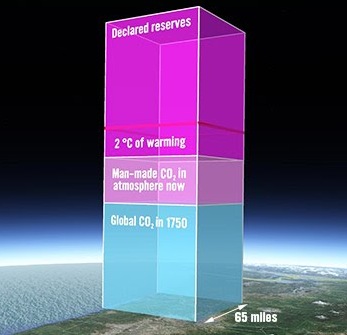
Carbon overload Carbon in atmosphere and amount in fossil fuel reserves

That number was 52 billion tonnes of CO2 in 2012

Only when this number declines will we know we’re making the shift to climate protection

By Stephen Leahy

UXBRIDGE, Canada, Dec 17 2012 (IPS) 

The most important number in history is now the annual measure of carbon emissions. That number reveals humanity’s steady billion-tonne by billion-tonne march to the edge of the carbon cliff, beyond which scientists warn lies a fateful fall to catastrophic climate change.

With the global total of climate-disrupting emissions likely to come in at around 52 gigatonnes (billion metric tonnes) this year, we’re already at the edge, according to new research.

To have a good chance of staying below two degrees C of warming, global emissions should be between 41 and 47 gigatonnes (Gt) by 2020, said Joeri Rogelj, a climate scientist at Switzerland’s Institute for Atmospheric and Climate Science in Zurich.

Only when we see the annual global emissions total decline will we know we’re making the shift to climate protection,” Rogelj told IPS.

Making the shift to a future climate with less than two degrees C of warming is doable and not that expensive if total emissions peak in the next few years and fall into the 41-47 Gt “sweet spot” by 2020, Rogelj and colleagues show in their detailed analysis published Sunday in the journal Nature Climate Change.

The study is the first to comprehensively quantify the costs and risks of emissions surpassing critical thresholds by 2020. Continue reading

Jail Before Climate-Wrecking Tar Sands, Canadians Say

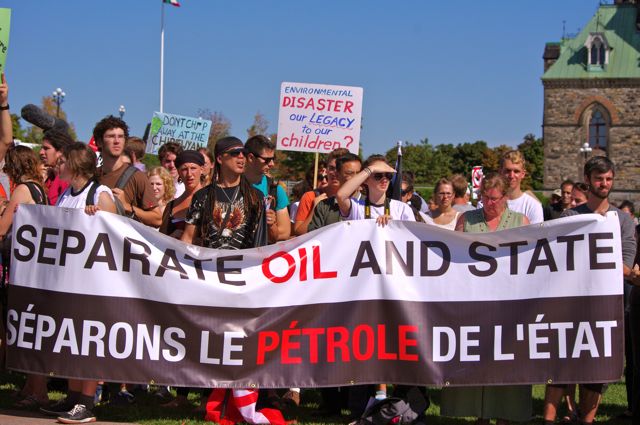
Tar sands protest Sept 2011, Ottawa Pic by R Leahy

[Repost: After the rally against Keystone XL in Washington last Sunday, a reminder that Canadians are willing to be arrested to stop growth of climate-destroying tar sands. — Stephen ]

By Stephen Leahy

OTTAWA, Sep 27, 2011 (IPS)

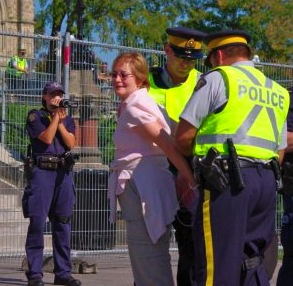
More than 200 Canadians engaged in civil disobedience, with 117 arrested in Canada’s quiet capital city on Monday. The reason? To protest the Stephen Harper right-wing government’s open support for the oil industry and expanding production in the climate-disrupting tar sands.

The normally placid and polite Canadians shouted, waved banners and demanded the closure of the multi-billion-dollar tar sands oil extraction projects in northern Alberta to protect the global climate and the health of local people and environment.

“People are here because they know that if we don’t turn away from the tar sands and fossil fuels soon it will be too late,” Peter McHugh, a spokesperson for Greenpeace Canada, told IPS.

“The tar sands are unsustainable. Canadians are willing to shift away from fossil fuels but our government isn’t,” Gabby Ackett a university student and protester, told IPS as she stood in front of a long line of police.

In what was proudly touted as “civil” civil disobedience, protesters aged 19 to 84 were arrested for using a step-stool to climb a low barrier separating them from the House of Commons, the seat of Canadian government. The police were friendly and accommodating because the organisers had promised there would be no violence.

“We live downstream and see the affects of tar sands pollution on the fish and the birds,” said George Poitras, a former chief of the Mikisew Cree First Nation in northern Alberta.

“Some our young people have rare forms of cancer,” Poitras told more than 500 protesters.

“Expanding the tar sands is not the way to go in a world struggling with climate change,” he said. Continue reading

US Climate Rally Draws “Line in the Sand” on Keystone Pipeline

The tar sands in Alberta, Canada. Credit: howlmonteal/cc by 2.0The tar sands in Alberta, Canada. Credit: howlmonteal/cc by 2.0
By Stephen Leahy

UXBRIDGE, Canada, Feb 16 2013 (IPS)

The largest climate rally in U.S. history is expected Sunday in Washington DC with the aim of pressuring President Barack Obama to reject the Keystone XL tar sands pipeline.

Activists are calling Keystone “the line in the sand” regarding dangerous climate change, prompting the Sierra Club to suspend its 120-year ban on civil disobedience. The group’s executive director, Michael Brune, was arrested in front of the White House during a small protest against Keystone on Wednesday.

“The Keystone XL pipeline is part of the carbon infrastructure that will take us to dangerous levels of climate change,” said Simon Donner, a climate scientist at the University of British Columbia.

To permit the pipeline would represent a heartbreaking acquiescence to climate change on the part of President Obama and our national leaders.

“By itself, Keystone won’t have much of an impact on the climate, but it is not happening on its own,” Donner told IPS.

Carbon emissions are increasing elsewhere, and the International Energy Agency recently warned humanity is on a dangerous path to four degrees C of warming before the end of this century. Children born today will experience this. Preventing that dire future is inconsistent with expanding tar sands production, Donner said.

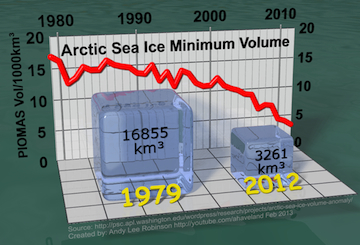
arctic-sea-ice-min-volume-comparison-1979-2012-smallA new study released this week revealed that the volume of Arctic sea ice is declining rapidly. Ice volume has fallen 80 percent since 1980, according to the latest data from European Space Agency satellite, CryoSat-2. Summers with a sea ice-free Arctic are only a few years away, scientists now agree. This will have significant and permanent impacts on weather patterns in the Northern Hemisphere.

“Keystone XL is the key to opening up the expansion of the tar sands industry,” said Jim Murphy, senior counsel with the National Wildlife Federation.

“By rejecting the Keystone XL tar sands pipeline, we can keep this toxic oil in the ground,” Murphy said in a statement.

Continue reading

Climate Inaction Is a Clear Failure of Democracy

Jersey shore Superstorm Sandy flood

Re-engineering our societies to prosper on green alternatives is only option

By Stephen Leahy

UXBRIDGE, Canada, Jan 4 2013 (IPS)

Around the world, 2012 was the year of extreme weather, when we unequivocally learned that the fossil fuel energy that powers our societies is destroying them. Accepting this reality is the biggest challenge of the brand new year.

Re-engineering our societies and lifestyles to prosper on green alternatives is the penultimate challenge of this decade.There is no more important task for all of us to engage in because climate change affects everything from food to water availability.

A number of scientific analyses have demonstrated we already have the technology to re-engineer our society to thrive on green alternative energy. The newest of these was published Wednesday in the prestigious journal Nature. It plainly states that politics is the real barrier, not technology nor cost. (It is far cheaper to act than not.)

Keeping global warming to less than two degrees C is mainly dependent on “when countries will begin to take serious action to reduce greenhouse gas emissions”, according to the study “Probabilistic cost estimates for climate change mitigation”.

Climate change has already pushed global temperatures up 0.8 degrees C, with significant consequences. No climate scientist thinks two degrees C will be “safe”. Many countries, especially least-developed countries and small island states, want the global target to be less than 1.5C of heating. Even then large portions of the Arctic and Antarctic will continue to melt raising sea levels, albeit at a slower rate.

Delay in making the shift to non-fossil fuel energy sources will be very costly. Waiting until 2020 to curb global emissions will cost twice as much compared with peaking emissions by 2015, the Nature analysis shows.

Serious action to reduce greenhouse gas emissions means 65 percent of current coal power plants will have to be shut down in the next decade or two, a previous Nature study reported by IPS shows.

Continue reading