I’ve done several articles previously about the problems of biofuels. (see below). New report out today shows Europe’s biofuel policy completely wrong headed.
European plans to promote biofuels will drive farmers to convert 69,000 square km of wild land into fields and plantations, depriving the poor of food and accelerating climate change, a report by green groups warned.
…extra biofuels that Europe will use over the next decade will generate between 81 and 167 percent more carbon dioxide than fossil fuels,
My previous articles listed below cover much of the same ground although the report is more specific reading impacts of EU policy than anything to date. — Stephen
One the world’s most acclaimed climate scientists, NASA’s James Hansen was handcuffed and arrested in front of the White House yesterday.
Hansen and hundreds more were urging the US government to end the coal industry practice of blowing off the tops of mountains to mine coal. Such practices are extremely damaging to the environment and local communities he says. Moreover to prevent catastrophic climate change coal must stay in the ground Hansen said.
Excerpts of Hansen’s speech in front of the White House:
“… government is failing to protect the future of young people, knowingly allowing and even subsidizing actions that benefit the few at the expense of the public and at the expense of all life sharing this Earth. Continue reading →
[Updated May 11 2012: At last a serious plan to phase out these subsidies will be on the table at the Rio+20 meet in June. I will be following this closely – with your help – Stephen ]
Experts say the subsidy madness must stop. With unemployment high can governments facing recession summon the will to end the fossil fuel industries’ FREE RIDE?
By Stephen Leahy
BERLIN, Jun 29, 2010 (IPS)
Every day, governments give away an estimated two billion dollars of taxpayer money to the fossil fuel industry. This unmatched largesse to a highly profitable sector by countries verging on bankruptcy or unable to feed large numbers of their own people is “complete madness”, according to many experts.
In Toronto Sunday, at the conclusion of G20 summit, countries agreed the madness must be constrained if not stopped.
“With countries committed to cutting their deficits, it is hard to ignore giving billions of real money away to the fossil fuel industry or to keep fuel prices low,” Halle said in an interview.
The two-billion-dollars-a-day public subsidy for carbon- based fuels is a very conservative estimate based on the extensive research conducted by the IISD’s Global Subsidies Initiative, said Halle. Not only do such huge subsidies undermine policies on energy efficiency, they make it impossible for alternative energy sources to compete, he said. [See also Fossil Fuel Subsidies Are 12X (more like 20X) Support for Renewables, Study Shows — Stephen]
“We can’t make the transition to low-carbon economies nor can the energy playing field be leveled without the elimination of fossil fuels. And time for that has finally come,” he said.
Others are less optimistic given the G8 and G20 track record for broken promises.
“It (the G20 commitment) fell short of vision and courage that is expected from global leaders in the light of the disastrous oil spill” in the Gulf of Mexico, said Darek Urbaniak of Friends of the Earth Europe. Urbaniak noted that BP, the company responsible for the spill, receives British and EU public subsidies.
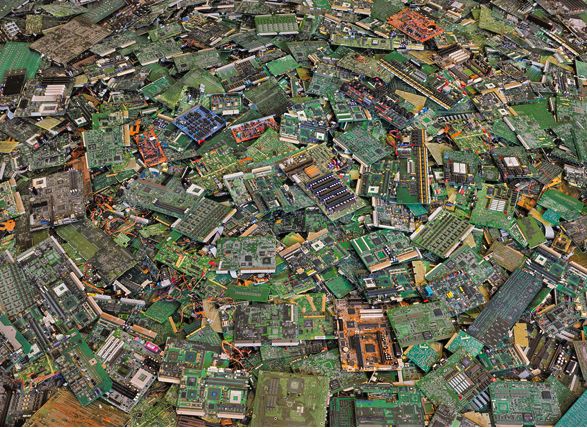
Circuit Boards – Chris Jordan “Intolerable Beauty: Portraits of American Mass Consumption http://www.chrisjordan.com
By Stephen Leahy
BERLIN, Jun 3, 2010 (IPS)
Rising global wealth spells disaster for the planet, with environmental impacts growing roughly 80 percent with a doubling of income, reports the first comprehensive study of consumption.
It adds to the mountain of evidence that the gospel of economic growth must be urgently transformed into the new gospel of resource-efficient green economies, a U.N. expert panel concluded Wednesday.
What are the biggest planetary criminals?
Fossil fuel use and agriculture, the study found. Ironically, these are also the two most heavily subsidised sectors, noted Ernst von Weizsaecker of Norwegian University of Science and Technology, and co-chair of the International Panel for Sustainable Resource Management.
“In the case of CO2, a doubling of wealth typically increases environmental pressure 60 to 80 percent, sometimes more in emerging economies,” von Weizsaecker said in an interview.
Rising affluence has also triggered a shift in diets towards meat and dairy products so that livestock now consumes much of the world’s crops and indirectly consumes 70 percent of the fresh water and produce much of the fertiliser pollution, von Weizsaecker said from Brussels.
“It is clear that a meat-based diet uses more land and fertiliser and emits far more CO2 than a vegetarian diet,” said von Weizsaecker.
The study also found that rich countries like Japan, the United States and many in the European Union are now “exporting” a large part or most of their true environmental impacts to developed countries by importing goods and food from those countries.
In a spiral of destructive co-dependency, China’s rising CO2 emissions and deforestation in Malaysia are in part a direct result of North American and European consumption of the goods made there.
“International trade clearly shows rich countries are outsourcing their impacts,” von Weizsaecker said.
“Given this fact, perhaps the current way of structuring agreements on emission reduction targets is becoming obsolete,” said Ashok Khosla, co-chair of the panel and president of the World Conservation Union (IUCN)
At the household level, it is the goods and services consumed, not the fossil fuel used for cars or homes, that accounts for most of the environmental impacts. This is despite energy and material efficiency gains over the past two decades. Efficiency has improved on a per dollar expenditure basis but people are consuming more, which drowns out any efficiency gains, said panel expert Sangwon Suh of the University of California, Santa Barbara.
“Policy makers cannot just look at direct emissions, they need to look at a full life cycle of their consumption and incorporate those impacts into their decision making,” Suh told IPS.
Representing the world’s foremost experts, the panel synthesised a comprehensive library of the most authoritative global studies to provide science-based assessments of products, materials and economic and lifestyle activities, producing the greatest harm to the planet.
“It is the first global assessment of what kind of consumption activities have the biggest impacts,” Suh said.
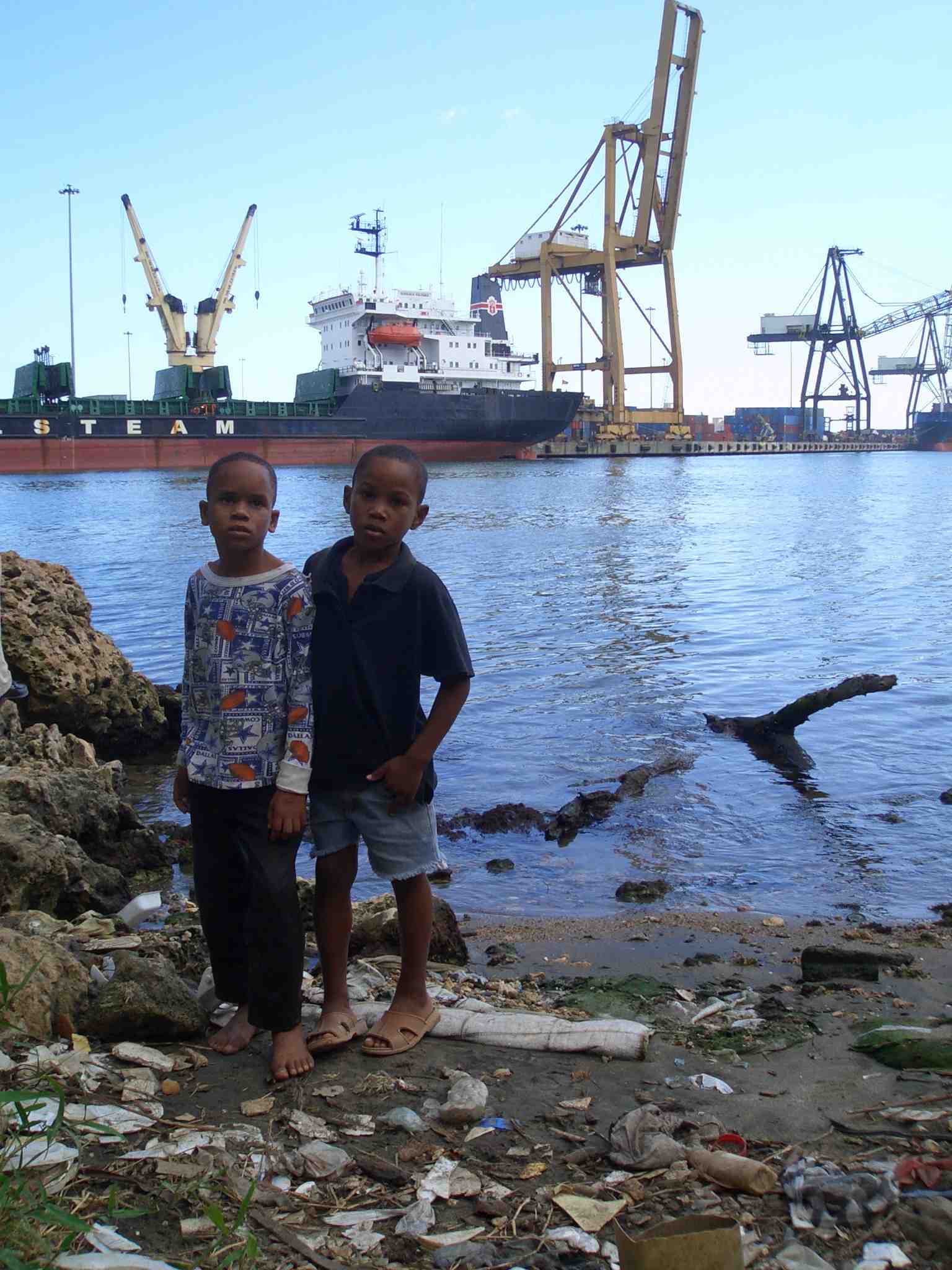
Children poisoned by lead from battery waste in Dominican Republic
Fossil fuel use and agriculture topped the list in the149-page report, followed by the heavily subsidised industrial fishing industry and the production and consumption of materials like metals and plastics. While the latter do cause severe damage locally all over the world, shockingly these are not that significant compared to global impacts of fossil fuel and agriculture, the report noted.
The purpose of this U.N. Environment Programme-sponsored study was to identify the “hot spots” in terms of environmental impacts so that policy makers can use this information to reform policies, said Suh.
“Setting priorities would seem prudent and sensible in order to fast track a low-carbon, resource-efficient green economy,” said Achim Steiner, UNEP’s executive director, which hosted the panel.
“Decoupling growth from environmental degradation is the number one challenge facing governments,” Steiner said in a statement.
However, this decoupling is not happening, the report shows. And it will not happen in the future without strong policy interventions, said von Weizsaecker.
Policy makers and economists will need to abandon their obsession with economic growth as the solution to all problems, writes Clive Hamilton in a new book “Requiem for a Species”. Growth has become a powerful symbol of success and modernity even though in reality it is neither, says Hamilton, a writer and academic at the Australian National University.
If someone is murdered, it adds about one million dollars to the GDP of rich countries when costs of police, courts, and prisons are factored in, according to his research.
“Murder is good for the economy. So is environmental destruction,” he writes.
It will take extraordinary leadership to reverse the consumption-driven society where children are bombarded with advertising – 17 billion dollars annually in the U.S. alone, Hamilton notes.
The same over-consumption brainwashing is well underway in the developing world. Shopping has become a form of recreation amongst China’s growing middle class and wealthy elite, who bought more than 12 percent of the world’s luxury goods in 2005, second only to the U.S., he says.
“Faced with the scale of the challenge, far more transformational measures need to be taken. Currently, we are fiddling – or fiddling around the edges – while Rome burns,” said Khosla.
Researchers have long proven emissions from cars, trucks, coal plants reduce air quality and affect our health. Yet another study documents the serious health impacts on all of us, specifically our heart and arteries.
The evidence is stronger than ever that pollution from industry, traffic and power generation causes strokes and heart attacks, and people should avoid breathing in smog, the American Heart Association said on Monday. Continue reading →
Like a reckless gambler, the federal government’s plan to deal with our emissions of climate-altering carbon dioxide is to put most of our money on an unproven, risky and expensive long shot called “carbon capture and sequestration,” CCS for short. In a pair of October announcements, the Alberta and federal governments committed $1.6 billion to use this untested technology to reduce carbon emissions from an Alberta coal plant and a Shell Oil tar sands upgrader. Billions more are promised.
Canada puts 600 million tonnes of carbon dioxide into the atmosphere every year. That has to stop. This generation, you and me, must determine what methods and technologies offer permanent CO2 reduction at the scale we need, and do so quickly, safely and at the lowest cost. And we must act on that knowledge as if the future of children’s lives depend it because we are shaping the world they will inherit.
We cannot rely on political and business leaders to make these decisions on their own, as will become evident.
What other ways could we reduce our CO2 emissions with $1.6 billion of public money – $200 per Canadian family of four?
Replace 3.2 million older inefficient refrigerators with high-efficiency ones, thus reducing carbon emissions by 2-3 million tonnes annually. Continue reading →
“We shouldn’t forget that a 2-degree C global mean warming would take us far beyond the natural temperature variations that life on Earth has experienced since we humans have been around.”
ANCHORAGE, Alaska, Apr 30 (IPS)
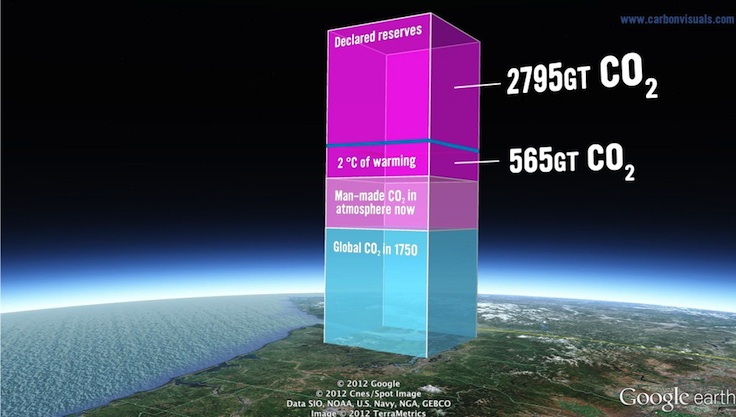
Climate scientists are calling for a phase-out of fossil fuels because humans are now pumping so much carbon dioxide (CO2) into the atmosphere that the ‘2-degree-C climate balloon’ will burst otherwise, new studies show.
That 2-degree C climate balloon has a maximum capacity of less than 1,400 gigatonnes of CO2 total emissions from the year 2000 to 2050, Malte Meinshausen and colleagues report in the current issue of Nature. The European Union and others consider a global temperature rise of more than 2 degrees C as dangerous and potentially catastrophic. Temperatures are already 0.8 C warmer than the pre-industrial period.
UPDATE Nov 2009Prospect of a four-degree Celsius rise in global average temperatures in 50 years is alarming – but not alarmist, climate scientists now believe. Four Degrees of Devastation
The reality is that global emissions for the last seven years amounted to almost 250 gigatonnes of these long-lived greenhouse gases, meaning that the current and growing rates of fossil fuel emissions would burst the balloon in about 20 years – or less. Even if emissions are held to 1,400 gigatonnes maximum for the next 40 years, there is still a 50-percent probability of exceeding 2 degrees C, said Meinshausen, lead author of the study and climate researcher at the Potsdam Institute for Climate Impact Research.
Indigenous peoples from around the world also called for a phase-out of fossil fuels at the conclusion of the first Indigenous Peoples’ Global Summit on Climate Change in Anchorage, Alaska, that concluded last week.
“That call is well-supported by the evidence in this study,” Meinshausen told IPS.
“The U.S. has led the fight to stem global hunger, now we are creating hunger,” said Lester Brown, president of the Earth Policy Institute.
Series of the latest articles that provide almost everything you need to know about why ethanol and biofuels will not reduce global warming but simply drive up fuel and food costs.
Many of those who deny that burning fossil fuels is altering the climate work diligently to confuse and delay action that would in reality benefit nearly all of us. These professional deniers and their followers can be convincing, citing well-known experts and twisting their views and findings.
So here’s a couple of common sense tips to add to your BS detection system.
Denier Tip #1:Check out suspect claims/sources with a simple Google search
100,000 repetitions or variations of a lie is still a lie. A reader recently told me global warming is really caused by variations in the sun’s activity. His proof was a “science” article from Investor’s Business Daily that said this was the conclusion of the Max Planck Institute for Solar System Research, a well-known research centre in Germany. A quick check of the Institute’s website revealed their actual conclusion: “Solar activity affects the climate but plays only a minor role in the current global warming.” See for yourself: it’s in English and still posted on their website.
Denier Tip # 2:Follow the money. Who benefits from denying climate change?
Among many others, journalist Ross Gelbspan has documented the money trail from the automotive and fossil fuel industry to various right-wing organisations and institutes in his two books, “The Heat is On” and “Boiling Point”.
Ask yourself how climate scientists benefit by concluding that humans are inadvertently changing their climate? Deniers often allege they get grants to do research on climate change. Yes they do, but they could also get grants to research water pollution or the ozone layer.
When scientists conduct research, they are simply asking questions about something and then trying to find answers. They don’t really care what the answers are. They are what they are: Humans are changing the climate.
Scientists are smart people. If they really wanted to make tonnes of money, they’d work on Wall Street, wouldn’t they?
“If we get that kind of increase it will be societal suicide”
By Stephen Leahy Nov 9 (IPS) – Today’s skyrocketing fossil fuel use will accelerate far faster in the coming decades, driving oil prices higher and virtually guaranteeing catastrophic climate change in the decades to come, energy experts say.
Emissions of greenhouse gases could increase a staggering 57 percent by 2030 if current trends continue, and with the strong growth of coal and oil energy use in India and China, the International Energy Agency (IEA) reported this week.
“If we get that kind of increase it will be societal suicide,” says Gavin Schmidt, a climate researcher at NASA Goddard Institute for Space Studies at Columbia University.











 Stephen Leahy, International Environmental Journalist