3 Reasons Why Gore Should Not Have Won Nobel Prize

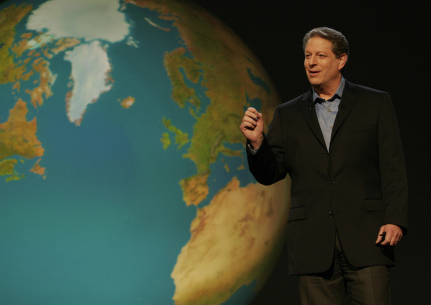
al-gore.pngThis year’s Nobel Prize for Peace went to Al Gore and the UN’s Intergovernmental Panel on Climate Change (IPCC) for their efforts to awaken the world about the risks of climate change. That’s great news but I’d have preferred to see the other candidate for the prize, Canadian Inuit Sheila Watt-Cloutier share the award with the IPCC not Gore.

Three Reasons Why Gore Should Not Have Won:

1. Watt-Cloutier has been a passionate and eloquent communicator about the fact that indigenous people of the Arctic, and indigenous peoples elsewhere, have taken the first and hardest climate change hits so far. It would be been fairer and more representative of the reality to award the prize to an indigenous person.watt-cloutier.png

2. For eight long years Al Gore was second in command of the largest greenhouse gas emitting country in the world. And yet emissions climbed and climbed even though Gore knew climate change was a real and pressing emergency. When running for President Gore barely mentioned GW and then the world had to suffer thru the other GW — George W Bush and his blind and selfish intransigence.

3. Al Gore’s GW solutions are mostly wrong. Biofuels are a bad idea and only make rich agri-corporations richer. Carbon trading markets are an equally bad idea — enshrines the rich countries’ right to pollute our common atmosphere. A moratorium on coal and a carbon tax are some of his better ideas. However, Gore fails to address the root of the problem which is an economic system based on endless growth on a tiny planet with an awful lot of people.

“People do want to do the right thing, but they just don’t realise that the Arctic is melting and they are responsible,” Watt-Cloutier told me in 2004. From Global Warming Will Decimate Arctic Peoples and also see Inuit Sue America Over Climate Change

Inuit Sue America over Climate Change

By Stephen Leahy

The Inuit people of the Arctic regions are preparing to charge the United States with human rights violations, saying that country is the leading culprit behind climate change, which threatens their way of life — and their very survival.

Originally published in Latin America Feb 15 2005 by Tierramérica

The sharp increase in temperatures in the Arctic has led to dramatic losses of sea ice and melting permafrost (the layer of ground that normally remains frozen year round), which have destroyed buildings and roads and forced relocations of entire native Inuit villages. Continue reading

Global Warming Will Decimate Arctic Peoples

By Stephen Leahy10000660_jpg.jpg

Climate change will soon make the Arctic regions of the world nearly unrecognisable, dramatically disrupting traditional Inuit and other northern native peoples’ way of life, according to a new report that has yet to be publicly released.

Originally published in September 11 2004 by the Inter Press Service

The dire predictions are just some of the findings by the Arctic Climate Impact Assessment (ACIA), an unprecedented four-year scientific investigation into the current and future impact of climate change in the region. “This assessment projects the end of the Inuit as a hunting culture,” said Sheila Watt-Cloutier, chairwoman of the group that represents about 155,000 Inuit in the Arctic regions of Canada, Russia, Greenland, and the United States.

The report predicts the depletion of summer sea ice, which will push marine mammals like polar bears, walrus and some seal species into extinction by the middle of this century, Watt-Cloutier told IPS. Continue reading

GW Dramatically Rearranging Arctic Landscape

By Stephen Leahy


Credit:micropolisnews

A lone glacier drifts in the Canadian Arctic, Aug. 14, 2007.

Oct 4 (IPS) – The hot breath of global warming has now touched some of the coldest northern regions of world, turning the frozen landscape into mush as temperatures soar 15 degrees C. above normal.

Entire hillsides, sometimes more than a kilometre long, simply let go and slid like a vast green carpet into valleys and rivers on Melville Island in Canada’s northwest Arctic region of Nunavut this summer, says Scott Lamoureux of Queens University in Canada and leader of one the of International Polar Year projects.

“The entire landscape is on the move, it was very difficult to find any slopes that were unaltered,” said Lamoureux, who led a scientific expedition to the remote and uninhabited island. Continue reading

Arctic Melts As Banks Invest Billions in Coal

By Stephen Leahy


Credit:Ed Brown

Coal-fired power plant in central Virginia, U.S.

Oct 2 (IPS) – As global warming melts the Arctic, the United States’s biggest banks are investing billions of dollars in as many as 150 new coal-fired power plants around the country.

The obvious climatic and fiscal stupidity of such investments is staggering, say environmentalists.

“What are they (the banks) thinking?” asked Leslie Lowe, energy and environment programme director at the Interfaith Centre on Corporate Responsibility.

Carbon regulations are coming, and profiting from the destruction of nature and communities is immoral in any case, Lowe told IPS at a press conference. Carbon regulations are coming, and profiting from the destruction of nature and communities is immoral in any case, Lowe told IPS at a press conference.

“It is folly to build new coal-fired plants,” she said. Continue reading

Pres. Bush: The Skunk at His Own Garden Party

By Stephen Leahy


Credit:White House Photo/Chris Greenberg

President George W. Bush addresses the Major Economies Meeting on Energy Security and Climate Change on Sep. 28, 2007.

Sep 29 (IPS) – After years of denial, the U.S. White House-sponsored summit on climate change ended Friday with President George W. Bush admitting that global warming was real and humans were responsible and asking for heads of state to join him at yet another summit next year (when his presidency ends).

It’s doubtful if anyone of consequence will attend that future gab-fest since President Bush continues to push voluntary cuts to greenhouse gas emissions when the rest of the world, including much of the business sector, has already said that approach simply doesn’t work.

“President Bush has so little credibility on climate change,” said Chris Flavin, president of the Worldwatch Institute, a U.S.-based environmental group. Continue reading

GW Desperation Drives Slightly Mad Ideas

coral-sea-oz.jpg

Climate Change: Time For Some Slightly Mad Ideas?
By Stephen Leahy

Sep 28 (IPS) – Lack of governmental action on climate change is forcing scientists to consider radical climate geo-engineering schemes such as giant vertical pipes in the ocean and growing vast blooms of plankton to try and prevent the worst from happening.

Companies backing some of these schemes hope to profit from the rising public clamour for action and politicians desperate to avoid serious reductions in greenhouse gas emissions.

“I wasn’t in favour of geo-engineering before, but we haven’t done well in reducing emissions,” said Chris Rapley, director of the Science Museum in London and former head of the British Antarctic Survey.

In fact, the global community continues on the “business as usual” path in terms of emissions of greenhouse gases (GHGs), thus increasing the chances of catastrophic climate change, Rapley, a climate change expert, told IPS.

“Just look at how incredibly quick the Arctic sea ice is melting,” he said. Continue reading

Organic Provides 3X More Food Per Acre in Poor Countries – podcast

Organic farming can yield up to three times as much food on individual farms in developing countries, as low-intensive methods on the same land—according to new findings by researchers from the University of Michigan.

This refutes the long-standing claim that organic farming methods cannot produce enough food to feed the global population.

Listen to U of Michigan Podcast and Podcast En Español

Related articles/posts:
Food Additives Make Kids Hyperactive – Organic Better?
Overweight? Hungry? Blame “Hollow Food”
Organic Agriculture Reduces Climate Change, Poverty and Hunger
The Real Cost of US Strawberries

“Climate change is like the Internet — it is never going away”

“Climate change is like the Internet — it is never going away.”
— Paul Dickinson, CEO of the Carbon Disclosure Project

Climate of Change Confronts Wall Street
By Stephen Leahy

Sep 24 (IPS) – Stockholders, investors and financial analysts are now demanding to know how climate change will affect companies’ bottom line, and a new report reveals large corporations’ risks and opportunities.

At the behest of institutional investors managing over 41 trillion dollars, several hundred large corporations voluntarily revealed how they are responding to this new reality in a report released Monday at a major event on New York’s Wall Street, where former U.S. President Bill Clinton will also speak.

“Climate change will change the way we do everything,” said Paul Dickinson, CEO of the Carbon Disclosure Project, an independent not-for-profit organisation.

“Nothing will go back to the way things were,” Dickinson told IPS.

Continue reading

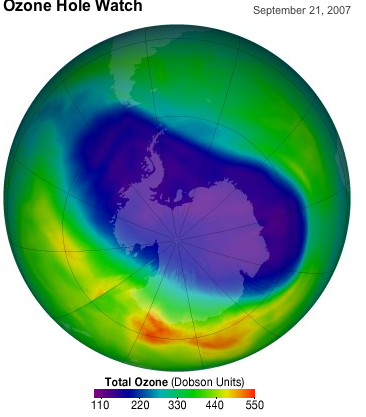
Skin Cancer Rising Despite New Ozone Deal to Cut CO2 Emissions

Ozone Deal to Cut Down CO2 Emissions

By Stephen Leahy


MONTREAL, Sep 23’07 (IPS) – More than 190 nations agreed this week to combat global warming and accelerate the healing of the ozone layer, although critics say more could have been accomplished.

The sun shone bright and warm here on Friday, the final day of the 19th Meeting of the Parties to the Montreal Protocol to protect the ozone layer. Outside, caravans of pre-school children in strollers or holding hands as they walked sported hats and long-sleeved shirts to protect their delicate skin.

It can be easy to forget that the sun was not always so dangerous, and that modern society is responsible for putting chemicals into the atmosphere that continue to destroy the ozone layer that protects all life from harmful levels of solar ultraviolet radiation.

[UPDATE: Sept 2009 — Ozone Treaty May Hold Key to Halting Climate Change;

— Ozone Hole 2009 – Bigger than North America – 24 million sq km]]

And we forget that things could have been far worse without international action in the form of the Montreal Protocol, which opened for signature 20 years ago this week.

Sadly, that action came late and was not vigorous enough for millions of people who have or will get skin cancer. Continue reading