Pollute for Free – America’s Economic Model

copyright Pembina Institute

If ever there was a project where sustainable accounting is needed, Alberta tar sands oil extraction is it.” — Mindy S. Lubber

Mindy Lubber, president of Ceres, a leading coalition of investors and environmental groups working on sustainability issues notes in this article today that the current “accounting system meant that companies were long able to “externalize” natural resource costs. In other words, they could pollute for free without paying for environmental damage and cleanups. Society and taxpayers shouldered these costs instead.”

Reform of this not-grounded-in-reality accounting and economic system is essential to move towards sustainable societies.

Canada’s oil or tar sands that supply the US with much of its oil is devastating huge swaths of pristine boreal forest, ruining wild rivers and polluting the air of the north Lubber says. For more on the environmental impacts of the biggest industrial project on the planet see Destroying Canada’s Boreal Forest for America’s Oil

Greenland on Verge of Meltdown

Copyright Alfred Wegener Institute for Polar and Marine Research Deniers Jump on NASA Gaff, While Greenland on Verge of Meltdown
By Stephen Leahy

Aug 16, 2007 (IPS) – Scientists warn that climate change tipping points are imminent, and will lead to potentially catastrophic events like a seven-metre sea level rise. Meanwhile, conservatives in the North American media are focusing on a NASA admission of a climate calculation error.

First the error.

Continue reading

Roads Lead to Deforestation in Untouched Peruvian Amazon

Recently-contacted Murunahua man, River Yurua, Peru. He was shot in the eye by loggers during first contact. © David Hill / Survival

Satellites Show Logging Decline in Peruvian Amazon
By Stephen Leahy

Deforestation in the Peruvian Amazon, intense in zones near roads and mining operations, has had little impact in protected forests, say researchers.

Aug 13 (Tierramérica).- Rainforest conservation policies are reducing the rate of deforestation in the Peruvian Amazon, but roads are unquestionably the drivers of change, new satellite data reveal.

Although Brazil’s Amazon forests draw the most international attention, Peru’s 661,000 square kilometers of rainforests are recognized as a unique and important ecosystem.

However, the impacts of human activities throughout the region have been poorly understood, until a study published Aug. 10 in the journal Science.

“Peru’s forest reserves and conservation areas appear to be working well,” said Greg Asner, director of the Carnegie Airborne Observatory, at Stanford University in California.

Continue reading

Elections Pushed Iraq Into Current Chaos as Predicted

Not my usual beat but with the Iraq tragedy worsening each day it may be useful to recall that experts said in 2004 before the much-heralded Iraq elections that voting would make the situation worse. Sadly they were all too correct.

“It is one of the perverse realities of post-conflict elections that this linchpin of the democratic process can also be its undoing,” Benjamin Reilly, a political scientist at Australian National University — 2004.

UN Study: Premature Vote May Prove Disastrous
by Stephen Leahy

(Originally published in Oct 2004)

Oct 19 (IPS) Elections in Afghanistan and Iraq may prove disastrous by increasing violence and extremism, according to studies of other post-conflict societies included in a book released Monday by United Nations University Press.

If elections in volatile situations are ill-timed or poorly designed, they risk producing the direct opposite of the intended outcome, fueling chaos and reversing progress toward democracy, adds the volume, The UN Role in Promoting Democracy.

“It is one of the perverse realities of post-conflict elections that this linchpin of the democratic process can also be its undoing,” Benjamin Reilly, a political scientist at Australian National University, said in a news release announcing the book.

Continue reading

Atlantic Bluefin Tuna Going Way of Northern Cod

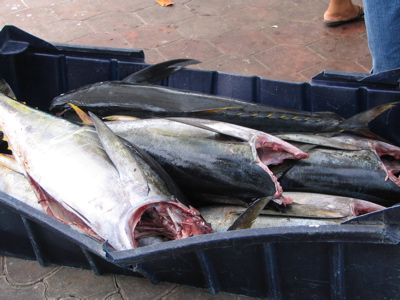
tuna-hall-sml.jpgAtlantic Bluefin Tuna Going Way of Northern Cod
By Stephen Leahy

Aug 6 (IPS) – Fishing wiped out Atlantic Bluefin tuna stocks in Northern Europe 50 years ago, according to a new study, while ongoing pressure on the remaining stocks is pushing the entire species to the edge of extinction.

Every summer in the early 1900s, Northern European waters from Holland to northern Norway teemed with Atlantic Bluefin tuna, some three metres long and weighing 700 kilogrammes, according to historical fishing records. Few could catch the powerful, fast-swimming fish until the 1930s and 1940s when bigger, faster boats with better catch gear were designed.

“The Bluefin population crashed in the 1960s and more than 40 years later it still hasn’t recovered,” said Brian MacKenzie of the Technical University of Denmark, who led the study to be published in the journal Fisheries Research.yellow-fin-tua-galapagos.jpg

“You simply don’t see bluefins in these waters any more,” MacKenzie told IPS.

There is a clear parallel to the more recent collapse of once abundant Northern Cod stocks. Also fished into near extinction on the other side of the Atlantic, the Cod have not recovered despite a no-fishing ban for the past 15 years.

“I’m afraid what happened to the Bluefin is similar to what happened to the Northern Cod,” he said.

Continue reading

Who Owns the Arctic?

arctic-oil-rig-on-ice.pngWith Russia planting its flag 14,000 feet under the North Pole yesterday, oil and gas exploration and conflict over territorial rights in the vast Arctic ocean basin is just beginning.

“The Arctic is one of the last frontiers, representing about 25 percent of the last unexplored potential oil and gas reserves in the world,” says Michael Byers, Canada research chair in Global Politics and International Law at the University of British Columbia

Sovereignty Claims Revived in the Arctic
By Stephen Leahy

(Originally published in 2006)

TORONTO, Apr 22 (Tierramérica) – An expedition is under way to help Canada and Denmark prove their sovereignty over certain areas of this frozen region, and its potential sources of petroleum and natural gas.

Canada and Denmark launched a joint expedition in early April to map the floor of the Arctic Ocean and help the two countries prove their claims of sovereignty over areas potentially rich in petroleum and natural gas.

Continue reading

Drowning Country: Tuvalu Symbol of Catastrophe and Hope

Tiny Tuvalu Fights for Its Literal Survival
By Stephen Leahy


Credit:NASA

Funafuti atoll seen from 125 miles above the Eart

VIENNA, Jul 27 (IPS/IFEJ) – The second smallest nation on Earth hopes to turn itself into an example of sustainable development that others can emulate.

But the South Pacific island nation of Tuvalu and its 10,500 people may only have 50 years or less to set that example before it is swept away by rising sea levels due to climate change.

“Construction of the first ever biogas digestor on a coral island is complete,” said Gilliane Le Gallic, president of Alofa Tuvalu, a Paris-based group that is working with the local Tuvaluan government.

Located on a small islet near Tuvalu’s capital of Funafuti, the biogas digester uses manure from about 60 pigs to produce gas for cooking stoves. More importantly, more than 40 Tuvaluans have been trained at the newly opened Tuvalu National Training Centre on renewable energy.

“We are trying to create simple, workable models of sustainable development that can be reproduced by others elsewhere,” Le Gallic, a documentary filmmaker, told IPS from Paris.

Continue reading

Overweight? Hungry? Blame “Hollow Food”

New Studies Back Benefits of Organic Diet: Conventional agriculture produces “hollow food”, with low levels of nutrients and vitamins

wheat harvest sml

By Stephen Leahy

TORONTO, Canada, Mar 4, 2006 (Tierramérica)

(Originally published in 2006, two authoritative 2007 studies with similar findings are referenced at the end)

Organic foods protect children from the toxins in pesticides, while foods grown using modern, intensive agricultural techniques contain fewer nutrients and minerals than they did 60 years ago, according to two new scientific studies.

A U.S. research team from Emory University in Atlanta analysed urine samples from children ages three to 11 who ate only organic foods and found that they contained virtually no metabolites of two common pesticides, malathion and chlorpyrifos. However, once the children returned to eating conventionally grown foods, concentrations of these pesticide metabolites quickly climbed as high as 263 parts per billion, says the study published Feb. 21 (2006).

Organic crops are grown without the chemical pesticides and fertilisers that are common in intensive agriculture.There was a “dramatic and immediate protective effect” against the pesticides while consuming organically grown foods, said Chensheng Lu, an assistant professor at the Rollins School of Public Health at Emory University.

These findings, in addition to the results of another study published in Britain earlier this month, have fueled the debate about the benefits of organically grown food as compared to conventional, mass-produced foods, involving academics, food and agro-industry executives and activists in the global arena.

Continue reading

Carbon Project Endangers the Galápagos

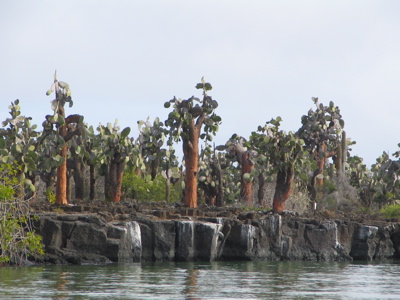
img_0235.jpg


By Stephen Leahy

A company is preparing to enrich seawater with iron in order to promote phytoplankton growth and the absorption of carbon from the atmosphere near the environmentally-protected Galápagos Islands.

PUERTO AYORA, Galápagos, Ecuador, Jul 9 ’07 (Tierramérica).- Later this month a U.S. company, Planktos Inc., plans to dump 100 tons of iron dust into the ocean near Ecuador’s Galápagos Islands, despite opposition from environmental groups and marine scientists.This will be the first-ever commercial effort to reduce carbon dioxide in the atmosphere, one of the main gases blamed for climate change, by using iron particles to create a 10,000-square-kilometer “plankton bloom”.

Planktos says the extra volume of these small, floating organisms will absorb large amounts of CO2 from the atmosphere and take it deep into the sea. And this method may be the fastest and most powerful tool to battle climate change.

img_0508.jpg

“The currents will likely bring the bloom into the [Galápagos] Marine Reserve,” covering 133,000 sq. km, the world’s third largest marine reserve, says Washington Tapia, director of the Galápagos National Park, which includes the reserve. Continue reading