Ocean Acidification Leaves Mollusks Naked and Confused

By Stephen Leahy

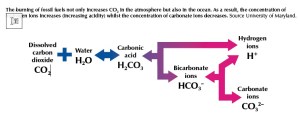
When the carbon dioxide absorbed by the oceans dissolves in seawater, carbonic acid is formed and calcium carbonate, vital for the formation of the skeletons and shells of many marine organisms, becomes scarcer.

MONTEREY, California, Oct 2 2012 (IPS) –

Climate change will ruin Chilean sea snails’ ability to sniff out and avoid their archenemy, a predatory crab, according to Chilean scientists who presented their findings at an international science symposium here.

Researchers from Australia also revealed that as the oceans become more and more acidic, some fish become hyperactive and confused, and move towards their predators instead of trying to escape.

“The conditions in oceans are changing 100 times faster than at any time in the past,” said Jean-Pierre Gattuso, a marine biologist with CNRS-INSU and the Laboratoire d’Océanographie de Villefranche in France.

Climate change is making oceans warmer and more acidic. “We are beginning to understand what will happen. I think we can expect the worst,” Gattuso told Tierramérica*.

via IPS – Ocean Acidification Leaves Mollusks Naked and Confused | Inter Press Service.

Connecting dots: extreme weather to oil, gas, coal

Stephen's avatarStephen Leahy, International Environmental Journalist

+15,000 temperature records already broken in the US this year 

By Stephen Leahy

UXBRIDGE, Canada, May 4, 2012 (IPS)

What are you doing on Saturday? Peter Nix, a retiree, will be standing on a railway track on Canada’s west coast blocking a coal train destined to ship U.S. and Canadian coal to Asia.

Nix will be joined by dozens of people near White Rock, British Columbia on May 5. They will be in good company as tens of thousands of people around the world participate in global day of action to “connect the dots” between climate change and extreme weather.

“There will be at least 1,200 actions in more than 100 countries,” says Jamie Henn, communications director for 350.org, a U.S.-based environmental group.

Please throw something in the tip jar before reading on. This is how I make my living.
There’s been a general perception that climate change is…

View original post 823 more words

Am updating this with latest science from a major conference this week in California. — Stephen

Stephen's avatarStephen Leahy, International Environmental Journalist

Oceans home to 80% of all life — plankton provide 50 percent of the oxygen we breathe

By Stephen Leahy

DURBAN, South Africa, Dec 3 (IPS)

The world’s oceans are becoming hot, sour and breathless – threatening a vital source of food for a billion people mainly in the developing world experts warned today at a special Oceans Day event at the UN climate negotiation.

Oceans are home 80 percent of all life on the planet and emissions from fossil fuels are turning them increasingly acidic, raising water temperatures and reducing the amount of oxygen in some regions said oceanographer Carol Turley from Plymouth Marine Laboratory in the UK.

“We don’t know what all the consequences will be. We suspect the combination of all three will be far worse than one alone,” Turley told IPS in an interview on the sidelines of climate treaty negotiations known as COP 17.

It…

View original post 637 more words

Given the record shattering sea ice melt along with some new science we are well into a full on climate emergency. Everyone needs to be shouting FIRE! — Stephen

Stephen's avatarStephen Leahy, International Environmental Journalist

By Stephen Leahy

UXBRIDGE, Canada, May 25, 2012 (IPS)

Climate-heating carbon emissions set a record high in 2011, in a 3.2 percent increase over the previous year, the International Energy Agency reported this week. The main reason for this dangerous increase is that governments are failing to implement policies to prevent catastrophic increases of global temperatures.

A new report released on the last days of international climate talks in Bonn, Germany this week reveals that the planet is heading to a temperature rise of at least 3.5 degrees Celsius, and likely more, according to the Climate Action Tracker (CAT), despite an international agreement to keep global temperature rise below two degrees Celsius.

Not only are pledges inadequate, but countries are unable to fulfill even those pledges, a new CAT analysis shows. CAT is a joint project of Dutch energy consulting organisation Ecofys, Germany’s Climate Analytics, and the…

View original post 655 more words

The melting Arctic sea ice is the alarm bell for our climate and dangerous threat as well. — Stephen

Stephen's avatarStephen Leahy, International Environmental Journalist

2 degrees C of warming could spark runaway global warming

By Stephen Leahy

UXBRIDGE, Canada, Sep 20, 2010 (IPS)

The carbon dioxide emissions from burning fossil fuels have melted the Arctic sea ice to its lowest volume since before the rise of human civilisation, dangerously upsetting the energy balance of the entire planet, climate scientists are reporting.

“The Arctic sea ice has reached its four lowest summer extents (area covered) in the last four years,” said Mark Serreze, director of the National Snow and Ice Data Center in the U.S. city of Boulder, Colorado.

The volume – extent and thickness – of ice left in the Arctic likely reached the lowest ever level this month, Serreze told IPS.

“I stand by my previous statements that the Arctic summer sea ice cover is in a death spiral. It’s not going to recover,” he said.

Is this article of interest? It exists…

View original post 986 more words

This is an analysis piece from 2011. I will be interviewing experts around the world for a new article on this year’s record breaking melt of Arctic ice. — Stephen

Stephen's avatarStephen Leahy, International Environmental Journalist

Rapidly warming planet biggest threat to all nations

Military budget more than enough to convert USA to 100% renewable energy

Analysis by Stephen Leahy

UXBRIDGE, Canada, Sep 15, 2011 (IPS)

All the analysis and commentary about safety and security on the tenth anniversary of 9/11 ignored by far the biggest ongoing threat to global security: climate change.

Just days before Sunday’s commemoration of the attacks, German scientists pointed to yet another smoking gun of climate change: the Arctic sea ice reached a new historic minimum ice extent.

The rapidity with which the planet is losing its northern ice cap continues to astonish experts. The defrosting northern pole is one of the prime drivers of Earth’s climate system and is changing global weather patterns in unpredictable ways.

The Arctic ice melt is also accelerating the rate of climate change beyond what humanity is doing with every barrel of oil, tonne of…

View original post 843 more words

Global Temperatures Rising on a Devastating Trajectory

Global temperatures are only 0.7C warmer — on pace for +4C!

By Stephen Leahy

UXBRIDGE, Canada, May 25, 2012 (IPS)

Climate-heating carbon emissions set a record high in 2011, in a 3.2 percent increase over the previous year, the International Energy Agency reported this week. The main reason for this dangerous increase is that governments are failing to implement policies to prevent catastrophic increases of global temperatures.

A new report released on the last days of international climate talks in Bonn, Germany this week reveals that the planet is heading to a temperature rise of at least 3.5 degrees Celsius, and likely more, according to the Climate Action Tracker (CAT), despite an international agreement to keep global temperature rise below two degrees Celsius.

Not only are pledges inadequate, but countries are unable to fulfill even those pledges, a new CAT analysis shows. CAT is a joint project of Dutch energy consulting organisation Ecofys, Germany’s Climate Analytics, and the Potsdam Institute for Climate Impact Research.

“When we compared the emission reduction pledges of countries like Brazil, Mexico and the U.S., we found they did not have the policies in place to meet those pledges,” said Niklas Höhne, director of energy and climate policy at Ecofys.

Höhne told IPS that they looked only at the policies of a few countries, but no country’s policies were enough to meet their targets. Continue reading

There will be 3x more forest fires with global warming and that’s conservative estimate say fire scientists.

Stephen's avatarStephen Leahy, International Environmental Journalist

“In a warmer world, there will be more fire”

Fires already burn an area larger than India every year.

By Stephen Leahy

VANCOUVER, Feb 29, 2012 (IPS)

Rising temperatures are drying out northern forests and peatlands, producing bigger and more intense fires. And this will only get much worse as the planet heats up from the use of ever larger amounts of fossil fuels, scientists warned last week at the end of the major science meeting in Vancouver.

“In a warmer world, there will be more fire. That’s a virtual certainty,” said Mike Flannigan, a forest researcher at the University of Alberta, Canada.

“I’d say a doubling or even tripling of fire events is a conservative estimate,” Flannigan told IPS.

While Flannigan’s research reveals forest fire risk may triple in future, a similar increase in peat fires will be far more dangerous. There are millions of square kilometres of tundra…

View original post 780 more words

Common Pollutant as Bad as PCBs?

“They’re crumbling out of couches…”

Blast from the past:  my previously published article on topic that’s back on front pages – Stephen

By Stephen Leahy

Wired News May 22 2004

Scientists reported this week that gull eggs in the Great Lakes region contain rising levels of a contaminant that could be as dangerous as the PCBs banned in the 1970s.

The contaminant, called polybrominated diphenyl ethers, or PBDEs, is used mainly as a flame retardant in upholstered furniture, computers, TVs, carpets and drapes.

While concentrations of the chemical have been shooting upward, doubling approximately every three years since the early 1980s, scientists have yet to investigate the environmental risks the substance poses.

Ross Norstrom, an adjunct chemistry professor at Carleton University in Ottawa, told the Toronto Globe and Mail that, “There is no reason to believe that these things will be any different than the PCBs.”

High levels of PBDEs are also being found in household dust, two new studies report this week. “PBDEs are everywhere,” said Bill Walker of the Environmental Working Group, a nonprofit research group in Washington, D.C., that conducted one of the studies.

“They’re crumbling out of couches and migrating out of plastics and TVs and getting into people’s blood and women’s breast milk,” Walker said in an interview. PBDEs are also being detected in just about every animal and fish around the world.

Lab research on animals shows PBDEs disrupt thyroid hormones, which can impact the developing brain and have other harmful effects. Newborn mice exposed to PBDEs have learning and motor-skill problems, and at least one form of the chemical is carcinogenic.

European countries have banned two of the three main forms of PBDEs, and U.S. manufacturers are also taking them off the market by year’s end. New research shows that the most heavily used remaining form, called “deca,” breaks down into one of the more toxic forms and ought to be banned as well, Walker said.

Many computer and electronics manufacturers such as IBM, Apple Computer and Toshiba are ahead of the curve and eliminating PBDEs from their products. “It also makes good economic sense because other countries are banning them too,” said Walker.

New Projects Dispel Myths and Spread the Truth About Vaccines

By Stephen Leahy

UXBRIDGE, Canada, May 3, 2012 (IPS)

In northern Pakistan, one in ten children dies before the age of five from diseases such as polio, measles or hepatitis, despite the availability of vaccines. And while health workers feared visiting this region, which includes the mountainous Swat district controlled by the Taliban until 2009, local people also fear the potentially life-saving vaccines.

“Some local imams (religious leaders) have been preaching that vaccines are an attempt by the U.S. government to sterilise children,” said Erfaan Hussein Babak, director of The Awakening project, which aims to promote vaccinations in the Swat district.

“The child mortality rate from preventable diseases is distressingly high,” Babak told IPS by phone from the region.

Some people in the region understand that vaccines are safe, but overall, there is little demand by parents for vaccinations, he said. To counter certain negative perceptions, The Awakening project is working to promote child vaccination by establishing village health committees, school clubs and radio programs.

The project is being funded by the Canada-based Sandra Rotman Centre as one of five projects awarded 10,000 U.S. dollars to educate populations in developing countries about the use of vaccines and immunisation to prevent diseases.

Combating myth

By 2004, polio had nearly been eradicated in Pakistan. However, the disease has seen a resurgence in the northern areas, in part due to the mistaken belief that the oral vaccine could render children impotent or sterile.  Continue reading