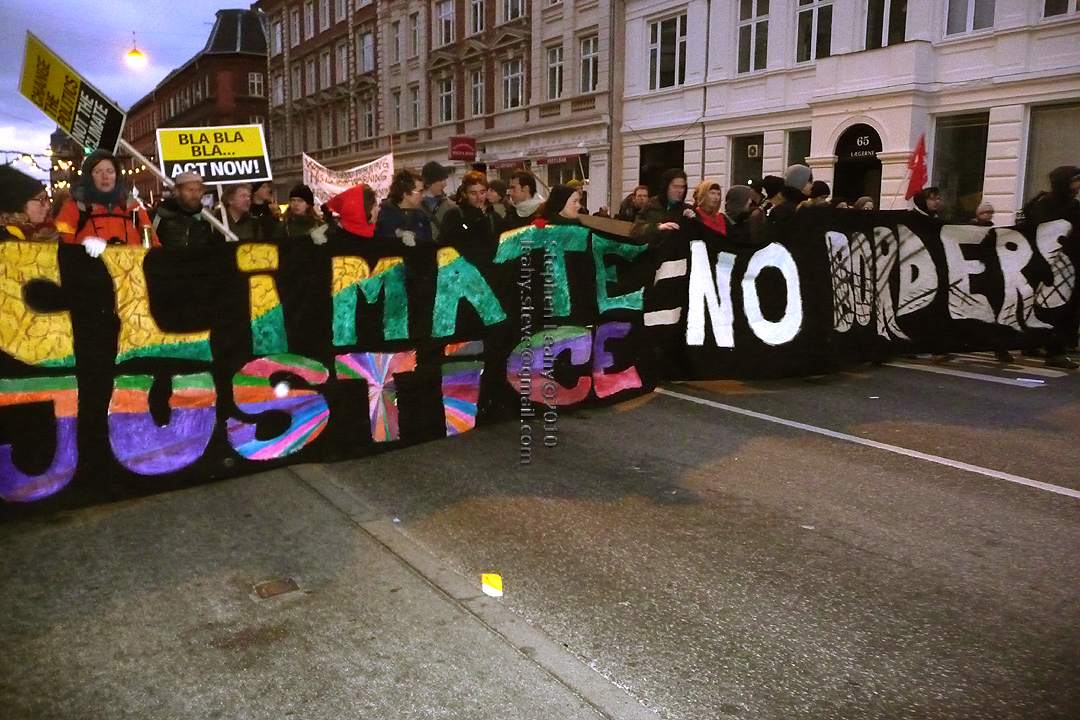
Bill McKibben is a U.S. journalist, writer and environmentalist and the founder of 350.org. Credit: Stephen Leahy
Stephen Leahy
COPENHAGEN (IPS/TerraViva) Dec 2009
Bill McKibben is a U.S. writer, environmentalist and the founder of 350.org, an international climate campaign. His first book, “The End of Nature”, was published in 1989 and is regarded as the first book written for a general audience about climate change.
350.org is credited with organising the most widespread political action in history when more than 5,200 public demonstrations were held on Oct. 24 in 181 countries. The organisation’s goal is to raise public awareness about the dangers of climate change and the need to return carbon concentrations in the atmosphere to 350 parts per million (ppm). Currently, concentrations are 387 ppm and increasing at 2.0 to 3.0 ppm per year.
Recent science suggests that a maximum of 350 ppm may be what is needed to keep overall global temperatures below 2.0 degrees C.
TERRAVIVA: Why are you here?
BILL MCKIBBEN: I wrote a book on climate change 20 years ago and you could say I’m just following the trail to its end. We’ve also brought 350 young people from all over the world to make sure negotiators hear their voice and insert a little reality into an unreal situation. Continue reading →
Noam Chomsky gets it exactly right in my experience when he says that a large minority of scientists are terrified that climate change may be much worse than anyone wants to admit. — Stephen
“This government is doing nothing on climate but they always make sure to sound like they’re doing something to fool Canadians.” — John Bennett, Sierra Club of Canada
By Stephen Leahy
UXBRIDGE, Canada, Mar 16, 2010 (IPS)
Canada’s climate researchers are being muzzled, their funding slashed, research stations closed, findings ignored and advice on the critical issue of the century unsought by Prime Minister Stephen Harper’s government, according … Read More
Last year’s cold and snowy winter directly connected to warmer Arctic new research reveals
By Stephen Leahy
OSLO, 15 June 2010 (IPS)
Last winter’s big snowfall and cold temperatures in the eastern United States and Europe were likely caused by the loss of Arctic sea ice, researchers concluded at the International Polar Year Oslo Science Conference in Norway in June.
Climate change has warmed the entire Arctic region, melting 2.5 million square kilometres of sea ice, and that, paradoxically, is producing colder and snowier winters for Europe, Asia and parts of North America.
“The exceptional cold and snowy winter of 2009-2010 in Europe, eastern Asia and eastern North America is connected to unique physical processes in the Arctic,” said James Overland of the NOAA/Pacific Marine Environmental Laboratory in the United States.
“In future, cold and snowy winters will be the rule rather than the exception” in these regions, Overland told IPS.
[[UPDATE Dec 29 2010 – Winter of 2010-11 appears to follow same pattern, see new post with northern hemisphere temp map for 20 Dec: Arctic Hothouse Turns Europe into an Icebox]]
Scientists have been surprised by the rapid warming of the Arctic, where annual temperatures have increased two to three times faster than the global average. In one part of the Arctic, over the Barents and Karas Seas north of Scandinavia, average annual temperatures are now 10 degrees C higher than they were in 1990.
Overland explains the warming of the Arctic as the result of a combination of climate change, natural variability, loss of sea ice reflectivity, ocean heat storage and changing wind patterns, which has disrupted the stability of the Arctic climate system. In just 30 years, all that extra heat has shrunk the Arctic’s thick blanket of ice by 2.5 million square kilometres – an area equivalent to more than one quarter the size of the continental U.S.
The changes in the Arctic are now irreversible, he said. Continue reading →
Ice-free summer in the Arctic is just a matter of time – mostly likely within the next 5 years. Here’s a “six-pack” of my recent articles on how global warming is transforming the Arctic:
Things Happen Much Faster in the Arctic — “Things are happening much faster in the Arctic. I think it will be summer ice-free by 2015,” said David Barber, an Arctic climatologist at the University of Manitoba.
Arctic Is the Canary in the Coalmine — The Arctic is “ground zero” for climate change, with temperatures rising far faster than anywhere else on the planet.
Arctic Oil and Gas Rush Alarms Scientists— As greenhouse gas pollution destroys Arctic ecosystems, countries like Canada are spending millions not to halt the destruction but to exploit it.
Oil vs Polar Bears in Alaska — A coalition of environmental groups sued the George W. Bush administration Monday for delaying a decision to protect polar bears threatened with extinction
Polar Bears’ Future Bleak in Melting Arctic — “Without taking serious and urgent action to stabilize the climate, there is no future for polar bears” says Andrew Derocher, Chair of the World Conservation Union (IUCN), Polar Bear Specialist Group.
…the truth about the “big lie” that burning wood for energy is carbon- neutral
By Stephen Leahy
BERLIN, Jun 7, 2010 (IPS)
Europe seems hell-bent on burning the world’s forests for bioenergy, even as it offers billions of euros to save them, critics say.
The dirty secret of Europe’s vaunted green energy revolution is the fact that 68.5 percent of its renewable energy portfolio comes from biofuels and burning wood for energy, according to a report released in Brussels last week. Modern technologies like wind and solar get all the press, but burning wood is well, prehistoric.
“We estimate at least 27 million tonnes of wood biomass will be needed annually to supply planned power stations in the UK (United Kingdom) alone,” said Almuth Ernsting from Biofuelwatch, a British NGO focused on bioenergy issues.
In a story broken by IPS last fall, at least one million hectares of forest annually will be needed to feed the dozens of planned wood-fired power plants in Britain alone. The Netherlands is already burning one million tonnes of wood. Germany is up 23 million cubic meters (16.5 million tonnes) – mostly imported – and plans to double this figure by 2020, said the report co-published with the Global Justice Ecology Project, “Wood Based Bioenergy: The Green Lie”.
It will take lot of us – probably in the streets” to make politicians face the truth, says climate scientist James Hansen.
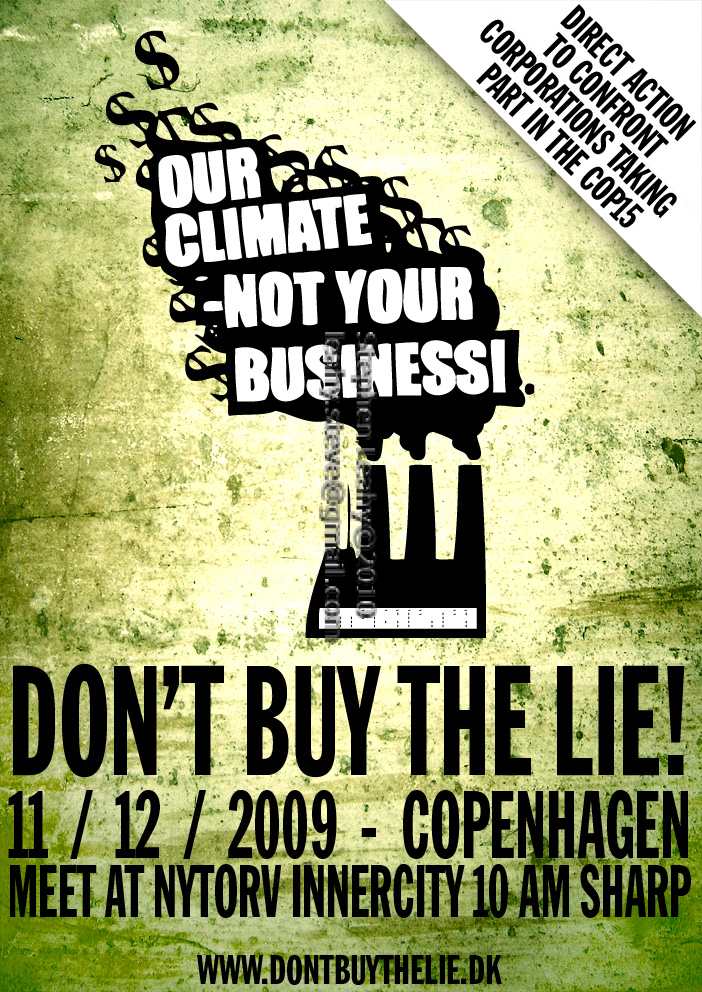
[Dangerous climate change is already upon us say some of the best scientists we have. But political leaders — and most of the public — don’t get it. This is an attempt to close the chasm between climate reality and climate denial fantasy. I wrote this at the end of the Copenhagen Climate meetings last December thanks in part to financial contributions from readers that allowed me to do the research and interviews. — Stephen]
“Our leaders do not get the scale of the problem or the rapidity of the changes.” — Andrew Weaver, climatologist at Canada’s University of British Columbia
The roof of our house is on fire but our leaders, our economic system and we ourselves are ignoring the alarms and continuing to add more fuel. There are no exit doors in our house; there is nowhere else to go.
Dangerous climate change is already here.
The two-week climate summit in Copenhagen came to an end with disappointing results and details that are still vague.
A ”Copenhagen Accord” was agreed by the US, China, South Africa and India by Friday night. It was unclear which other countries were willing to support it.
But coral reefs are dying, the Arctic is melting and rising sea levels threaten the homes of millions. And we’re on our way to a planet-transforming four-degree C rise in global average temperatures in as soon as 50 years.
Future generations could face an utterly transformed planet, where large areas will be seven to 14 degrees C warmer, making them uninhabitable. In this world-on-fire, the one to two metre sea level rise by 2100 will leave hundreds of millions homeless, according to the latest science presented at the “4 Degrees and Beyond, International Climate Science Conference” at the University of Oxford in September.
That’s the science-based, slap-in-the-face reality as the Copenhagen climate talks fizzle out here with little progress Friday.
“Our leaders do not get the scale of the problem or the rapidity of the changes. They don’t get that it must be dealt with now,” said Andrew Weaver, a climatologist at Canada’s University of British Columbia and lead author of the Intergovernmental Panel on Climate Change (IPCC) reports. Continue reading →
Two guys were sitting in a bar one evening. The first one says: “Climate change is a complete hoax you know. There’s lots information on the internet proving that.”
“No it’s not” the second guy replies. “I’ve talked to dozens and dozens of climate scientists around the world and read hundreds of reports and studies.”
The first guy responds saying: “All my friends agree with me. This global warming thing was just scam to make money for Al Gore.”
“But I’ve seen the vanishing glaciers, melting Arctic ice, rising temperatures and sea levels and extreme weather events with my own eyes,” says the second.
The first guy, pauses for a few seconds and says: “Well, I guess you’re entitled to your opinion. So let’s just say the jury is still out on global warming.”
The two fall silent for awhile. Finally the second asks: “Let’s say I’m driving you home and it’s foggy out. You tell me to slow down a bit because there’s a sharp curve in the road coming up. Now I’ve never been on this road before and could acknowledge you might know the road well but instead of slowing down I say: ‘you’re entitled to your opinion, but the road looks straight enough to me’ and then step on the gas.”
The first guy gets up and puts on his coat saying: “You’d have to be crazy not to slow down just in case. I don’t think we’re talking about the same thing now.”
“But we are,” says the second as the first guy walks out the door.
Even if the world’s best scientists are wrong about climate change taking action now will create new jobs, save money, clean the air and water, improve energy efficiency, boost the health of our children, reduce our dependency on big oil companies, create more sustainable communities and many more benefits to all.
So you have to wonder why people oppose this.
And should 30 years of climate research done in dozens of countries be correct, the “bonus” in taking action is keeping rising temperatures to no more than 2 degrees C hopefully ensuring our children and grandchildren have a reasonable climate system to live with.
My wish for the new decade is that common sense will come back in fashion.
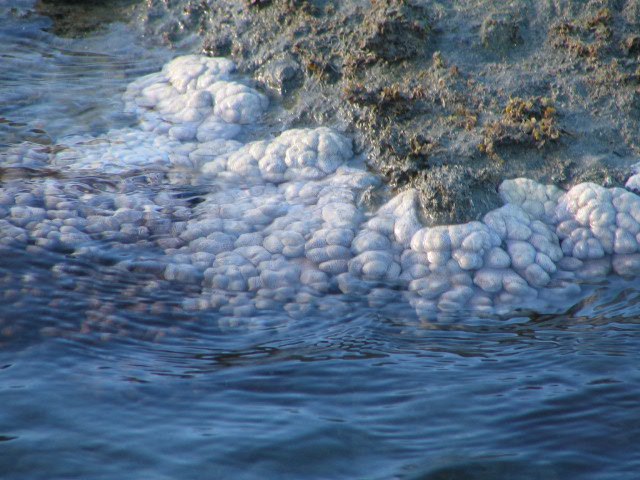
Bleached coastal corals. Bantry Bay, Australia. R Leahy 2006
[2°C is a death sentence for corals scientists agree due to ocean acidification and bleaching resulting from emissions of carbon dioxide into the atmosphere. However the developed nations of the world have set 2 degrees C as the climate stabilization target not that any of them have figured out how to reach this target. It is as if the oceans don’t matter. This reflects a fundamental ignorance about life on Earth, an assumption that we can lose or seriously damage entire ecosystems without suffering any consequences.
This story shows we need to get serious about tackling emission reductions (below 2C) and preserving anything that sequesters or traps carbon because these will be tremendously valuable in a climate-changed world . — Steve
By Stephen Leahy*
COPENHAGEN, Dec 11 (IPS/TerraViva)
What would it be like if the air we breathe was 30 percent more acidic? The oceans are already 30 percent more acidic, and on their way to becoming 120 percent more acidic in 50 years at the current rates of carbon dioxide emissions.
“In the last 10 years, the growth of coral reefs in many areas has declined 15 percent,” said Carl Gustaf Lundin, head of the IUCN’s Global Marine Programme.
“That’s a dramatic shift,” Lundin told TerraViva.
The oceans absorb some carbon dioxide (CO2) from the atmosphere, but the vast quantity being emitted – mainly from the burning of fossil fuels – has altered basic ocean chemistry, turning it sour. That’s also affecting shell-forming plankton and disrupting the growth rates of other species, Lundin said.
The stated goal of many countries to stabilise global temperatures within an increase of no more than 2.0 degrees C. is still “a death sentence for most coral reefs”, he said. The 2.0 C. target implies a level of CO2 in the atmosphere of 450 parts per million (ppm), well up from the historical average of 280 ppm. Continue reading →
“….nature is sick, which threatens the survival of the human species”
“Conservation of nature is the first order strategy for climate change and carbon capture sequestration”
The only way forward is that “we must learn to live a simple life that is spiritually based”
By Stephen Leahy
MÉRIDA, Mexico, Nov 12 (IPS)
Lawrence Amos travelled from the Arctic at the top of the world to the tropical middle to recite in a soft voice the ongoing destruction of his home by climate change.
The ice is rougher and not as thick, and melts in May instead of June. There is less snow, more coastal erosion, and permafrost is melting, threatening to swallow homes, said Amos, an Inuit who lives in Sachs Harbour in Canada’s High Arctic, one of the remotest communities on the planet.
Amos was speaking here on Memorial Day at the 9th World Wilderness Congress from Nov. 6-13, where many other indigenous peoples, scientists and conservationists from more than 50 countries documented the escalating impacts of climate change on the land and in the oceans.
Like the roll call of the names of those fallen at Memorial or Remembrance Day ceremonies, Amos’ list of impacts experienced by the people of the western Arctic was tragically long.
Insects, birds and fish never seen before are now appearing in the region. “Grizzly bears are mating with polar bears… Our traditional knowledge about the land is becoming worthless,” he told IPS.
“Mother Nature does not use language. We must be aware of the signs, the changes in species, the melting of glaciers to inform us that nature is sick, which threatens the survival of the human species,” said Bittu Sahgal, founder of Sanctuary Asia, India’s leading environmental conservation magazine and book publisher.
“Nature will not talk to us, it will give us consequences,” he told more than 1,500 participants at the WILD9 congress, a partnership between the WILD Foundation, an international, non-governmental non-profit based in the United States, and Unidos para la Conservación, a conservation organisation in Mexico. Continue reading →







 Stephen Leahy, International Environmental Journalist