Emission Reductions Punted to Durban, Breakthrough Seen on Forests

As carbon emissions bend upward Canada’s Harper government singled out as worst at climate talks. Again.

By Stephen Leahy*

CANCÚN, Mexico, Dec 11, 2010 (IPS/TerraViva)

If success is measured by delaying difficult decisions, then the Cancún climate meeting succeeded by deferring crucial issues over financing and new targets to reduce greenhouse gas emissions to the next Conference of the Parties meeting a year from now in Durban, South Africa.

International negotiations to address climate change proceeded at a glacial pace in the palatial, over-air-conditioned Moon Palace Resort in Cancún. After two long weeks, final talks dragged on into the early hours of Saturday morning, with Bolivia’s refusal to accept a weak agreement that puts the world on a path that “could allow global temperatures to increase by more than four degrees”, said Pablo Solón, Bolivia’s chief negotiator.

In the end, Bolivia’s continued objections were drowned out by applause and cheering by more than 190 national delegations as the chair of the meeting, Mexico’s foreign secretary Patricia Espinosa, gaveled the meeting to a close declaring “a consensus without Bolivia”.

“The Cancún text is a hollow and false victory that was imposed without consensus,” Bolivia said in a final statement.

Based on the science, Bolivia is not wrong.

The World Meteorological Organisation declared last week that the decade will close as the hottest 10- year period on record. The 100+ pages that form the “Cancún Agreements” will do nothing to curb greenhouse gas emissions warming the planet, but did revive the U.N. climate negotiation process after its near death in Copenhagen last year.

This article was made possible thanks to contributions from Janos Mate, James Creskey. Extra special thanks to monthly contributors Julie Davis, Aidan Constable, Patricia A Warwick, Judith A Leahy

[Due to the high costs of covering such important events, support is needed from readers like you. Please consider making a small automatic monthly contribution as a fair exchange for these articles – for more information.] Continue reading

Cancún Climate Summit Gives Fossil Fuels a Free Pass

Burning just 25 per cent of proven reserves is road to climate disaster scientists say

By Stephen Leahy*

CANCÚN, Mexico, Dec 7, 2010 (Tierramérica)

The main cause of climate change is the burning of fossil fuels, so why are billions of dollars being invested to find and produce more oil, coal and natural gas?

That is the question posed by Canadian indigenous representatives at the alternative civil society meet, Klimaforum, held parallel to the United Nations-sponsored climate summit under way in the Mexican resort city of Cancún.

“Canada’s tar sands project emits 40 million tonnes of carbon every year, with ambitious growth plans pushing that to nearly 140 million tonnes by 2020. The entire country of Denmark emits just 52 million tonnes,” said Melina Laboucan- Massimo.

The activist comes from the Lake Lubicon Cree band of First Nations in the province of Alberta, where thousands of square kilometres of tar-laden soil and sands underlying pristine boreal forests and marshes are being mined.

Canada is not being censured for this flagrant disregard for the global climate at the 16th Conference of Parties (COP 16) to the UN Framework Convention on Climate Change, she said.

The nearly 200 national delegations gathered for COP 16 (Nov. 29-Dec. 10) aim to stabilise emissions of greenhouse- effect gases to prevent climate change, but there is little hope of success.

In fact, at the Cancún summit no country is being challenged for expanding operations of oil, coal or natural gas or looking for new deposits.

Burning just one-quarter of the proven reserves of oil, gas and coal will push the global climate beyond the two degrees Celsius of average warming, scientists have predicted.

This article was brought to you in part by J. Bowers of the United Kingdom

Due to the high costs of covering such important events, support is needed from readers like you. Please consider making a small automatic monthly contribution as a fair exchange for these articles – for more information.

Continue reading

Only China Can End Fossil Fuel Industry’s Iron Grip on Governments — James Hansen, Climate Scientist

In a stunning opinion piece  (pdf) NASA’s chief climate scientist James Hansen, acting a private citizen, asks China to take the lead on combating climate change. The US government is too fractured and too beholden to the fossil fuel interests to take action. “Big money” is also behind the lack of action in many other industrialized countries including Canada and Norway while they expand production of tar sands he writes.

He says China is the world’s best hope to end the rule of the world by fossil fuel interests.

Like most governments the Obama administration says climate change is a crisis, claims to have a plan and does little  to nothing. Hansen calls this “green washing”. (FYI this is a wide spread practice that most people are unaware of.)

In this picture Hansen, one the world’s most acclaimed climate scientists, is being handcuffed and arrested in front of the White House during a protest to urge the US government to end the coal industry practice of blowing off the tops of mountains to mine coal. Such practices are extremely damaging to the environment and local communities he says.

Moreover to prevent catastrophic climate change coal must stay in the ground Hansen said.

There is plenty of scientific evidence to back up that last statement. See my previous articles below — Stephen

Why Are We Looking for More Oil & Coal? We Already Have Enough to Cook the Planet 4X

Heading for +2 degrees C (3.6 degrees F) Carbon Use Must Peak by 2015 Scientists Warn

Please consider making a small automatic monthly contribution as a fair exchange for these articles.


CANADA: A Govt Versus Its People on Climate Change

Stephen Harper, Canadian politician
Image via Wikipedia

By Stephen Leahy

UXBRIDGE, Nov 19, 2010 (IPS)

The Canadian public is completely at odds with its own government on climate change, a new survey revealed Friday.

A large majority of Canadians want urgent action on climate, including redirecting military expenditures to reduce greenhouse gas emissions. In sharp contrast, the Stephen Harper-led Conservative minority government used parliamentary trickery to kill pending legislation to reduce emissions that had already been passed by the majority of Canada’s elected representatives.

“This is a real low point in Canadian democracy,” said Andrew Weaver, a climate scientist at the University of Victoria.

“It’s an abuse of democracy like we’ve never seen before in this country,” Weaver told IPS.

Do consider making a small automatic monthly contribution as a fair exchange for these articles.

Continue reading

‘Don’t Worry Be Happy’ Canada Sees Global Warming “Prosperity” Instead of Calamity

By Stephen Leahy

UXBRIDGE, Canada, Oct 8, 2010 (IPS)

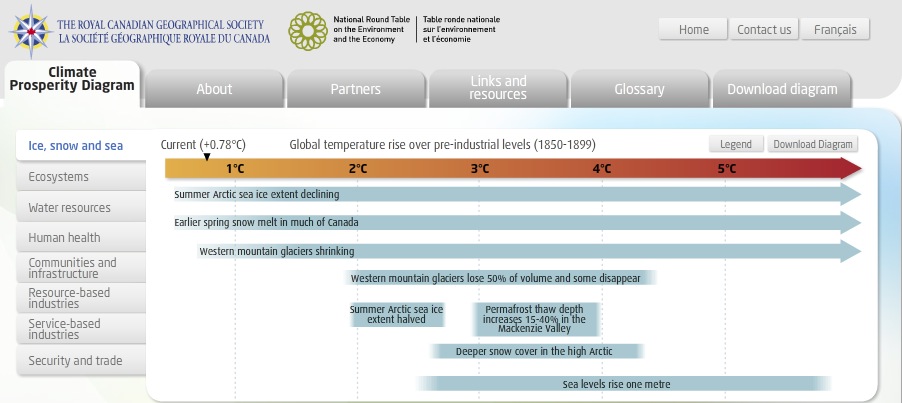
The first comprehensive look at the expected impacts of climate change on Canada offers an embarrassing and misleading “don’t worry, be happy” vision, citing more golf days and better access to northern deposits of oil and gas courtesy of global warming, critics say.

“The chart needs to be withdrawn,” said climate scientist Danny Harvey of the University of Toronto. “It is full of bad science and utterly downplays the serious impacts of climate change.”

The chart Harvey referred to is the “Degrees of Change” interactive diagram released this week as part of a national educational initiative called “Climate Prosperity” by the prestigious Royal Canadian Geographical Society and the National Round Table on the Environment and the Economy (NRTEE).

How can we (Canada) talk about profiting from climate change when most of the world will suffer devastating impacts, in part because of our emissions?” Harvey said.

“It is disgusting.”

In a release about the Climate Prosperity initiative, David McLaughlin, NRTEE president and CEO, said, “Adapt and prosper will be increasingly central to Canadian governments, communities, and businesses as these effects become more and more evident.”

NRTEE officials did not respond to IPS requests for an interview.

Is this article of interest? It exists thanks to contributions from readers. Please click here to learn more about Community Supported Journalism.

Continue reading

The Future of Journalism: Adopt a Muckraker

I’m pretty damn angry that media companies are putting profits ahead of truth.

The media are deeply broken… That’s a real threat to democracy.”

— Stanford University climate scientist, Stephen Schneider


Renowned Swiss journalist Daniel Wermus and Director of the Media21 Global Journalism Network  discusses my launch of Community Supported Journalism in this article. — Stephen

“Should you and I pay for the kind of accurate news reporting that is needed to fill us in on what is happening to the planet?

If we’re not willing to pick up the tab to stay better informed, who will?”

Frontline Earth: Adopt a Muckraker?

By Daniel Wermus

“I meet international freelance journalists quite often. Most make it clear that budget cuts have made it increasingly difficult for just about anyone, especially freelancers, to get into print. It is usually the freelancers who are most willing to risk their lives to get the stories that need reporting the most. If the day arrives when they can no longer carry out their professions, we will all have a serious problem.

Muckraker: A reporter or writer who investigates and publishes reports involving a host of social issues, broadly including crime and corruption

Stephen Leahy, a Canadian, and one of the world’s best-known investigative reporters on environmental issues, has launched a challenge: if corporations won’t pay for the news, then it is up to communities and the public to fill the gap. A free society needs journalism, even if reporting the news is not commercially profitable.

Leahy’s model for supporting the news has the journalist make his pitch over the internet. The completed article can then be distributed by news agencies or magazines that are low on funds but high on public interest. That could be IPS, Reuters-Alertnet, Commondreams, InfoSud, The Essential Edge or any number of other publications and news outlets.

[edit: Wermus concludes]

Leahy observes that: “Many people tell me, we need individuals like you to get real information out.”

It may be too early to tell whether this really signals a new citizen’s approach to the need for hard information that may be crucial to society. In the best of all worlds it could bring together both consumers and media for promoting a better planet. The danger is that it could also produce yet another quagmire of holier-than-thou preaching.”

Learn more about Community Supported Journalism in the Public Interest

Adopt a Muckraker for only $10 a month

Update: Community Supported Journalism is working. However 50 people helping out has to become 500 so we all can get the crucial information we need.  Please consider becoming one of the 500. Thank you. — Stephen


Arctic Ice in Death Spiral, Thaws Permafrost — Risks Climate Catastrophe

2 degrees C of warming could spark runaway global warming

By Stephen Leahy

UXBRIDGE, Canada, Sep 20, 2010 (IPS)

The carbon dioxide emissions from burning fossil fuels have melted the Arctic sea ice to its lowest volume since before the rise of human civilisation, dangerously upsetting the energy balance of the entire planet, climate scientists are reporting.

“The Arctic sea ice has reached its four lowest summer extents (area covered) in the last four years,” said Mark Serreze, director of the National Snow and Ice Data Center in the U.S. city of Boulder, Colorado.

The volume – extent and thickness – of ice left in the Arctic likely reached the lowest ever level this month, Serreze told IPS.

“I stand by my previous statements that the Arctic summer sea ice cover is in a death spiral. It’s not going to recover,” he said.

Is this article of interest? It exists thanks to contributions from readers. Please click here to learn more about Community Supported Journalism.

Continue reading

Arctic Melt Down Is Bringing Harder Winters and Permanently Altering Weather Patterns

Last year’s cold and snowy winter directly connected to warmer Arctic new research reveals

By Stephen Leahy

OSLO, 15 June 2010 (IPS)

Last winter’s big snowfall and cold temperatures in the eastern United States and Europe were likely caused by the loss of Arctic sea ice, researchers concluded at the International Polar Year Oslo Science Conference in Norway in June.

Climate change has warmed the entire Arctic region, melting 2.5 million square kilometres of sea ice, and that, paradoxically, is producing colder and snowier winters for Europe, Asia and parts of North America.

“The exceptional cold and snowy winter of 2009-2010 in Europe, eastern Asia and eastern North America is connected to unique physical processes in the Arctic,” said James Overland of the NOAA/Pacific Marine Environmental Laboratory in the United States.

In future, cold and snowy winters will be the rule rather than the exception” in these regions, Overland told IPS.

[[UPDATE Dec 29 2010 – Winter of 2010-11 appears to follow same pattern, see new post with northern hemisphere temp map for 20 Dec:  Arctic Hothouse Turns Europe into an Icebox]]

Scientists have been surprised by the rapid warming of the Arctic, where annual temperatures have increased two to three times faster than the global average. In one part of the Arctic, over the Barents and Karas Seas north of Scandinavia, average annual temperatures are now 10 degrees C higher than they were in 1990.

Is this article of interest? It exists thanks to contributions from readers. Please click here to learn more about Community Supported Journalism.

Overland explains the warming of the Arctic as the result of a combination of climate change, natural variability, loss of sea ice reflectivity, ocean heat storage and changing wind patterns, which has disrupted the stability of the Arctic climate system. In just 30 years, all that extra heat has shrunk the Arctic’s thick blanket of ice by 2.5 million square kilometres – an area equivalent to more than one quarter the size of the continental U.S.

The changes in the Arctic are now irreversible, he said. Continue reading

Ice, Polar Bears & the Arctic Melt Down That’s Changing the World

polar-bear-snout-wwwfirstpeopleus-smlIce-free summer in the Arctic is just a matter of time – mostly likely within the next 5 years. Here’s a “six-pack” of my recent articles on how global warming is transforming the Arctic:

The Arctic — The Earth’s Freezer — Is Defrosting With Dire Results

The rapidly warming Arctic region is destabilising Earth’s climate in ways science is just beginning to comprehend.

Arctic Leaking Methane a Super-Potent Global Warming Gas — Reaching Feared Tipping Point?“The way we’re going right now, I’m not optimistic that we will avoid some kind of tipping point.ceberg-in-glacier-strait-nunavut-canada-image-credit-sandy-briggs

Arctic Ice Gone in 5 Years – First Time in One Million Years– “We’re going to see huge changes in the Arctic ecosystem”

Things Happen Much Faster in the Arctic — “Things are happening much faster in the Arctic. I think it will be summer ice-free by 2015,” said David Barber, an Arctic climatologist at the University of Manitoba.

Arctic Is the Canary in the Coalmine — The Arctic is “ground zero” for climate change, with temperatures rising far faster than anywhere else on the planet.

Arctic Oil and Gas Rush Alarms Scientists — As greenhouse gas pollution destroys Arctic ecosystems, countries like Canada are spending millions not to halt the destruction but to exploit it.

Oh yeah, and about those polar bears:

Polar Bear (Sow And Cub), Arctic National Wild...

Polar Bears Go Hungry as Icy Habitat Melts Away — The iconic animal of the frozen north, the polar bear, is starving to death because climate change is melting the Arctic Ocean sea ice.

Oil vs Polar Bears in Alaska — A coalition of environmental groups sued the George W. Bush administration Monday for delaying a decision to protect polar bears threatened with extinction

Polar Bears’ Future Bleak in Melting Arctic — “Without taking serious and urgent action to stabilize the climate, there is no future for polar bears” says Andrew Derocher, Chair of the World Conservation Union (IUCN), Polar Bear Specialist Group.

Every Day Governments Give an Estimated $2 billion to Oil, Coal & Gas Industry – I hope You’re Not Hungry or Living on the Street

[Updated May 11 2012: At last a  serious plan to phase out these subsidies will be on the table at the Rio+20 meet in June. I will be following this closely – with your help – Stephen ]

Experts say the subsidy madness must stop. With unemployment high can governments facing recession summon the will to end the fossil fuel industries’ FREE RIDE?

By Stephen Leahy

BERLIN, Jun 29, 2010 (IPS)

Every day, governments give away an estimated two billion dollars of taxpayer money to the fossil fuel industry. This unmatched largesse to a highly profitable sector by countries verging on bankruptcy or unable to feed large numbers of their own people is “complete madness”, according to many experts.

In Toronto Sunday, at the conclusion of G20 summit, countries agreed the madness must be constrained if not stopped.

“I was impressed. I think the commitment to phase out fossil fuel subsidies has finally arrived,” said Mark Halle, director of trade and investment at the International Institute for Sustainable Development (IISD) European office in Geneva.

“With countries committed to cutting their deficits, it is hard to ignore giving billions of real money away to the fossil fuel industry or to keep fuel prices low,” Halle said in an interview.

Title: Offshore Description: Offshore platform...

The two-billion-dollars-a-day public subsidy for carbon- based fuels is a very conservative estimate based on the extensive research conducted by the IISD’s Global Subsidies Initiative, said Halle. Not only do such huge subsidies undermine policies on energy efficiency, they make it impossible for alternative energy sources to compete, he said. [See also Fossil Fuel Subsidies Are 12X (more like 20X) Support for Renewables, Study Shows — Stephen]

We can’t make the transition to low-carbon economies nor can the energy playing field be leveled without the elimination of fossil fuels. And time for that has finally come,” he said.

Others are less optimistic given the G8 and G20 track record for broken promises.

“It (the G20 commitment) fell short of vision and courage that is expected from global leaders in the light of the disastrous oil spill” in the Gulf of Mexico, said Darek Urbaniak of Friends of the Earth Europe. Urbaniak noted that BP, the company responsible for the spill, receives British and EU public subsidies.

Do you find this article interesting? It exists thanks to contributions from readers. Please click here to learn more about Community Supported Journalism. Continue reading