GW Desperation Drives Slightly Mad Ideas

coral-sea-oz.jpg

Climate Change: Time For Some Slightly Mad Ideas?
By Stephen Leahy

Sep 28 (IPS) – Lack of governmental action on climate change is forcing scientists to consider radical climate geo-engineering schemes such as giant vertical pipes in the ocean and growing vast blooms of plankton to try and prevent the worst from happening.

Companies backing some of these schemes hope to profit from the rising public clamour for action and politicians desperate to avoid serious reductions in greenhouse gas emissions.

“I wasn’t in favour of geo-engineering before, but we haven’t done well in reducing emissions,” said Chris Rapley, director of the Science Museum in London and former head of the British Antarctic Survey.

In fact, the global community continues on the “business as usual” path in terms of emissions of greenhouse gases (GHGs), thus increasing the chances of catastrophic climate change, Rapley, a climate change expert, told IPS.

“Just look at how incredibly quick the Arctic sea ice is melting,” he said. Continue reading

“Climate change is like the Internet — it is never going away”

“Climate change is like the Internet — it is never going away.”
— Paul Dickinson, CEO of the Carbon Disclosure Project

Climate of Change Confronts Wall Street
By Stephen Leahy

Sep 24 (IPS) – Stockholders, investors and financial analysts are now demanding to know how climate change will affect companies’ bottom line, and a new report reveals large corporations’ risks and opportunities.

At the behest of institutional investors managing over 41 trillion dollars, several hundred large corporations voluntarily revealed how they are responding to this new reality in a report released Monday at a major event on New York’s Wall Street, where former U.S. President Bill Clinton will also speak.

“Climate change will change the way we do everything,” said Paul Dickinson, CEO of the Carbon Disclosure Project, an independent not-for-profit organisation.

“Nothing will go back to the way things were,” Dickinson told IPS.

Continue reading

Skin Cancer Rising Despite New Ozone Deal to Cut CO2 Emissions

Ozone Deal to Cut Down CO2 Emissions

By Stephen Leahy


MONTREAL, Sep 23’07 (IPS) – More than 190 nations agreed this week to combat global warming and accelerate the healing of the ozone layer, although critics say more could have been accomplished.

The sun shone bright and warm here on Friday, the final day of the 19th Meeting of the Parties to the Montreal Protocol to protect the ozone layer. Outside, caravans of pre-school children in strollers or holding hands as they walked sported hats and long-sleeved shirts to protect their delicate skin.

It can be easy to forget that the sun was not always so dangerous, and that modern society is responsible for putting chemicals into the atmosphere that continue to destroy the ozone layer that protects all life from harmful levels of solar ultraviolet radiation.

[UPDATE: Sept 2009 — Ozone Treaty May Hold Key to Halting Climate Change;

— Ozone Hole 2009 – Bigger than North America – 24 million sq km]]

And we forget that things could have been far worse without international action in the form of the Montreal Protocol, which opened for signature 20 years ago this week.

Sadly, that action came late and was not vigorous enough for millions of people who have or will get skin cancer. Continue reading

The Real Cost of US Strawberries

The Chemical That Must Not Be Named
By Stephen Leahy

MONTREAL, Canada, Sep 20 (IPS) – Delegates from 191 nations are on the verge of an agreement under the Montreal Protocol for faster elimination of ozone-depleting chemicals, but the United States insists it must continue to use the banned pesticide methyl bromide.

Even as another enormous ozone hole forms over the Antarctic this week, the rest of the world appears to be giving in to U.S. demands despite the fact that the use of methyl bromide in developed countries was supposed to have been completely phased out by Jan. 1, 2005 under the Montreal Protocol on Substances that Deplete the Ozone Layer.

“It’s a black mark on this meeting. It is the chemical that must not be named,” said David Doniger, climate policy director at the Natural Resources Defence Council, a U.S. environmental group.

“There is a powerful lobby group of strawberry and vegetable growers in Washington,” Doniger told IPS.

Methyl bromide is a highly toxic fumigant pesticide which is injected into soil to sterilise it before planting crops. It is also used as a post-harvest decontaminant of products and storage areas. Although it is highly effective in eradicating pests such as nematodes, weeds, insects and rodents, it depletes the ozone layer and poses a danger to human health.

While alternatives exist for more than 93 percent of the applications of methyl bromide, some countries such as the U.S., Japan and Israel claimed that because of regulatory restrictions, availability, cost and local conditions, they had little choice but to continue its use as a pest control. And so despite the ban, the Montreal Protocol allows “critical use exemptions” for countries to continue to use banned substances for a short period of time until they can find a substitute.

In 2006, the United States received an exemption to use 8,000 tonnes of methyl bromide, compared to 5,000 tonnes for the rest of the developed world combined. Continue reading

Canada’s First Official F5 Tornado

Environment Canada meteorologists confirmed Sept 18 that the Elie, Manitoba tornado of June 22, 2007 reached F5 intensity, the highest rating on the Fujita tornado damage scale. Wind speeds are estimated to have reached between 420 to 510 km/hour when the tornado was at its most intense. 

Eleven tornadoes have occurred in Manitoba so far this summer. In 2006, Manitoba experienced 15 tornadoes, compared to a long term (1984-2006) average of nine tornadoes.

Is climate change responsible?

Ozone Treaty Best Bet to Slow Climate Change

Ozone Treaty Could Slow Climate Change
By Stephen Leahy


Credit:Nasa image

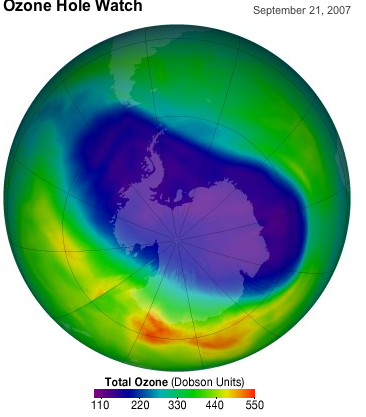
Blue represents the Antarctic ozone layer in 2006.


MONTREAL, Sep 17 (IPS) – Delegates from 191 nations are in Montreal, Canada this week to celebrate and extend the world’s most successful environmental treaty, the Montreal Protocol to protect the ozone layer.

With 95 percent of the target chemicals now eliminated, there is strong support to accelerate the phase-out of newer ozone-depleting chemicals that are also powerful greenhouses gases.

In fact, many experts believe this meeting could do more to reduce greenhouse emissions than the more widely-publicised Kyoto Protocol.

Challenges do remain — the United States continues to use large amounts of methyl bromide, an ozone-depleting substance (ODS), and the economic booms in China and India have rapidly increased the numbers of air conditioners using replacement chemicals.

Continue reading

Facebook: Last Hope for Environment?

facebook-header.png

Global trends indicate a looming environmental catastrophe, and engaging high school students around the world may be the only hope.

By Stephen Leahyvital-signs.png

Sept 14’07 (IPS)
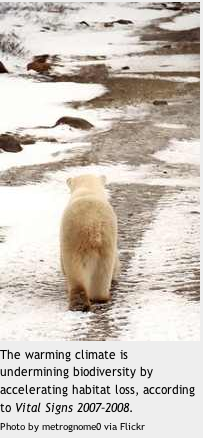
Governments, the corporate sector and media continue to champion industrial and economic growth at the cost of escalating impacts on the environment, concludes the latest report from the Washington-based Worldwatch Institute, “Vital Signs 2007-2008“.

For a number of years, the “Vital Signs” report has tracked 44 trends that are shaping the future, and they document a record level of industrial growth, says Erik Assadourian, Vital Signs project director.

“‘Vital Signs’ also documents the escalating impacts of such growth on the environment,” Assadourian told IPS in an interview from Barcelona.

The scale of the environmental crisis, in which catastrophic climate change is just one of many, is undermining the ecosystems that support life on Earth.

“Climate change and other environmental problems are symptoms of the root problem, which is the obsession with consumerism,” he said.

Vital Signs reports that in 2005, more wood was removed from forests than in any previous year. Fossil fuel usage dumped 7.6 billion tonnes of carbon emissions into the atmosphere. Meat production hit a record 276 million tonnes (43 kilogrammes per person) in 2006. Rising meat consumption is driving rising soybean demand to feed cattle, which in turn is a driver of deforestation as tropical forests are turned into soy fields.

And on it goes: global seafood consumption breaks records, steel and aluminium production too. None of this is sustainable — another three or four or five planets would be needed to maintain these levels of production and consumption. Continue reading

Greenland Ice Collapse Producing Earthquakes

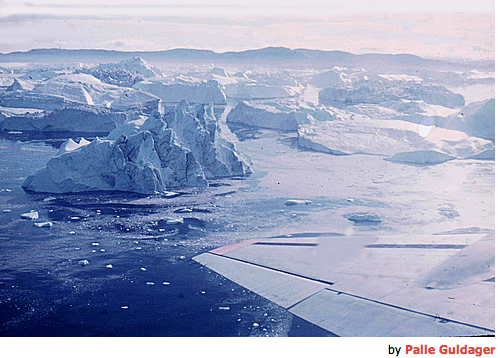
isfjorden-ved-jakobshavn-ilulissat.pngChilling from-the-scene update on my Greenland on Verge of Meltdown article in August: the Greenland ice cap is melting so quickly that it is triggering earthquakes as pieces of ice several cubic kilometres in size break off says Guardian reporter in Greenland.

UPDATE:
Here is a satellite view of Lulissat, Vestgronland Greenland just pan and zoom to the upper glacier to see the meltwater on the ice (not sure when this satellite pic was taken)
View Larger Map

Related stories:

The Earth is Going Dark Scientists Say
US Generals Say Warming Poses Major Security Threat

Climate Panel Report Called Too Conservative

First Ever: Two Hurricane Landfalls on Same Day – Pix

Yesterday was the first time Atlantic and Pacific hurricanes have made landfall on the same day. Here is an super picture of both Felix and Henriette by

NASA (high resolution pix here):

picture-5.png

Can only hope and pray that damage from these massive storms is minimal.

Check Reuters AlertNet for various emergency assistance agencies that are sending aid to these areas and for information updates.

To learn more about modern hurricanes and the potential link to climate change check out Steve’s Hurricane Handbook 2007. This is a compendium of the most interesting quotes and facts about hurricanes from scientists and other experts since 2004. You can download this collection free of charge but nothing is truly free. Donations appreciated

Future Belongs to the Shrub

picture-3.png 21st Century May Belong to the Shrub
By Stephen Leahy

Sep 1 (IPS) – As atmospheric carbon dioxide levels continue to climb shrubs and other woody plants will likely dominate grasslands, altering pastoral lifestyles around the world, a U.S. study has found.

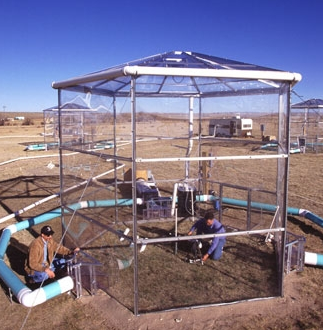
In the first experiment of its kind done on native grassland, U.S. scientists artificially doubled carbon dioxide (CO2) levels over enclosed sections of prairie in Colorado, a state in the western United States, for five years. To their surprise, one shrub species, Artemisia frigida — commonly known as fringed sage — thrived under those conditions. In fact, it grew 40 times faster than normal, dominating other plant species.

“This kind of response to higher CO2 levels is almost unprecedented,” said Jack Morgan, a plant physiologist at the U.S. Department of Agriculture, and lead author of the study, published Aug. 28 in the ‘Proceedings of the National Academy of Sciences‘ (PNAS), a science journal.

“Fringed sage is a minor species on the landscape normally. We were not expecting to see this,” Morgan told IPS.

Continue reading