Europeans stopped Canada’s Slaughter of Baby Seals – Can They Stop Canada’s Tar Sands?

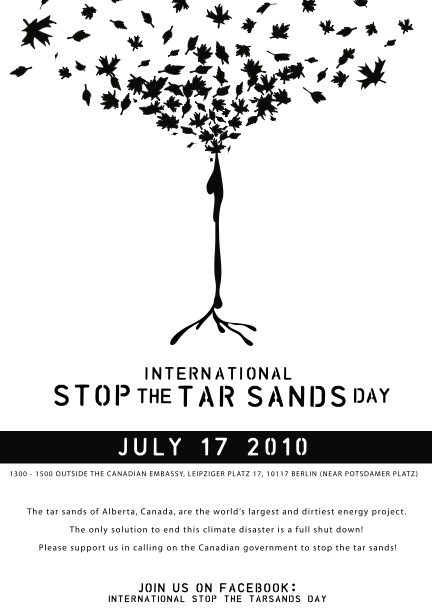
On July 17th Berliners and other Europeans will take to the streets to stop the worst environmental disaster on the planet:

Canada’s “Dirty Oil” Tar Sands

[UPDATE: See pix and story on the Stop Tar Sands “demo-fest”]

“The tar sands of Canada constitute one of our planet’s greatest threats” — James Hansen, Director of NASA’s Goddard Institute for Space Studies

“Extracting oil from Alberta’s tar sands jeopardizes the survival of our species” — Al Gore

Warning of the global environmental disaster represented by Canada’s production of oil from its western tar sands, protesters will gather in front of the Canadian Embassies in Berlin, London and Copenhagen on Saturday, July 17 to mark International Stop the Tar Sands Day.

[Download poster international tar sands day A3]

The goal of International Stop the Tar Sands Day is to raise awareness in Europe that oil made from Canada’s tar sands has “two-to-three times the global warming pollution of conventional oil,” according to eminent scientist James Hansen, Director of NASA’s Goddard Institute for Space Studies. “But the process also diminishes one of the best carbon-reduction tools on the planet: Canada’s Boreal Forest.”

Similar protests are planned at Canadian embassies in London, Paris and Vienna.

“Ultimately only Canadian people can stop the expansion of the tar sands. Through our demonstrations we want to show Canadians there is international support for a moratorium,” says first-time organizer Derek Leahy, a Canadian living in Berlin.

“We believe Canadians will make the right decision,” Leahy said

“Although European companies and banks are profiting from Canada’s tar sands few Europeans have heard about the tar sands. We intend to change that ,” he said

[Full disclosure: this is copied from a press release and Derek is my son — Steve] Continue reading

‘Tourists Please Don’t Go To Home of Canada’s Dirty Oil Sands’ Ad Campaign

Beautiful Alberta, Canada??

US enviro group is putting up billboards in four U.S. cities urging Americans to exclude Alberta from their travel plans, saying it is “one of the world’s dirtiest destinations”.

Let’s be clear here: I am not a supporter of this use of  a big “economic” club to hit govt over the head to get their attention. It will hurt many Albertans who are in the tourist biz where many likely support a moratorium on new tar sands development. Indeed most Albertans have said they want a “time out” in the tar sands. But big oil says no way and are pushing for faster approvals of new projects with “streamlined environmental reviews” of course.

In their  Re-Think Alberta Campaign enviro groups say they are trying to counter Alberta and Canadian government propaganda. Canada is lobbying the US  to prevent any cleaner-fuel regulations because the tar sands has the world’s highest CO2 levels and is the most destructive form of oil production. Yes worse, than off shore drilling – see here for more

And they are also down here lobbying for infrastructure, new pipelines, refineries, which would keep us addicted to high-carbon oil for another 50 years.” Corporate Ethics International Executive Director Michael Marx told Reuters.

1.3 million barrels of dirty oil is shipped  from tar sands region  to the US every day

Corporate Ethics also has a powerful video about the ongoing environmental mess that can easily be seen from space it is so big.

See also International Stop the Tar Sands Day commencing July 17 (more on this later).

You can learn more on enviro impacts of the tar sands in my short ebook:

Oil Stains in the Boreal Forest: The Environmental Cost of Canada’s Oil Sands

And from my recent articles:

Canada’s “Mordor” Ensures Climate Treaty Failure in Copenhagen

Tar Sands, Riot Police & Hope in Copenhagen

— Green wishes, Steve

Proof of Anti-Global Warming Cabal: Fossil fuel Interests, Christian Evangelicals and the Media

Stephen Leahy interviews science historian NAOMI ORESKES

PARIS, Mar 24, 2010 (IPS)

Even though 2009 was the fifth warmest year since 1850, and 2000-09 the warmest decade ever, according to the World Meterological Organisation, surveys show that public concern about global warming in the United States and Canada has dropped sharply in the past 18 months.

Why? Because of a relentless disinformation effort from an unlikely cabal of fossil fuel interests, Christian evangelicals and the media, says Naomi Oreskes, a professor of history and science studies at the University of California, San Diego.

“They have managed to reopen the debate over global warming in people’s minds,” she told IPS.

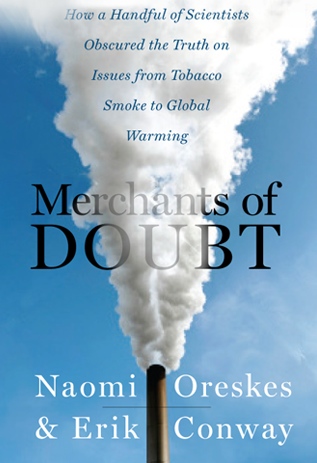
Oreskes and co-author Erik Conway, a science historian at the Jet Propulsion Laboratory, document similar efforts to manufacture doubt around the science on acid rain, the ozone hole, secondhand cigarette smoke, and the pesticide DDT in their just published book, “Merchants of Doubt: How a Handful of Scientists Obscured the Truth on Issues from Tobacco Smoke to Global Warming”. [Tons of excellent reviews —  the “eye-opener of the year” says one reviewer.]

In 2004, Oreskes was vilified on TV, radio and in print by commentators for providing clear evidence there was in fact a scientific consensus on global climate change. Her essay in the journal Science examined all of the peer-reviewed scientific papers on climate over the previous 10 years and found none dissented with the theories that climate change was occurring and it was caused by humans. Her survey has never been successfully challenged, despite many attempts.

IPS environmental correspondent Stephen Leahy spoke to Oreskes over the phone. Excerpts of the interview follow.

Q: Where is the vehement opposition to the very idea that we need to do something about climate change?

A: Some of it is ideological, part of a long history in the United States that equates environmental regulation as going down the slippery slope to socialism. And some is religious. Christian evangelicals don’t like science in general and have found common cause with the coal industry as a way to be able to teach creationism. Obviously, the motivation of the coal industry is rather different but now these people have come together to undermine science in general.

Are you enjoying this article? It is funded by contributions from readers. Please click here to learn more about Community Supported Journalism.

Continue reading

Carbon Capture Fraud: The $1.6 billion (and counting) Taxpayer Gift to Coal and Oil Industry

Could carbon capture and sequestration save the world?

Canadian taxpayers are putting $1.6 billion into the experiment

Desperate Times, Desperate Measures

by Stephen Leahy

Published in Nov/Dec’09 issue of Watershed Sentinel

Like a reckless gambler, the federal government’s plan to deal with our emissions of climate-altering carbon dioxide is to put most of our money on an unproven, risky and expensive long shot called “carbon capture and sequestration,” CCS for short. In a pair of October announcements, the Alberta and federal governments committed $1.6 billion to use this untested technology to reduce carbon emissions from an Alberta coal plant and a Shell Oil tar sands upgrader. Billions more are promised.

Canada puts 600 million tonnes of carbon dioxide into the atmosphere every year. That has to stop. This generation, you and me, must determine what methods and technologies offer permanent CO2 reduction at the scale we need, and do so quickly, safely and at the lowest cost. And we must act on that knowledge as if the future of children’s lives depend it because we are shaping the world they will inherit.

We cannot rely on political and business leaders to make these decisions on their own, as will become evident.

What other ways could we reduce our CO2 emissions with $1.6 billion of public money – $200 per Canadian family of four?

Replace 3.2 million older inefficient refrigerators with high-efficiency ones, thus reducing carbon emissions by 2-3 million tonnes annually. Continue reading

OUR Roof is on Fire: Dangerous Climate Change is Here

It will take lot of us – probably in the streets” to make politicians face the truth, says climate scientist James Hansen.

[Dangerous climate change is already upon us say some of the best scientists we have. But political leaders — and most of the public — don’t get it. This is an attempt to close the chasm between climate reality and climate denial fantasy. I wrote this at the end of the Copenhagen Climate meetings last December thanks in part to financial contributions from readers that allowed me to do the research and interviews. — Stephen]

Our leaders do not get the scale of the problem or the rapidity of the changes.”            — Andrew Weaver, climatologist at Canada’s University of British Columbia

Analysis by Stephen Leahy

COPENHAGEN Dec 22 ,2009 (IPS/TerraViva)

The roof of our house is on fire but our leaders, our economic system and we ourselves are ignoring the alarms and continuing to add more fuel. There are no exit doors in our house; there is nowhere else to go.

Dangerous climate change is already here.

The two-week climate summit in Copenhagen came to an end with disappointing results and details that are still vague.

A ”Copenhagen Accord” was agreed by the US, China, South Africa and India by Friday night. It was unclear which other countries were willing to support it.

But coral reefs are dying, the Arctic is melting and rising sea levels threaten the homes of millions. And we’re on our way to a planet-transforming four-degree C rise in global average temperatures in as soon as 50 years.

Future generations could face an utterly transformed planet, where large areas will be seven to 14 degrees C warmer, making them uninhabitable. In this world-on-fire, the one to two metre sea level rise by 2100 will leave hundreds of millions homeless, according to the latest science presented at the “4 Degrees and Beyond, International Climate Science Conference” at the University of Oxford in September.

That’s the science-based, slap-in-the-face reality as the Copenhagen climate talks fizzle out here with little progress Friday.

Our leaders do not get the scale of the problem or the rapidity of the changes. They don’t get that it must be dealt with now,” said Andrew Weaver, a climatologist at Canada’s University of British Columbia and lead author of the Intergovernmental Panel on Climate Change (IPCC) reports. Continue reading

A Tipping Point on Species Loss?

By Stephen Leahy

UXBRIDGE, Canada, Jan 13, 2010 (IPS)

Humanity is destroying the network of living things that comprise our life support system. While this sawing-through-the-branch-we’re-perched-on is largely unintentional, world leaders can’t say they didn’t know what’s going on: 123 countries promised to take urgent action in 2003 but have done little to stem the rising tide of extinctions in what’s known as the extinction or biodiversity crisis.

Species are going extinct at 1,000 times their natural pace due to human activity, recent science has documented, with 35 to 40 species vanishing each day, never to be seen again.

“The question of preserving biological diversity is on the same scale as climate protection,” German Chancellor Angela Merkel said in a speech in Berlin Monday at the official launch of the United Nations’ International Year of Biodiversity.

This week’s official launch will be followed by the first major event of the International Year, a high-profile meeting at the Paris headquarters of the U.N. Educational, Scientific and Cultural Organisation, Jan. 20-21.

“We need a sea change. Here, now, immediately – not some time in the future,” Merkel said.

While climate has been the focus in 2009, this year will be a global celebration of and action on biodiversity, Ahmed Djoghlaf, executive secretary of the Convention on Biological Diversity (CBD), told IPS from Berlin.

Continue reading

Rage and the Economics of the Environment

Economist Tim Jackson, Copenhagen Dec 2009

[Rage does feel appropriate at times with the continuing mis-information regarding climate change and the IPCC. While some focus on looking for typos in 3000 page report, the real issue is an overwhelming need to bring our economic system in line with the reality that we have but one planet to live on. Economists like Tim Jackson, who I met in Copenhagen, and others are taking on this vitally important task but are getting little media attention. — Stephen]

Stephen Leahy interviews British economist TIM JACKSON*

Tim Jackson: “The climate treaty wasn’t the only thing that failed in Copenhagen.”

TORONTO, Canada, Jan 28, 2010 (Tierramérica)

“Rage is sometimes the appropriate response” to the failure of the world’s leaders to craft a new climate treaty at the Copenhagen summit, says British economist Tim Jackson.

The Copenhagen Accord, the outcome of the 15th Conference of Parties (COP15) to the United Nations Framework Convention on Climate Change in December, not only revealed global environmental governance as a fiction, but also demonstrated a continuing blind adherence to the mantra of economic growth, says Jackson

Professor of sustainable development and director of the Research Group on Lifestyles, Values and Environment at Surrey University in Britain, Jackson also serves as British government advisor and economics commissioner for the Sustainable Development Commission.

In addition, Jackson is a professional playwright with numerous radio-writing credits for the BBC, based in London.

Tierramérica’s Stephen Leahy spoke with Jackson by phone about his new, controversial book “Prosperity without Growth: Economics for a Finite Planet”, the Copenhagen Accord and prospects for a real climate treaty, continuing a conversation they began last month in Copenhagen.

Q: Your book “Prosperity without Growth” argues that economic growth in developed countries is making people less happy and destroying the Earth itself.

A: It’s clear the continued pursuit of growth endangers the ecosystems on which we depend for long-term survival.

There is also ample evidence that increasing material wealth in developed countries is not making people any happier, but just the opposite in some countries. Beyond a certain level of income, there is no correlation of greater income with greater happiness.

Q: If the era of economic growth is over, what will take its place?

A: Wealth and prosperity need to be redefined along the lines of (1998 Nobel laureate in economics) Amartya Sen’s “capability for flourishing.” Flourishing is defined as having enough to eat, being part of a community, worthwhile employment, decent housing, access to education and medical services.

Continue reading

Canada’s “Mordor” Ensures Climate Treaty Failure in Copenhagen

[Hello from snowy and cold Copenhagen. Tensions have ramped up as political leaders arrived but are mainly meeting in secret.

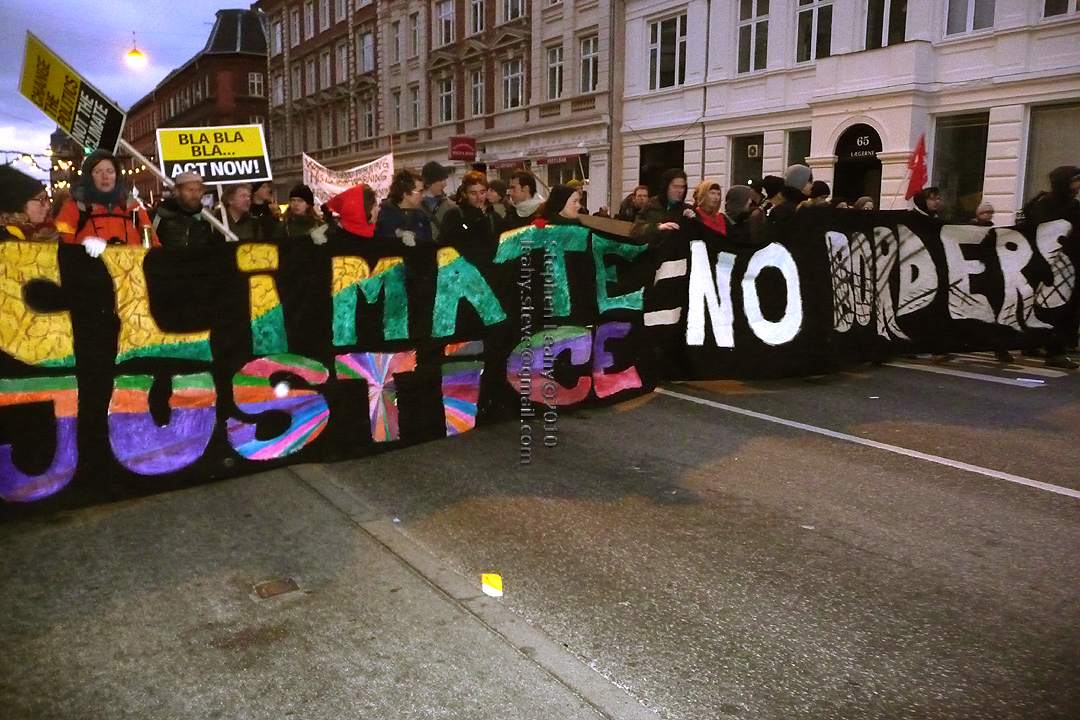
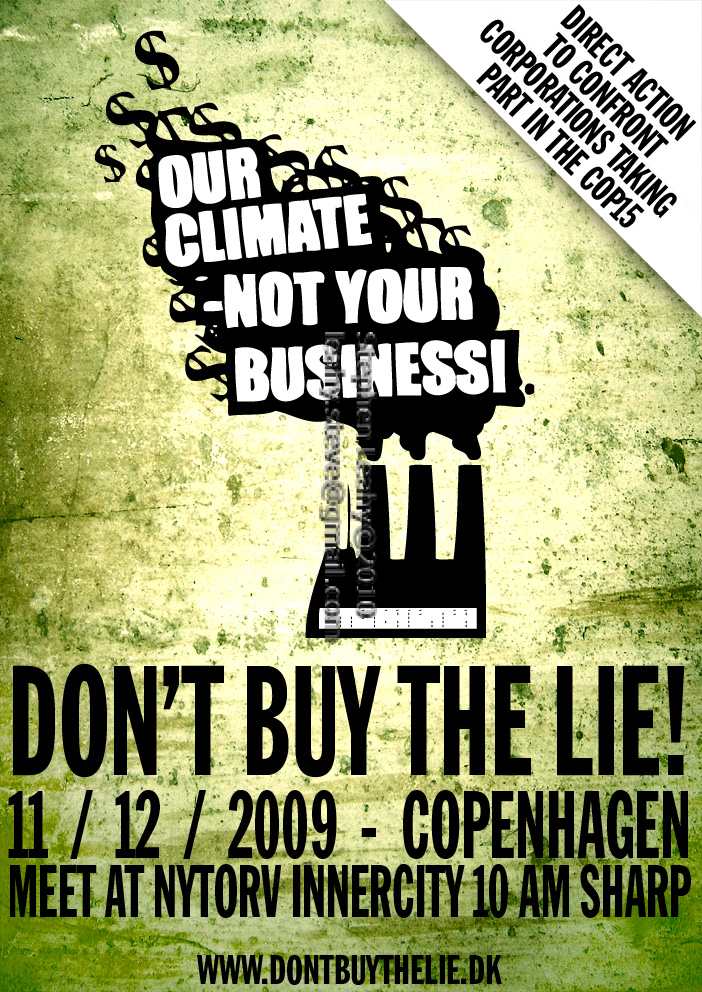
Ashamed to say Canada is a widely acknowledged as a public embarrassment here. And called a climate criminal by some. Several protests like the one I covered below and a smaller one earlier have focused on the Athabasca Tar Sands perhaps the world’s biggest source of carbon emissions.

Outside the artificial reality of the Bella Center ordinary people get it. Here is good video summary of what happened on Wed as civil society were gradually banned from the conference. It accords with my son’s version who was in the middle of all this as an observer. — Steve]


By Stephen Leahy

COPENHAGEN (IPS/TerraViva) Dec 14 2009

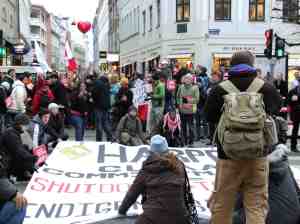
Climate activists jammed a small square near the police-barricaded Canadian Embassy here Monday for the second day of protests over the country’s tar sands development.

Simultaneous protests were held at the Canadian Embassy in London because British oil companies and financial institutions are deeply invested in the Canadian mega-project.

“As indigenous people, we are here at the international climate negotiations to speak about threats to our cultural survival and the direct life-threatening impacts of climate change in our communities,” said Clayton Thomas Muller, tar sands campaigner for the Indigenous Environmental Network.

“Canada has been blocking the climate negotiations and hasn’t kept Kyoto commitments…because of the tar sands,” he told a crowd of 75 to 100 people surrounded by four squads of riot police.

Boreal forests and wetlands the size of Greece are been destroyed in northern Alberta in an industrial project that turns millions of tonnes of sand and earth into oil, mainly for the U.S. market he said.

“All the efforts by Canadians to reduce their carbon emissions are undone by the tar sands,” said Canadian writer and activist Naomi Klein.

The tar sands are Canada’s largest single source of carbon dioxide (CO2) emissions and the major reason why Canada has refused to live up to its commitments to reduce emissions and is blocking negotiations, Klein told protesters.

“Canada is making a mockery of international law and of developing countries’ need for urgent emission reductions in rich countries,” she said.

Canadian Prime Minister Stephen Harper is here at the Dec. 7-18 U.N.-sponsored climate summit under false pretences, Klein charged.
Harper does not have the Canadian people’s permission to promote the tar sands or to favour Canadian interests over those of the planet,” she said.

The tar sands are “Canada’s Mordor”, said Maude Barlow, head of the Council of Canadians, the largest citizens’ group in Canada. She was referring to the devastated land of rock and fire in the “Lord of the Rings” trilogy.

“What else can you call a project that leaks 11 million litres of toxic waste a day into rivers and groundwater?” Barlow said in this very un-Mordor upscale shopping district of downtown Copenhagen.

The tar sands project has the largest toxic waste containment ponds on the planet – easily visible from space. Last week, a report revealed the extent of the leaks to be an estimated 11 million litres a day.

Shockingly, this is based on the oil companies’ own self-reported data, says Environmental Defence, the Canadian advocacy, research and education group that compiled the report.

It calculated that four billion litres of leakage a year will grow to 25 billion in a decade based on current growth of the tar sands and aging of the enormous dams that hold back the waste.

“There is no question Harper will stand up for  the oil sector [in the climate talks here],” Barlow said.

Their [oil industry] footprints are all over this negotiation and that is why it will fail.”

-30-

Corrected 2/2/12

For more on the Tar Sands see:

Oil Stains in the Boreal Forest: The Environmental Cost of Canada’s Oil Sands – Revised V2.1Oil Stains in the Boreal Forest: The Environmental Cost of Canada’s Oil Sands – Revised V2.1

Lavish US Lobbying Pushes Nuclear Energy — Taxpayers on the hook for 360 billion to 1.6 trillion dollars (again)

windmill winter poniesBy Stephen Leahy*

BERLIN, Jul 31 (IPS)

Climate change and the resulting need for low-carbon energy sources is driving the current interest in nuclear energy despite the industry’s near universal legacy of staggering cost-overruns, technical difficulties and dependence on enormous government subsidies.

Government interest in new nuclear energy plants seems far more political than practical or economic in light of the fact that Europe’s latest nuclear plant under construction in Finland is four years behind schedule and 50 to 70 percent over budget.

Any claims that nuclear is a viable low-carbon or clean energy source are negated by its extraordinary costs that have increased at least five-fold in the past decade.

Nuclear energy has always been heavily subsidised by governments around the world,” Ellen Vancko, a nuclear energy analyst at the Union of Concerned Scientists, a U.S.-based non governmental organisation.

Under proposed U.S. legislation to reduce greenhouse gas emissions (Waxman-Markey Energy Bill), billions more dollars are headed the nuclear industry’s way in the form of research and development funding, production tax credits, and 20 billion dollars in loan guarantees.

Added to that a major push by some politicians in the U.S. Senate to dramatically expand government-backed loan guarantees to subsidise the construction of 100 new nuclear plants in the U.S. over the next 20 years, Vancko told IPS.

“The U.S. taxpayer could be on the hook for 360 billion to 1.6 trillion dollars. This potentially is as large or larger than the U.S. financial crisis,” she says. Continue reading

2020 Climate Deadline Is the Crucial “Litmus Test”

Chile—The fury of Chaitén volcano - nat geo

The atmosphere and the climate is a public good, a commons, and can’t be protected by the private sector.”

— Marianne Haug, Oxford Institute for Energy

By Stephen Leahy

VIENNA, Jun 29 2009 (IPS)

“So who here thinks there will be a meaningful deal in Copenhagen?”

Few of the more than 600 energy ministers, officials and experts from 80 countries attending the Vienna Energy Conference raised their hands in response to the conference moderator’s question about the final round of climate negotiations this December in Copenhagen.

“I don’t think there will be agreement on an emissions cap,” said Andre Amado, Brazil’s vice-minister for energy, science and technology.

Greenhouse gas emissions from the burning of fossil fuels must peak between 2015 and 2020 and then decline to prevent dangerous, irreversible climate change, scientists have warned. A strong international agreement on emissions targets for both the industrialised and developing world is widely believed to be the only way to ensure emissions peak and then decline.

“There will be agreement on technology transfer and reducing barriers for technology transfers,” to assist developing countries in cutting their emissions and adapting to the changing climate, Amado told participants last week in Austria’s capital city.

Continue reading