New study reveals a major trend is underway. More and more countries are acting on climate – only Canada going backward
By Stephen Leahy
UXBRIDGE, Canada, Jan 15 2013 (IPS)
A majority of major economies have made significant progress in addressing climate change, with countries like South Korea and China taking aggressive action so they can benefit from energy- and resource-efficient economies, a new report released Monday found.
The study by GLOBE International and Grantham Research Institute profiled 33 major economies in an annual examination of climate and energy legislation. 32 of them, including the United States, made significant progress in 2012, while only Canada regressed.
“The study reveals a major trend is underway. More and more countries are acting on climate,” said Adam Matthews, secretary general of GLOBE International, an organisation of legislators.
While major international climate conferences such as the Conference of the Parties (COP) held in Doha in November and December 2012 have made little progress, cities, states and national governments around the world are taking action.
The political reality, Matthews told IPS, is that local and national climate regulations and legislation must come first. “An environment minister in Doha couldn’t commit his country to an ambitious carbon reduction target unless the country has already decided to chart a new economic course,” he said. Continue reading →
Concentrated Solar Power plant of Ain Beni Mathar, Morocco is a first in the world.
Countries cannot afford to miss the green wave of Rio+20
No alternative to low-carbon, resource-efficient economies
By Stephen Leahy
UXBRIDGE, Canada, May 25, 2012 (IPS)
Think of Rio+20 as the hothouse to grow the green ideas and values humanity needs to thrive in the 21st century.
No one is expecting, or even wants, a big new international treaty on sustainable development said Manish Bapna, interim president of the World Resources Institute, a global environmental think tank based in Washington, D.C.
“The important action will be on the sidelines of the formal negotiations,” Bapna told IPS in an interview.
Blocs of countries, civil society organisations and representatives of business will meet, create coalitions and make commitments on specific issues and on regional concerns.
“There could be some exciting specific commitments coming out of Rio,” Bapna said.
Perhaps the most important outcome from Rio+20 would be to put to rest the erroneous belief that protecting the environment comes at the cost of economic growth when it is in fact the opposite. Without a healthy, functioning environment, humanity loses the benefits of the environment’s “free products”: air, water, soil to grow food, stable climate and so on.
“One of the big hurdles to a sustainable future is that officials in many countries think they can’t afford to move onto a more sustainable pathway,” he said.
Bapna hopes Rio+20 will generate a “new narrative” – a wider understanding that there is no viable alternative to the transition to low-carbon, resource-efficient economies that alleviate poverty and create more jobs. Continue reading →
Climate change plays a role in all extreme weather now – atmosphere is 0.8C hotter and 4-6% wetter – turns out small increases can have big impacts. — Stephen
Extreme weather is fast becoming the new normal. Canada and much of the United States experienced summer temperatures during winter this year, confirming the findings of a new report on extreme weather.
For two weeks this March most of North America baked under extraordinarily warm temperatures that melted all the snow and ice and broke 150-year-old temperature records by large margins.
Last year the U.S. endured 14 separate billion-dollar-plus weather disasters including flooding, hurricanes and tornados.
A new report from the Intergovernmental Panel on Climate Change (IPCC), released Mar. 28, provides solid evidence that record-breaking weather events are increasing in number and becoming more extreme. And if current rates of greenhouse gas emissions are maintained, these events will reach dangerous new levels over the coming century.
Since 1950 there have been many more heat waves and record warm temperatures than in…
‘Public largely unaware of the e-waste impacts on human health and environment’
By Stephen Leahy
UXBRIDGE, Canada, Nov 1, 2011 (IPS)
Mountains of hazardous waste grow by about 40 million tons every year. This waste, mostly from Europe and North America, is burned in developing countries like Ghana in a hazardous effort to recover valuable metals.
A children’s school in Accra, Ghana’s capital, was recently found to be contaminated by lead, cadmium and other health-threatening pollutants at levels over 50 times higher than risk-free levels. The school is located directly beside an informal electronic waste salvage site.
“Poor people in Africa cannot afford to process Europe’s or America’s electronic wastes,” said Ghanaian researcher Atiemo Sampson.
“Those wastes are poisoning our children,” Sampson told IPS from Accra.
Ghana does not regulate the importation and management of electronic waste, or e-waste. The government hopes to have rules in place next year, he…
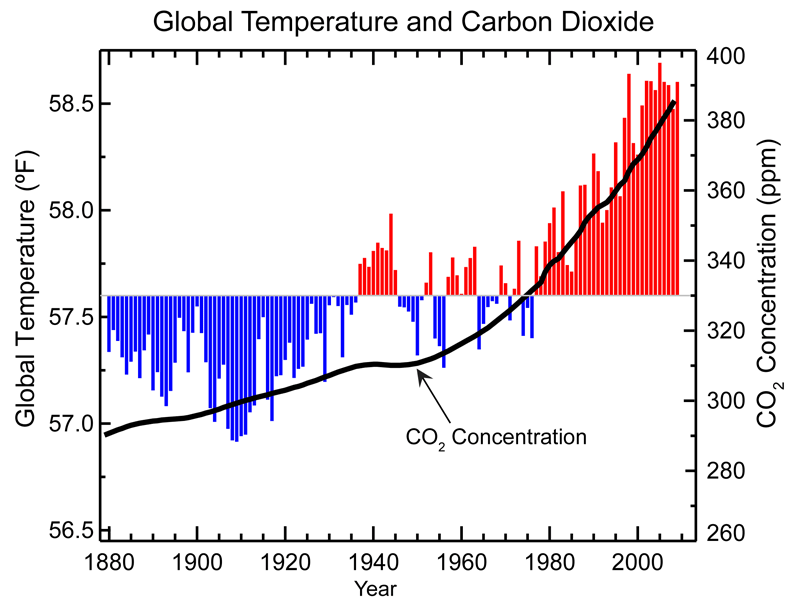
Global temperatures are only 0.7C warmer — on pace for +4C!
By Stephen Leahy
UXBRIDGE, Canada, May 25, 2012 (IPS)
Climate-heating carbon emissions set a record high in 2011, in a 3.2 percent increase over the previous year, the International Energy Agency reported this week. The main reason for this dangerous increase is that governments are failing to implement policies to prevent catastrophic increases of global temperatures.
A new report released on the last days of international climate talks in Bonn, Germany this week reveals that the planet is heading to a temperature rise of at least 3.5 degrees Celsius, and likely more, according to the Climate Action Tracker (CAT), despite an international agreement to keep global temperature rise below two degrees Celsius.
Not only are pledges inadequate, but countries are unable to fulfill even those pledges, a new CAT analysis shows. CAT is a joint project of Dutch energy consulting organisation Ecofys, Germany’s Climate Analytics, and the Potsdam Institute for Climate Impact Research.
“When we compared the emission reduction pledges of countries like Brazil, Mexico and the U.S., we found they did not have the policies in place to meet those pledges,” said Niklas Höhne, director of energy and climate policy at Ecofys.
Höhne told IPS that they looked only at the policies of a few countries, but no country’s policies were enough to meet their targets. Continue reading →
Last week the Japanese govt injected $billions into Tepco, owners of the damaged Fukushima nuke plant that still poses a huge threat. Many more billions are needed to make it safe.
The nuclear energy industry only exists thanks to what insurance experts call the “mother of all subsidies”, and the public is largely unaware that every nuclear power plant in the world has a strict cap on how much the industry might have to pay out in case of an accident.
In Canada, this liability cap is an astonishingly low 75 million dollars. In India, it is 110 million dollars and in Britain 220 million dollars. If there is an accident, governments – i.e. the public – are on the hook for all costs exceeding those caps.
Japan has a higher liability cap of 1.2 billion dollars, but that is not nearly enough for the estimated 25 to 150 billion dollars in decommissioning and liability costs for what is still an ongoing disaster at its Fukushima Daiichi nuclear plant. Seven weeks…
Frances Moore Lappé, author of "EcoMind: Changing the Way We Think to Create the World We Want"
“Our economy creates scarcity by being extraordinarily wasteful and destructive.”
Stephen Leahy interviews writer and environmentalist FRANCES MOORE LAPPÉ
UXBRIDGE, Canada (IPS)
To meet the challenges of the 21st century, including climate change, feeding the world and eliminating poverty, we need to free ourselves from the “thought traps” that prevent us from seeing the world as it truly is and narrow our vision of how to respond.
At same time, we need to eliminate “privately-held government”, says Frances Moore Lappé, author of “EcoMind: Changing the Way We Think to Create the World We Want” published by Nation Books. Lappé has written 18 books, including the very influential “Diet for a Small Planet”.
“There is no way to deal with climate change or poverty without real democracy,” she says.
IPS climate and environment correspondent Stephen Leahy spoke with Lappé about her new book.
Q: What do you mean by the term “thought traps”?
A: We don’t see the world as it really is but through a filter or mental map. Research in neuroscience shows that we interpret the world based on our previous experiences and understanding of the world. In other words we see what we expect to see.
One of the dominant ideas in our society is about scarcity or lack. There isn’t enough resources or food or whatever for all of us. We then “see” or interpret everything from that filter or frame of reference.
Q: How does this widely-held idea of “scarcity” affect us?
A: Believing there isn’t enough makes us defensive and competitive with each other. We think we’d better get ours before someone else does. The majority of people I talk to insist with seven billion people on the planet scarcity is our reality now and into the future. They are blinkered by this scarcity mentality.
Q: But isn’t it true that we are running out of resources like water, energy, food and so on?
A: I discovered as a young student that the U.S. food production was extraordinarily wasteful and inefficient. Sixteen pounds of corn and soy fed to cattle to get one pound of meat. That pound of meat also requires as much as 12,000 gallons of water. Nearly half of all food harvested is never consumed.
This staggering waste is the rule, not the exception, and not just in food production. The U.S. energy sector wastes 55-87 percent of the energy generated – most of it in the form of waste heat at power plants. It’s not just the U.S. U.N. studies showed that 3,000 of the world’s biggest corporations caused two trillion dollars in damage to the global environment in 2008 alone.
Powerful and inspiring, EcoMind will open your eyes and change your thinking. I want everyone to read it — Jane Goodall
Q: Why are we so destructive and wasteful?
A: It’s a result of the current market economy with its single focus on generating the quickest and highest return to a small minority of wealth-holders. Our economy creates scarcity by being extraordinarily wasteful and destructive. The term “free market economy” is completely wrong. What we have is a corporate-monopoly market economy of waste and destruction. We need to be more careful and more precise in our language.
Q: There is a growing call by environmentalists and some economists of the need to shift from a growth economy to a no-growth economy, but you say this is a thought trap?
A: Yes, it leads to a distracting debate about merits of growth versus no-growth. Growth sounds like a good thing so most people will resist the idea of no growth. Better to focus on creating a system that enhances health, happiness, ecological vitality and social power.
Q: In your book you also say everyone needs to focus on “living democracy”.
A: America has become what’s called a “plutonomy”, where the top one percent control more wealth than the bottom 90 percent. Inequality is now greater in the U.S. than in Pakistan or Egypt, according to the World Bank. The result is corporations and the very wealthy sway public decision making via political contributions and lobbying. There are now two dozen lobbyists for every member of Congress.
To counter this privately-held government we need to re-create a culture of mutual responsibility, transparency, citizen participation and public financing of elections. Democracy is not just voting once a year, it is a culture, a way of living.
The “mother of all issues” in most countries is removing the power of concentrated wealth from public-decision making and infusing citizens’ voices instead. The environmental crisis is in fact a crisis in democracy.
Q: There is a feeling amongst many environmentally-aware people that it is already too late and there is too much to be overcome.
A: Thinking it’s too late is another thought trap. It may be too late to avoid significant impacts that could have been avoided if action had been taken two decades ago. It is not too late for life. My book is filled with examples of people taking charge and turning things around.
What makes people think it’s too late is that they feel alone and powerless. People feel that way because of the thought traps, the false beliefs about scarcity and of human nature as greedy and selfish. Those beliefs and a privately-held government have led to feelings of powerlessness.
Q: This year is the 20th anniversary of the historic Earth Summit and major conference called Rio+20 will be held in June. What are your thoughts?
A: I participated in the Rio+10 conference and we’ve gone backwards in those 10 years. Rio+20 could be the opportunity to reverse course and align ourselves with nature to create the world we really want.
“It is unacceptable that the Canadian public sits back and allows access to the science they’re funding to be denied them,” said Andrew Weaver, a climate scientist.
Canadian media coverage of climate change has fallen by 80 percent
By Stephen Leahy
VANCOUVER, Canada, Feb 21, 2012 (IPS)
Amid revelations of a well-funded U.S. organisation’s plans to deliberately distort climate science, scientists and journalists at a major scientific conference called on the Canadian government to stop its muzzling of scientists.
For the past four years, the Canadian government has been denying timely access to government scientists even when their findings are published in leading scientific journals, said scientists and journalists in a special session of the American Academy for the Advancement of Science meeting here in Vancouver, British Columbia.
“The Canadian public doesn’t know as much as they could about science and climate change,” said Margaret Munro, who is a science writer for Postmedia News, based in Vancouver.
“The more controversial the story, the less likely you are to talk to the scientists,” Munro told IPS.
Need global moratorium on new large-scale mining, extraction and prospecting
The average U.S. citizen uses an astonishing 22,000 times their weight in minerals, metals and fuels in their lifetime
By Stephen Leahy
UXBRIDGE, Canada – March 1 2012, IPS
A global scramble for land and mineral resources fuelled by billions of investment dollars is threatening the last remaining wilderness and critical ecosystems, destroying communities and contaminating huge volumes of fresh water, warned environmental groups in London Wednesday.
No national park, delicate ecosystem or community is off limits in the voracious hunt for valuable metals, minerals and fossil fuels, said the Gaia Foundation’s report, “Opening Pandora’s Box”. The intensity of the hunt and exploitation is building to a fever pitch despite the fact the Earth is already overheated and humanity is using more than can be sustained, the 56-page report warns.
“We’re calling for a global moratorium on new, large-scale mining, extraction and prospecting,” said Teresa Anderson of The Gaia Foundation, an international NGO headquartered in London, UK that works with local communities.
The International Union for Conservation of Nature (IUCN) has recently warned of the threats to World Heritage Sites from planned mining and oil and gas projects. One in four iconic natural areas in Africa is negatively affected, the report notes.
“No matter where you live, land acquisitions for mining, oil or gas are coming,” Anderson told IPS following the report’s launch in London.
The easy-to-get resources are gone. Now the extractive industries, funded by pension funds and commodities speculators, are using new technologies like fracking for natural gas to get at previously unprofitable resources. Continue reading →
Civil society has warned of the danger of turning Africa’s food-producing lands into “carbon farms” so that rich countries can avoid making cuts in their carbon emissions.
On Friday, they called on host country South Africa to refrain from forcing so-called “climate smart” agriculture into the United Nations climate treaty negotiations known as the 17th Conference of the Parties (COP 17).
South African President Jacob Zuma has stated that agriculture should be part of a new climate treaty. South African officials have previously told IPS they want it included so there will be “specific funds and specific actions” for agriculture under the U.N. Framework Convention on Climate Change.
“Putting agriculture into a future climate treaty is supposedly a consolation prize to Africa for failure by rich countries to agree to legally binding targets,” said Teresa Anderson of the Gaia Foundation, an international non-governmental organisation based in London.
“This consolation prize is a poisoned chalice. It will lead to land grabs and deliver African farmers into the hands of fickle carbon markets,” Anderson told IPS.
Agriculture is a major source of global warming gases like carbon and methane – directly accounting for 15 percent to 30 percent of global emissions. When the entire food production system is included, total agriculture emissions represent nearly half of all emissions. For those reasons there have been previous efforts to incorporate agriculture under a new climate treaty.
Changes in agricultural practices can greatly reduce emissions. However, the best way to do that is through regulations, not a climate treaty and carbon credits, said Anderson.
“Why are markets now seen as the only solution when less than 10 years ago they weren’t a focus at all?” Continue reading →







 Stephen Leahy, International Environmental Journalist