Geoengineering for a Desperate Planet — UN Declares Global Moratorium

By Stephen Leahy*

NAGOYA, Japan, Oct 25, 2010 (Tierramérica)

[Update from Nagoya 30 October 2010. Global moratorium passes.]

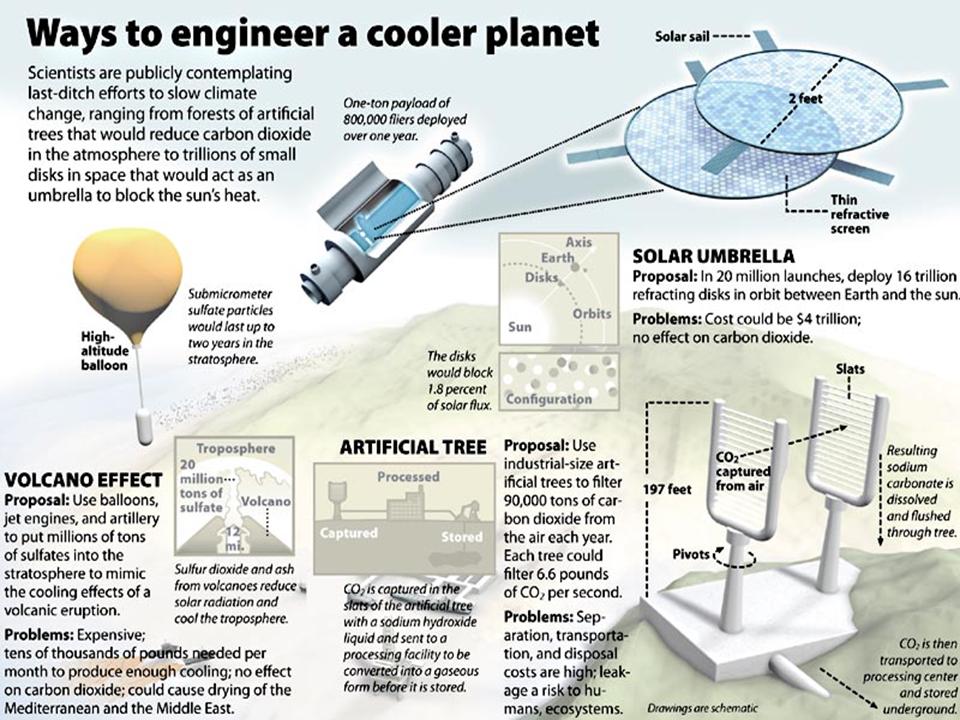
Delegates to the world summit on biodiversity here are calling for a moratorium on climate engineering research, like the idea of putting huge mirrors in outer space to reflect some of the sun’s heating rays away from the planet.

Climate engineering or geoengineering refers to any large-scale, human- made effort to manipulate the planet to adapt to climate change.

Representatives from Africa and Asia expressed concern about the negative impacts of geoengineering during the opening week of the 10th Conference of Parties (COP 10) to the United Nations Convention on Biological Diversity (CBD), Oct. 18-29. They were joined by civil society organisations in calling for a moratorium on geoengineering experiments.

The geoengineering proposals include installing giant vertical pipes in the ocean to bring cold water to the surface, pumping vast amounts of sulphates into the stratosphere to block sunlight, or blowing ocean salt spray into clouds to increase their reflectivity.

[Previously posted – Full Story here] 

The Oxymoron of Political Leadership and Political Will

Analysis by Stephen Leahy

VIENNA, Jun 29, 2011 (IPS)

Political will is all that’s needed to bring electricity to the 2.5 billion people with no or unreliable access to power, or to feed the one billion who go hungry every day, or to finally begin to slash carbon emissions to avoid dangerous climate change, or just about any other global problem.

Humanity has the technology, resources and even the money to solve these problems, agree scientists, corporate business leaders, heads of civil society organisations and United Nations agencies and government ministers. “All that is lacking is political will,” they almost always declare at the dozens of international conferences, summits and forums this reporter has attended for the past five years. And then everyone goes home.

What is this magical “political will” that can solve any problem?

via The Oxymoron of Political Leadership – IPS ipsnews.net.

Talking green is cheap

Postponing emissions cuts carries steep price-tag.

Dateline: Tuesday, June 28, 2011

by Stephen Leahy for InterPress Service

BONN, Jun 20, 2011 (IPS) — If we’re lucky, by the time a tough but fair international treaty to meet the climate change challenge is finalised, it will be largely unnecessary. The snail’s pace of negotiations certainly gives countries plenty of time to understand the financial, social and environmental advantages of kicking their dangerous addiction to fossil fuels.

That may be a cynical optimist’s hope, but the European Union is already moving in that direction.


No developed country is close to the 40-percent cut that the science says is needed by 2020 to stay below a two degrees C increase.

via Straight Goods – Talking green is cheap.

Reducing Soot and Smog Would Help Stabilise Climate and Save Millions of Lives

Picture of smog in Cairo.
Image via Wikipedia

By Stephen Leahy

BONN, Jun 14, 2011 (IPS)

Clean the air, cool the planet and prevent millions of deaths with fast action on soot and smog, a new report urges.

Air pollutants like black carbon (soot) and ground-level ozone (smog) arise from incomplete combustion of fossil fuels and biomass like wood and charcoal.

Nations or regional blocks of nations could decide to put measures into place that quickly improve their air quality, reduce crop losses and shorten lives. And, almost as a side benefit, those efforts would do much to slow the rate of global warming, says the scientific assessment report released at the United Nations Framework Convention on Climate Change (UNFCCC) negotiating session here in Bonn.

Continue reading

On the Road to Green Energy for All

27 Jun 2011 09:33

By Stephen Leahy

VIENNA, Jun 27 (IPS)

Like our cave-dwelling ancestors of 200,000 years ago, nearly three billion people still use fire for cooking and heating. Of those, some 1.5 billion people have no access to electricity. For a billion more, their only access is to sporadic and unreliable electricity networks.Now an ambitious global effort is being launched by the United Nations to bring electricity to everyone on the planet by 2030.

“Energy is the issue for the next decade,” said Kandeh Yumkella, director-general of the United Nations Industrial Development Organization (UNIDO).

“Achieving the Millennium Development Goals (MDGs) is impossible without energy,” Yumkella said at the opening of the 2011 Vienna Energy Forum last week.

via On the Road to Green Energy for All – AlertNet.

Nuclear for the Poor, Renewables for the Rich?

By Stephen Leahy

VIENNA, Jun 27, 2011 (IPS)

In a debate about the future of energy, the global south wants to spend tens of billions of dollars on nuclear plants while the global north looks to spend hundreds of millions on decentralised, renewable energy.

At least those were the positions taken by representatives during the BBC TV’s World Debate programme filmed at the 2011 Vienna Energy Forum.

“We must have nuclear energy if India is to develop,” said Srikumar Banerjee, the chair of India’s Atomic Energy Commission.

via Nuclear for the Poor, Renewables for the Rich? – IPS ipsnews.net.

Limited Liability – Nuclear Energy’s ‘Mother of all Subsidies’

By Stephen Leahy

UXBRIDGE, Canada, May 6, 2011 (IPS)

The nuclear energy industry only exists thanks to what insurance experts call the “mother of all subsidies”, and the public is largely unaware that every nuclear power plant in the world has a strict cap on how much the industry might have to pay out in case of an accident.

In Canada, this liability cap is an astonishingly low 75 million dollars. In India, it is 110 million dollars and in Britain 220 million dollars. If there is an accident, governments – i.e. the public – are on the hook for all costs exceeding those caps.

Japan has a higher liability cap of 1.2 billion dollars, but that is not nearly enough for the estimated 25 to 150 billion dollars in decommissioning and liability costs for what is still an ongoing disaster at its Fukushima Daiichi nuclear plant. Seven weeks after the tsunami caused the disaster, radiation levels continued to spike higher.

No one knows when the reactors will finally be in cold shutdown, or when the costs of theFukushima disaster will stop piling up. One report suggests decommissioning will take 30 years.

This independent environmental journalism depends on public support. Click here learn more.

Japan’s credit rating was downgraded because of the accident, noted Mycle Schneider, a Paris-based energy and nuclear policy analyst who has worked in Japan. “The Japanese know it’s just a matter of time before another large earthquake occurs,” Schneider told IPS.

“Japan will never build another nuclear plant.
Continue reading

Fossil Fuel Industry Kings of Corporate Welfare

This graphic from GOOD magazine shows who gets the bulk of the enormous US energy subsidies. Many subsidies are hidden and difficult to estimate and this attempt looks to be low according to the experts I’ve interviewed for various articles (cited below). The graphic also doesn’t include subsidies for nuclear which are equally enormous.  — Stephen

The enormous fossil fuel subsidies are rarely acknowledged when complaints are raised about costs of renewable energy. This report shown below says subsidies for fossil fuel are 12X that for green energy but this is a gross underestimate based on the experts I’ve interviewed in June for this article Free Ride for Oil and Coal Industry May Be Over.

Subsidies experts in Switzerland told me that “two-billion-dollars-a-day public subsidy for carbon-based fuels is a very conservative estimate..”

In reality big oil and coal get more like 20X the money green energy. So let’s do some real pricing: electricity from coal 5 cents kWh X 20 for subsidies (not to mention free use of the atmosphere /environment for its CO2, mercury etc waste products.) Corporate welfare at its best.

A few of the many articles I’ve written on the subject of energy subsidies:

Fossil Fuel Subsidies Are 12X (more like 20X) Support for Renewables, Study Shows

Every Day Governments Give an Estimated $2 billion to Oil, Coal & Gas Industry

Oil Companies and Special Interests Spend Half a Billion Dollars to Defeat US Clean Energy – Study

Nuclear Power Costs Skyrocket, Cost of Renewables Plummet

Is Rio Earth Summit 2.0 Doomed to Fail?

By Stephen Leahy

UXBRIDGE, Mar 7, 2011 (IPS)

Timed to coincide with the 20th anniversary of the 1992 Rio de Janeiro Earth Summit, the Rio 2012 Summit hopes to recapture the optimism of that earlier era.

At the June 2012 Rio Summit it is hoped countries will agree on policies to move toward a green economy from the present “brown” economic system driven by fossil fuel energy and the serial depletion and degradation of natural resources and ecosystems. A green economy promises to bring good jobs, clean energy and water while ensuring a more sustainable and fairer use of resources.

“If we continue on our current path, we will bequeath material and environmental poverty, not prosperity, to our children and grandchildren,” said Rio 2012 Secretary-General Sha Zukang.

“Rio 2012 will be one of the most important events in the coming decades,” Zukang said

Continue reading

Peak Water Has Already Come and Gone

Woman from Woukpokpoe village in Benin

By Stephen Leahy

UXBRIDGE, Canada, Mar 22, 2011 (IPS)

Canadian Kevin Freedman is celebrating World Water Day Tuesday by living on 25 litres of water a day, instead of the North American average of 330 litres per day. And he has enlisted 31 others in his “Water Conservation Challenge” to go water- lean, using just 25 litres per day for cooking, drinking, cleaning, and sanitation for the entire month of March.

“People in Canada and the U.S. have no idea how much water they use or how much they waste,” Freedman told IPS.

“Although people live on less, it is very difficult to use just 25 litres a day. You can’t shower or use a washing machine,” he said. “I’m hoping to raise awareness that water is a finite resource.”

Nearly a billion people don’t have good access to safe fresh water. In a single generation, that number could double as growing demands for water will exceed the available and sustainable supply by 40 percent, according a recent study. “Peak water” has already come and gone. Humanity uses more water than can be sustained, drawing on non-renewable reserves of water accumulated over thousands of years in deep aquifers.

“Water cannot be created, it can only by managed,” said Margaret Catley-Carlson, a former senior official with both the Canadian government and at the United Nations, a renowned global authority on water issues, and a director at the Canadian Water Network Continue reading