Green Energy Solves Dual Crises of Poverty and Climate

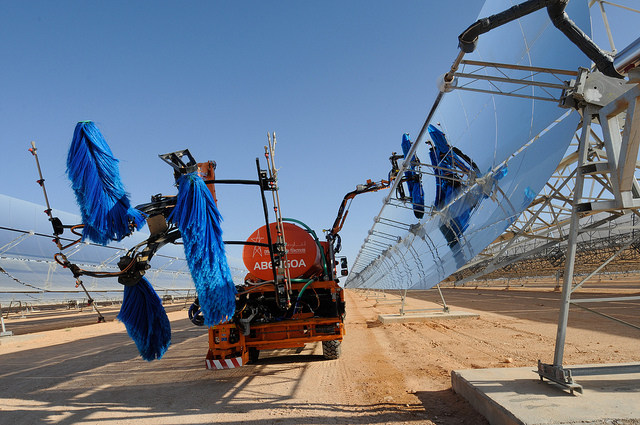
Ain Beni Mathar Integrated Combined Cycle Thermo-Solar Power Plant

By Stephen Leahy

UXBRIDGE, Canada, Feb 25 2013 (IPS) 

Green energy is the only way to bring billions of people out of energy poverty and prevent a climate disaster, a new study reveals.

Conservative institutions like the World Bank, the International Energy Agency and accounting giant Price Waterhouse Coopers (PwC) all warn humanity is on a path to climate catastrophe unless fossil fuel energy is replaced by green energy.

The U.N.’s Sustainable Energy for All initiative intends to bring universal access to modern energy, doubling the share of renewable energy globally, and doubling the rate of improvement in energy efficiency by 2030.

Poverty eradication, sustainable development and the transition away from fossil fuel energy go hand in hand.

If those targets are met and similar efforts undertaken to reduce deforestation, then climate disaster can be avoided, said Joeri Rogelj of the Institute for Atmospheric and Climate Science in Zurich  who headed the analysis published Sunday in the journal Nature Climate Change.


National Legislation Key to Combating Climate Change

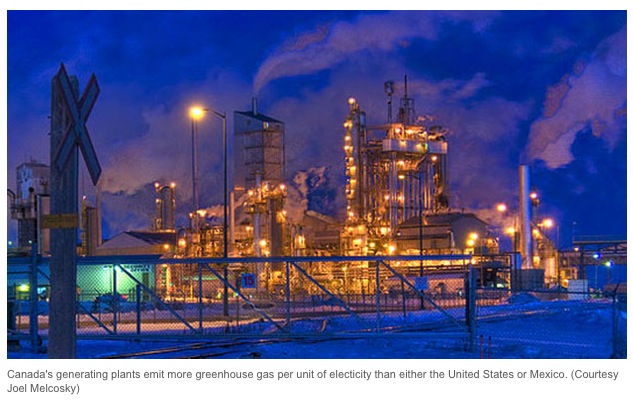
Canada's fossil fuel electricity has highest carbon emissions

By Stephen Leahy

UXBRIDGE, Canada, Jan 15 2013 (IPS)

A majority of major economies have made significant progress in addressing climate change, with countries like South Korea and China taking aggressive action so they can benefit from energy- and resource-efficient economies, a new report released Monday found.

The study by GLOBE International and Grantham Research Institute profiled 33 major economies in an annual examination of climate and energy legislation. 32 of them, including the United States, made significant progress in 2012, while only Canada regressed.

“The study reveals a major trend is underway. More and more countries are acting on climate,” said Adam Matthews, secretary general of GLOBE International, an organisation of legislators.

Critics Brand Climate Talks Another Lost Opportunity

findlay ohio flooding AP

By Stephen Leahy

DOHA, Qatar, Dec 11 2012 (IPS)

Rich countries came to the U.N. climate talks in Doha intent on delaying needed action on climate change for another three years and a still to be hammered out new global treaty.

This delay will be extraordinarily expensive and risky.

Every year that fossil fuel emissions fail to decline adds to the cost and reduces the odds that a global temperature rise can be kept below two degrees C.

“Science says emissions need to peak in 2015,” said Kumi Naidoo, executive director of Greenpeace International, as the final plenary of COP 18 concluded last Saturday night, a full day late.

The 195 parties to the U.N. Framework Convention on Climate Change (UNFCCC) approved a set of documents called “The Doha Climate Gateway” that does not increase emission reductions or guarantee much-needed financial help to poor countries suffering present and future impacts of climate change.

“Doha is a betrayal of people living with impacts now. And it is a sellout of our children and grandchildren’s future,” said Naidoo.

“The fossil fuel industry won,” said Alden Meyer, the Union of Concerned Scientists’ director of strategy and policy, who has attended nearly every one of these climate negotiations over the past 18 years.

“The science is clear that four-fifths of known fossil fuel reserves must stay in the ground but we continue to burn them like there is no tomorrow,” Meyer said.

“Doha became more of a trade fair…Negotiators protected the interests of corporations and not the needs of people,” he told IPS.

More than 16,000 delegates participated in the two-week conference of the parties (COP) in Doha, Qatar, a country rich in oil and gas in the heart of the Middle East fossil fuel empire.

Meyer, along with representatives from more than 700 civil society organisations, blamed the U.S. for blocking proposals for greater emissions cuts. The U.S. also refused to commit a singly penny to assisting countries hard hit by climate change. U.S. negotiators did acknowledge poor countries were suffering costly damages and losses.

The world has already warmed 0.8 degrees C, altering weather patterns and increasing extreme events which have led to nearly 400,000 deaths and more than 1.2 trillion dollars being lost every year, according a 2011 study.

A delegate from Bangladesh told IPS that climate-related damages cost his country three to four percent of its annual GDP. Climate change, which is also driven by deforestation and land conversion for agriculture, is undercutting development and will push his country’s and other countries’ economies into a steady decline, he said.

To help governments cope, industrialised nations promised to put 100 billion dollars a year into a Green Climate Fund by 2020. To bridge the gap until then, developing nations asked for 60 billion dollars in total by 2015. Britain, Germany and a few other countries promised to contribute six billion dollars.

But the U.S., Canada, Japan and others agreed only to more talks next year.

“The U.S. spends 60 billion dollars on its military marching bands,” said Naidoo.

The only hope is to build a robust grassroots movement to force countries to act in the interest of the public and future generations, he said.

“We have to build a new social movement like (the one) that overcame slavery,” agreed Oxfam International climate change policy advisor Tim Gore.

“We reject what our leaders are doing here. We are more angry, more impassioned to defeat this process,” said Gore.

The COP process is an obstacle because a few big countries can easily block the will of the majority, said Mohamed Aslam, former environment minister and chief negotiator for the Republic of the Maldives.

“The signs of global warming are obvious and we know that the safe limit is to stay below 1.5 C…and yet we are failing to act,” Aslam said in a press conference.

The U.N. spends millions of dollars on these negotiations and they are going nowhere, he said. “We are running out of time. (We) need to take this to another fora,” he said.

What is lacking is a real commitment to reduce global emissions, said Christina Figueres, executive secretary of the United Nations Framework Convention on Climate Change (UNFCCC).

“What needs to change most is political will,” Figueres told IPS.

In Doha, the U.N. secretary-general announced a world leaders’ summit in 2014 to hammer out emission reduction targets to keep warming below two degrees C. The Doha Climate Gateway confirmed details for a new negotiation track to have a new global climate treaty ready for ratification in 2015 and go into force in 2020.

Under this agreement all countries will likely be obligated to make emission cuts, varying in depth and timing. Without additional cuts before 2020, reductions afterwards will need to be rapid and massive, moving to a zero-fossil fuel emission society in a few decades based on the science.

The Doha agreement includes a second phase of the Kyoto Protocol with the European Union, Australia and a few other countries agreeing to cut fossil fuel emissions between 2013 and 2020. However, they did not set new targets, agreeing instead to a mandatory review of targets in 2014.

The nations involved only represent 12 percent of global emissions, and do not include large developing country emitters like China, India and Brazil. The U.S. has never participated, while Canada and Japan have opted out of the second phase but are supposed to make to make comparable cuts but offered nothing new.

“Rich countries think they can protect themselves from the impacts, leaving the poor with no clear pathway to the future,” said Mohamed Adow of Christian Aid.

“Our leaders have let us down. Civil society will have to lead to get the future we really want,” said Adow.

Original IPS story

Be Part of a New Collaborative Approach to Media Coverage of Climate

Screen Shot 2013-10-17 at 10.09.20 PM

Frustrated by the lack of interest in climate coverage by mainstream media, 15 young journalists on 4 continents want to bring a new collaborative approach to climate change journalism. This is a voluntary effort to both increase and improve reporting called the Climate News Mosaic (CNM).


They need your help for their first collaborative project to connect what’s happening at the UN climate conference (COP) in Warsaw this November with climate impacts/perspectives on the ground from their home countries.

Here’s how it will work:

* 2 or 3 journalists will go to the COP in Warsaw to report and co-ordinate. The rest will be back home doing local coverage on climate. Everyone contributes and shares interviews, links to reports, sources, A/V and so on.

* Members (mainly freelancers) do articles, audio and video for their own outlets. Some 25-30 original stories in at least 4 languages will be made available for use in whole or in part by any media outlet anywhere in the world.

* A live blog placed on a number non-profit news sites like IPSEarth Journalism Network , and others will bring the public a wealth of current info on what is happening at the Warsaw COP but also from other countries. (i.e. a short video from Warsaw, a photo from a rally in San Francisco, a soundbite from a press conference in Nairobi, a quote from an interview with an Italian scholar.)

Learn more about CNM participants on this global map with short bios.

I’m sort of the mentor having used crowd-sourced funding to support my science and climate journalism the past 4 years. That support kept me going and in 2012 I was a co-winner of the Prince Albert/United Nations Global Prize for media coverage of climate change.

For-profit media owners are simply not interested in good science and environment reporting. Coverage of climate change has been in sharp decline since the UN climate summit in Copenhagen in 2009. Even the New York Times closed its environment desk this year. It’s not that there isn’t a lot to report on. Quite the opposite.

Here’s how you can help:

Please spread the word about this project. We need to raise $6000 for travel, accomodation and other costs to do the Warsaw COP reporting.  Please click on Indiegogo to contribute what you can. (There are ‘perks’ for contributors including a Google Hangout.)

This is a fresh new idea: Independent journalists in different countries working together to provide all of us with the news and information on the most important issue of our time.

Please join in and help out.

24 Policies That Can End Our Earth Emergency

blue-marble-720x696-720x696

“Ecological literacy is vital for those in positions of power and influence”

Never vote for anyone who isn’t literate

By Stephen Leahy

UXBRIDGE, Canada, Jun 7 2012 (IPS)

Ecologically ignorant policies are largely responsible for the interlinked crises that are unraveling the planet’s life support system.

The unintended consequences of such policies are climate change, desertification, biodiversity decline, ocean pollution and the destruction of forests, according to the policy advocacy organisation World Future Council.

The solution is to eliminate “bad” policies and implement policies that ensure a healthy planet for future generations. On world environment Day, Jun. 5, the World Future Council will present an emergency policy agenda consisting of 24 tipping-point policies that need to be implemented globally to preserve a habitable planet.

“We are in an Earth Emergency. It’s an unbelievable crisis. Policies are the most important tool we have to change this,” Jakob von Uexkull, founder and chair of the World Future Council (WFC).

The five-year old WFC is based in Hamburg, Germany and comprised of 50 eminent individual from around the globe who have already successfully promoted change.

“Policy may be seen as dull and boring but they are the things that shape our societies,” von Uexkull told IPS.

In 2000, the German government created the now famous feed-in tariff policy launching a renewable energy revolution. That policy has enabled Germany to generate 22 percent of its electricity from renewables today and created a new business sector employing more people than its automotive industry.

“With the best laws and right policy incentives we can mobilise human inventiveness and entrepreneurship to safeguard a healthy planet for future generations,” he said.

On the other hand bad government policies allow 3,000 of the world’s biggest corporations to escape more than 2.2 trillion dollars in annual costs through their impacts on the natural environment, according to the U.N. Environment Programme. (A trillion is one thousand billion. A trillion seconds is nearly 32,000 years). Continue reading

Fossil Energy Interests Buy Politicians – and they’re cheap says economist

[This interview with economist Robert Repetto (now at Yale) was published two years ago. It is more relevant than ever in showing how fossil fuel money influences politics and prevents real action on climate. — Stephen]

‘What else can you do with coal except burn it? Railways make a lot of money shipping coal’

By Stephen Leahy

UXBRIDGE, Canada, Mar 2, 2011 (IPS)

Powerful fossil energy interests are preventing the United States from making the necessary transition to 21st century energy sources, one of the country’s leading environmental economists documents in a just-published book.

Fossil energy interests are spending “hundreds of millions of dollars” lobbying U.S. politicians in Congress and funding groups to confuse the public about the serious risks climate change poses, says Robert Repetto, author of  “America’s Climate Problem: The Way Forward”.

IPS climate and environment correspondent Stephen Leahy spoke with Repetto about his new book.

Q: Why did you write this book?

A: We’re running out of time. The latest science shows that climate change is coming faster and posing greater risks than previously thought. We are at risk of triggering positive feedbacks that will lead to uncontrollable climate change.

Meanwhile, America is locked in a climate-policy stalemate, with very few in the public comprehending the real risks climate change poses. Most don’t understand that climate change is happening now. They don’t link extreme weather events we’ve been experiencing with climate change. As a result they are not demanding that politicians take action.

Q: Why don’t most Americans understand the fact that climate change is already underway and poses serious risks? Continue reading

The Most Important Number in Human History

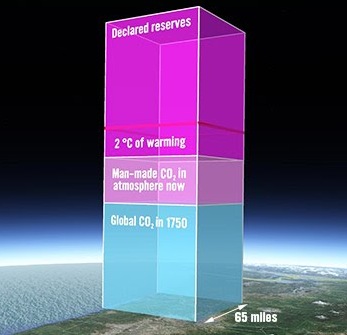
Carbon overload Carbon in atmosphere and amount in fossil fuel reserves

That number was 52 billion tonnes of CO2 in 2012

Only when this number declines will we know we’re making the shift to climate protection

By Stephen Leahy

UXBRIDGE, Canada, Dec 17 2012 (IPS) 

The most important number in history is now the annual measure of carbon emissions. That number reveals humanity’s steady billion-tonne by billion-tonne march to the edge of the carbon cliff, beyond which scientists warn lies a fateful fall to catastrophic climate change.

With the global total of climate-disrupting emissions likely to come in at around 52 gigatonnes (billion metric tonnes) this year, we’re already at the edge, according to new research.

To have a good chance of staying below two degrees C of warming, global emissions should be between 41 and 47 gigatonnes (Gt) by 2020, said Joeri Rogelj, a climate scientist at Switzerland’s Institute for Atmospheric and Climate Science in Zurich.

Only when we see the annual global emissions total decline will we know we’re making the shift to climate protection,” Rogelj told IPS.

Making the shift to a future climate with less than two degrees C of warming is doable and not that expensive if total emissions peak in the next few years and fall into the 41-47 Gt “sweet spot” by 2020, Rogelj and colleagues show in their detailed analysis published Sunday in the journal Nature Climate Change.

The study is the first to comprehensively quantify the costs and risks of emissions surpassing critical thresholds by 2020. Continue reading

Nuclear Energy and the ‘Mother of all Subsidies’

[The two year anniversary of the Fukushima nuclear disaster  is March 11. Little has changed from this 2011 article (except cleanup costs may be higher at $250 billion). Generations of Japanese taxpayers will have to cover those costs. Other countries also have liability caps which means the public provides ‘free insurance’ to the industry. As this article shows it’d be cheaper to give interest-free loans to solar or wind industry. — Stephen.]

“…it is basically insanity to shoulder the public with risk to get relatively small amount of electricity…”

By Stephen Leahy

UXBRIDGE, Canada, May 6, 2011 (IPS)

The nuclear energy industry only exists thanks to what insurance experts call the “mother of all subsidies”, and the public is largely unaware that every nuclear power plant in the world has a strict cap on how much the industry might have to pay out in case of an accident.

In Canada, this liability cap is an astonishingly low 75 million dollars. In India, it is 110 million dollars and in Britain 220 million dollars. If there is an accident, governments – i.e. the public – are on the hook for all costs exceeding those caps.

Japan has a higher liability cap of 1.2 billion dollars, but that is not nearly enough for the estimated 25 to 150 billion dollars in decommissioning and liability costs for what is still an ongoing disaster at its Fukushima Daiichi nuclear plant. Seven weeks after the tsunami caused the disaster, radiation levels continued to spike higher.

No one knows when the reactors will finally be in cold shutdown, or when the costs of the Fukushima disaster will stop piling up. One report suggests decommissioning will take 30 years.

This independent environmental journalism depends on public support. Click here learn more.

Japan’s credit rating was downgraded because of the accident, noted Mycle Schneider, a Paris-based energy and nuclear policy analyst who has worked in Japan. “The Japanese know it’s just a matter of time before another large earthquake occurs,” Schneider told IPS.

“Japan will never build another nuclear plant.
Continue reading

Canada and US Spending Billions to Create Climate Chaos

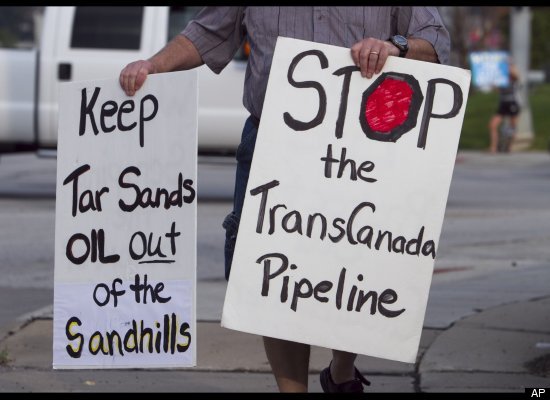
tar sands pipeline protest signs

Welcome to Bizarro World

[This is a 2011 repost about Keystone XL and expansion of fossil fuel production while world’s nations are supposed to be reducing climate-wrecking emissions of carbon. — Stephen] 

Analysis by Stephen Leahy

UXBRIDGE, Canada, Aug 10, 2011 (IPS)

Canada and the United States are now the centre of Bizarro World. This is where leaders promise to reduce carbon emissions but ensure a new, supersized oil pipeline called Keystone XL is built, guaranteeing further expansion of the Alberta tar sands that produce the world’s most carbon-laden oil.

“It’s imperative that we move quickly to alternate forms of energy – and that we leave the tar sands in the ground,” the U.S.’s leading climate scientists urged President Barack Obama in an open letter Aug. 3.

“As scientists… we can say categorically that it’s [the Keystone XL pipeline] not only not in the national interest, it’s also not in the planet’s best interest.”

The letter was signed by 20 world-renowned scientists, including NASA’s James Hansen, Ken Caldeira of the Carnegie Institution, Ralph Keeling of the Scripps Institution of Oceanography, and George Woodwell, founder of the Woods Hole Research Center Continue reading

Climate Change B.S. Detector: Sorting Fact from Fiction

which makes more sense sml

By Stephen Leahy

Uxbridge Cosmos, Feb 2013

There is quite a bit of misinformation about climate science and climate change (global warming). This is the most important issue of our time but it can be a complex subject. Here are some tips to help sort fact from fiction based on my experience of writing about science and climate change for the past 15 years.

Tip #1: Consider the source

It’s important to know where the information is coming from. Are they an expert or someone with an impressive looking website but no climate science training? No one goes to an engineer if they want their appendix removed.

If someone says a group of retired NASA scientists claim there is no evidence carbon dioxide causes global warming, I check to see if they are climate scientists — they’re not. Then I go to the official NASA website and in a big headline it says: “97% of climate sciences agree” climate change is happening.  This is followed by a long list of well-regarded scientific societies from around the world who also agree.

Tip#2 Verify

A reader once sent me a link to a “science” article from Investor’s Business Daily that said increased activity of the sun was entirely responsible for the current warming according to the Max Planck Institute for Solar System Research, a well-known research centre in Germany. A quick check of the Max Planck Institute’s website revealed their actual conclusion: “Solar activity affects the climate but plays only a minor role in the current global warming.”

Tip#3 Brush up on some science

Our atmosphere traps and retains the suns heat which is called the greenhouse effect. Without this the Earth would be more like the moon: +100C in the day and -170C at night. Carbon dioxide (CO2) is a greenhouse gas that helps keep the planet warm by retaining some of the sun’s heat.  John Tyndall proved this 150 years ago in 1861. In the last 100 years our burning of oil, gas and coal has added 40% more CO2 to the atmosphere. That extra CO2 has warmed the planet 0.8C globally and 1.5C to 2.0C in Canada so far.

Tip # 4: Follow the money

Ask this question who has the most to gain or lose? Climate scientist’s largely rely on getting research money from governments. Scientists are smart people who are good with numbers so if they just wanted to make money they’d be working on Bay St or Wall St.

On the other hand the oil, coal and gas companies represent by far the richest industry in human history. In 2010 their revenues were estimated to be $5 trillion, far more than Canada’s $1.7 trillion gross domestic product (GDP) that year. (A trillion is one thousand billion. A trillion seconds is nearly 32,000 years).

The five biggest oil companies made a record $137 billion in profits in 2011. Surprisingly Canada’s largely foreign-owned oil and gas industry still receives $1.3 billion a year in public subsidies despite many promises to end this taxpayer handout.abyess cartoon 2012Toon05

Some fossil fuel companies have been caught sowing confusion and doubt about climate change just like the tobacco companies did regarding the link between smoking and lung cancer. Fossil fuel interests fund organizations that look official or science-based and they publish reports, write opinion pieces or do media interviews stating that global warming is a hoax and there is no real need to burn less oil, gas or coal. One of these organizations is Canada’s Friends of Science and its related site ClimateChange101 that received funding from Calgary oil company Talisman Energy to put out false and long-debunked critiques of climate science.

Here’s two of the best sources I use to help me sort fact from fiction:

For climate science go to “Skeptical Science”, a volunteer community with clearly written, rock solid science-based answers on climate.

For everything else go to “DeSmogBlog – Clearing the PR Pollution that Clouds Climate Science” . There is now a Canadian version “DeSmogCanada”  that I will be contributing to.

No one really wants to think about climate change and what it means for our children’s future. It is too difficult, too painful to even consider. But avoiding or denying global warming and its dangers prevents us from taking action to minimize future impacts. Inaction and delay are truly terrifying. However taking action at the personal, family and community levels is liberating and empowering. We need to start a conversation about this.

Uxbridge’s Stephen Leahy is the 2012 co-winner of the Prince Albert/United Nations Global Prize for Climate Change reporting . He is the senior science and environment correspondent at IPS,  Inter Press Service News Agency, based in Rome. His work is also published in National Geographic, The Guardian (UK), New Scientist, Al Jazeera, Earth Island Journal and others.

Or Just Print This Cheat Sheet Will Help You Win Every Climate Argument (thanks to Mother Jones)climate-flowchart_FINAL2sml