Satélites revelan caída de tala amazónica en Perú

Para los lectores españoles:

Satélites revelan caída de tala amazónica en PerúRecently-contacted Murunahua man, River Yurua, Peru. He was shot in the eye by loggers during first contact. © David Hill / Survival
Por Stephen Leahy

La deforestación peruana, intensa en las áreas cercanas a carreteras y explotaciones minerales, ha tenido escaso impacto en las selvas protegidas, afirman investigadores.

TORONTO, 13 ago (Tierramérica).- Las políticas de conservación de selvas redujeron el ritmo de la deforestación en la Amazonia peruana, afirma un nuevo estudio basado en detección satelital de alta precisión.

Aunque los bosques amazónicos de Brasil son los que concitan la mayor parte de la atención internacional, los 661 mil kilómetros cuadrados de selvas peruanas son reconocidos como un ecosistema único.

Pero los impactos de la actividad humana en toda la región han sido mal comprendidos hasta un estudio publicado el viernes 10 en la revista científica Science.

“Las reservas forestales y las áreas de conservación de Perú parecen estar funcionando bien”, dijo Greg Asner, director del estadounidense Observatorio Aéreo de la Carnegie Institution of Washington, con sede en California.

Continue reading

Steve’s Hurricane Handbook 2007

hurri-handbk.png One year before Katrina devastated New Orleans and the Gulf Coast, scientists feared global warming was going to make hurricanes more powerful.

Five Little-Known Facts:

  1. “These are not natural disasters, they are environmental disasters.”
  2. NOAA study found that Katrina was only a Category 1 or perhaps 2 on landfall
  3. Storms in the NorthWest Pacific Ocean are 75 percent more powerful than they were 30 years ago
  4. Climate change has the potential to raise oceans temperatures high enough create future hypercanes — 600 kilometre per hour superstorms
  5. “The U.S. has a very big societal problem when it comes to coping with hurricanes” (ok, maybe you knew that)

This is a sampling of the little known information about hurricanes from respected scientists collected in the modestly titled “Steve’s Hurricane Handbook 2007 – Lessons Learned 2004-2006? “ (1.2 mb pdf). It’s a compendium of the most interesting quotes and facts about hurricanes from hurricane experts since 2004. Continue reading

Flying Blind Into a Monster Hurricane Season

ivan.jpgFlying Blind Into Monster Storm Season

By Stephen Leahy

“…New Orleans is at the same risk as it was before Katrina.”
— Stephen Leatherman, director of the International Hurricane Research Center

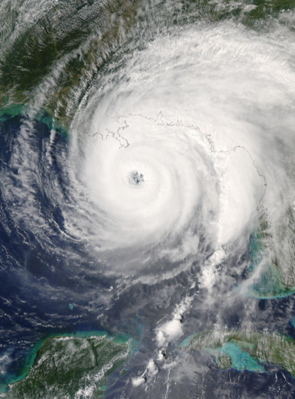
Aug 24 (IPS) – Category Five Hurricane Dean is just the first of several monster storms coming this hurricane season, meteorologists predict.

The United States and other countries remain highly vulnerable, even as budget cuts to the National Aeronautics and Space Administration (NASA) imperil hurricane prediction and research.

“The U.S. will experience landfalls of between two and four major hurricanes this year,” said Gerry Bell, lead seasonal hurricane forecaster at the National Oceanic and Atmospheric Administration (NOAA) Climate Prediction Centre in Maryland.

“In addition to Dean, the Caribbean region can expect two or three more major storms,” Bell told IPS. Continue reading

Pollute for Free – America’s Economic Model

copyright Pembina Institute

If ever there was a project where sustainable accounting is needed, Alberta tar sands oil extraction is it.” — Mindy S. Lubber

Mindy Lubber, president of Ceres, a leading coalition of investors and environmental groups working on sustainability issues notes in this article today that the current “accounting system meant that companies were long able to “externalize” natural resource costs. In other words, they could pollute for free without paying for environmental damage and cleanups. Society and taxpayers shouldered these costs instead.”

Reform of this not-grounded-in-reality accounting and economic system is essential to move towards sustainable societies.

Canada’s oil or tar sands that supply the US with much of its oil is devastating huge swaths of pristine boreal forest, ruining wild rivers and polluting the air of the north Lubber says. For more on the environmental impacts of the biggest industrial project on the planet see Destroying Canada’s Boreal Forest for America’s Oil

Greenland on Verge of Meltdown

Copyright Alfred Wegener Institute for Polar and Marine Research Deniers Jump on NASA Gaff, While Greenland on Verge of Meltdown
By Stephen Leahy

Aug 16, 2007 (IPS) – Scientists warn that climate change tipping points are imminent, and will lead to potentially catastrophic events like a seven-metre sea level rise. Meanwhile, conservatives in the North American media are focusing on a NASA admission of a climate calculation error.

First the error.

Continue reading

Roads Lead to Deforestation in Untouched Peruvian Amazon

Recently-contacted Murunahua man, River Yurua, Peru. He was shot in the eye by loggers during first contact. © David Hill / Survival

Satellites Show Logging Decline in Peruvian Amazon
By Stephen Leahy

Deforestation in the Peruvian Amazon, intense in zones near roads and mining operations, has had little impact in protected forests, say researchers.

Aug 13 (Tierramérica).- Rainforest conservation policies are reducing the rate of deforestation in the Peruvian Amazon, but roads are unquestionably the drivers of change, new satellite data reveal.

Although Brazil’s Amazon forests draw the most international attention, Peru’s 661,000 square kilometers of rainforests are recognized as a unique and important ecosystem.

However, the impacts of human activities throughout the region have been poorly understood, until a study published Aug. 10 in the journal Science.

“Peru’s forest reserves and conservation areas appear to be working well,” said Greg Asner, director of the Carnegie Airborne Observatory, at Stanford University in California.

Continue reading

Who Owns the Arctic?

arctic-oil-rig-on-ice.pngWith Russia planting its flag 14,000 feet under the North Pole yesterday, oil and gas exploration and conflict over territorial rights in the vast Arctic ocean basin is just beginning.

“The Arctic is one of the last frontiers, representing about 25 percent of the last unexplored potential oil and gas reserves in the world,” says Michael Byers, Canada research chair in Global Politics and International Law at the University of British Columbia

Sovereignty Claims Revived in the Arctic
By Stephen Leahy

(Originally published in 2006)

TORONTO, Apr 22 (Tierramérica) – An expedition is under way to help Canada and Denmark prove their sovereignty over certain areas of this frozen region, and its potential sources of petroleum and natural gas.

Canada and Denmark launched a joint expedition in early April to map the floor of the Arctic Ocean and help the two countries prove their claims of sovereignty over areas potentially rich in petroleum and natural gas.

Continue reading

Drowning Country: Tuvalu Symbol of Catastrophe and Hope

Tiny Tuvalu Fights for Its Literal Survival
By Stephen Leahy


Credit:NASA

Funafuti atoll seen from 125 miles above the Eart

VIENNA, Jul 27 (IPS/IFEJ) – The second smallest nation on Earth hopes to turn itself into an example of sustainable development that others can emulate.

But the South Pacific island nation of Tuvalu and its 10,500 people may only have 50 years or less to set that example before it is swept away by rising sea levels due to climate change.

“Construction of the first ever biogas digestor on a coral island is complete,” said Gilliane Le Gallic, president of Alofa Tuvalu, a Paris-based group that is working with the local Tuvaluan government.

Located on a small islet near Tuvalu’s capital of Funafuti, the biogas digester uses manure from about 60 pigs to produce gas for cooking stoves. More importantly, more than 40 Tuvaluans have been trained at the newly opened Tuvalu National Training Centre on renewable energy.

“We are trying to create simple, workable models of sustainable development that can be reproduced by others elsewhere,” Le Gallic, a documentary filmmaker, told IPS from Paris.

Continue reading

Coke Spraying with Roundup Damages DNA in Ecuador/Colombia

New Studies Reveal DNA Damage from Anti-Coca Herbicide
42_330_x62_538622.jpgBy Stephen Leahy

Scientific studies have collected evidence of the negative effects of the glyphosate-based herbicide Roundup on human and animal health. The chemical is used in aerial spraying to eliminate illicit coca crops in Colombia.

TORONTO, Jun 11 (Tierramérica).- U.S.-funded aerial spraying of suspected coca plantations in Colombia near the Ecuador border has severely damaged the DNA of local residents, a new study has found.

Blood samples from 24 Ecuadorians living within three kilometers of the northern border had 600 to 800 percent more damage to their chromosomes than people living 80 km away, found scientists from the Pontificia Catholic University in Quito, Ecuador.

The border residents who were tested had been exposed to the common herbicide glyphosate — sold by the U.S. agribusiness giant Monsanto under the brand Roundup –during a series of aerial sprayings by the Colombian government begun in 2000, part of the anti-drugs and counterinsurgency Plan Colombia, financed by Washington.

The Ecuadorians suffered a variety of ailments immediately following the spraying, including intestinal pain and vomiting, diarrhea, headaches, dizziness, numbness, burning of eyes or skin, blurred vision, difficulty in breathing and rashes, says the study, which is to be published in the journal Genetics and Molecular Biology.

But the extensive damage to DNA (deoxyribonucleic acid) found in the randomly selected individuals may activate the development of cancer or other developmental effects resulting in miscarriages, according to lead researcher César Paz y Miño, head of human molecular genetics at the Catholic University of Ecuador. Continue reading

The Earth is Going Dark Scientists Say

From Big Melt to Big Swamp
By Stephen Leahy


Credit:Mette M.

Spitsbergen glacier in Norway, Arctic Ocean

Jun 5 (IPS) – The Earth is going dark. From the Arctic Ocean to the Himalayan mountains to the Russian tundra, ice and snow are in rapid and permanent retreat in response to global warming, a new U.N. report said Tuesday.

Glaciers, ice sheets, sea and river ice are all melting. The areas in the northern hemisphere covered by snow and ice have declined 1.3 percent per decade for the past four decades. And that’s expected to accelerate dramatically in the coming years.

“Around the Earth, white is being replaced by dark,” said Gunnar Sander of the Norwegian Polar Institute in Tromso, Norway.

The white — snow and ice — reflect sunlight while the dark — bare ground and open water — absorb the heat from sunlight, increasing the pace of global warming.

“This is affecting the heat balance of the planet,” Sander told IPS.

Continue reading