Freelance environmental journalist Stephen Leahy: Going it alone and making it work

Stephen Leahy speaking at Toronto Climate March 2014


With little demand for environmental stories in Canadian mainstream publications, freelance journalist Stephen Leahy faced two options: Give up the beat, or find a new way to make ends meet. Paul Weinberg explains why the 20-year veteran chose the latter and how he is faring.

[Published by the Canadian Journalism Project in 2012]

A committed freelance environmental journalist has discovered a way to cover important—and often unreported—stories and stay electronically in touch with readers without going through a mainstream media intermediary.

Not that Stephen Leahy had any choice in the matter, after finding fewer newspapers and magazines in Canada and abroad buying his stories a few years ago. It was a problem he saw his American colleagues facing in their domestic market as well.

Based in Uxbridge, east of Toronto, he has also found himself one of the few Canadian reporters still covering international conferences where scientists convene over the latest findings on climate, resources depletion, weather, energy, conservation or other environmental issues.

It all came to a head at the 9th World Wilderness Congress (WWC), in Mérida, Yucatán, on November 6, 2009. Leahy and some other fellow freelance journalists —working for such outlets as Reuters and The New York Times—sat down feeling quite discouraged.  Amidst them was the excitement of a weighty conference featuring the likes of high-profile scientist Jane Goodall.

These “highly motivated” journalistic veterans, recounts Leahy, could not sell a single story from this major conference to their traditional mainstream media outlets across North America.

“These guys were making no money. [Most] of us freelancers were making zero money. Fortunately, our hotel and flight costs were covered [by the conservation conference organizers] but we were not making money,” he recalls.

Leahy was the exception, having one regular client, alternative Rome-based global news agency Inter Press Service, which was still keen on receiving his latest story from the conservation meeting for its largely developing world audience.

Searching for alternatives

During that session in Mexico, Leahy and his fellow freelancers engaged in the kind of soul searching that one does when the writing is on the wall. Freelance work involving the covering of international scientific conferences for money had virtually dried up, and so most of these journalists specializing in the environmental were considering packing it in and opting instead for public relations work or a job in academia.

In fact, many of Leahy’s freelancer colleagues had had better contacts among the major buyers of environmental stories in the media during the good times—when the state of the climate and the planet’s fauna and flora was fashionable, he says.  “If they could not make it, how was I supposed to make a go of it?”

Leahy had started covering the environment about 20 years by writing entirely for Canadian newspapers and magazines before expanding eventually into international outlets such as Inter Press, The GuardianNew ScientistAudubon Magazine, Al Jazeera and National Geographic News Watch.

But in the last several years the environmentally-focused publications which had been his bread and butter had either disappeared or were (in the case of Audubon) coming out less frequently because of diminished advertising dollars.

Funding his way—with some help

Earning less freelance income meant that Leahy could not afford to attend as many of the international scientific conferences, which had been his major beat for years.

Rather than give up, Leahy was determined to prove that a market still exists for “independent” environmental journalism and he adopted a funding model to allow him to continue.

Leahy has asked his readers to defray his expenses from travelling and staying in the cities around the world where these international gatherings of scientists continue to meet. Each supporter is asked to send in $10 a month via PayPal or a credit card on his web site to help him continue his work in “community supported environmental journalism.”

“I made a commitment to people that obviously the money is going to be used strictly for journalistic purposes and to stay in touch with them,” he says.

Currently, Leahy has upwards of 300 readers who are offering financial support and feedback on his reporting.

Surprisingly enough, Leahy has not fully taken advantage of Twitter which could really expand his legion of supporters.

“I have been thinking about [social media]. Doing it right takes time. In fact I do spend a significant amount of time fundraising. One of the downsides [of this funding model],” he maintains.

Today, Leahy says he still generates an income below the poverty line. On the other hand, he lives frugally, with support from his long term spouse and family back home. “I don’t have any debts,” he says simply.

Leahy’s funding model was unique at the start but other journalists including those new to the profession are taking a serious gander at doing something similar to financially support their work and in some cases get themselves established.

One of Leahy’s colleagues, for instance, is using an appeal to readers to raise close to $3,000 to pay for a six-week trip to the Democratic Republic of the Congo to research its internal conflicts for an upcoming book.

But Leahy, who is close to 60, says the toll of travelling to eight to ten international conferences annually (often resulting in being outside Canada close to five months a year) and sleeping on supporters’ couches has taken a physical toll on him in the past   year.

“My ultimate hope is to have 10, 20 or 30 younger people doing something similar. I do get quite a few calls from journalism students from around the world and I always have time for them. Folks younger than me understand social media better and they can use it.”

Diminishing coverage of environmental issues

A perennially-losing candidate for the Green Party in federal elections for the Ontario constituency of Durham—where Minister of International Cooperation Bev Oda holds the seat—Leahy has discovered among prospective voters “a hunger” for information on the environment.

“People are really concerned about environmental issues and the state of our democracy. And the second thing is they are so unaware of what is going on in the world, which I think is astonishing,” he says.

The blame for this comes from the disappearance of science issues from the general news programs, Leahy states. He cites as the latest manifestation of this trend—the recent cancellation of CBC News Network’s Connect with Mark Kelly. “It was one of the few sources [for the environment] on broadcast. This is a big blow.”

One of Leahy’s regrets is that with the exception of the alternative online site, Straightgoods.com (which reprints his IPS stories) his articles are largely published outside Canada.

“I started off in Canada, more than 20 years ago, writing 100 per cent for Canadian publications. I used to do weekly columns on environmental issues for daily newspapers that don’t exist,” he said.

Leahy is one of those people who cannot imagine doing anything but journalism.

His funding model, he adds, “has enabled me to continue doing what I think is a pretty useful public service, providing people around the world with information about the important environmental issues.”

CORRECTION: A previous version of this article incorrectly stated that Leahy had been interviewed on Connect with Mark Kelly a couple of times. Though he had been asked to appear, due to scheduling changes or bumps, Leahy has never actually been interviewed on the show.


Help Sustain Independent Environmental Journalism

We Have Five Years to Stop Building Coal Plants and Gas-Powered Cars

Measurement of CO2 levels in atmosphere

By Stephen Leahy

[Authors note: One of the most difficult and important articles I’ve written in 20 years of environmental journalism. Originally published Sept 6 2014 @Vice Motherboard]


Here’s the frightening implication of a landmark study on CO2 emissions:

By 2018, no new cars, homes, schools, factories, or electrical power plants should be built anywhere in the world, ever again, unless they’re either replacements for old ones or carbon neutral. Otherwise greenhouse gas emissions will push global warming past 2˚C of temperature rise worldwide, threatening the survival of many people currently living on the planet.

Every climate expert will tell you we’re on a tight carbon budget as it is—that only so many tons of carbon dioxide (CO2) can be pumped into the atmosphere before the global climate will overheat. We’ve already warmed temperatures 0.85˚C from pre-industrial levels, and the number rises every year. While no one thinks 2˚ C is safeper se, it’s safer than going even higher and running the risk that global warming will spiral out of our control completely.

Last year, the latest Intergovernmental Panel on Climate Change (IPCC) report established a global carbon budget for the first time. It essentially stated that starting in 2014, the carbon we can afford is up to around 1,000 billion tons of CO2. In other words, our cars, factories, and power plants can only emit 1,000 billion tons (1,000 Gt, or gigatons) of CO2 into the atmosphere if we want to have a greater than 50/50 chance of keeping our climate below 2˚C of warming.

Even considering that humanity pumped 36 gigatons of CO2 into the atmosphere last year alone, 1,000 Gt still seems like a big budget. It might even seem like we have room to spare.

Maybe not.

WORLDWIDE, WE’VE BUILT MORE COAL-BURNING POWER PLANTS IN THE PAST DECADE THAN IN ANY PREVIOUS DECADE

New research shows that we may not have been paying attention to the entire CO2 emissions picture. We’ve only been counting annual emissions, and not the fact that building a new coal or gas power plant is in reality a commitment to pumping out CO2 for the lifespan of a given plant—which usually ranges from 40 to 60 years. These future emissions are known as a carbon commitment.

A new study has tallied the carbon commitments from all existing coal and gas power plants by looking at their annual CO2 emissions and current age. The study assumes an operating life of 40 years. A 38-year old coal plant will have far smaller future CO2 emissions, and thus smaller carbon commitment than one built today. The study, “Commitment accounting of CO2 emissions,” determined that most new power plants that went online in 2012 have a very large carbon commitment—19 Gt of CO2.

Building new power plants means more carbon commitments to eat into our 2˚C carbon budget. Build enough giant coal plants today, and their future emissions would tie up the entire budget, leaving no room for any other source of CO2 emissions.

Meanwhile, the rate at which new plants are built far outpaces the closure of old plants. Many US coal plants operate for longer than 40 years; the oldest is currently around 70 years.

“Worldwide, we’ve built more coal-burning power plants in the past decade than in any previous decade, and closures of old plants aren’t keeping pace with this expansion,” said study co-author Steven Davis of the University of California, Irvine.

Image: Flickr

Fossil Fuels Power Plant Carbon Commitment: 300 Gt

In the study, Davis and co-author Robert Socolow of Princeton University calculated that the existing coal and gas power plant carbon commitment turns out to be very large—more than 300 Gt.

Non-Power Plant Carbon Commitment: 400 Gt 

The reality of carbon commitment applies to any new fossil-fuel burning infrastructure, including office buildings and homes using gas heating or automobiles and planes burning jet fuel. All of these have an operating life of several or many years during which they will emit CO2 from now until they are ‘retired.’ These future emissions also count as a carbon commitment. In another upcoming study, Davis calculated the carbon commitments from other CO2 sources, including from the transport, industry, commercial and residential sectors. He estimates that as of 2013 this carbon commitment exceeded 400 Gt.

Together with the power plant commitment of 300 Gt laid out in the current study, that’s more than 700 Gt in carbon commitments on a global carbon budget of 1000 Gt. That leaves less than 300 Gt for future power plants, steel mills, cement plants, buildings, and other stuff that burns fossil fuels.

At current rates we’ll have accounted for the remainder of the budget in only five years.

Here’s how it breaks down:

Estimated Annual Emissions 2014-2018: 200 Gt

Global CO2 emissions from all sources amounted to 36 Gt in 2013. Annual emissions have been growing at a rate of 2 to 3 percent per year. Without major efforts to reduce emissions, another 200 gigatons of CO2 will be emitted between 2014 and 2018.

Estimated New Carbon Commitments 2014-2018: 100 Gt

Davis and Socolow determined that carbon commitments from new fossil fuel burning infrastructure will average at least 20 Gt per year, totaling 100 Gt over five years.

300 + 400 +200 +100 = 1,000 Gigatons of Carbon, Locked in by 2018

Unless coal and gas power plants or other major sources of CO2 are shut down before the end of their life span, the 1,000 Gt global carbon budget will be fully allocated sometime in 2018. No one will notice, because things won’t look or feel too much different than today. CO2 is akin to a slow, trans-generational poison. The climate impacts of blowing the carbon budget won’t be felt until 2030 or 2040 —and for a long time after.

WE’VE BEEN HIDING WHAT’S GOING ON FROM OURSELVES: A HIGH-CARBON FUTURE IS BEING LOCKED IN BY THE WORLD’S CAPITAL INVESTMENTS

Even the climate experts won’t notice much, because annual CO2 emissions have been the sole focus of countries and the United Nations process to address climate change said Davis.

“That’s like driving down the highway and only looking out of the side window,” Davis told me.

Politicians, business leaders, investors, planners, bureaucrats and whole lot of other people should be looking out the front window and paying attention to the hard reality of carbon commitments. If Davis and Socolow’s calculations are correct, it means no new coal or gas power plants can go online after 2018 unless they’re replacing retired plants. It means freezing the size of the global automobile fleet, and the industrial and commercial sectors, unless their energy efficiency increases. And so on.

The fact that much of our current and future infrastructure carries huge carbon commitments is blindingly obvious, but receives little attention.

Can’t solve a problem by making it worse

“If you build it, there will be emissions year after year. This should be a fundamental part of the decision to build most things,”” Davis said.

Ignoring the reality of carbon commitments means we’re investing heavily in technologies that make the problem worse, he said.

“We’ve been hiding what’s going on from ourselves: A high-carbon future is being locked in by the world’s capital investments,” said co-author Robert Socolow. Any plan or strategy to cut CO2 emissions has to give far greater prominence to those investments. Right now the data shows “we’re embracing fossil fuels more than ever,” Socolow told me.

So what can we do to begin to prepare for a jam-packed carbon budget? First, we need to stop building fossil fuel-reliant power plants.

Surprisingly, it appears the Australia is a pioneer here, despite recently rolling back its pioneering carbon tax. Thanks to wide-spread adoption of solar energy on homes and business the country’s electricity use is in steep decline. For the first time in its history, no new coal or gas power capacity will be needed to maintain supply over the next 10 years, according to the Australian Energy Market Operator. Germany too is rapidly adopting clean energy sources like wind and solar, so as to avoid building coal or nuclear power.

Next, we need to think about meeting energy demand by improving efficiency, instead of building more power generation.

Potential energy efficiency gains of 50 percent are possible across many sectors in most countries, Socolow said, and could reduce the number of fossil fuel energy power plants.

The US is the king of energy waste by most estimates. This costs Americans an estimated $130 billion a year, according to the Alliance to Save Energy. But despite the potential for huge cost and emission reductions, governments everywhere put nearly all their energy research efforts into new sources of energy like new power plants rather than helping to develop energy-efficient cars, buildingsm and appliances. It’s 2012 international study also found that improving energy efficiency provides by far the best bang-for-the-buck for energy security, improved air quality, reduced environmental and social impacts and carbon emission reductions.

However, efficiency improvements take time, and there is precious little time left to make the CO2 emissions cuts to stay below 2˚C, said Socolow.

While refusing to say a planet that’s 2˚C hotter is inevitable, he did say that all efforts to reduce emissions must be undertaken as soon as possible: “3˚C is a whole lot better than 5˚C, the current path we’re on.”

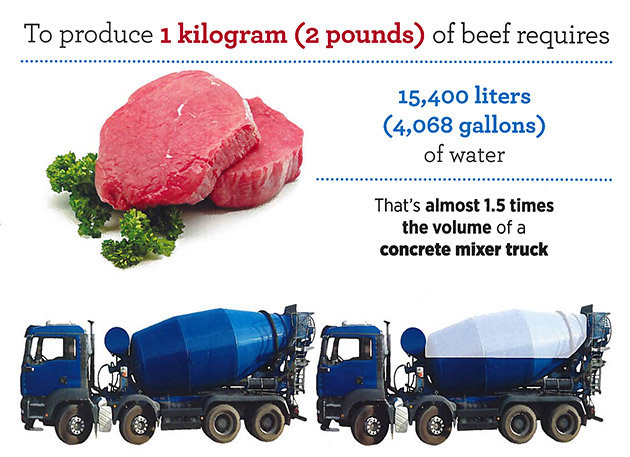
My breakfast took 1100 litres (290 gal) of water to make – how much was yours?

meat sample

( Graphic from  ‘Your Water Footprint’) 

I have a confession: I used 1100 litres of water to make my breakfast today. It was nothing special, just a small glass of orange juice, a cup of coffee, two eggs, toast and two pieces of bacon. But it did take 1100 litres of water to grow and process the ingredients. Thats a whole lot of water considering the average bathtub only holds about 80 litres.

Even after 20 years of covering environmental issues in two dozen countries I had no idea of the incredible amounts of water needed to grow food or make things. Now, after two years working on my book Your Water Footprint Im still amazed the T-shirt Im wearing needed a whopping 2500 litres to grow and process the cotton. Or that 140 litres was needed to grow and process the coffee beans to make my morning coffee. Since a litre of water weighs a kilogram, thats 140 kilos of water, imagine having to haul that much in a bucket every morning!

Your Water Footprint wins Lane Anderson award as best Canadian Science book for general public

Water more valuable and useful than oil

Researching all of this I soon realized were literally surrounded by a hidden world of water. Although we cant see it, there is water in everything we eat, everything we use and buy. Almost anything you can think of – cars, furniture, books, dishes, TVs, highways, buildings, jewelry, toys and even electricity would not exist without water.

Its no exaggeration to say water is far more valuable and useful than oil.

Unfortunately, water is often taken for granted and undervalued, resulting widespread misuse and waste. The idea behind my book is to increase awareness of huge quantities of the hidden water our entire way of life depends on. Your Water Footprint uses colourful infographics to illustrate the size of the water footprints of a wide range things from shoes to whiskey. A water footprint is the amount of water consumed’ to make, grow or produce something. I use the word consumed to make it clear this is water that can no longer be used for anything else. Water can often be cleaned or reused, so those amounts of water are not included in the water footprints in the book.

For example, when you drink a half-litre of bottle water youre actually consuming 5.5. litres. Why so much? Making the plastic bottle consumed 5 litres of water.

After poring through many studies on water footprints, I was really surprised to see how tiny my direct use of water for drinking, cooking, showers and so on was by comparison. Each day the average North American uses 300 to 400 litres. (FYI: Flushing toilets is the biggest water daily use, not showers.) Now, 400 litres is not a trivial amount of water, and we can all get by using less by employing some water-savings tips.


How big is your water footprint? Take a quick test


However, compared to the hidden water, also known as virtual water, thats in the things we eat, wear and use for a day averages an incredible 7500 litres. That means our daily water footprint is almost 8,000 litres (direct + hidden freshwater use). Carrying all this water would be like trying to haul the weight of four mid-size cars every day.

Peak water is here

Water scarcity is a reality in much of the world. About 1.2 billion people live in areas with chronic scarcity, while two billion are affected by shortages every year. That’s two in seven people. And as the ongoing drought in California proves, water scarcity is increasing reality for many of us in the US and Canada. Water experts estimate that by 2025, three in five people may be living with water shortages.

While low-flow shower heads and toilets are great water savers, the water footprint concept can lead to even bigger reductions in water consumption. If a family of four replaced beef with chicken in all their meals, they would reduce their water use an astonishing 900,000 litres a year. That’s enough to fill an Olympic-sized pool to a depth of two feet. The reason is the water footprint of beef is four times larger than chicken.

Vegetables have an even smaller water footprint. If the average family liked the idea of “Meatless Mondays,” they’d save 400,000 litres of water a year.

My hope with Your Water Footprint is to give you enough information to make water-wise choices to reduce your water use which will help you save money, be prepared for shortages and ensure our children and grandchildren will have abundant fresh water. This is all about smart substitutions and changes, rather than sacrifice and self-denial.

To do this we need to know how much we are currently using. We can’t make the water-wise choices unless we begin to see and understand the invisible ways in which we rely on water.

Stephen Leahy is an award-winning environmental journalist based in Uxbridge, Ontario, Canada. He is the author ofYour Water Footprint: The Shocking Facts About How Much Water We Use to Make Everyday Products.

(First published Yahoo Canada News – Mon, 8 Sep, 2014)

Your Water Footprint: The Shocking Facts About How Much Water We Use to Make Everyday Products 

Only $19.95 paperback; 160 pages, 125 unique infographics,

also available as Kindle and in other ebook formats

In US:  AmazonPowell’s Books; Barnes&NobleIndiebound

Canada:  Chapters-Indigo Signed copies avail at Blue Heron Books – Stephen’s home town bookstore; In Ottawa visit the legendary Octopus Books

UK:  WH SmithAmazonWaterstones

Australia: Angus & RobertsonBooktopia

New Zealand: Mighty Ape

Keystone XL Pipeline Carbon Emissions Top 100 Million Tons a Year

The Keystone XL oil pipeline could put up to 110 million tons of additional climate-heating CO2 into the atmosphere every year for 50 years, according a study publishedSunday in the journal Nature Climate Change.

If Keystone XL was a country, its 110 million tons of CO2 emissions would be comparable to those of the Czech Republic, Greece, and a number of other mid-sized European nations. And it could have a real shot at making the top 35 worst carbon polluting countries in the world.

The study notes that 110 million tons of CO2 is four times more emissions than the US State Department’s highest estimate for the controversial pipeline, which is currently undergoing an environmental review.

The State Department failed to account for the potential emissions from the increase in the global supply of oil, said study co-author Peter Erickson, a researcher with the US office of the Stockholm Environment Institute (SEI), an independent international research institute.

This new study is an update to an SEI working paper Motherboard reported on last December. At that time the estimated CO2 emissions from Keystone were 93 million tons, but that’s climbed higher with the benefit of updated information.

“This time it’s gone through the ringer of peer-review and is a far clearer and more direct version of the previous paper,” Erickson said in an interview. “It’s also generated a lot more media interest this time.”

The study shows how Keystone XL’s projected daily volume of 830,000 barrels of Canada’s bitumen oil could slightly lower oil prices on the global market and increase global consumption. More precisely, for every barrel of increased production, global oil consumption could increase by 0.6 barrels owing to the incremental decrease in global oil prices, Erickson said.

This finding is potentially crucial because of President Obama’s prior statement that he will only approve Keystone, “if this project does not significantly exacerbate the problem of carbon pollution.”

The decision remains largely in Obama’s hands because Keystone XL crosses national borders. The current plan is for a 1,200-mile, 36-inch diameter pipe to be built from Hardisty, Alberta to Steele City, Nebraska. The $7 billion pipeline will bring tar sands bitumen from under the frozen forests and lakes of northern Alberta to the world market, and will help the region’s booming oil operations expand even further. XL is part of a larger 2,500-mile Keystone pipeline system that terminates on the Texas Gulf Coast and is owned and operated by energy company TransCanada.

In 2012, Obama rejected TransCanada’s application because the pipeline route was through Nebraska’s environmentally sensitive Sandhills region. A few months later, TransCanada re-applied with a new pipeline route. The State Department is now doing an environmental review using energy consulting company Environmental Resources Management, which is expected to be completed next year.

Building more oil infrastructure is exactly the wrong thing to be doing when the world is struggling to reduce CO2 emissions. The SEI report pegs global investment in oil and gas infrastructure at $700 billion per year for the next 20 years, based on data from the International Energy Agency, along with considerable investment in coal.

That investment will only burn through our carbon budget faster than we are now. According to the IEA’s 2013 World Energy Outlook, which is one of the top energy reports annually, some two-thirds of our proven fossil fuel reserves must stay in the ground to avoid heating the planet by more than two degrees Celsius by 2050. That’s a threshold set by the US and other nations who have made climate change mitigation pledges.

However, SEI study co-author Michael Lazarus said last December that the CEOs, board members, bankers, and government officials who make the decisions to build new infrastructure won’t even talk about cutting back. “It seems to be off limits to talk about cutting back on fossil fuel extraction,” he said.

Presumably, these folks also aren’t talking about the disastrous environment all of us will be trapped in if we heat the planet by those two degrees and beyond. We can’t quit oil immediately because it will take time to build an alternative energy infrastructure. However, at this point it makes little environmental sense to build new pipelines like Keystone XL to increase access to tar sands bitumen, the world’s dirtiest form of oil.

UN Climate Talks End In Dramatic Showdown But Little Progress

COP 19 Final Showdown between US and Fiji

By Stephen Leahy

WARSAW, Nov 24 2013 (IPS)

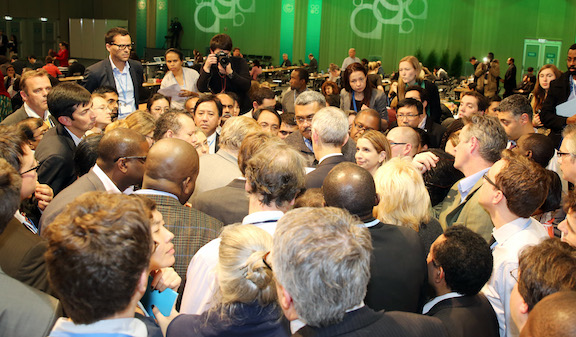
The U.N. climate talks in Warsaw ended in dramatic fashion Saturday evening in what looked like a schoolyard fight with a mob of dark-suited supporters packed around the weary combatants, Todd Stern of the United States and Sai Navoti of Fiji representing G77 nations.

It took two weeks and 36 straight hours of negotiations to get to this point.

At issue in this classic North versus South battle was the creation of a third pillar of a new climate treaty to be finalised in 2015. Countries of the South, with 80 percent of the world’s people, finally won, creating a loss and damage pillar to go with the mitigation (emissions reduction) and adaptation pillars.

Super-typhoon Haiyan’s impact on the Philippines just days before the 19th Conference of the Parties (COP19) amply illustrated the reality of loss and damages arising from climate change.  Philippines lead negotiator Yeb Saño made an emotional speech announcing “fast for the climate” at the COP19 opening that garnered worldwide attention, including nearly a million YouTube views

Click for complete story


Japan Bails Out on CO2 Emissions Target

cop presidentBy Stephen Leahy

WARSAW, Nov 15 2013 (IPS)   Japan announced Friday that it will renege on its carbon emissions pledge, likely ending any hope global warming can be kept to 2.0 degrees C.

The shocking announcement comes on the fifth day of the U.N. climate talks in Warsaw known as COP19, where more than 190 nations have agreed to a 2.0 C target and are trying to close the carbon emission gap to get there.

“It’s like a slap in the face of those suffering from the impacts of climate change such as the Philippines.” — Wael Hmaidan

Japan will increase that gap three to four percent with its new 2020 reduction target, according to the Climate Action Tracker (CAT). It amounts to a three-percent increase compared to a 1990 baseline. Japan’s 2009 Copenhagen Accord pledge was a 25 percent reduction by 2020.

“Japan is taking us in the opposite direction,” Marion Vieweg of Climate Analytics, a German climate research organisation, told IPS here in Warsaw.

“Their revision shows the bottom up approach is not working if countries can simply drop their pledges at any time,” Vieweg said.

Climate scientists have long maintained that the 2020 target for industrialised countries should be to reduce emissions 25-40 percent compared to a 1990 baseline. However, even if nations meet their current climate pledges under the Copenhagen Accord, CO2 emissions in 2020 are likely to be eight to 12 billion tonnes higher than what’s needed, according to the U.N. Environment Programme’sEmissions Gap Report 2013.

Japan, the fifth largest emitter of CO2, is just the latest to abandon its international commitments.

The Bigger Canada’s Energy Sector Gets the Poorer People Become

By Stephen Leahy

Thu, 2013-03-21 05:00 DeSmog Canada

Blame Canada is a four part series revealing how Canada has become a wealthy, fossil-fuelled energy superpower and an international climate pariah. For Part 1, click here. Part 2 here

Few are aware Canada’s GDP shot up from an average of $600 billion per year in the 1990s to more than $1.7 trillion in 2012. This near tripling of the GDP is largely due to fossil fuel investments and exports.

However not many Canadians are three times wealthier. For one thing GDP is only a measure economic activity. The other reason is that little of this new wealth stayed in Canada. And what did stay went to a small percentage of the population, worsening the gap between rich and poor.

One of the hallmarks of a “petro-state” is that while a country’s energy industry generates fantastic amounts of money, the bulk of its citizens remain poor. Nigeria is a good example. Canada’s poverty rates have skyrocketed in step with the growth of the energy sector. One Canadian child in seven now lives in poverty, according to the Conference Board of Canada, the country’s foremost independent research organization.

Income inequality increased faster than the US, with the rich getting richer and poor and middle class losing grounds over the past 15 to 20 years, the Conference Board also reported January 2013.

“Most of Canada’s increase in wealth went to the big shareholders in the resource industries,” says Daniel Drache, a political scientist at Toronto’s York University. “It mainly went to the elites.”

Full Story: http://desmog.ca/2013/03/20/blame-canada-part-3-bigger-canada-s-energy-sector-gets-poorer-people-become_

Canada Uses Foreign Aid to Promote Its Mining/Energy Sector

mining gaia

The absorption of Canada’s aid agency into the foreign affairs and international trade ministry has been widely condemned

By Stephen Leahy

Monday 25 March 2013 17.37 GMT theguardian.com

Following the unexpected announcement that the Canadian International Development Agency (Cida) will be folded into the ministry of foreign affairs and international trade, the Canadian government has made it clear there must be a direct return on its aid “investment”, primarily access to resources in other countries.

“It is a fundamental change. Canada is tying aid to its commercial interests. This is going to leave a bitter taste out there,” says Samantha Nutt, executive director of War Child Canada, which has received CIDA funding for more than a decade.

As Nutt acknowledges, all aid is politicised to some extent. But Canada has taken this to a new level. Civil society aid organisations working with CIDA are no longer aid delivery partners but sub-contractors, bidding on aid programmes and increasingly forced to work with the private sector, says Nutt.

“This puts Canadian aid organisations in ethical conflict. How can they criticise the actions of the mining companies they have to work with to get funding to help the poor?”

Cida’s fate has startled not only Canada’s foreign aid community but, by all accounts, Cida staff, who learned of the agency’s fate through the media.

The new department of foreign affairs, trade and development will continue to tackle poverty in developing countries with its $4.8 billion aid budget intact, the government said.

“This is Canadian money … Canadians are entitled to derive a benefit,” said international co-operation minister Julian Fantino last December, adding that Cida is working with the private sector to help Canada “maintain a global advantage”.

Full story

Canada’s Plan to Get Rich by Trashing the Climate

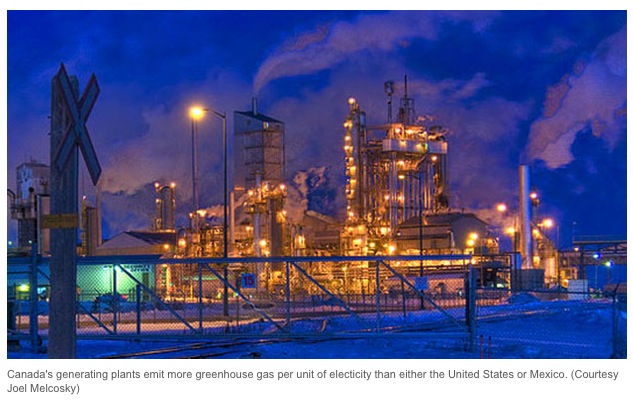
Canada's fossil fuel electricity has highest carbon emissions

By Stephen Leahy

Blame Canada is a four part series revealing how Canada has become a wealthy, fossil-fuelled energy superpower and an international climate pariah. For Part 1, click here.

Like every other country in the world, Canada has promised to help keep global warming to less than 2 degrees C. However Canada’s political and corporate leadership are committed to turning the country into a fossil-fuelled “energy superpower.”

With a drug lord’s just-providing-a-service hypocrisy Canada has openly declared it’s future is tied to the profits from dumping hundreds of millions of tonnes of climate-heating carbon into the atmosphere every year.

And the world’s new energy superpower plans to grow those annual emissions to 1.5 billion tonnes by 2020 giving one of the least populated countries a gigantic carbon bootprint.

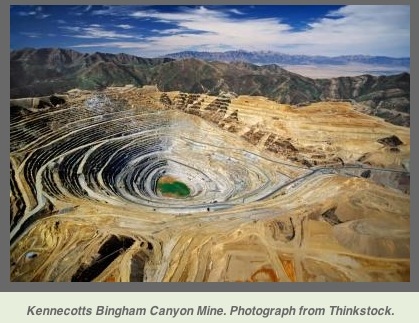
Most of this climate-wrecking carbon energy will come from Canada’s tar sands located just underneath the pristine boreal forest and wetlands of northern Alberta. The oil industry likes to call them “oil sands,” although there is no liquid oil only a tarry bitumen mixed deep in the sandy soil.

With an estimated 170 billion barrels, the tar sands are the third largest crude oil reserves. Extraordinary efforts involving colossal amounts of water, heat, chemicals and machinery are needed to get the bitumen out of the ground and into pipelines. This the world’s largest industrial project with more than $300 billion invested since 2001 by the oil industry.

Nowhere has fossil energy expansion or investment been faster or larger. Environmental activists call it “Canada’s Mordor.”

Who Wants a Sustainable, Pollution-Free New York by 2030?

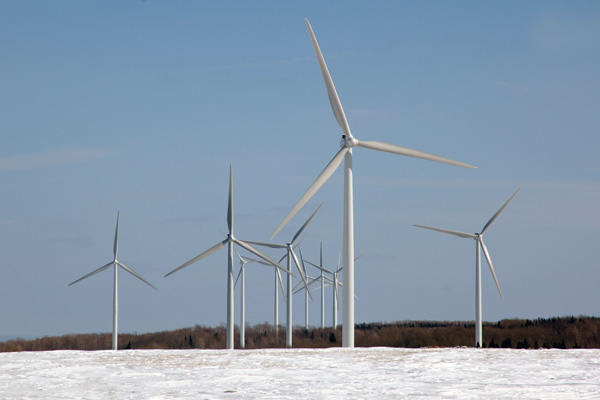
Wind turbines on the Tug Hill plateau in upstate New York

By Stephen Leahy

UXBRIDGE, Canada, Mar 19 2013 (IPS)

As usual, midtown Manhattan is packed with whisper-quiet cars and trams while thousands walk the streets listening to the birds of spring sing amongst the gleaming, grime-free skyscrapers in the crystal-clear morning air.

Welcome to New York City in April 2030.

I think the public will be 100 percent behind this, if they know about it.

This is not a fantasy. It is a perfectly doable goal, said Stanford University energy expert Mark Jacobson. In fact, the entire state of New York could be powered by wind, water and sunlight based on a detailed plan Jacobson co-authored.

It’s not only doable, powering New York on green energy is “sustainable and inexpensive” and would save lives and health costs, Jacobson told IPS.

Each year, air pollution kills 4,000 people in New York State and costs the public 33 billion dollars in health costs, according to the study Jacobson co-authored with experts from all over the U.S. It will be published in the journal Energy Policy.

Full Story