Hurricane Sandy Speaks: Storm Surge Flooding Warning: “I have too much energy”

I’m sorry to say that I have so much wind energy from the warm ocean water I am pushing the sea into your living rooms along the mid-Atlantic coast. The ocean is like a bowl full of water, blow hard enough on an angle and it will readily spill over.

Read full post at Hurricane Sandy Speaks (crosspost)

Sandy Says: Not “Targeting” New York or Anywhere Else

To be absolutely clear: I am not “targeting” New York City or anywhere else. I am pushed and pulled by temperature and pressure differences. My winds are powered by warm water and moisture. And there is enough heat and moisture for my winds to make 12-foot high waves over a 3 million sq km area – one third the size of the US.

Read full post at Hurricane Sandy Speaks (crosspost)

Historic SuperStorm Sandy Heading for New York City

Sandy here again. Early this morning I turned north-northwest and am about 500 km (300 mi) southeast of New York City. I am probably the largest storm on record, spanning 3,200 km (2000 mi). I wanted to stay out at sea but a massive band of cold air and low pressure over the Great Lakes region has pulled me in this direction. The coming collision between very cold and moist, warm air will make me more powerful and dangerous: a historic SuperStorm.

Read full post at Hurricane Sandy Speaks (crosspost)

Hothouse Needed for Green Energy, Green Ideas Revolution

Concentrated Solar Power plant of Ain Beni Mathar, Morocco is a first in the world.

Countries cannot afford to miss the green wave of Rio+20

No alternative to low-carbon, resource-efficient economies

By Stephen Leahy

UXBRIDGE, Canada, May 25, 2012 (IPS)

Think of Rio+20 as the hothouse to grow the green ideas and values humanity needs to thrive in the 21st century.

No one is expecting, or even wants, a big new international treaty on sustainable development said Manish Bapna, interim president of the World Resources Institute, a global environmental think tank based in Washington, D.C.

“The important action will be on the sidelines of the formal negotiations,” Bapna told IPS in an interview.

Blocs of countries, civil society organisations and representatives of business will meet, create coalitions and make commitments on specific issues and on regional concerns.

“There could be some exciting specific commitments coming out of Rio,” Bapna said.

Perhaps the most important outcome from Rio+20 would be to put to rest the erroneous belief that protecting the environment comes at the cost of economic growth when it is in fact the opposite. Without a healthy, functioning environment, humanity loses the benefits of the environment’s “free products”: air, water, soil to grow food, stable climate and so on.

“One of the big hurdles to a sustainable future is that officials in many countries think they can’t afford to move onto a more sustainable pathway,” he said.

Bapna hopes Rio+20 will generate a “new narrative” – a wider understanding that there is no viable alternative to the transition to low-carbon, resource-efficient economies that alleviate poverty and create more jobs. Continue reading

My recent articles only touch on some of the significant problems with fracking. There’s more to come. (And check out trailer for the new fracking movie starring Matt Damon http://bit.ly/TC8qNB) —  Stephen

Stephen's avatarStephen Leahy, International Environmental Journalist

UPDATE Jan 2013:

Yet another study reveals fracking has a huge problem of gas leaks. Up to  9% of the gas pumped out of the ground leaks into the atmosphere according to a study by National Oceanic and Atmospheric Administration (NOAA) published in Nature this week. Natural gas (methane) is a powerful greenhouse gas. If these leaks are widespread, fracking is worse than burning coal, accelerating global warming.

In Jan 2012 I detailed new research in the article below showing that replacing coal with natural gas from fracking does little to fight climate change (see below). Now two studies published that since then make an even stronger case that fracking for natural gas is a HUGE MISTAKE:

From Nature: Air sampling reveals high emissions from gas field. Methane leaks during production may offset climate benefits of natural gas.

From Environmental Research Letters: New study demonstrates switching to natural…

View original post 1,145 more words

Common Pollutant as Bad as PCBs?

“They’re crumbling out of couches…”

Blast from the past:  my previously published article on topic that’s back on front pages – Stephen

By Stephen Leahy

Wired News May 22 2004

Scientists reported this week that gull eggs in the Great Lakes region contain rising levels of a contaminant that could be as dangerous as the PCBs banned in the 1970s.

The contaminant, called polybrominated diphenyl ethers, or PBDEs, is used mainly as a flame retardant in upholstered furniture, computers, TVs, carpets and drapes.

While concentrations of the chemical have been shooting upward, doubling approximately every three years since the early 1980s, scientists have yet to investigate the environmental risks the substance poses.

Ross Norstrom, an adjunct chemistry professor at Carleton University in Ottawa, told the Toronto Globe and Mail that, “There is no reason to believe that these things will be any different than the PCBs.”

High levels of PBDEs are also being found in household dust, two new studies report this week. “PBDEs are everywhere,” said Bill Walker of the Environmental Working Group, a nonprofit research group in Washington, D.C., that conducted one of the studies.

“They’re crumbling out of couches and migrating out of plastics and TVs and getting into people’s blood and women’s breast milk,” Walker said in an interview. PBDEs are also being detected in just about every animal and fish around the world.

Lab research on animals shows PBDEs disrupt thyroid hormones, which can impact the developing brain and have other harmful effects. Newborn mice exposed to PBDEs have learning and motor-skill problems, and at least one form of the chemical is carcinogenic.

European countries have banned two of the three main forms of PBDEs, and U.S. manufacturers are also taking them off the market by year’s end. New research shows that the most heavily used remaining form, called “deca,” breaks down into one of the more toxic forms and ought to be banned as well, Walker said.

Many computer and electronics manufacturers such as IBM, Apple Computer and Toshiba are ahead of the curve and eliminating PBDEs from their products. “It also makes good economic sense because other countries are banning them too,” said Walker.

Global Forest Decline with Warming Temperatures Scientists Warn

Image

Forests diebacks are taking place all around the world. The evidence is quite sobering,” said tropical biologist Daniel Nepstad of IPAM in Belem, Brazil.

This reinforces the urgent need to reduce emissions of fossils fuels and to develop a global land strategy to turn sources of CO2 into sinks for CO2, he said.

“Most of the evidence shows climate change is speeding up. Meanwhile political action on climate is slowing down,” Nepstad added.

–From a previous post on how the loss of trees to deforestation, drought and disease is accelerating climate change.

Trashing the Oceans: 3 to 6 X More Trash Than Plankton – ‘Using Oceans as Universal Sewer’ — Cousteau

This is a repost from last year. Sad to see  little progress on this issue. — Stephen

“There is no reason for delay. Governments and industry need to take action and people have to stop pointing fingers at each other and get on with it.”

California nearly became the first U.S. state to ban plastic bags, but a multi-million-dollar lobby effort by industry killed the proposed legislation

By Stephen Leahy

HONOLULU, Hawaii, U.S., Mar 28, 2011 (IPS)

Every day, billions of plastic bags and bottles are discarded, and every day, millions of these become plastic pollution, fouling the oceans and endangering marine life.

No one wants this, but there is wide disagreement about how to stop it.

“Every time I stick my nose in the water, I am shocked. I see less and less fish and more and more garbage,” said Jean-Michel Cousteau, son of the legendary marine ecologist Jacques Cousteau, who has spent four decades making documentaries and educating people about the oceans.

Please throw something in the tip jar before reading on. This is how I make my living.

On trips to the remote and uninhabited northwestern Hawaiian Islands, Cousteau found miles and miles of plastic bottles, cigarette lighters, television tubes, spray cans, broken toys, and thousands of other pieces of plastic on the beaches and thousands of tonnes of derelict fishing nets in the reefs.

“We are using the oceans as a universal sewer,” he told some 440 participants from the plastics manufacturing, food and beverage sectors, environmental organisations, scientists and policy-makers from over 35 countries at the Fifth International Marine Debris Conference in Honolulu, Hawaii, which ended Mar. 25. Continue reading

Eliminate GDP and Economic Growth to Create the Real Green Economy Indigenous Peoples Say

Wind-solar electricity generation built by indigenous Telengits community in Russia's Altai  Mountains.   Photo:  Foundation for Sustainable Development of Altai

Wind-solar electricity generation built by indigenous Telengits community in Russia’s Altai Mountains. Photo: Foundation for Sustainable Development of Altai

by Stephen Leahy

First published at National Geographic’s NewsWatch

The planet is in peril, 3,000 scientists and other experts concluded at the recent Planet Under Pressure conference in London. Climate change, overuse of nitrogen and loss of biodiversity are just three of the perils threatening to make much of our home uninhabitable.

World leaders will meet in Rio de Janeiro June 20-22 to address this at the Rio+20 Conference, 20 years after the very first Earth Summit.

Rio+20 needs to be the moment in human history when the nations of the world come together to find ways to ensure ‘the very survival of humanity,’ environmentalists and scientists have said.

A “Green Economy” will be one of the main ideas under discussion in Rio. The idea is to make a transition to an economic system that maximizes human well-being while operating within the planet’s environmental limits. Exactly how this could be accomplished has yet to be defined.

The current economic system rewards those who exploit and destroy nature, said Vicky Tauli-Corpuz, Executive Director, Tebtebba (Indigenous Peoples’ International Centre for Policy Research and Education).

The current system hinders and even blocks Indigenous peoples from practicing their traditional ways of living that actually represent “a real green economy” that can be sustainable, achieve well being and are climate-friendly, said Tauli-Corpuz, a member of the indigenous Kankana-ey Igorot community in the Philippines.

Please throw something in the tip jar before reading on. This is how I make my living.

Continue reading

Rio+20: The Moment in History to Ensure Our Future Survival?

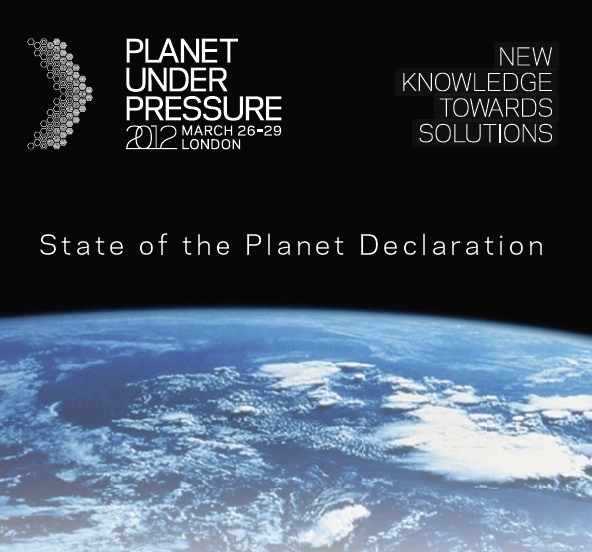
Planet Under Pressure - State of the Planet Declaration Mar 29 2012.

Worlds’ Scientists Say Facing “Planetary Emergency”

By Stephen Leahy

UXBRIDGE, Canada, (IPS)

The upcoming Rio+20 conference has to be the moment in human history when the nations of the world come together to find ways to ensure the very survival of humanity, many science and environmental experts believe.

Except that governments, the media and the public aren’t paying attention to the “planetary emergency” unfolding around them. The situation is like firefighters yelling “fire” in crowded room and still no listens.

“The situation is absolutely desperate and yet there’s nothing on the front pages or on the agenda of world leaders,” said Pat Mooney, executive director of the ETC Group, an international environmental organisation based in Ottawa.

“The lack of attention is a tragedy,” said Mooney, who has 40 years experience in international environment and development issues.

Humanity is failing in its stewardship of the planet. An incredible 85 percent of the world’s oceans are in trouble, said Susan Lieberman, director of international policy at the Pew Environment Group, a U.S. organisation.

Rio+20 is a major opportunity to turn this around, Lieberman told IPS.

The Jun. 20-22 Rio+20 meet is timed to coincide with the 20th anniversary of 1992 Earth Summit in Rio de Janerio. The Earth Summit captured world attention, with leaders from most countries and some 10,000 media attending.

It gave birth to the most important environmental treaties on climate change, biodiversity and land degradation and desertification. World leaders also endorsed Agenda 21, a detailed blueprint on how nations can practice sustainable development.

Years of preparation went into the 1992 Summit, while only months have gone into Rio+20.

“There hasn’t been nearly enough preparation to be able to sign treaties,” said Lieberman. It’s been a struggle to get many governments like such as the US to focus on Rio+20 at all she said.

“Governments are not giving this opportunity enough importance given the mess we are in,” said Lisa Speer, director of the international oceans programme at the Natural Resources Defense Council, a U.S. NGO. Continue reading