Runaway Global Economy Decimating Nature — World Bank Offers A Solution

By Stephen Leahy

NAGOYA, Japan, Oct 28, 2010 (IPS)

One-fifth of all birds, fish and animals are threatened with extinction – as many as six million unique and irreplaceable forms of life – an authoritative new assessment warned Wednesday.

Deforestation, agricultural expansion, overfishing, invasive alien species and climate change are the specific causes, but the main engine of destruction is an economic system that is blind to the reality that there is no economy or human well-being without nature, experts here say.

“Without global conservation efforts the situation would be massively worse,” noted Simon Stuart, chair of the International Union for Conservation of Nature (IUCN) Species Survival Commission, which launched the study at the 10th Conference of the Parties to the Convention on Biological Diversity (CBD) in Nagoya, Japan.

Published in the peer-reviewed journal Science, it is the most comprehensive assessment ever done of the world’s vertebrates – mammals, birds, amphibians, reptiles and fishes – Stuart said.

Every year, 52 species of mammals, birds and amphibians move one step down a three-step path to extinction, according to the study, which utilised data for 25,000 species from the IUCN Red List of Threatened Species.

Southeast Asia has experienced the most dramatic recent losses, largely driven by the planting of export crops like oil palm, commercial hardwood timber operations, agricultural conversion to rice paddies and unsustainable hunting, the study found. Parts of Central America, the tropical Andes of South America, and even Australia have also all experienced marked losses, in particular due to the impact of the deadly chytrid fungus on amphibians.

“The backbone of biodiversity is being eroded,” said the eminent U.S. ecologist and writer Edward O. Wilson of Harvard University.

Is this article of interest? It exists thanks to contributions from readers. Please click here to learn more about Community Supported Journalism.

Continue reading

Tackling Climate Change Only Way to Halt Species Extinction Crisis and Declines

An IPCC for Species Needed

By Stephen Leahy

NAGOYA, Japan, Oct 26, 2010 (IPS)

A major change in the direction of economic development is essential to avoid the catastrophic unraveling of Earth’s ecosystems that support all life, a new global analysis published in the journal Science revealed Tuesday.

Climate change, pollution, deforestation and other forms of land use change are pushing species into extinction, reducing their abundance and home ranges.

Human societies and infrastructures have evolved with and rely on particular sets of species and ecosystems and now these are being reshuffled,” said Paul Leadley of the University Paris-Sud in France who led the study.

“Even optimistic scenarios for this century consistently predict extinctions and shrinking populations of many species,” Leadley told IPS by telephone from France.

The goal of halting the loss of biodiversity by 2020 is under intense negotiation this week in Nagoya at the 10th Conference of the Parties to the Convention on Biological Diversity. However, based on five recent global environmental assessments, Leadley says that ending biodiversity loss by 2020 is sadly “unrealistic”.

Is this article of interest? It exists thanks to contributions from readers. Please click here to learn more about Community Supported Journalism.

Continue reading

Dams Come At a Price of Hi-Quality Food — Hard to Put a Price-tag on Healthy Rivers

By Stephen Leahy

NAGOYA, Japan, Oct 22, 2010 (IPS)

Damming a river may bring electric power, but it often comes at the price of high-quality food fisheries, experts say. When dams are proposed for power, flood control or irrigation, the often devastating impacts on fisheries in rivers and lakes are ignored or discounted.

“It is very difficult to put a dollar value on what inland fisheries represent because it is much more than the landed value of the fish at the dock,” says Yumiko Kura of the WorldFish Center office in Phnom Penh, Cambodia.

Kura is co-author of a new report, “Blue Harvest: Inland Fisheries as an Ecosystem Service”, which highlights the wide-ranging importance of inland fisheries in diets, especially among children, and not just in terms of protein but in supplying micronutrients, notably vitamin A, calcium, iron and zinc.

“Detailed studies in Bangladesh for example have shown that daily consumption of small fish contributes 40 percent of the total daily household requirement of vitamin A and 31 percent of calcium,” according the report released Friday at a side event at the 10th Conference of the Parties to the Convention on Biological Diversity.

In addition, it notes there are more than 60 million full- and part-time jobs in fishing and other activities such as processing, with over half these jobs carried out by women.

Is this article of interest? It exists thanks to contributions from readers. Please click here to learn more about Community Supported Journalism. Continue reading

Blame Canada: Seeks to Drop Native Peoples from New Biodiversity Pact

Awarding Winner Poster - CBD COP 10 Nagoya - Copyright Stephen Leahy

By Stephen Leahy

NAGOYA, Japan, Oct 21, 2010 (IPS)

Blame Canada if countries fail to agree to a new binding treaty to curb the rapid loss of plant, animal and species that form the intricate web of life that sustains humanity.

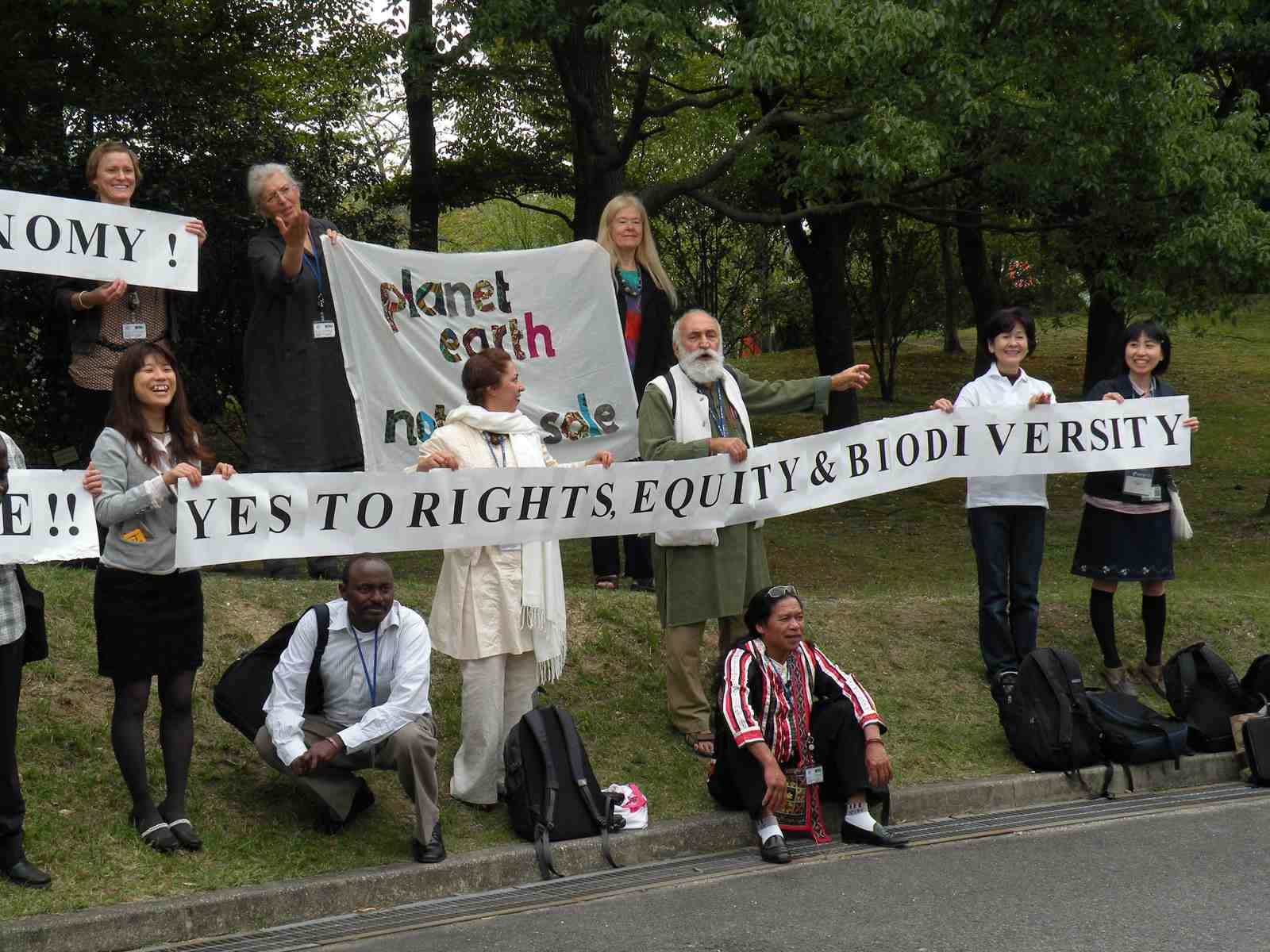
That is the view of indigenous representatives from Canada in response to a late night move by the Canadian delegation to strike a reference to indigenous peoples’ rights at the U.N. Convention on Biological Diversity (CBD) members’ conference here.

“Canada is stalling progress here, weakening our rights and fighting against a legally-binding protocol on access and benefit sharing,” said Armand MacKenzie, executive director of the Innu Council of Nitassinan, the indigenous inhabitants in northeastern Canada.

“Their opposition threatens global biodiversity… people need to speak out,” MacKenzie told IPS.

A protocol on access and benefit sharing (ABS) without a guarantee of the rights of indigenous people and local communities “would be totally void”, said Paulino Franco de Carvalho, head of the Brazilian delegation.

“Brazil will not accept any agreement on biodiversity without a fair ABS protocol…. We are not bluffing on that, I must be very clear,” Franco de Carvalho said in a press conference.

Is this article of interest? It exists thanks to contributions from readers. Please click here to learn more about Community Supported Journalism. Continue reading

North-South Divide Again Clouds Biodiversity Talks


By Stephen Leahy

NAGOYA, Japan, Oct 19, 2010 (IPS)

The accelerating destruction of natural habitats will take millions of years to recover from, scientists have warned.

This may be the last chance to apply the brakes, Achim Steiner, executive director of the U.N. Environment Programme, reminded delegates representing the 193 member countries of the U.N. Convention on Biological Diversity (CBD).

“This meeting is being held to address a very simple fact: we are destroying life on this Earth,” Steiner said at the opening plenary meeting Monday. “It is absolutely essential that nations work together here.”

Ryu Matsumoto, Japan’s environment minister, warned that the world was about to reach a threshold where the loss of biodiversity would become irreversible.

“We’re now close to a tipping point on biodiversity,” he said. “We may cross that in the next 10 years.”

With 16,000 participants, the Oct. 18-29 gathering is by far the biggest international meeting on biodiversity. The term biodiversity refers to the variety of plants, animals and other species that provide a wide range of services to humanity.

Is this article of interest? It exists thanks to contributions from readers. Please click here to learn more about Community Supported Journalism. Continue reading

Biodiversity at the Cliff’s Edge – Nature’s ‘Free Services’ In Sharp Decline

By Stephen Leahy*

NAGOYA, Japan, Oct 18, 2010 (Tierramérica)

What nature gives us is often taken for granted, but if its basic elements disappear, human life on Earth would not be possible. The mission of the biodiversity summit under way in Nagoya is to reverse the headlong rush towards the precipice.

The 10th Conference of Parties (COP 10) to the Convention on Biological Diversity (CBD), Oct. 18-29 in this southern Japanese city, seeks to create a new set of international agreements to halve the rate of loss of natural habitat, end overfishing, achieve zero net deforestation, eliminate harmful subsidies, and ensure that agriculture is sustainable by 2020, among other goals.

Without a successful meeting in Nagoya, achieving the United Nations Millennium Development Goals (MDGs) will be impossible, Janez Potočnik, of the European Union’s Commission for the Environment, told a high-level UN meeting last month in New York.

“Biodiversity” is term used to describe the wide variety of the living things that comprise the planet’s biological infrastructure and provide us with health, wealth, food, water, fuel and other vital services.

Many people fail to understand how dependent humanity is on the many natural services provided by nature, says Hal Mooney, an environmental biologist at Stanford University, in California.

“Those services are considered ‘free’ and not valued under the current economic structures,” Mooney told Tierramérica.

Is this article of interest? It exists thanks to contributions from readers. Please click here to learn more about Community Supported Journalism.

via Biodiversity at the Cliff’s Edge – IPS ipsnews.net.

‘Don’t Worry Be Happy’ Canada Sees Global Warming “Prosperity” Instead of Calamity

By Stephen Leahy

UXBRIDGE, Canada, Oct 8, 2010 (IPS)

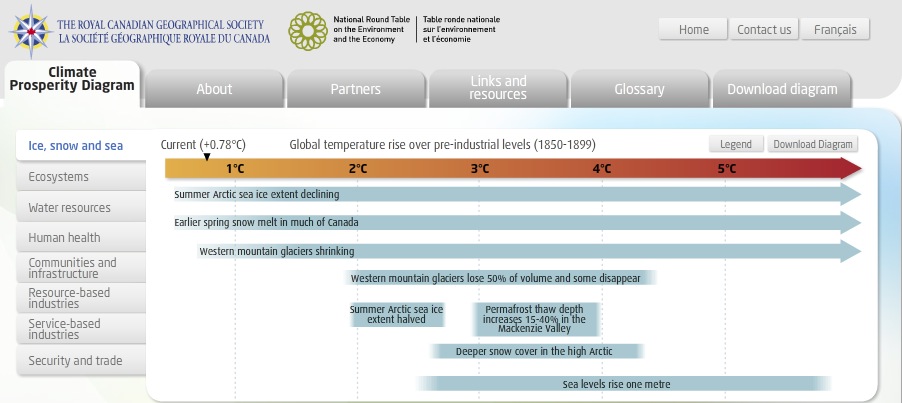
The first comprehensive look at the expected impacts of climate change on Canada offers an embarrassing and misleading “don’t worry, be happy” vision, citing more golf days and better access to northern deposits of oil and gas courtesy of global warming, critics say.

“The chart needs to be withdrawn,” said climate scientist Danny Harvey of the University of Toronto. “It is full of bad science and utterly downplays the serious impacts of climate change.”

The chart Harvey referred to is the “Degrees of Change” interactive diagram released this week as part of a national educational initiative called “Climate Prosperity” by the prestigious Royal Canadian Geographical Society and the National Round Table on the Environment and the Economy (NRTEE).

How can we (Canada) talk about profiting from climate change when most of the world will suffer devastating impacts, in part because of our emissions?” Harvey said.

“It is disgusting.”

In a release about the Climate Prosperity initiative, David McLaughlin, NRTEE president and CEO, said, “Adapt and prosper will be increasingly central to Canadian governments, communities, and businesses as these effects become more and more evident.”

NRTEE officials did not respond to IPS requests for an interview.

Is this article of interest? It exists thanks to contributions from readers. Please click here to learn more about Community Supported Journalism.

Continue reading

“Do you want an economy, or a planet we can all live on? I don’t want my future compromised by inaction on climate” — 16 year old from India

Children begged world leaders to craft a new climate treaty and left Copenhagen empty-handed. Their story.

By Stephen Leahy

COPENHAGEN, Dec 5 2009 (IPS/TerraViva)

Young people from 44 countries are demanding that world leaders take decisive action on climate change. The time for talk is over, they declared at the end of a weeklong Children’s Climate Forum here.

“Our plates are empty due to drought. Our future is at risk, and we demand that something be done,” they wrote in a declaration titled “Our World, Our Future” signed by 164 participants aged 14 to 17 at the conclusion of the forum.

I don’t want my future compromised by inaction on climate,” said Bipra Biswambhara, 16, of India.

Biswambhara and many of her fellow delegates were “shocked to learn how many people and parts of the world are already affected by climate change”, she told TerraViva. “We youth are committed to taking action in our home communities,” she said.

“We must have pity for future generations to come,” said Mohamed Axam Maumoon, 15, of the Maldives, a low-lying chain of islands that will likely vanish under rising oceans if temperatures rise two degrees C.

Is this article of interest? It exists thanks to contributions from readers. Please click here to learn more about Community Supported Journalism.

“We are not alone, everyone is being affected,” Maumoon said. As a result there was a strong feeling of cooperation and common cause throughout the week, he said. “If we all work together we can have a bright future.” Continue reading

“We’re Here to Insert Some Reality into an Unreal Situation” — 350.org Founder Bill McKibben

Bill McKibben is a U.S. journalist, writer and environmentalist and the founder of 350.org. Credit: Stephen Leahy

Stephen Leahy

COPENHAGEN (IPS/TerraViva) Dec 2009

Bill McKibben is a U.S. writer, environmentalist and the founder of 350.org, an international climate campaign. His first book, “The End of Nature”, was published in 1989 and is regarded as the first book written for a general audience about climate change.

350.org is credited with organising the most widespread political action in history when more than 5,200 public demonstrations were held on Oct. 24 in 181 countries. The organisation’s goal is to raise public awareness about the dangers of climate change and the need to return carbon concentrations in the atmosphere to 350 parts per million (ppm). Currently, concentrations are 387 ppm and increasing at 2.0 to 3.0 ppm per year.

Recent science suggests that a maximum of 350 ppm may be what is needed to keep overall global temperatures below 2.0 degrees C.

TERRAVIVA: Why are you here?

BILL MCKIBBEN: I wrote a book on climate change 20 years ago and you could say I’m just following the trail to its end. We’ve also brought 350 young people from all over the world to make sure negotiators hear their voice and insert a little reality into an unreal situation. Continue reading

The Future of Journalism: Adopt a Muckraker

I’m pretty damn angry that media companies are putting profits ahead of truth.

The media are deeply broken… That’s a real threat to democracy.”

— Stanford University climate scientist, Stephen Schneider


Renowned Swiss journalist Daniel Wermus and Director of the Media21 Global Journalism Network  discusses my launch of Community Supported Journalism in this article. — Stephen

“Should you and I pay for the kind of accurate news reporting that is needed to fill us in on what is happening to the planet?

If we’re not willing to pick up the tab to stay better informed, who will?”

Frontline Earth: Adopt a Muckraker?

By Daniel Wermus

“I meet international freelance journalists quite often. Most make it clear that budget cuts have made it increasingly difficult for just about anyone, especially freelancers, to get into print. It is usually the freelancers who are most willing to risk their lives to get the stories that need reporting the most. If the day arrives when they can no longer carry out their professions, we will all have a serious problem.

Muckraker: A reporter or writer who investigates and publishes reports involving a host of social issues, broadly including crime and corruption

Stephen Leahy, a Canadian, and one of the world’s best-known investigative reporters on environmental issues, has launched a challenge: if corporations won’t pay for the news, then it is up to communities and the public to fill the gap. A free society needs journalism, even if reporting the news is not commercially profitable.

Leahy’s model for supporting the news has the journalist make his pitch over the internet. The completed article can then be distributed by news agencies or magazines that are low on funds but high on public interest. That could be IPS, Reuters-Alertnet, Commondreams, InfoSud, The Essential Edge or any number of other publications and news outlets.

[edit: Wermus concludes]

Leahy observes that: “Many people tell me, we need individuals like you to get real information out.”

It may be too early to tell whether this really signals a new citizen’s approach to the need for hard information that may be crucial to society. In the best of all worlds it could bring together both consumers and media for promoting a better planet. The danger is that it could also produce yet another quagmire of holier-than-thou preaching.”

Learn more about Community Supported Journalism in the Public Interest

Adopt a Muckraker for only $10 a month

Update: Community Supported Journalism is working. However 50 people helping out has to become 500 so we all can get the crucial information we need.  Please consider becoming one of the 500. Thank you. — Stephen