Make Climate Change Art, Not War

franke-suzuki-sml.jpg“Unlike the scientist, we artists have the freedom to weave facts, opinions, thoughts, emotion and color all together. We can instill passion and motivate change. That is our palette.” — Visual artist Franke James

Toronto artist Franke James is doing great work both in expressing her concern and understanding in her colourful and insightful visual essays about climate change but also as a teacher of others in workshops for young artists — Six Tools to Make Climate Change Art.

Artists are desperately needed to help us understand the impacts of climate change at an emotional level and to inspire action. Information and knowledge are not nearly enough. As Franke wisely notes:

“Think of this: If any one of us stands up and tells a group an idea we have, it may spread — or it may disappear into the ether. A far more effective way to make an idea spread is to give it ‘tangible form’.” Continue reading

3 Reasons Why Gore Should Not Have Won Nobel Prize

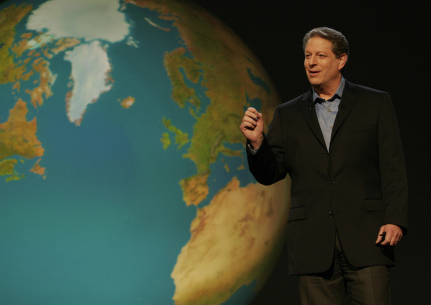
al-gore.pngThis year’s Nobel Prize for Peace went to Al Gore and the UN’s Intergovernmental Panel on Climate Change (IPCC) for their efforts to awaken the world about the risks of climate change. That’s great news but I’d have preferred to see the other candidate for the prize, Canadian Inuit Sheila Watt-Cloutier share the award with the IPCC not Gore.

Three Reasons Why Gore Should Not Have Won:

1. Watt-Cloutier has been a passionate and eloquent communicator about the fact that indigenous people of the Arctic, and indigenous peoples elsewhere, have taken the first and hardest climate change hits so far. It would be been fairer and more representative of the reality to award the prize to an indigenous person.watt-cloutier.png

2. For eight long years Al Gore was second in command of the largest greenhouse gas emitting country in the world. And yet emissions climbed and climbed even though Gore knew climate change was a real and pressing emergency. When running for President Gore barely mentioned GW and then the world had to suffer thru the other GW — George W Bush and his blind and selfish intransigence.

3. Al Gore’s GW solutions are mostly wrong. Biofuels are a bad idea and only make rich agri-corporations richer. Carbon trading markets are an equally bad idea — enshrines the rich countries’ right to pollute our common atmosphere. A moratorium on coal and a carbon tax are some of his better ideas. However, Gore fails to address the root of the problem which is an economic system based on endless growth on a tiny planet with an awful lot of people.

“People do want to do the right thing, but they just don’t realise that the Arctic is melting and they are responsible,” Watt-Cloutier told me in 2004. From Global Warming Will Decimate Arctic Peoples and also see Inuit Sue America Over Climate Change

Organic Provides 3X More Food Per Acre in Poor Countries – podcast

Organic farming can yield up to three times as much food on individual farms in developing countries, as low-intensive methods on the same land—according to new findings by researchers from the University of Michigan.

This refutes the long-standing claim that organic farming methods cannot produce enough food to feed the global population.

Listen to U of Michigan Podcast and Podcast En Español

Related articles/posts:
Food Additives Make Kids Hyperactive – Organic Better?
Overweight? Hungry? Blame “Hollow Food”
Organic Agriculture Reduces Climate Change, Poverty and Hunger
The Real Cost of US Strawberries

Skin Cancer Rising Despite New Ozone Deal to Cut CO2 Emissions

Ozone Deal to Cut Down CO2 Emissions

By Stephen Leahy


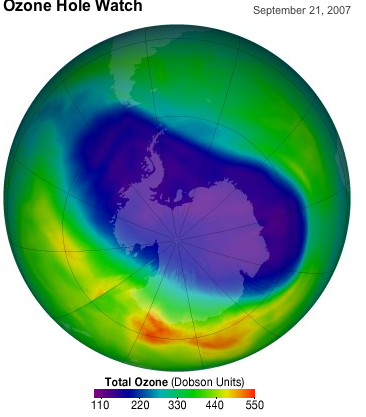
MONTREAL, Sep 23’07 (IPS) – More than 190 nations agreed this week to combat global warming and accelerate the healing of the ozone layer, although critics say more could have been accomplished.

The sun shone bright and warm here on Friday, the final day of the 19th Meeting of the Parties to the Montreal Protocol to protect the ozone layer. Outside, caravans of pre-school children in strollers or holding hands as they walked sported hats and long-sleeved shirts to protect their delicate skin.

It can be easy to forget that the sun was not always so dangerous, and that modern society is responsible for putting chemicals into the atmosphere that continue to destroy the ozone layer that protects all life from harmful levels of solar ultraviolet radiation.

[UPDATE: Sept 2009 — Ozone Treaty May Hold Key to Halting Climate Change;

— Ozone Hole 2009 – Bigger than North America – 24 million sq km]]

And we forget that things could have been far worse without international action in the form of the Montreal Protocol, which opened for signature 20 years ago this week.

Sadly, that action came late and was not vigorous enough for millions of people who have or will get skin cancer. Continue reading

Facebook: Last Hope for Environment?

facebook-header.png

Global trends indicate a looming environmental catastrophe, and engaging high school students around the world may be the only hope.

By Stephen Leahyvital-signs.png

Sept 14’07 (IPS)
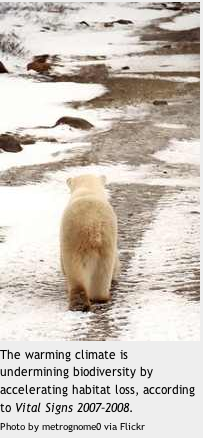
Governments, the corporate sector and media continue to champion industrial and economic growth at the cost of escalating impacts on the environment, concludes the latest report from the Washington-based Worldwatch Institute, “Vital Signs 2007-2008“.

For a number of years, the “Vital Signs” report has tracked 44 trends that are shaping the future, and they document a record level of industrial growth, says Erik Assadourian, Vital Signs project director.

“‘Vital Signs’ also documents the escalating impacts of such growth on the environment,” Assadourian told IPS in an interview from Barcelona.

The scale of the environmental crisis, in which catastrophic climate change is just one of many, is undermining the ecosystems that support life on Earth.

“Climate change and other environmental problems are symptoms of the root problem, which is the obsession with consumerism,” he said.

Vital Signs reports that in 2005, more wood was removed from forests than in any previous year. Fossil fuel usage dumped 7.6 billion tonnes of carbon emissions into the atmosphere. Meat production hit a record 276 million tonnes (43 kilogrammes per person) in 2006. Rising meat consumption is driving rising soybean demand to feed cattle, which in turn is a driver of deforestation as tropical forests are turned into soy fields.

And on it goes: global seafood consumption breaks records, steel and aluminium production too. None of this is sustainable — another three or four or five planets would be needed to maintain these levels of production and consumption. Continue reading

Lifespans: Americans 80 years and rising; Africans 40 and falling

esc-cover.pngMedical Research Hits Cultural Roadblocks
By Stephen Leahy

The lifespan of a U.S. citizen is 80 and rising while an African’s is 40 and falling.
“That is the mother of all ethical challenges for the world to grapple with,” said Peter Singer of McLaughlin-Rotman Centre for Global Health in Toronto.

Sep 11 (IPS) – Many new medical technologies to improve the lives of people in the global South fail to be adopted not because of the costs but because of ethical, social and cultural issues, a new study reveals.

These issues include community and public engagement, cultural acceptability and gender, according to the comprehensive study featuring interviews with leading health experts in developing countries and published Monday in the U.S. peer-reviewed online journal PLoS Medicine.

Improper consultation with affected communities resulted in public pressure to end to medical trials of tenofovir, an antiviral medication used to treat HIV, in Cambodia, Cameroon, and Nigeria. In that instance, the community was commercial sex workers who weren’t properly consulted and would not benefit from the trials. Continue reading

Wildlife Vanishing from African Game Parks

AFRICA: Game Parks Offering Protection in Name Only?
By Stephen Leahy

“If the international community increased funding by 10 times then there is hope. But I don’t think that’s realistic,” said Paul Scholte of the Institute of Environmental Science at Leiden University

kob-antelope.png

Sep 8 (IPS) – The sharp decline of Africa’s abundant wildlife is now happening inside the continent’s protected areas, a new analysis indicates. Africa’s world renowned parks are destined to become isolated pockets of wilderness with few large animals left, as is the case in Europe, conclude the authors of an article in the current edition of the ‘African Journal of Ecology’.

“It is not a pleasant conclusion,” said Paul Scholte, co-author of the article, and a researcher at the Institute of Environmental Science at Leiden University in the Netherlands.

“Where we have good data, there are dramatic declines in wildlife inside parks and protected areas,” he told IPS. “It was a shock. The declines are far worse than we expected.” Continue reading

Future Belongs to the Shrub

picture-3.png 21st Century May Belong to the Shrub
By Stephen Leahy

Sep 1 (IPS) – As atmospheric carbon dioxide levels continue to climb shrubs and other woody plants will likely dominate grasslands, altering pastoral lifestyles around the world, a U.S. study has found.

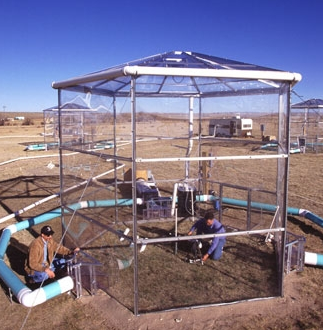
In the first experiment of its kind done on native grassland, U.S. scientists artificially doubled carbon dioxide (CO2) levels over enclosed sections of prairie in Colorado, a state in the western United States, for five years. To their surprise, one shrub species, Artemisia frigida — commonly known as fringed sage — thrived under those conditions. In fact, it grew 40 times faster than normal, dominating other plant species.

“This kind of response to higher CO2 levels is almost unprecedented,” said Jack Morgan, a plant physiologist at the U.S. Department of Agriculture, and lead author of the study, published Aug. 28 in the ‘Proceedings of the National Academy of Sciences‘ (PNAS), a science journal.

“Fringed sage is a minor species on the landscape normally. We were not expecting to see this,” Morgan told IPS.

Continue reading

Dirt: The Silent Global Crisis

Dirt Isn’t So Cheap After All


By Stephen Leahy

Aug 30 (IPS) – Soil erosion is the “silent global crisis” that is undermining food production and water availability, as well as being responsible for 30 percent of the greenhouse gases driving climate change.

“We are overlooking soil as the foundation of all life on Earth,” said Andres Arnalds, assistant director of the Icelandic Soil Conservation Service.

“Soil and vegetation is being lost at an alarming rate around the globe, which in turn has devastating effects on food production and accelerates climate change,” Arnalds told IPS from Selfoss, Iceland, host city of the International Forum on Soils, Society and Climate Change which starts Friday.

Along with many other international partner institutions, Iceland is marking the centenary of its Soil Conservation Service by convening this forum of experts.

Every year, some 100,000 square kilometres of land loses its vegetation and becomes degraded or turns into desert.

“Land degradation and desertification may be regarded as the silent crisis of the world, a genuine threat to the future of humankind,” Arnalds said.

Food production has kept pace with population growth by increasing 50 percent between 1980 and 2000. But it is an open question whether there will be enough food in 2050 with an estimated three billion more mouths to feed.

That means more food has to be produced within the next 50 years than during the last 10,000 years combined he noted.

“Global food production per hectare is already declining,” said Zafar Adeel, director of the United Nations University’s Canadian-based International Network on Water, Environment and Health.

There are a number of reasons for this decline, including the fact that soil degradation is producing growing shortages of water. Soil and vegetation act as a sponge that holds and gradually releases water, Adeel explained.

The newest challenge to food production and conserving land and water resources is the boom in vegetable-based biofuels, says Andrew Campbell, Australia’s first National Landcare Facilitator.

“Soils are under greater pressure than ever before,” Campbell said in an interview. “Governments around the world are subsidising crops to produce biofuels.”

For complete article see Dirt Isn’t So Cheap After All.

Elections Pushed Iraq Into Current Chaos as Predicted

Not my usual beat but with the Iraq tragedy worsening each day it may be useful to recall that experts said in 2004 before the much-heralded Iraq elections that voting would make the situation worse. Sadly they were all too correct.

“It is one of the perverse realities of post-conflict elections that this linchpin of the democratic process can also be its undoing,” Benjamin Reilly, a political scientist at Australian National University — 2004.

UN Study: Premature Vote May Prove Disastrous
by Stephen Leahy

(Originally published in Oct 2004)

Oct 19 (IPS) Elections in Afghanistan and Iraq may prove disastrous by increasing violence and extremism, according to studies of other post-conflict societies included in a book released Monday by United Nations University Press.

If elections in volatile situations are ill-timed or poorly designed, they risk producing the direct opposite of the intended outcome, fueling chaos and reversing progress toward democracy, adds the volume, The UN Role in Promoting Democracy.

“It is one of the perverse realities of post-conflict elections that this linchpin of the democratic process can also be its undoing,” Benjamin Reilly, a political scientist at Australian National University, said in a news release announcing the book.

Continue reading