The United States is awash in oil with four times as many oil rigs pumping domestic oil today than eight years ago and declining demand
Canada needs overseas markets for its dirty oil
[Excerpts from my September 2nd article on the proposed Keystone XL pipeline — Stephen]
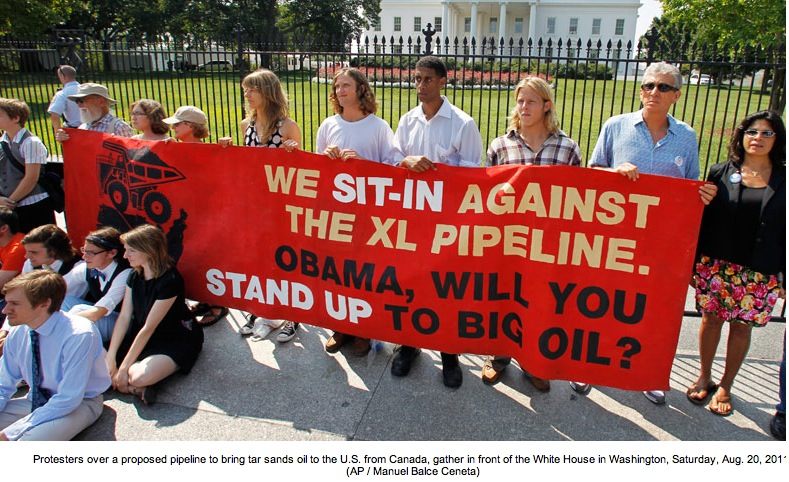
The only reason U.S. citizens may be forced to endure a risky, Canadian-owned oil pipeline called Keystone XL is so oil companies with billion-dollar profits can get the dirty oil from Canada’s tar sands down to the Gulf of Mexico to export to Europe, Latin America or Asia, according to a new report by Oil Change International released Wednesday.
“Keystone XL will not lessen U.S. dependence on foreign oil, but rather transport Canadian oil to American refineries for export to overseas markets,” concludes the report, titled “Exporting Energy Security“.
….
“The oil industry would have done the Northern Gateway [pipeline] first but gambled that resistance to the [Keystone XL] pipeline would be far weaker in the mid-west,” he told IPS.
Put a glass lid over Japan, Germany or England and they wouldn’t last long.
[excerpts from my Nov 2010 article on why losing species matters to everyone — Stephen]
Japan imports more than 60 percent of its food and most of Europe’s ecosystems have been trashed, with only 17 percent in reasonable shape, according to a first-ever assessment. The only reason those countries haven’t collapsed is they are rich enough to help themselves to nature’s ecological resources and services like food, timber, materials from the rest of the world.
Countries of the North are like desperate bio-pirates, addicted to plundering the richer ecosystems of the South for food, raw materials and cheap labour. Increasingly, the South is resisting and seeking redress. Part of that redress, and the only way to end the escalating loss of species – an estimated 5,000 to 30,000 extinctions per year – is to transform the growth economy
“Japan played a central role in the growth economy. We need to move to a subsistence economy,” Mushakoji told IPS.
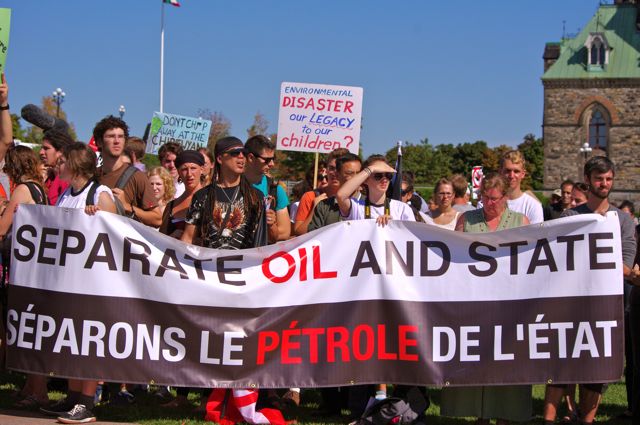
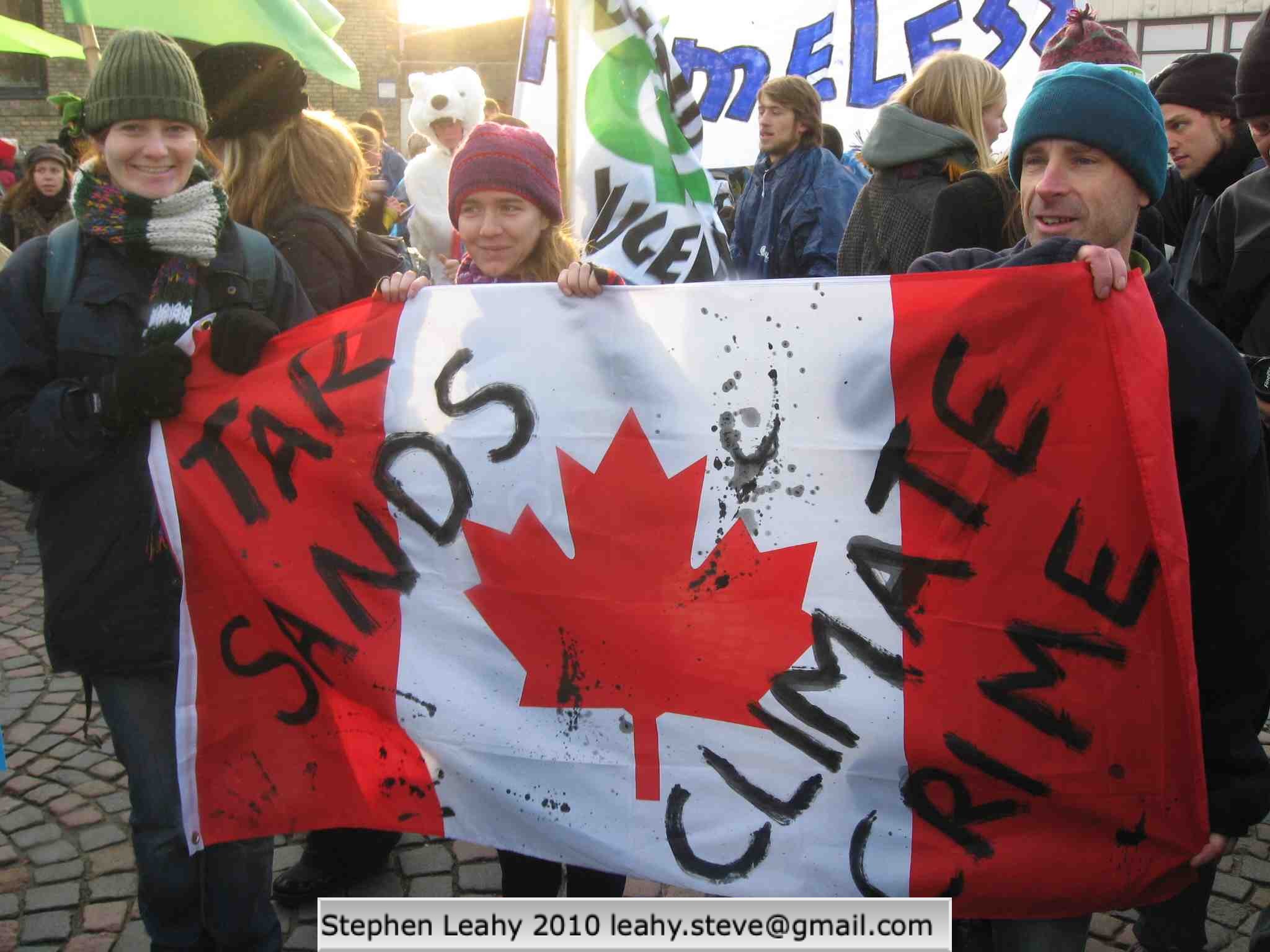
More than 200 Canadians engaged in civil disobedience, with 117 arrested in Canada’s quiet capital city on Monday. The reason? To protest the Stephen Harper right-wing government’s open support for the oil industry and expanding production in the climate-disrupting tar sands.
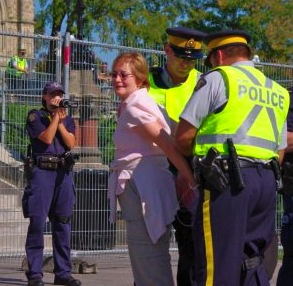
Maude Barlow, chairperson of the Council of Canadians, is arrested at the Sep. 26 tar sands protest. Credit:Renée Leahy/IPS
The normally placid and polite Canadians shouted, waved banners and demanded the closure of the multi-billion-dollar tar sands oil extraction projects in northern Alberta to protect the global climate and the health of local people and environment.
“People are here because they know that if we don’t turn away from the tar sands and fossil fuels soon it will be too late,” Peter McHugh, a spokesperson for Greenpeace Canada, told IPS.
“The tar sands are unsustainable. Canadians are willing to shift away from fossil fuels but our government isn’t,” Gabby Ackett a university student and protester, told IPS as she stood in front of a long line of police.
In what was proudly touted as “civil” civil disobedience, protesters aged 19 to 84 were arrested for using a step-stool to climb a low barrier separating them from the House of Commons, the seat of Canadian government. The police were friendly and accommodating because the organisers had promised there would be no violence.
“We live downstream and see the affects of tar sands pollution on the fish and the birds,” said George Poitras, a former chief of the Mikisew Cree First Nation in northern Alberta.
“Some our young people have rare forms of cancer,” Poitras told more than 500 protesters.
“Expanding the tar sands is not the way to go in a world struggling with climate change,” he said.
Carbon emissions from the tar sands production have increased 300 percent since 1990 and, at 45 to 50 million tonnes annually, are greater than most countries. And that does not include the carbon contained in the oil itself.
When burned, the 1.6 million barrels of oil that are extracted every day will add 346 million tonnes of carbon to the atmosphere this year alone. That’s almost the entire emissions of the country of Australia. The oil industry is making billion-dollar investments in the tar sands to more than double production by 2025. Continue reading →
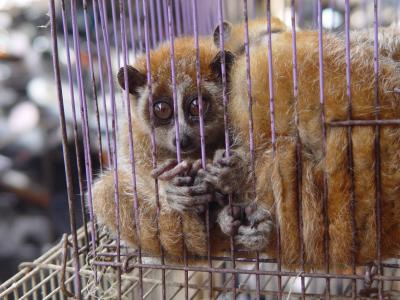
Slow loris from an illegal wildlife market in Southeast Asia
This story was featured on the IPS wire and on the Al Jazeera network . It’s about a study showing that national parks, conservation and protected areas have not and cannot halt the decline in biodiversity that is our life support system. It is hopeless without addressing the root cause of this and all other environmental problems: too many of us, taking too much and having too big of an impact. On our present course we’ll need 27 planet Earths by 2050 they conclude. — Stephen
By Stephen Leahy
UXBRIDGE, Canada, Jul 29, 2011 (IPS)
Protecting bits of nature here and there will not prevent humanity from losing our life support system. Even if areas dedicated to conserving plants, animals, and other species that provide Earth’s life support system increased tenfold, it would not be enough without dealing with the big issues of the 21st century: population, overconsumption and inefficient resource use.
Without dealing with those big issues, humanity will need 27 planet Earths by 2050, a new study estimates.
The size and number of protected areas on land and sea has increased dramatically since the 1980s, now totaling over 100,000 in number and covering 17 million square kilometres of land and two million square kilometres of oceans, a new study reported Thursday.
But impressive as those numbers look, all indicators reveal species going extinct faster than ever before, despite all the additions of new parks, reserves and other conservation measures, according to the study published in the journal Marine Ecology Progress Series.
“It is amazing to me that we haven’t dealt with this failure of protected areas to slow biodiversity losses,” said lead author Camilo Mora of University of Hawaii at Manoa.
“We were surprised the evidence from the past 30 years was so clear,” Mora told IPS.
The ability of protected areas to address the problem of biodiversity loss – the decline in diversity and numbers of all living species – has long been overestimated, the study reported. The reality is that most protected areas are not truly protected. Many are “paper parks”, protected in name only. Up to 70 percent of marine protected areas are paper parks, Mora said.
The study shows global expenditures on protected areas today are estimated at six billion dollars per year, and many areas are insufficiently funded for effective management. Effectively managing existing protected areas requires an estimated 24 billion dollars per year – four times the current expenditure.
“Ongoing biodiversity loss and its consequences for humanity’s welfare are of great concern and have prompted strong calls for expanding the use of protected areas as a remedy,” said co-author Peter Sale, a marine biologist and assistant director of the United Nations University’s Institute for Water, Environment and Health.
“Protected areas are a false hope in terms of preventing the loss of biodiversity,” Sale told IPS. Continue reading →
Cars are parked 22 hours a day on average yet world will have 2.5 billion cars in 2050
The costs of car ownership and travel are far higher than anyone realizes: a 100 km total trip costs between 65 and 80 dollars when parking, fuel, wear and tear, insurance, depreciation, repairs are included. A car is usually parked and unused 22 hours a day but still incurs costs. Why not let someone use the car when you’re not and make some money at the same time Robin Chase told me for this article. She’s launched Buzzcar in France as part of a strategy for reducing carbon emissions and congestion in cities. — Stephen
Why do car owners get so much more public space than bus riders, bicyclists or walkers?
By Stephen Leahy
BERLIN, Jun 2, 2011 (IPS)
The world’s more than 850 million cars and small trucks are parked 20 to 22 hours a day. Why not use these vehicles more efficiently by letting other people drive them when the owners aren’t, asks Robin Chase, CEO of Buzzcar, a car- sharing network to be launched shortly in France.
“Sharing vehicles is much more efficient and represents a huge opportunity,” Chase told some 800 attendees from more than 50 countries at the OECD’s annual International Transport Forum (ITF) in Leipzig last week. The Forum is an intergovernmental organisation for the transport sector involving 52 different nations.
The ITF projects there will be three times as many cars – an eye-popping 2.5 billion – by 2050 according to its Transport Outlook 2011 report released at the meeting. Adding that many more vehicles in a sustainable way is an “extraordinary challenge”, said Jack Short, Secretary General of the ITF.
The vast majority of this growth will come from the developing countries since travel by passenger vehicle in a number of high-income countries has not increased, and even declined in some countries. Short acknowledged making such projections is risky because many factors such as lower economic growth, congestion in cities or new technologies will have an impact on levels of car ownership in future.
And the Transport Outlook report did not factor in the potential for car-sharing to offer personal mobility without car ownership.
Buzzcar is a car sharing service where car-owners in a city or town allow their idle cars to be used by other local citizens in exchange for getting about 70-75 per cent of the rental fee, Chase told IPS in an interview. Even when a car is parked it costs their owners money, she says. The average cost of owning and operating car is 8,000 to 12,000 dollars a year even if it sits parked 22 hours a day. (update: more like $9,000 to 14,000 according to auto clubs)
Buzzcar is an opportunity for car owners to get better value out of their vehicles and to help with ever- rising costs of car ownership. More importantly car sharing reduces the need for car ownership overall, she says.
Chase was a co-founder of Zipcar, a U.S.-based car-rental network with more than a half million members where people rent cars by the hour from easy-to-access neighbourhood lots or stations. Zipcar owns some 8,000 rental cars. She then went on to start GoLoco, a ride sharing company in which people pay to ride along with others in the network, and the drivers take a cut of the fees. Continue reading →
This article looks at the huge upswing in extreme events around the world. Imagine this: the worst-ever tornado season, the worst flooding, and worst heatwave have hit the US this year. And they may yet experience one the worst hurricane seasons. “24 Hours of Reality” online broadcast documented this Sept 15 to help people clear their heads of the fossil fuel propaganda and open their eyes to the crisis we are facing. — Stephen
“There are four anti-climate change lobbyists in Washington for every member of Congress.”
By Stephen Leahy
UXBRIDGE, Canada, Sep 15, 2011 (IPS)
The dramatic increase in extreme weather that has affected hundreds of millions across the planet is one of the clearest signs that burning billions of tonnes fossil fuels has seriously and permanently disrupted the global climate, experts say.
That is the reality former U.S. vice president Al Gore is focusing on Thursday through an unprecedented live online event called “24 Hours of Reality” broadcast from 24 time zones and reaching millions of viewers in multiple languages.
“In 30 years of weather forecasting I have never seen extreme weather events like those in the last two years globally,” said Jeff Masters, co-founder and Director of Meteorology for Weather Underground, the web’s first commercial weather service.
“I never thought we could have the greatest outbreak of tornados, the worst-ever flooding, record heatwaves and droughts all in one year,” Masters told IPS at a press conference last week in reference to the multi-billion-dollar extreme weather the U.S. has endured this year.
“The hurricane season is only half over and is on pace to be a record year as well,” he said.
Masters and other climate experts say is the “new normal” for the coming decades is the reason why. Burning of oil, gas, coal puts billions of tonnes of carbon dioxide into the atmosphere, where it traps more of the sun’s heat in what is known as the greenhouse effect.
That additional heat warms the oceans and air and allows more moisture to be retained in the atmosphere, scientists have long since proven. The enormous amounts of additional heat and moisture now trapped in the atmosphere are the potent fuel for extreme events.
“More than 1,400 high temperature records were broken in July in the eastern U.S.,” said Jerry Meehl, a senior scientist at the National Center for Atmospheric Research. Continue reading →
E-cycles, bike highways and cutting government addiction to gas taxes
By Stephen Leahy
BERLIN, Jun 6, 2011 (IPS)
As global carbon emissions hit record-high levels last year, officials from leading Asian nations told the 2011 International Transport Forum in nearby Leipzig that their citizens want more cars.
At the same meeting, some Europeans urged a 21st century renaissance in bicycle transport, with electric and electric-assist bikes for personal health and the health of the climate.
“We in India need to provide more roads and rail,” said B.K. Chaturvedi, a member of India’s Planning Commission.
“Cycling is a miniscule thing. That’s not the future,” Chaturvedi told the nearly 800 attendees.
“The bike is better to get around in Beijing, but bicycle use is dropping fast due to poor air quality and the danger from car traffic,” said Pan Haixiao, a professor at Tongji University in China.
Dar es Salaam, Tanzania's Moving Planet Cycle Caravan.
The number of cars and light trucks globally is projected to triple from the current 850 million to 2.5 billion by 2050, according to the International Transport Forum’s (ITF) Transport Outlook 2011. That growth is projected to be almost entirely in the developing world.
Richer countries are actually reducing the personal vehicle use in the last few years.
The Organisation for Economic Cooperation and Development’s ITF is an intergovernmental organisation for the transport sector involving 52 different nations.
Transport is the second leading source of carbon dioxide emissions, contributing about 7.5 gigatonnes to the 30.6 gigatonnes (Gt) emitted in total in 2010. The International Energy Agency (IEA) reported last week that humanity cannot exceed annual emissions of 32.0 Gt or it will be impossible to achieve the internationally-agreed target of below two degrees C of global warming to avoid very dangerous levels of global warming. Continue reading →
More than 5 million affected by flooding in Pakistan Sept 2011 - a repeat of 2010.
Climate disruption shrinking areas where people can live.
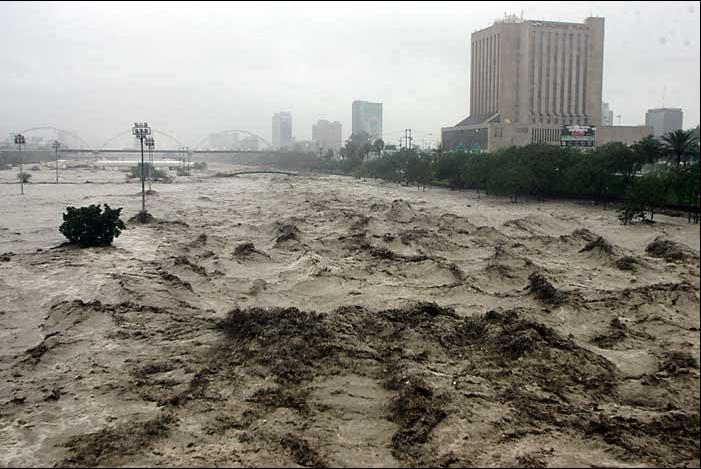
Mexico faces $10 billion in storm/flood damage to roads, schools, clinics, etc every year
By Stephen Leahy
OSLO, Jun 9, 2011 (IPS)
Mass migration will inevitably be part of human adaptation to climate change, experts agree, since parts of the world will become uninhabitable in the coming decades.
Last year, 38 million people were displaced by climate-related disasters such as the flooding in Pakistan and China.
“Human displacement due to climate change is happening now. There is no need to debate it,” Jonas Gahr Støre, Norway’s minister of foreign affairs, told over 200 delegates attending the Nansen Conference on Climate Change and Displacement in the 21st Century in Oslo Jun. 6-7.
Governments and the humanitarian community need to understand this fact – and that it will get much worse in the coming decades, Støre said.
Without major emissions reductions, climate change could get far worse than anyone is prepared to think about.
“It may be more realistic to consider four degrees C of warming rather than two degrees C,” suggested Harald Dovland, former head of the Norwegian Delegation to the United Nations climate change negotiations.
The world has already warmed 0.8C and will rise to least 1.6 C even if all emissions of carbon and other greenhouse gases ended today, James Hansen, head of NASA’s Goddard Institute for Space Studies, told the conference.
A four-degree C warmer world is a very different planet and risks runaway climate change. Even two degrees C is not safe, Hansen said.
“The last time the planet was two degrees C warmer was during the Pliocene (five to 2.4 million years ago) and sea levels were 25 metres higher,” he said. “If we burn all the fossil fuels (coal, oil, natural gas) we’re creating conditions that future generations will be unable to cope with.”
Even though a four-degree C warmer world “is choosing the suicidal path”, experts must avoid fuelling xenophobia with predictions of mass migrations and conflicts, says Francois Gemenne, research fellow at the Institute for Sustainable Development and International Relations in Paris.
“This also feeds into a security agenda of panic and paranoia,” Gemenne said.
At least 20 percent of humanity will be at high risk of severe flooding due to sea level rise and extreme rainfall events in the coming decades.
“Too many people live in low-lying deltas and other parts of the world that are becoming too dangerous to live in,” said Gemenne. They will be forced to move and often this movement will be permanent.
Rather than building walls and barriers, countries and the international community need to encourage people to move to safer ground. “Lift the barriers so that people can use migration to adapt to climate change,” he urged delegates. Continue reading →
‘Oil companies are in the driver’s seat when it comes to Canadian federal energy policy’
By Stephen Leahy
BONN, Jun 13, 2011 IPS
Canada was roundly criticised by other nations at a major U.N. climate meeting last week after being caught underreporting carbon emissions from its tar sands oil production facilities, one of the countrys biggest and fastest growing sources of global warming gases.
But even the “full emissions” data that Canada finally released represents only about half of the actual emissions, according to a new report.
“Small oil sands companies are not required to report their emissions. And oil-refining emissions are not included in tar sands emissions,” said independent Canadian researcher Michelle Mech.
Canada likes to claim the city-sized tar sands project in the western province of Alberta represents only five percent of the country’s entire emissions, but the real number is closer to 10 percent, Mech told IPS.
Getting oil out of the tar sands requires extraordinary efforts, including enormous amounts of energy, and has been labeled ‘dirty oil’ as a result.
“Average emissions for oil sands production and upgrading (well-to- pump) are estimated to be 3.2 to 4.5 times as carbon intensive as conventional crude produced in North America,” concluded Mech’s report, “A Comprehensive Guide to the Alberta Oil Sands”.
“The tar sands are huge in terms of their impact on the environment but also on Canadian democracy. Oil is starting to run the country now,” she said.
Negotiations over a new international climate agreement are on the brink as new analyses show that carbon emission reduction promises by industrialised nations are actually lower than those made by China, India, Brazil and other developing nations.
Even with all the promises or pledges added together they are still far short of cuts needed to prevent global temperatures from rising two degrees Celsius, experts reported here.
“It’s a very sad picture we see here,” said Marion Vieweg of Climate Analytics, a German NGO that analyses climate science and policy.
“The rich nations are doing nothing to improve their emissions pledges,” Vieweg told reporters during the final hours of the United Nations Framework Convention on Climate Change (UNFCCC) negotiating session here in Bonn. These meetings are intended to work out the details for a new international agreement for government ministers to consider at the 17th Conference of the Parties under the UNFCCC in Durban, South Africa in late November.







 Stephen Leahy, International Environmental Journalist