Final Update: COP 16 Cancun Climate Conference

19 Dec 2010

On reflection there was some progress at COP 16. Small island states, whose very existence is threatened, were satisfied the world is on its way to a significant climate treaty so that is something. Last year in Copenhagen, hardly anyone happy with the outcome. There is still a long and difficult road ahead. Not least because there remains a powerful and well-funded opposition to emission reductions in many countries.

In 2011 I hope to uncover more about that opposition while continuing to write about how the physical processes of climate change are not waiting for us to get our act together. Substantial changes are already underway. Changes to the global water cycle have been shown in the first global study of evapotranspiration rates as detailed in my article: “Climate Changes Herald a Future of Widespread Drought – Water Left High and Dry in Climate Talks”

The article also looks at some fairly dire drought projections for the coming decades.

For those experiencing a rough, early winter, I did the first article revealing how the melting Arctic may be bringing earlier and harsher winters to the UK, parts of Europe and North America. That story happened because of donations to help cover my costs of attending a polar science conference in Oslo were those new findings were presented. Science journalism isn’t easy or cheap to do. I was one of  few journalists in Oslo because hardly any media outlet covers travel costs any more – never mind paying a decent fee for a story. That’s why I am trying Community Supported Journalism where people support my efforts to inform people about the great issues of our time.

A warm thank you to those who sponsored some of the Cancun articles, contributing some much needed cash to help cover my costs.  Supporters names are prominently listed in the articles here. I can no longer continue to do environmental and science journalism without your help so thank you for helping out.

— Stephen

Just click the button to go to the PayPal Secure Donation* page & enter your sponsorship amount (fully secure, major Credit Cards accepted)

Your one-time or monthly contributions are vital for Community Supported Environmental Journalism (click for more info)

*More than 100,000 non-profits safely use PayPal Donate service

Emission Reductions Punted to Durban, Breakthrough Seen on Forests

As carbon emissions bend upward Canada’s Harper government singled out as worst at climate talks. Again.

By Stephen Leahy*

CANCÚN, Mexico, Dec 11, 2010 (IPS/TerraViva)

If success is measured by delaying difficult decisions, then the Cancún climate meeting succeeded by deferring crucial issues over financing and new targets to reduce greenhouse gas emissions to the next Conference of the Parties meeting a year from now in Durban, South Africa.

International negotiations to address climate change proceeded at a glacial pace in the palatial, over-air-conditioned Moon Palace Resort in Cancún. After two long weeks, final talks dragged on into the early hours of Saturday morning, with Bolivia’s refusal to accept a weak agreement that puts the world on a path that “could allow global temperatures to increase by more than four degrees”, said Pablo Solón, Bolivia’s chief negotiator.

In the end, Bolivia’s continued objections were drowned out by applause and cheering by more than 190 national delegations as the chair of the meeting, Mexico’s foreign secretary Patricia Espinosa, gaveled the meeting to a close declaring “a consensus without Bolivia”.

“The Cancún text is a hollow and false victory that was imposed without consensus,” Bolivia said in a final statement.

Based on the science, Bolivia is not wrong.

The World Meteorological Organisation declared last week that the decade will close as the hottest 10- year period on record. The 100+ pages that form the “Cancún Agreements” will do nothing to curb greenhouse gas emissions warming the planet, but did revive the U.N. climate negotiation process after its near death in Copenhagen last year.

This article was made possible thanks to contributions from Janos Mate, James Creskey. Extra special thanks to monthly contributors Julie Davis, Aidan Constable, Patricia A Warwick, Judith A Leahy

[Due to the high costs of covering such important events, support is needed from readers like you. Please consider making a small automatic monthly contribution as a fair exchange for these articles – for more information.] Continue reading

Cancún Climate Summit Gives Fossil Fuels a Free Pass

Burning just 25 per cent of proven reserves is road to climate disaster scientists say

By Stephen Leahy*

CANCÚN, Mexico, Dec 7, 2010 (Tierramérica)

The main cause of climate change is the burning of fossil fuels, so why are billions of dollars being invested to find and produce more oil, coal and natural gas?

That is the question posed by Canadian indigenous representatives at the alternative civil society meet, Klimaforum, held parallel to the United Nations-sponsored climate summit under way in the Mexican resort city of Cancún.

“Canada’s tar sands project emits 40 million tonnes of carbon every year, with ambitious growth plans pushing that to nearly 140 million tonnes by 2020. The entire country of Denmark emits just 52 million tonnes,” said Melina Laboucan- Massimo.

The activist comes from the Lake Lubicon Cree band of First Nations in the province of Alberta, where thousands of square kilometres of tar-laden soil and sands underlying pristine boreal forests and marshes are being mined.

Canada is not being censured for this flagrant disregard for the global climate at the 16th Conference of Parties (COP 16) to the UN Framework Convention on Climate Change, she said.

The nearly 200 national delegations gathered for COP 16 (Nov. 29-Dec. 10) aim to stabilise emissions of greenhouse- effect gases to prevent climate change, but there is little hope of success.

In fact, at the Cancún summit no country is being challenged for expanding operations of oil, coal or natural gas or looking for new deposits.

Burning just one-quarter of the proven reserves of oil, gas and coal will push the global climate beyond the two degrees Celsius of average warming, scientists have predicted.

This article was brought to you in part by J. Bowers of the United Kingdom

Due to the high costs of covering such important events, support is needed from readers like you. Please consider making a small automatic monthly contribution as a fair exchange for these articles – for more information.

Continue reading

Will Year of Climate Extremes End Without Progress on Tackling Climate Change?

By Stephen Leahy*

CANCÚN, Mexico, Nov 29, 2010 (IPS/TerraViva)

This year will likely be the warmest ever recorded, with soaring ocean temperatures resulting in a near record die-off of tropical corals, extreme heat and drought in Russia and massive flooding in Pakistan – all signs that climate change has taken hold.

But despite the ever more compelling science regarding the urgency and risks of climate change and growing public support for action, representatives from nearly 200 countries meeting here in Cancún for the next two weeks are unlikely to produce a new binding agreement.

At best, matters such as forestry, climate finance and mitigation commitments will be further developed in the faint hope that the next big meeting in South Africa might produce some kind of deal.

“Carbon emissions continue to climb despite the economic recession and yet I have never seen such low expectations for a COP (Conference of the Parties),” said Richard Somerville, an eminent climate scientist at the Scripps Institution of Oceanography in California.

“The science is quite compelling regarding the need for urgent action. We don’t have another five years to reach an agreement,” Somerville told TerraViva.

In 2009, Somerville and others co-authored an update on the latest climate science called ‘The Copenhagen Diagnosis’ which concluded that global carbon emissions had to peak and begin to decline before 2020 to have any hope of keeping global warming to less than 2.0 degrees C.

However, the negotiators in Cancún will mostly not be acting on the science but on their national interests as directed by their political leadership, who largely do not understand climate change, he said.

“Developed countries think they can adapt to warmer temperatures. I don’t see how we can keep warming below 2.0 degrees C.,” Somerville said.
Continue reading

Only China Can End Fossil Fuel Industry’s Iron Grip on Governments — James Hansen, Climate Scientist

In a stunning opinion piece  (pdf) NASA’s chief climate scientist James Hansen, acting a private citizen, asks China to take the lead on combating climate change. The US government is too fractured and too beholden to the fossil fuel interests to take action. “Big money” is also behind the lack of action in many other industrialized countries including Canada and Norway while they expand production of tar sands he writes.

He says China is the world’s best hope to end the rule of the world by fossil fuel interests.

Like most governments the Obama administration says climate change is a crisis, claims to have a plan and does little  to nothing. Hansen calls this “green washing”. (FYI this is a wide spread practice that most people are unaware of.)

In this picture Hansen, one the world’s most acclaimed climate scientists, is being handcuffed and arrested in front of the White House during a protest to urge the US government to end the coal industry practice of blowing off the tops of mountains to mine coal. Such practices are extremely damaging to the environment and local communities he says.

Moreover to prevent catastrophic climate change coal must stay in the ground Hansen said.

There is plenty of scientific evidence to back up that last statement. See my previous articles below — Stephen

Why Are We Looking for More Oil & Coal? We Already Have Enough to Cook the Planet 4X

Heading for +2 degrees C (3.6 degrees F) Carbon Use Must Peak by 2015 Scientists Warn

Please consider making a small automatic monthly contribution as a fair exchange for these articles.


A Reporter’s Diary: EXCLUSIVE COVERAGE OF UN CONVENTION ON BIOLOGICAL DIVERSITY FROM NAGOYA, JAPAN

NOTE: The following are excerpts from my personal notes to friends and supporters written during the heat, confusion and massive information dump of a major international conference. Often written late at night I attempted to offer some personal perspective into what was going on and what I was up to. — Stephen

Tuesday, 19 Oct – Geopolitical obstacles getting in the way

I’m here at the big UN conference on biodiversity. It’s 430 am here, the first day ended about 9 pm. It’s 12-ring cat circus like the Copenhagen climate meeting but the mood here is more positive. There are similar geopolitical obstacles getting in the way of slowing the loss of species and ecosystems. Another major difference is the lack of little public awareness of the fact that we cannot continue to shred nature’s web of life without suffering dire consequences.

I’ll try and do my bit – write 10 -12 articles over next two weeks. I wanted to thank a couple of supporters who helped out to cover some of the travel costs. I want to keep you informed of what’s going on here but these notes take a couple of hours to do.

This week is a story about an important development in Africa: In sincere efforts to make one last major attempt to transform Africa’s poverty and hunger are we imposing our worldview on Africa yet again? Bill Gates and others are donating hundreds of millions to create a New Green Revolution for Africa. This difficult and controversial story took over a week to do and wrote the final draft during my 17 hr flight here.

My other story connects the dots between extreme weather this summer and climate change. No single storm is directly attributable to CC BUT without CC it is unlikely the Russian heat wave and floods in Pakistan would have occurred. (PS those were events were two sides of the same coin)

Finally I received a number of letters, mostly positive but a couple saying I was too negative in last week’s article ‘Don’t Worry Be Happy’ Canada Sees Global Warming “Prosperity” Instead of Calamity’. Any organization that puts out a chart of climate impacts at 4 – 5C of global warming and fails to mention the scale of the calamity that would result is delusional or deceptive. Some take the stunningly selfish and naive view we can ‘adapt’ by turning up the AC.

Do consider making a small automatic monthly contribution as a fair exchange for these articles.

Greenest wishes, Steve


Wednesday, 20 Oct – Diversity R Us

There is an astonishing diversity of people here. Last nite I talked to an Amazonian Indian who took 10 days to get here, had wine accidentally spilled on me by a reindeer herder from Finland and found the lost passport of a Brazilian diplomat. And that is a five minute snap shot. It is a very big world with so many different people it is incredible they have all come here to try and address a common issue. That they can’t agree on what kinds of actions and how to implement should not come as a surprise.

Sunday, 24 Oct – Canada won’t play nice (yet again)

Canada is blocking agreement on a key measure to get a new international agreement to protect biodiversity here. This is not new. In recent years Canada has gone out its way to snub international UN agreements including the outright refusal to fulfill its legal obligations under the Kyoto Protocol. Hard to believe the same government lobbied hard for a seat on the UN security council and actually expected to be rewarded.

Sadly there is no one reporting for Canadian publications to document the irony. (And as a result Canadian’s aren’t really aware of what their government is up to.) Continue reading

Why Are We Looking for More Oil & Coal? We Already Have Enough to Cook the Planet 4X

Proven reserves of oil, gas and coal represent four times the amount of carbon that would blow through the 2-degree C climate target (which no one really thinks is ‘safe’).  Burning just one quarter of those proven reserves will bring humanity to the 50-50 point of tipping into dangerous climate change said leading climate scientists in 2009. We need a plan to phase out emissions of carbon entirely they said in my article for IPS. — Stephen

“Only a fast switch away from fossil fuels will give us a reasonable chance to avoid considerable warming,” said Malte Meinshausen, climate researcher at the Potsdam Institute for Climate Impact Research.

See full article based on studies published in Nature:

Heading for +2 degrees C (3.6 degrees F) Carbon Use Must Peak by 2015 Scientists Warn

Reefs and Forests Burn as Climate Disruption Takes Hold NOW


A lot of coral reefs have died this year due to unprecedented ocean heating largely due to climate change. I broke that story last summer. Few coral reefs will survive the next 50 years most experts say without immediate action to reduce greenhouse gas emissions.


Forests are next in line according a new study in PNAS. Huge uncontrollable wildfires will dominate forest landscapes of the near future without dramatic reductions in the burning of fossil fuels the study found.

I would have done a full article explaining all this but simply can’t find a publication willing to pay me to do the work. That’s why I am trying community supported journalism where readers donate small amounts so these articles get done and made available for millions to read.

— Stephen (November 10 2010)

Biofuels Worse Than Paying People to Use More Gasoline – European Study

I’ve done several articles previously about the problems of biofuels. (see below). New report out today shows Europe’s biofuel policy completely wrong headed.

European plans to promote biofuels will drive farmers to convert 69,000 square km of wild land into fields and plantations, depriving the poor of food and accelerating climate change, a report by green groups warned.

…extra biofuels that Europe will use over the next decade will generate between 81 and 167 percent more carbon dioxide than fossil fuels,

— read Reuters take

My previous articles listed below cover much of the same ground although the report is more specific reading impacts of EU policy than anything to date.  — Stephen

Europe’s Green Energy Portfolio Up in Smoke?

“Europe is going to cook the world’s tropical forests to fight climate change; it’s crazy” — Millions of Trees Burned for ‘Green Energy’

Ethanol and Biofuels – Everything (Almost) You Need to Know

Geoengineering on a Desperate Planet — UN Declares Global Moratorium

By Stephen Leahy

NAGOYA, Japan, Oct 25, 2010 (Tierramérica)

[Update 30 October 2 am. Global moratorium passes.]

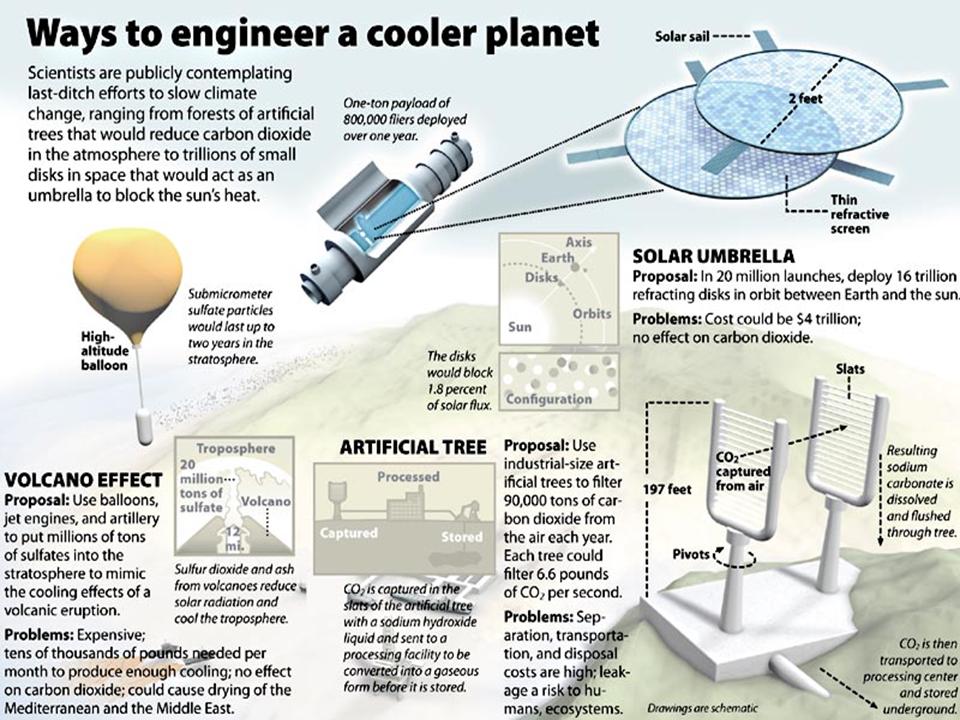
Delegates to the world summit on biodiversity here are calling for a moratorium on climate engineering research, like the idea of putting huge mirrors in outer space to reflect some of the sun’s heating rays away from the planet.

Climate engineering or geoengineering refers to any large-scale, human- made effort to manipulate the planet to adapt to climate change.

Representatives from Africa and Asia expressed concern about the negative impacts of geoengineering during the opening week of the 10th Conference of Parties (COP 10) to the United Nations Convention on Biological Diversity (CBD), Oct. 18-29. They were joined by civil society organisations in calling for a moratorium on geoengineering experiments.

The geoengineering proposals include installing giant vertical pipes in the ocean to bring cold water to the surface, pumping vast amounts of sulphates into the stratosphere to block sunlight, or blowing ocean salt spray into clouds to increase their reflectivity.

The geoengineering proposals include installing giant vertical pipes in the ocean to bring cold water to the surface, pumping vast amounts of sulphates into the stratosphere to block sunlight, or blowing ocean salt spray into clouds to increase their reflectivity.

Broadly speaking, there are two main geoengineering approaches: solar radiation management and carbon sequestration, in other words, absorbing carbon dioxide from the atmosphere to reduce the concentration of this greenhouse-effect gas.

Is this article of interest? It exists thanks to contributions from readers. Please click here to learn more about Community Supported Journalism.

To manage the sun’s rays, there are ideas like releasing sulphates into the atmosphere or placing giant mirrors in outer space. For absorbing carbon, the possible approaches include ocean fertilisation, in which iron or nitrogen is added to seawater to stimulate the growth of phytoplankton to sequester the carbon deep in the ocean.

“Some of the proponents of these technologies think it’s easier to ‘manage the sun’ than get people to take a bus” to reduce carbon in the atmosphere, said Pat Mooney, executive director of the ETC Group, an international environmental organisation headquartered in Canada. [etc “Geopiracy” report]

“Politicians in rich countries see geoengineering as ‘Plan B’ so they don’t have to make the hard choices of reducing emissions causing climate change,” Mooney told Tierramérica.

Continue reading