Snow Cover Turning to Lakes in the Himalayas

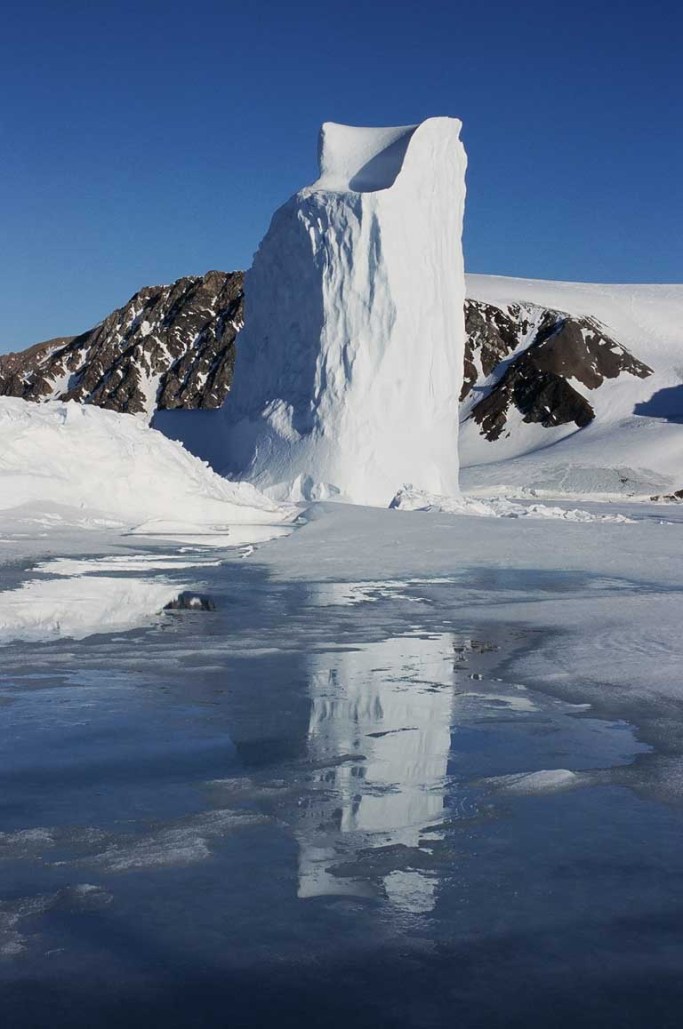
Iceberg in Glacier Strait, Nunavut, Canada, Image credit- Sandy Briggs.By Stephen Leahy

UXBRIDGE, Canada, May 7 (IPS) – As climate change takes hold, even the mighty Himalayas and Hindu Kush mountain ranges are now losing their snow and ice.

These are the world’s greatest repositories of snow and ice outside of the polar regions, and yet they may melt away in just 20 to 30 years, leaving more than a billion people desperately short of water, experts concluded in San Diego this week.

“There’s been a super-rapid decline in the glaciers of the region,” said Charles Kennel, senior strategist at the University of California San Diego Sustainability Solutions Institute and former director of Scripps Institution of Oceanography.

Kennel told IPS that nearly all of the 20,000 glaciers in the Himalaya-Hindu Kush mountain ranges are in retreat and the meltwater from some has created enormous lakes held back by rockslides that will inevitably burst, endangering anyone living in the valleys below. The World Wildlife Fund calculates there are 2,000 glacial lakes forming in Nepal and around 20 are in danger of bursting. Several have already flooded valleys in the past two decades in Nepal and Tibet.

“We are trying to make it known that the Himalayas are to the issue of the world’s water supply problem what the Amazon rain forest is to the issue of deforestation,” he said in reference to the “Ice, Snow, and Water” workshop convened at UC San Diego this week that included scientists from India, Nepal, Singapore and China. Continue reading

Deep CO2 Cuts May Be Last Hope for Acid Oceans

(Report from the World Oceans Conference in Indonesia)

gbr cap mushroom death4By Stephen Leahy

UXBRIDGE, Canada, May 15 (IPS) –

Ocean acidification offers the clearest evidence of dangers of climate change.

And yet the indisputable fact that burning fossil fuels is slowly turning the oceans into an acid bath has been largely ignored by industrialised countries and their climate treaty negotiators, concluded delegates from 76 countries at the World Oceans Conference in Manado, Indonesia.

Oceans and coastal areas must be on the agenda at the crucial climate talks in Copenhagen in December, they wrote in a declaration. “We must come to the rescue of the oceans,” declared Indonesian President Susilo Bambang Yudhoyono at the opening of high-level government talks on Thursday in the northern city of Manado.

It is fair to say most international climate negotiators aren’t aware of the impacts of climate change on the oceans, said Carl Gustaf Lundin, head of the IUCN’s Global Marine Programme.

“Very few people understand that carbon emissions are making the oceans acidic,” Lundin told IPS.

Continue reading

Ethanol and Biofuels: Almost Everything You Need to Know

“The U.S. has led the fight to stem global hunger, now we are creating hunger,” said Lester Brown, president of the Earth Policy Institute.

Series of the latest articles that provide almost everything you need to know about why ethanol and biofuels will not reduce global warming but simply drive up fuel and food costs.

maize - mexicoEthanol Worse Than Gasoline

Only Green Part of Most Biofuels is the Wealth (Subsidies) They Generate

Ethanol: The Great Big Green Fraud

International Enviro Standards Needed for Biofuels

Six Experts On Why Ethanol is a Dumb Idea

Food & Fuel: Can Sorghum Be The New Magic Bullet Biofuel??

Biofuels: Another Good Reason to Hate American Policy

(Cellulosic) Greenest Ethanol Still Unproven

Indigenous Peoples Demand Greater Role in Climate Debate

native-windmill-art

By Stephen Leahy*


ANCHORAGE, Alaska, Apr 20 (Tierramérica) – While indigenous peoples from around the world are meeting in this Alaskan city to seek a greater role in global climate negotiations, the rapidly warming Arctic is forcing some Inuit villages to be relocated.

“We have centuries of experience in adapting to the climate and our traditional lifestyles have very low carbon footprints,” Victoria Tauli-Corpuz, an indigenous leader from the Philippines and chair of the United Nations Permanent Forum on Indigenous Issues, told Tierramérica.

Carbon-based gases are the principal cause of the greenhouse effect, which leads to climate change. The excessive release of these gases, like carbon dioxide and methane, comes from human activities: the combustion of fossil fuels in industry and transportation, and emissions from livestock production and deforestation.

Some 400 indigenous people, including Bolivian President Evo Morales and observers from 80 nations, are gathered in Anchorage, Alaska for the Apr. 20-24 U.N.-affiliated Indigenous Peoples’ Global Summit on Climate Change.

They will discuss and synthesise ways that traditional knowledge can be used to both mitigate and adapt to climate change.

“Indigenous peoples have contributed the least to the global problem of climate change, but will almost certainly bear the greatest brunt of its impact,” said Patricia Cochran, chair of both the Inuit Circumpolar Council and the April Summit. Continue reading

Skin Would Fry in 5 Mins Without Ozone Treaty says NASA – Precautionary Lesson for Climate

ozone-hole-sept-08Disaster avoided.   If the world didn’t agree to cut back on ozone destroying chemicals that produce the annual polar ozone holes dangerous UV radiation would have increased a whopping 650 per cent by the year 2065 a new NASA study has found. By then two thirds of the protective ozone layer would have vanished creating a global ozone hole.

Five minutes of summer sun would burn skin in the mid-latitude regions like New York, London, Toronto. And it would be far worse in other regions.

And because those same chemicals are potent greenhouse gases the Earth would be 4 degrees warmer by then well past the critical tipping tip of 2 degrees scientists say we dare not exceed.

The world would have become a “real horrible place”, said NASA scientists.

I covered this in an IPS article last September  and how world leaders took a precautionary and averted catastrophe:

“In hard economic times, protecting the environment is often seen as a luxury — or ignored completely. But had that attitude prevailed 20 years ago when it came to taking action to protect the ozone layer, skin cancer rates would have soared and climate change would be even more dramatic than it is today. “

Tourism Can Reduce Poverty But Some Places Must Be Off-Limits

img_0330By Stephen Leahy*

QUEBEC CITY, Mar 24 (Tierramérica)More than ever before, global tourism must play its part in sustainable development and poverty alleviation, stated experts at an international symposium in this Canadian city.

But others wonder if tourism can be truly sustainable when it involves flying thousands of kilometres to reach some “carbon-neutral” eco-lodge in the jungle.

Climate change is a major concern and air transport makes a significant contribution, sustainable tourism expert Costas Christ told more than 500 attendees of the International Symposium on Sustainable Tourism Development, Mar. 16-19.

However, Christ said, it is also important to tell the public that international tourism has played a major role in preserving biodiversity and in conservation in general.

“Without tourism, the Pantanal (in South America), the world’s largest wetland, would have just turned into a major cattle feed-lot for McDonald’s,” said Christ, a former board chair of The International Ecotourism Society.

If it weren’t for tourism, Africa would not have its game parks and nature preserves, and the Coral Triangle (which encompasses the waters of Indonesia, Malaysia, Papua New Guinea, Philippines, Solomon Islands and Timor-Leste) would have been devastated by overfishing, he continued.

“Tourism is not the problem; the challenge is how to do tourism right,” Christ told Tierramérica in an interview. Continue reading

Fishers Learn to Share Shrinking Catch

albacore-tuna-fishing-vessel-san-diego1

By Stephen Leahy

SAN DIEGO, California, Feb 10 (IPS) – With the oceans in crisis, where will our fish – an important source of protein for billions of people – come from?

Innovative new fisheries management tools called “catch share” have begun in recent years and promise to keep fish on the menu for future generations, according to experts at the recent Seafood Summit in San Diego.

“Adaptation is the key – adaptation and innovation,” Kristjan Davidsson, former CEO of Iceland Seafood International, told over 450 conference attendees last week.

“It is not hard to see that sustainability is the way to go but that requires collaboration with all sectors,” Davidsson said.

The summit brought together fishers, fish farmers, multinational seafood corporations and seafood buyers, along with conservationists and scientists, to debate and find common ground on how to create a sustainable seafood industry and protect the oceans.

Fish account for 28 percent of the animal protein consumed in Asia and 16 percent globally. North America is at the low end of the scale, with fish accounting for just 6.6 percent of animal protein, according to data from the U.N. Food and Agriculture Organisation. Continue reading

Plenty of Blame for Collapsing Fish Stocks

yellow-fin-tuna-catch-galapagosBy Stephen Leahy

SAN DIEGO, California, Feb 4 (IPS) – Climate change, pollution and overfishing have left the oceans in crisis, experts agree. Now a new study reveals that every national government with a fishing fleet has dramatically failed to manage fisheries in a responsible manner.

A detailed survey of the 53 countries that land 96 percent of the world’s marine catch shows that all have failed to comply with the U.N. Food and Agriculture Organisation’s Code of Conduct for Responsible Fisheries. Developed in 1995, the 53 fishing nations all agreed to comply with the code as a potential rescue measure for the world’s fisheries.

And while countries claimed to comply, in fact not one is in full compliance, according the detailed analysis reported in the science journal Nature Wednesday.

I’m confident we would have turned the corner on the collapsing fish stocks had countries complied with the code,” said Tony Pitcher of the University of British Columbia in Vancouver, Canada, one of the study co-authors. Continue reading

North American Trees Dying Twice as Fast

sugar-pine-dying-from-bark-beetle-attack-in-yosemite-national-parkimage-courtesy-of-jerry-franklinBy Stephen Leahy

UXBRIDGE, Canada, Jan 22 (IPS)

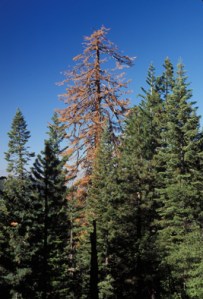
Our trees are dying. Throughout the western United States, cherished and protected forests are dying twice as fast as they did 20 years ago because of climate change, researchers reported Thursday in the journal Science.

Fire did not kill these trees, nor did some massive insect outbreak. The trees in this wide-ranging study were “undisturbed stands of old growth forests”, said Jerry Franklin, a professor of forest resources at the University of Washington and one of 11 co-authors of the report.

“The data in this study is from our most stable, resilient stands of trees,” Franklin told IPS.

What this means is that the United States’ best forests are getting thinner.

It is like a town where the birth rate is stable but the mortality rate for all ages doubled over the past two decades. “If that was happening in your hometown you’d become very concerned,” said Nate Stephenson, an ecologist with the U.S. Geological Survey (USGS).

This dramatic increase of in tree mortality applies to all kinds, sizes, ages and locations of trees. In the Pacific Northwest and southern British Columbia, the rate of tree death in older coniferous forests doubled in 17 years. In California, doubling mortality rates took a little longer at 25 years. For interior states it took 29 years. Continue reading