CANADA: Losing Control of Water Through NAFTA and SPP

By Stephen Leahy

“The SPP (Security and Prosperity Partnership ) is like putting the monkeys in charge of the peanuts.”

[UPDATED Feb 12’08]

TORONTO, Sep 22 2007 (Tierramérica) – Under the North American Free Trade Agreement, Canada lost control over its energy resources. Now, with “NAFTA-plus”, it could also lose control over its freshwater resources, say experts.Canada’s water is on the trade negotiating table despite widespread public opposition and assurances by Canadian political leaders, said Adèle Hurley, director of the University of Toronto’s Programme on Water Issues at the Munk Centre for International Studies.A new report released Sep. 11 by the programme reveals that water transfers from Canada to the United States are emerging as an issue under the auspices of the Security and Prosperity Partnership (SPP). The SPP — sometimes called “NAFTA-plus” — is a forum set up in 2005 in Cancún, by the three partners, Canada, United States and Mexico.

Economic integration as envisioned by the powerful but little-known SPP is slowly changing the lives of Canadians, says Andrew Nikiforuk, author of the report “On the Table: Water Energy and North American Integration“.

The SPP is comprised of business leaders and government officials who work behind the scenes and are already responsible for changes to border security, easing of pesticide rules, harmonisation of pipeline regulations and plans to prepare for a potential avian flu outbreak, Nikiforuk writes.

“The SPP is run by corporate leaders; governments are irrelevant,” said Ralph Pentland, a water expert and acting chairman of the Canadian Water Issues Council.

UPDATE: The Canadian Water Issues Council has written a model law to protect Canadian waters. For more see: Protecting Canada’s Water from the US Continue reading

The Real Cost of US Strawberries

The Chemical That Must Not Be Named
By Stephen Leahy

MONTREAL, Canada, Sep 20 (IPS) – Delegates from 191 nations are on the verge of an agreement under the Montreal Protocol for faster elimination of ozone-depleting chemicals, but the United States insists it must continue to use the banned pesticide methyl bromide.

Even as another enormous ozone hole forms over the Antarctic this week, the rest of the world appears to be giving in to U.S. demands despite the fact that the use of methyl bromide in developed countries was supposed to have been completely phased out by Jan. 1, 2005 under the Montreal Protocol on Substances that Deplete the Ozone Layer.

“It’s a black mark on this meeting. It is the chemical that must not be named,” said David Doniger, climate policy director at the Natural Resources Defence Council, a U.S. environmental group.

“There is a powerful lobby group of strawberry and vegetable growers in Washington,” Doniger told IPS.

Methyl bromide is a highly toxic fumigant pesticide which is injected into soil to sterilise it before planting crops. It is also used as a post-harvest decontaminant of products and storage areas. Although it is highly effective in eradicating pests such as nematodes, weeds, insects and rodents, it depletes the ozone layer and poses a danger to human health.

While alternatives exist for more than 93 percent of the applications of methyl bromide, some countries such as the U.S., Japan and Israel claimed that because of regulatory restrictions, availability, cost and local conditions, they had little choice but to continue its use as a pest control. And so despite the ban, the Montreal Protocol allows “critical use exemptions” for countries to continue to use banned substances for a short period of time until they can find a substitute.

In 2006, the United States received an exemption to use 8,000 tonnes of methyl bromide, compared to 5,000 tonnes for the rest of the developed world combined. Continue reading

Ozone Hole is Back and Bigger Than Ever

ozone-hole-sept-16-2007-sml.jpgThe World Meteorological Organization is reporting this week that the hole is back and bigger than ever. And it could grow larger in as spring returns to the region. In the past two years ozone holes larger than Europe have opened over the Antarctic and Southern Ocean.

The hole and the entire ozone layer and life on Earth would be in far worse shape if not for the The Montreal Protocol.

See also my stories on ozone and Montreal Protocol:

Ozone Treaty Best Bet to Slow Climate Change

From 2006:

Skin Cancer and the Record-breaking Antarctic Ozone Hole
60 Years to Restore the Ozone Layer Over Antarctica

Canada’s First Official F5 Tornado

Environment Canada meteorologists confirmed Sept 18 that the Elie, Manitoba tornado of June 22, 2007 reached F5 intensity, the highest rating on the Fujita tornado damage scale. Wind speeds are estimated to have reached between 420 to 510 km/hour when the tornado was at its most intense. 

Eleven tornadoes have occurred in Manitoba so far this summer. In 2006, Manitoba experienced 15 tornadoes, compared to a long term (1984-2006) average of nine tornadoes.

Is climate change responsible?

Ozone Treaty Best Bet to Slow Climate Change

Ozone Treaty Could Slow Climate Change
By Stephen Leahy


Credit:Nasa image

Blue represents the Antarctic ozone layer in 2006.


MONTREAL, Sep 17 (IPS) – Delegates from 191 nations are in Montreal, Canada this week to celebrate and extend the world’s most successful environmental treaty, the Montreal Protocol to protect the ozone layer.

With 95 percent of the target chemicals now eliminated, there is strong support to accelerate the phase-out of newer ozone-depleting chemicals that are also powerful greenhouses gases.

In fact, many experts believe this meeting could do more to reduce greenhouse emissions than the more widely-publicised Kyoto Protocol.

Challenges do remain — the United States continues to use large amounts of methyl bromide, an ozone-depleting substance (ODS), and the economic booms in China and India have rapidly increased the numbers of air conditioners using replacement chemicals.

Continue reading

Do you know what you’re eating? DNA barcoding IDs Fish Species

Geneticists Crack the Species Code
By Stephen Leahy


Credit:US CDC

Anopheles stephensi mosquito, a natural vector of malaria, which kills a million people per year.


Sep 14 (IPS) – Scientists are enthusiastic about a new DNA barcoding technology that will help keep illegal fish and timber out of global markets, slow the spread of invasive pests, and improve food safety and disease prevention and offer better environmental monitoring.

When a tree has been turned into a pile of lumber it’s very hard to know what species it was.” — David Schindel, executive secretary of the Consortium for the Barcode of Life

U.S. government regulatory agencies such as the Food and Drug Administration (FDA) and National Oceanic and Atmospheric Administration are beginning to utilise the three-year-old technology.

“It’s now a proven technology, everyone wants to use it,” said David Schindel, executive secretary of the Consortium for the Barcode of Life, comprised of 160 scientific and regulatory organisations from 50 countries and based at the Smithsonian Institution in Washington.

“It’s also an incredibly important technology for developing countries to research and protect their biodversity,” Schindel told IPS.

Continue reading

Facebook: Last Hope for Environment?

facebook-header.png

Global trends indicate a looming environmental catastrophe, and engaging high school students around the world may be the only hope.

By Stephen Leahyvital-signs.png

Sept 14’07 (IPS)
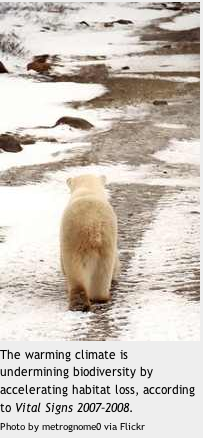
Governments, the corporate sector and media continue to champion industrial and economic growth at the cost of escalating impacts on the environment, concludes the latest report from the Washington-based Worldwatch Institute, “Vital Signs 2007-2008“.

For a number of years, the “Vital Signs” report has tracked 44 trends that are shaping the future, and they document a record level of industrial growth, says Erik Assadourian, Vital Signs project director.

“‘Vital Signs’ also documents the escalating impacts of such growth on the environment,” Assadourian told IPS in an interview from Barcelona.

The scale of the environmental crisis, in which catastrophic climate change is just one of many, is undermining the ecosystems that support life on Earth.

“Climate change and other environmental problems are symptoms of the root problem, which is the obsession with consumerism,” he said.

Vital Signs reports that in 2005, more wood was removed from forests than in any previous year. Fossil fuel usage dumped 7.6 billion tonnes of carbon emissions into the atmosphere. Meat production hit a record 276 million tonnes (43 kilogrammes per person) in 2006. Rising meat consumption is driving rising soybean demand to feed cattle, which in turn is a driver of deforestation as tropical forests are turned into soy fields.

And on it goes: global seafood consumption breaks records, steel and aluminium production too. None of this is sustainable — another three or four or five planets would be needed to maintain these levels of production and consumption. Continue reading

Wildlife Vanishing from African Game Parks

AFRICA: Game Parks Offering Protection in Name Only?
By Stephen Leahy

“If the international community increased funding by 10 times then there is hope. But I don’t think that’s realistic,” said Paul Scholte of the Institute of Environmental Science at Leiden University

kob-antelope.png

Sep 8 (IPS) – The sharp decline of Africa’s abundant wildlife is now happening inside the continent’s protected areas, a new analysis indicates. Africa’s world renowned parks are destined to become isolated pockets of wilderness with few large animals left, as is the case in Europe, conclude the authors of an article in the current edition of the ‘African Journal of Ecology’.

“It is not a pleasant conclusion,” said Paul Scholte, co-author of the article, and a researcher at the Institute of Environmental Science at Leiden University in the Netherlands.

“Where we have good data, there are dramatic declines in wildlife inside parks and protected areas,” he told IPS. “It was a shock. The declines are far worse than we expected.” Continue reading

Greenland Ice Collapse Producing Earthquakes

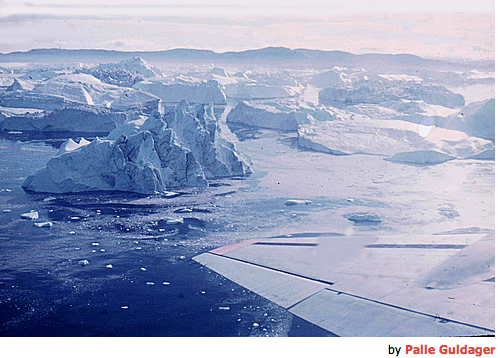
isfjorden-ved-jakobshavn-ilulissat.pngChilling from-the-scene update on my Greenland on Verge of Meltdown article in August: the Greenland ice cap is melting so quickly that it is triggering earthquakes as pieces of ice several cubic kilometres in size break off says Guardian reporter in Greenland.

UPDATE:
Here is a satellite view of Lulissat, Vestgronland Greenland just pan and zoom to the upper glacier to see the meltwater on the ice (not sure when this satellite pic was taken)
View Larger Map

Related stories:

The Earth is Going Dark Scientists Say
US Generals Say Warming Poses Major Security Threat

Climate Panel Report Called Too Conservative

First Ever: Two Hurricane Landfalls on Same Day – Pix

Yesterday was the first time Atlantic and Pacific hurricanes have made landfall on the same day. Here is an super picture of both Felix and Henriette by

NASA (high resolution pix here):

picture-5.png

Can only hope and pray that damage from these massive storms is minimal.

Check Reuters AlertNet for various emergency assistance agencies that are sending aid to these areas and for information updates.

To learn more about modern hurricanes and the potential link to climate change check out Steve’s Hurricane Handbook 2007. This is a compendium of the most interesting quotes and facts about hurricanes from scientists and other experts since 2004. You can download this collection free of charge but nothing is truly free. Donations appreciated