Runaway Global Economy Decimating Nature — World Bank Offers A Solution

By Stephen Leahy

NAGOYA, Japan, Oct 28, 2010 (IPS)

One-fifth of all birds, fish and animals are threatened with extinction – as many as six million unique and irreplaceable forms of life – an authoritative new assessment warned Wednesday.

Deforestation, agricultural expansion, overfishing, invasive alien species and climate change are the specific causes, but the main engine of destruction is an economic system that is blind to the reality that there is no economy or human well-being without nature, experts here say.

“Without global conservation efforts the situation would be massively worse,” noted Simon Stuart, chair of the International Union for Conservation of Nature (IUCN) Species Survival Commission, which launched the study at the 10th Conference of the Parties to the Convention on Biological Diversity (CBD) in Nagoya, Japan.

Published in the peer-reviewed journal Science, it is the most comprehensive assessment ever done of the world’s vertebrates – mammals, birds, amphibians, reptiles and fishes – Stuart said.

Every year, 52 species of mammals, birds and amphibians move one step down a three-step path to extinction, according to the study, which utilised data for 25,000 species from the IUCN Red List of Threatened Species.

Southeast Asia has experienced the most dramatic recent losses, largely driven by the planting of export crops like oil palm, commercial hardwood timber operations, agricultural conversion to rice paddies and unsustainable hunting, the study found. Parts of Central America, the tropical Andes of South America, and even Australia have also all experienced marked losses, in particular due to the impact of the deadly chytrid fungus on amphibians.

“The backbone of biodiversity is being eroded,” said the eminent U.S. ecologist and writer Edward O. Wilson of Harvard University.
Is this article of interest? It exists thanks to contributions from readers. Please click here to learn more about Community Supported Journalism.

Continue reading

Geoengineering on a Desperate Planet — UN Declares Global Moratorium

By Stephen Leahy

NAGOYA, Japan, Oct 25, 2010 (Tierramérica)

[Update 30 October 2 am. Global moratorium passes.]

Delegates to the world summit on biodiversity here are calling for a moratorium on climate engineering research, like the idea of putting huge mirrors in outer space to reflect some of the sun’s heating rays away from the planet.

Climate engineering or geoengineering refers to any large-scale, human- made effort to manipulate the planet to adapt to climate change.

Representatives from Africa and Asia expressed concern about the negative impacts of geoengineering during the opening week of the 10th Conference of Parties (COP 10) to the United Nations Convention on Biological Diversity (CBD), Oct. 18-29. They were joined by civil society organisations in calling for a moratorium on geoengineering experiments.

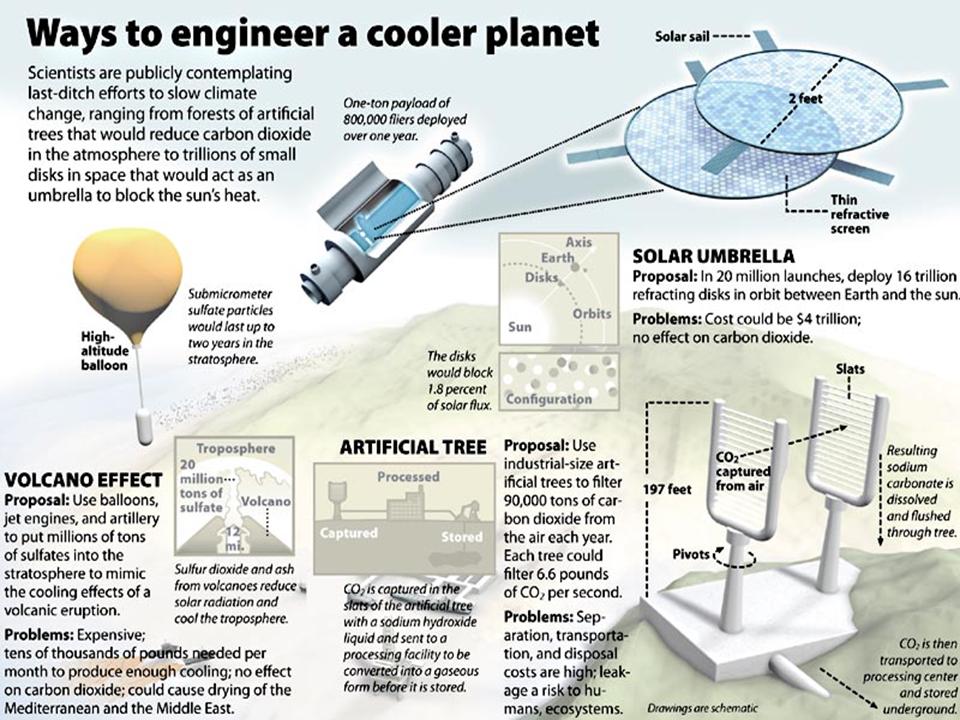
The geoengineering proposals include installing giant vertical pipes in the ocean to bring cold water to the surface, pumping vast amounts of sulphates into the stratosphere to block sunlight, or blowing ocean salt spray into clouds to increase their reflectivity.

The geoengineering proposals include installing giant vertical pipes in the ocean to bring cold water to the surface, pumping vast amounts of sulphates into the stratosphere to block sunlight, or blowing ocean salt spray into clouds to increase their reflectivity.

Broadly speaking, there are two main geoengineering approaches: solar radiation management and carbon sequestration, in other words, absorbing carbon dioxide from the atmosphere to reduce the concentration of this greenhouse-effect gas.

Is this article of interest? It exists thanks to contributions from readers. Please click here to learn more about Community Supported Journalism.

To manage the sun’s rays, there are ideas like releasing sulphates into the atmosphere or placing giant mirrors in outer space. For absorbing carbon, the possible approaches include ocean fertilisation, in which iron or nitrogen is added to seawater to stimulate the growth of phytoplankton to sequester the carbon deep in the ocean.

“Some of the proponents of these technologies think it’s easier to ‘manage the sun’ than get people to take a bus” to reduce carbon in the atmosphere, said Pat Mooney, executive director of the ETC Group, an international environmental organisation headquartered in Canada. [etc “Geopiracy” report]

“Politicians in rich countries see geoengineering as ‘Plan B’ so they don’t have to make the hard choices of reducing emissions causing climate change,” Mooney told Tierramérica.

Continue reading

Palau Announces Massive Marine Sanctuary to Protect Whales, Dolphins, Sharks

By Stephen Leahy

NAGOYA, Japan, Oct 25, 2010 (IPS)

One of Japan’s closest allies declared over the weekend that all of its oceans – more than 600,000 square kilometres – would be a sanctuary for whales, dolphins, dugongs, sharks and other species.

“There will be no hunting or harassment of marine mammals and other species in our waters,” said the Honourable Harry Fritz, minister of the environment, natural resources and tourism of the Republic of Palau.

“We urge other nations to join our efforts to protect whales, dolphins and other marine animals,” Fritz said at a press conference during Oceans Day at the meeting of the Conference of the Parties to the Convention on Biological Diversity in Nagoya, Japan.

Japan has long sought to overturn the global ban on commercial whaling and has actively solicited and received Palau’s support for many years. Japan is its second largest source of development aid after the United States. Japanese tourists frequent the islands since many people speak some Japanese.

“Palau now supports conserving marine mammals, along with sharks and other species,” said Susan Lieberman, director of international policy for the Pew Environment Group, a large U.S. NGO.

“This is a very significant announcement,” Lieberman told IPS.

Is this article of interest? It exists thanks to contributions from readers. Please click here to learn more about Community Supported Journalism. Continue reading

Rich Countries Trash Their River Systems and Make Things Worse With Expensive Engineering Fixes — Global Study in Nature

Jaw-dropping fact: Rivers in US and Europe in Worst Shape

By Stephen Leahy

UXBRIDGE Canada, Oct 5, 2010 (IPS)

Failure to protect and invest in nature has left the world’s rivers in crisis, threatening the water supply of more than five billion people according to a new study.

Pollution, dam building, agricultural runoff, conversion of wetlands, and water-works engineering have severely impacting global river systems, the first- ever health assessment of the planet’s riverine ecosystems reported in Nature last week (subscription req’d).

What made our jaws drop is that some of the highest threat levels in the world are in the United States and Europe,” says Peter McIntyre, a co-author of the report who is a zoologist at the University of Wisconsin-Madison in the U.S.

“Our study reveals, that on average, the richer the country the greater the threat to river systems,” McIntyre told IPS.

Is this article of interest? It exists thanks to contributions from readers. Please click here to learn more about Community Supported Journalism.

Expensive water-works engineering to control freshwater quality and quantity in rich countries decimate rivers’ natural abilities to control and clean water the Nature study found. River systems provide an estimated six to seven trillion dollars in services to humanity every year, but the hundreds of billions of dollars spent on engineering systems impairs those services for short-term gain, says co-author Charles Vörösmarty of the City University of New York, an expert on global water resources.

“We need to take another approach, to join hands with nature and work together,” Vörösmarty said in an interview. “If we do humanity will get a far better payback in the future.” Continue reading

Locally-Run Protected Areas Could Reverse Fisheries’ Death Spiral


Great Barracuda and Jacks, Diamond Rock, Saba,...
Image via Wikipedia


One third of all species of sharks, rays and reef-building corals are facing extinction while governments spend $27 billion subsidizing overfishing

By Stephen Leahy

UXBRIDGE, Canada, Sep 15, 2010 (IPS)

Local fishers objected to the creation of a new no-fishing marine protected area off the coast of Belize in 1996. Today they are benefiting from the bounty of fish spilling out of the Laughing Bird Caye National Park. Tourism has also boomed, illustrating the multiple benefits and value of marine protected areas, according to a new series of reports released Wednesday by Conservation International (CI).

“The ocean is in crisis but we can’t see it with our own eyes so we’re not aware of what is happening,” said Leah Bunce Karrer, co-author and director of the Marine Management Area Science Programme at CI.

“Marine managed areas offer a solution which could significantly reduce ocean degradation while benefiting local communities,” Karrer told IPS.

Is this article of interest? It exists thanks to contributions from readers. Please click here to learn more about Community Supported Journalism.

One third of all species of sharks, rays and reef-building corals are facing extinction. “Most people don’t realise that,” said Gregory Stone, chief ocean scientist at CI.

“As species disappear, entire ecosystems are altered in negative ways we don’t even want to imagine,” Stone said.

Only a fraction of one percent of the world’s oceans are effectively protected even though there is growing scientific consensus of the need to protect at least 20 percent of the seas. Continue reading

Record Heat Killing Caribbean and Indian Ocean Corals

By Stephen Leahy*

[There hasn’t been much news about the impacts of the record warming of parts of the world’s oceans but severe coral bleaching in the Indian ocean resulted in widespread coral death. Sadly the Caribbean also at high risk this month with record high water temps. My article connects that reality with how a new approach to protecting corals may give them the best chance to survive in hotter, more acidic oceans. — Stephen]

UXBRIDGE, Canada, Sep 13, 2010 (Tierramérica)

The waters of the Caribbean Sea are the warmest on record and the region’s imperilled corals are bleaching and beginning to die, experts warn.

This year many corals are already bleached and dying in the southern Caribbean Sea, especially in the Lesser Antilles, according to Mark Eakin coordinator of Coral Reef Watch at the U.S. National Oceanographic and Atmospheric Administration (NOAA).

Is this article of interest? It exists thanks to contributions from readers. Please click here to learn more about Community Supported Journalism.

The waters are even warmer than they were in 2005 when a severe bleaching occurred across much of the Caribbean. More than 60 percent of corals around the U.S. Virgin Islands died, Eakin told Tierramérica.

Water temperatures in this region reach their annual peak between September and October.

The area affected by bleaching and dying corals will likely extend to the region east of Nicaragua, past the island of Hispaniola (Haiti and Dominican Republic) to Puerto Rico and the Lesser Antilles, and south along the Caribbean coasts of Panama and South America, according to a warning issued by Coral Reef Watch last month.

“There is the potential that this will be worse than 2005, unless some tropical storms come through and mix the warm surface water with deeper, cooler water,” Eakin said.
Continue reading

Flee or be Made Homeless by Climate Change? Powerful New Film (video)

Three people in a unique Pacific Island community face the first devastating effects of climate change, including a terrifying flood.  Will they decide to stay with their island home or move to a new and unfamiliar land, leaving their culture and language behind forever?

Ultimately the documentary “There Once was an Island” is about what makes us who we are and what we all stand to lose as climate change unfolds. — Stephen

Related articles by Stephen Leahy:

Drowning Country: Tuvalu Symbol of Catastrophe and Hope

Canada Reneges on Kyoto Climate Change agreement

Extinction Tourism — See It Now Before Its Gone

Hurricane Madness – 3 Hurricanes Spinning At One Time

Record warm Atlantic sea surface temperatures have spawned three simultaneous hurricanes this Thurs and Friday: Hurricanes Igor, Julia, and Karl. Although this is not the first time other records continue to fall according to weather expert Jeff Master. Julia was the strongest hurricane on record so far east, Karl was the strongest hurricane so far south in the Gulf of Mexico, and Earl was the 4th strongest Atlantic hurricane so far north.

Master said Friday: “we are now ahead of the pace of the terrible hurricane seasons of 2004 and 2005 for number of major hurricanes so early in the year”.

Arctic Melt Down Is Bringing Harder Winters and Permanently Altering Weather Patterns

Last year’s cold and snowy winter directly connected to warmer Arctic new research reveals

By Stephen Leahy

OSLO, 15 June 2010 (IPS)

Last winter’s big snowfall and cold temperatures in the eastern United States and Europe were likely caused by the loss of Arctic sea ice, researchers concluded at the International Polar Year Oslo Science Conference in Norway in June.

Climate change has warmed the entire Arctic region, melting 2.5 million square kilometres of sea ice, and that, paradoxically, is producing colder and snowier winters for Europe, Asia and parts of North America.

“The exceptional cold and snowy winter of 2009-2010 in Europe, eastern Asia and eastern North America is connected to unique physical processes in the Arctic,” said James Overland of the NOAA/Pacific Marine Environmental Laboratory in the United States.

In future, cold and snowy winters will be the rule rather than the exception” in these regions, Overland told IPS.

[[UPDATE Dec 29 2010 – Winter of 2010-11 appears to follow same pattern, see new post with northern hemisphere temp map for 20 Dec:  Arctic Hothouse Turns Europe into an Icebox]]

Scientists have been surprised by the rapid warming of the Arctic, where annual temperatures have increased two to three times faster than the global average. In one part of the Arctic, over the Barents and Karas Seas north of Scandinavia, average annual temperatures are now 10 degrees C higher than they were in 1990.

Is this article of interest? It exists thanks to contributions from readers. Please click here to learn more about Community Supported Journalism.

Overland explains the warming of the Arctic as the result of a combination of climate change, natural variability, loss of sea ice reflectivity, ocean heat storage and changing wind patterns, which has disrupted the stability of the Arctic climate system. In just 30 years, all that extra heat has shrunk the Arctic’s thick blanket of ice by 2.5 million square kilometres – an area equivalent to more than one quarter the size of the continental U.S.

The changes in the Arctic are now irreversible, he said. Continue reading

Oceans on the Brink: Dying Plankton, Dead Zones, Acidification

A number of marine diatom cells

By Stephen Leahy

VIENNA, Jul 31, 2010 IPS

The oceans are the lifeblood of our planet and plankton its red blood cells. Those vital “red blood cells” have declined more than 40 percent since 1950 and the rate of decline is increasing due to climate change, scientists reported this week.

Phytoplankton are a critical part of our planetary life support system. They produce half of the oxygen we breathe, draw down surface CO2, and ultimately support all of our fisheries,” said

Boris Worm of Canadas Dalhousie University and one of the worlds leading experts on the global oceans.

“An ocean with less phytoplankton will function differently,” said Worm, the co-author of a new study on plankton published this week in Nature. Plankton are the equivalent of grass, trees and other plants that make land green, says study co-author Marlon Lewis, an oceanographer at Dalhousie.

“It is frightening to realise we have lost nearly half of the oceans’ green plants,” Lewis told IPS.

“It looks like the rate of decline is increasing,” he said.

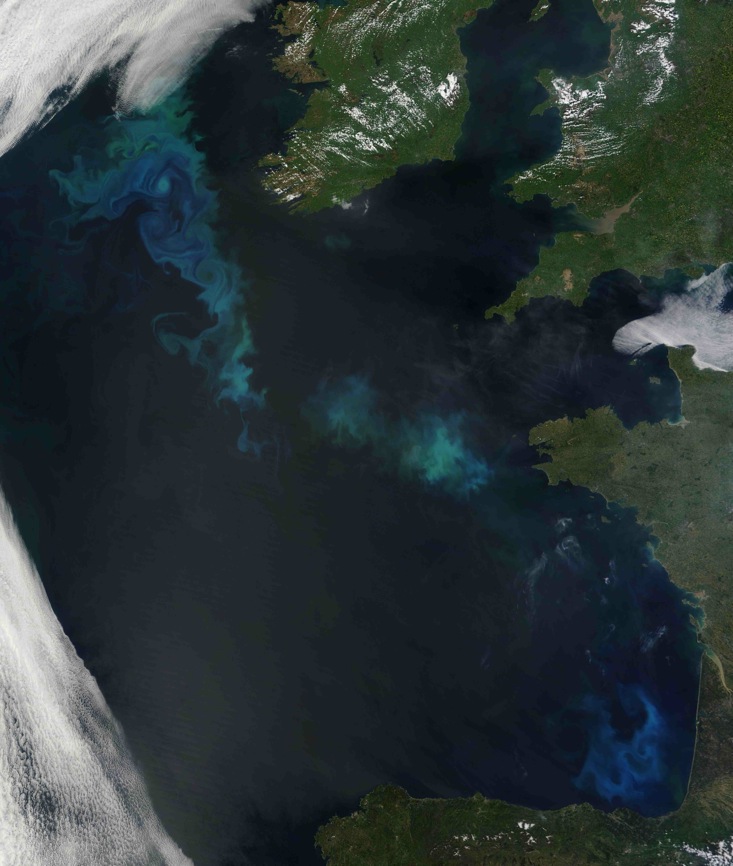
A large phytoplankton bloom in the Northeast Atlantic -NASA Earth Observatory Collection.

[See also my series of articles on ocean acidification]

Independent environmental journalism now depends on public support, learn more about how this works and how you can help, click here.

Climate change is warming the oceans about 0.2C per decade on average. This warmer water tends to stay on top because it is lighter and essentially sits on top of a layer of colder water. This layering, or stratification, is a problem for light-loving plankton because they can only live in the top 100 to 200 meters.

Eventually they run out of nutrients to feed on unless the cold, deeper waters mix with those near the surface. Ocean stratification has been widely observed in the past decade and is occurring in more and larger areas of the world’s oceans. Continue reading