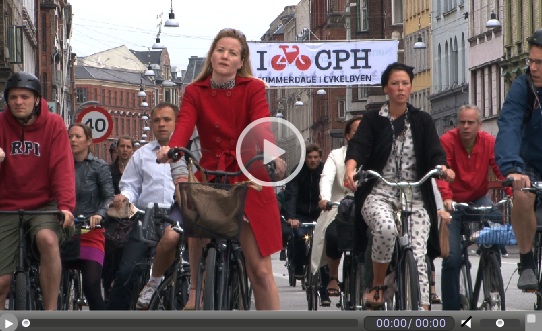
Copenhagen’s Fantastic Bike Culture Should Be In Every City — Great Video Shows Why

Copenhagen has a fantastic bike culture — 60+ % commute to work every day plus they have a great subway system too. It is cold and wet a lot of the year but people dress for it and were frankly a hell of lot warmer than I was walking when I was there for three weeks in December while covering the climate summit.

One Saturday morning before Christmas I was amazed to see a family of four on two bikes with their groceries and a 2-metre Christmas tree happily pedaling for home . In North America we think we need a van or at least a pick up truck

This professional video shows an overview of what makes Copenhagen such a fantastic city, as seen by North-American eyes

Sadly I didn’t get a chance to ride in Copenhagen but this should be a model for other cities around the world. Copenhagen did it in 40 years and it is truly amazing. — Steve

Proof of Anti-Global Warming Cabal: Fossil fuel Interests, Christian Evangelicals and the Media

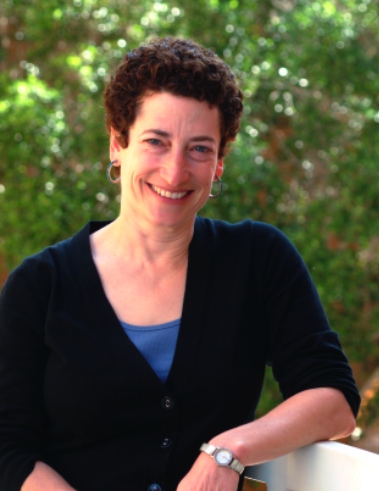
Stephen Leahy interviews science historian NAOMI ORESKES

PARIS, Mar 24, 2010 (IPS)

Even though 2009 was the fifth warmest year since 1850, and 2000-09 the warmest decade ever, according to the World Meterological Organisation, surveys show that public concern about global warming in the United States and Canada has dropped sharply in the past 18 months.

Why? Because of a relentless disinformation effort from an unlikely cabal of fossil fuel interests, Christian evangelicals and the media, says Naomi Oreskes, a professor of history and science studies at the University of California, San Diego.

“They have managed to reopen the debate over global warming in people’s minds,” she told IPS.

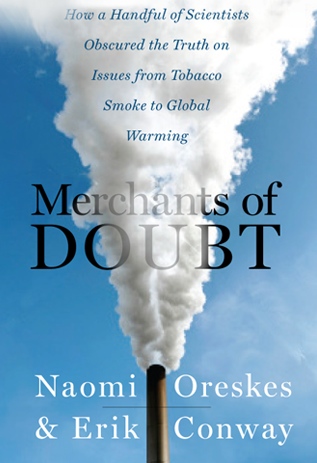
Oreskes and co-author Erik Conway, a science historian at the Jet Propulsion Laboratory, document similar efforts to manufacture doubt around the science on acid rain, the ozone hole, secondhand cigarette smoke, and the pesticide DDT in their just published book, “Merchants of Doubt: How a Handful of Scientists Obscured the Truth on Issues from Tobacco Smoke to Global Warming”. [Tons of excellent reviews —  the “eye-opener of the year” says one reviewer.]

In 2004, Oreskes was vilified on TV, radio and in print by commentators for providing clear evidence there was in fact a scientific consensus on global climate change. Her essay in the journal Science examined all of the peer-reviewed scientific papers on climate over the previous 10 years and found none dissented with the theories that climate change was occurring and it was caused by humans. Her survey has never been successfully challenged, despite many attempts.

IPS environmental correspondent Stephen Leahy spoke to Oreskes over the phone. Excerpts of the interview follow.

Q: Where is the vehement opposition to the very idea that we need to do something about climate change?

A: Some of it is ideological, part of a long history in the United States that equates environmental regulation as going down the slippery slope to socialism. And some is religious. Christian evangelicals don’t like science in general and have found common cause with the coal industry as a way to be able to teach creationism. Obviously, the motivation of the coal industry is rather different but now these people have come together to undermine science in general.

Are you enjoying this article? It is funded by contributions from readers. Please click here to learn more about Community Supported Journalism.

Continue reading

Why the BP Oil Spill Really Happened

We Can Live Without Oil

“It was a disaster that was going to happen, but business and government simply pretended it was not going to happen.”

[Update: Why the BP spill cannot be cleaned up]

By Stephen Leahy*

UXBRIDGE, Canada, May 10, 2010 (Tierramérica)

The policies and deals that contributed to the massive oil spill under way in the Gulf of Mexico are also jeopardising the Earth’s vital biological infrastructure, according to the Global Biodiversity Outlook 3, published Monday.

The British Petroleum oil spill of 5,000 barrels a day in the Gulf of Mexico, which began Apr. 20 when an explosion caused a rupture at the Deepwater Horizon oil rig, will have devastating consequences for marine life and coastal ecosystems for decades, experts say.

Similar business and policy decisions, multiplied thousands times over the last hundred years, have put the biological infrastructure that supports life in jeopardy, according to the Global Biodiversity Outlook 3 (GBO3) report, issued May 10 by the Convention on Biological Diversity.

The report is the most current assessment of the state of the planet’s biodiversity, the living organisms that provide us with health, wealth, food, fuel and other vital services.

In this study, “you can clearly see the outlines of what could be the sixth great extinction event of all life on Earth,” said Thomas Lovejoy, biodiversity chair at the Washington DC-based Heinz Centre for Science, Economics and the Environment, and chief biodiversity adviser to the president of the World Bank. Continue reading

Earth Day Wish – The 3 Rules

Take time to be outside today.

Think about everything that nature provides – air, water, plants and animals that sustain us. Such gifts should not be taken lightly for they can vanish or be degraded. With our numbers and powerful technologies we are ‘the bull in nature’s china shop’.

We need to take great care and practice Climate-safe Living.

3 Rules to dial down the temperature on our global greenhouse:

1. Reduce.

Reduce fossil fuel consumption everywhere.

2. Eliminate.

Eliminate all non-essential activities and products that involve burning fossil fuel.

3. Demand.

Demand that business and government provide transport, activities and products that use minimize fossil fuel use.

Reduce. Eliminate. Demand. R.E.D.

May you always cherish this Earth and share in her joys.

Stephen

[I’m an independent journalist based in Canada who supports his family and the public interest writing articles about important environmental issues. This is now only possible with your support (see Collapse of Media). A small contribution ($5, $10, $20) is the ONLY way this can continue.  PayPal or Credit Card Or contact me for mailing address.]

Fish Companies Push Hard to Halt Tuna Collapse

By Stephen Leahy*

VICTORIA, Seychelles, Feb 8, 2010 (IPS)

In the Seychelles’ only cannery, the din of thousands of empty tuna cans rattling on narrow metal troughs is incredible as they bustle along, soon to be filled with Skipjack tuna that only days ago were swimming freely in the inky blue Indian Ocean.

At one end of the Indian Ocean Tuna Limited processing plant – the world’s second largest – cranes offload nets full of frozen tuna from huge international fishing boats called purse seiners while at the other end of the plant, 5,000 cans of tuna roll off the line every minute.

That’s a lot of tuna – roughly 400 metric tonnes a day. Can the Indian Ocean tuna bounty, which amounts to more than 20 percent of the world’s tuna, be sustained?

That was the key question at the first-ever Seychelles Tuna Conference that ended last weekend. It brought together nearly 200 scientists, fishers, environmentalists and policy makers here in Victoria, Africa’s smallest capital city, located 1,800 km east of Somalia and practically in the middle of the Indian Ocean.

“The boats are much more efficient today and the tuna stocks are declining and there is much less tuna than before, ” said Alain Fonteneau, a scientist with the L’Institut de recherche pour le développement, in Montpellier, France, who opened the conference. Continue reading

Canada’s Idea of Working on Climate Change Means Muzzling Climate Scientists, Closing Research Stations and Cutting Funding

“This government is doing nothing on climate but they always make sure to sound like they’re doing something to fool Canadians.” — John Bennett, Sierra Club of Canada

By Stephen Leahy

UXBRIDGE, Canada, Mar 16, 2010 (IPS)

Canada’s climate researchers are being muzzled, their funding slashed, research stations closed, findings ignored and advice on the critical issue of the century unsought by Prime Minister Stephen Harper’s government, according to a 40-page report by a coalition of 60 non-governmental organisations.

“This government says they take climate change seriously but they do nothing and try to hide the truth about climate change,” said Graham Saul, representing Climate Action Network Canada (CAN), which produced the report “Troubling Evidence”.

“We want Canadians to understand what’s going on with this government,” Saul told IPS.

Climate change is not an abstract concept. It already results in the deaths of 300,000 people a year, virtually all in the world’s poorest countries. Some 325 million people are being seriously affected, with economic losses averaging 125 billion dollars a year, according to “The Anatomy of a Silent Crisis“, the first detailed look at climate change and the human impacts.

Released last fall by the Geneva-based Global Humanitarian Forum, the report notes that these deaths and losses are not just from the rise in severe weather events but mainly from the gradual environmental degradation due to climate change.

Is this article of interest? It exists thanks to contributions from readers. Please click here to learn more about Community Supported Journalism.

“People everywhere deserve to have leaders who find the courage to achieve a solution to this crisis,” writes Kofi Annan, former U.N. secretary-general and president of the Forum, in the report.

Canadians are unlikely to know any of this. Continue reading

OUR Roof is on Fire: Dangerous Climate Change is Here

It will take lot of us – probably in the streets” to make politicians face the truth, says climate scientist James Hansen.

[Dangerous climate change is already upon us say some of the best scientists we have. But political leaders — and most of the public — don’t get it. This is an attempt to close the chasm between climate reality and climate denial fantasy. I wrote this at the end of the Copenhagen Climate meetings last December thanks in part to financial contributions from readers that allowed me to do the research and interviews. — Stephen]

Our leaders do not get the scale of the problem or the rapidity of the changes.”            — Andrew Weaver, climatologist at Canada’s University of British Columbia

Analysis by Stephen Leahy

COPENHAGEN Dec 22 ,2009 (IPS/TerraViva)

The roof of our house is on fire but our leaders, our economic system and we ourselves are ignoring the alarms and continuing to add more fuel. There are no exit doors in our house; there is nowhere else to go.

Dangerous climate change is already here.

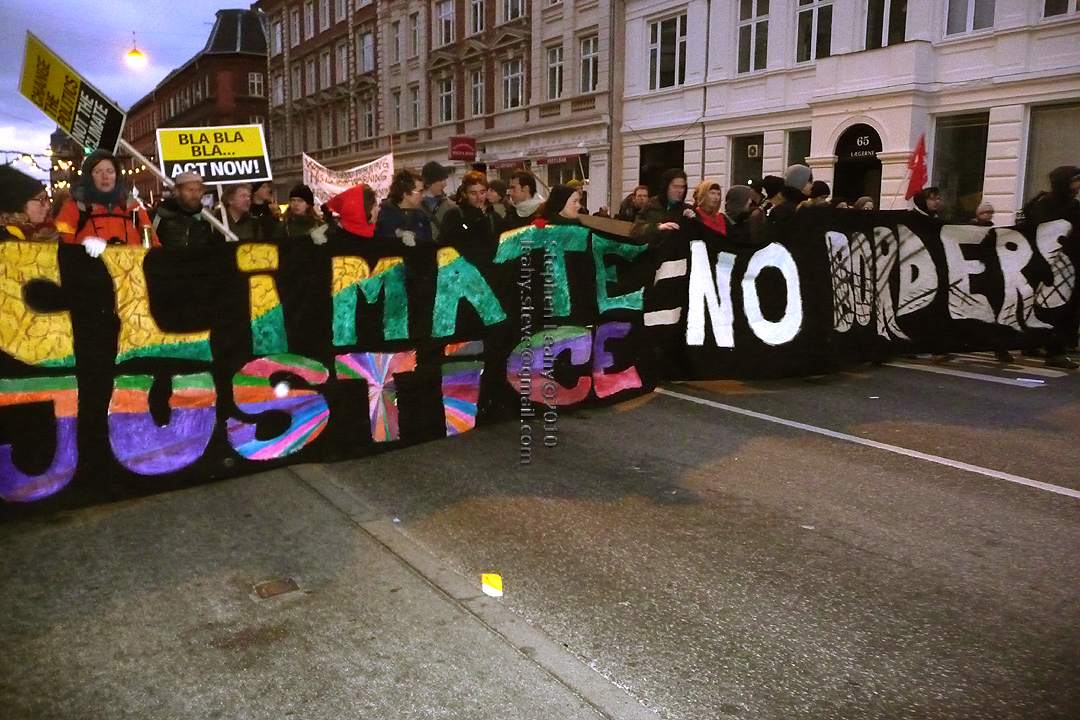
The two-week climate summit in Copenhagen came to an end with disappointing results and details that are still vague.

A ”Copenhagen Accord” was agreed by the US, China, South Africa and India by Friday night. It was unclear which other countries were willing to support it.
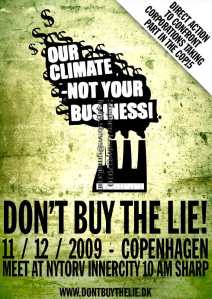
But coral reefs are dying, the Arctic is melting and rising sea levels threaten the homes of millions. And we’re on our way to a planet-transforming four-degree C rise in global average temperatures in as soon as 50 years.

Future generations could face an utterly transformed planet, where large areas will be seven to 14 degrees C warmer, making them uninhabitable. In this world-on-fire, the one to two metre sea level rise by 2100 will leave hundreds of millions homeless, according to the latest science presented at the “4 Degrees and Beyond, International Climate Science Conference” at the University of Oxford in September.

That’s the science-based, slap-in-the-face reality as the Copenhagen climate talks fizzle out here with little progress Friday.

Our leaders do not get the scale of the problem or the rapidity of the changes. They don’t get that it must be dealt with now,” said Andrew Weaver, a climatologist at Canada’s University of British Columbia and lead author of the Intergovernmental Panel on Climate Change (IPCC) reports. Continue reading

A Tipping Point on Species Loss?

By Stephen Leahy

UXBRIDGE, Canada, Jan 13, 2010 (IPS)

Humanity is destroying the network of living things that comprise our life support system. While this sawing-through-the-branch-we’re-perched-on is largely unintentional, world leaders can’t say they didn’t know what’s going on: 123 countries promised to take urgent action in 2003 but have done little to stem the rising tide of extinctions in what’s known as the extinction or biodiversity crisis.

Species are going extinct at 1,000 times their natural pace due to human activity, recent science has documented, with 35 to 40 species vanishing each day, never to be seen again.

“The question of preserving biological diversity is on the same scale as climate protection,” German Chancellor Angela Merkel said in a speech in Berlin Monday at the official launch of the United Nations’ International Year of Biodiversity.

This week’s official launch will be followed by the first major event of the International Year, a high-profile meeting at the Paris headquarters of the U.N. Educational, Scientific and Cultural Organisation, Jan. 20-21.

“We need a sea change. Here, now, immediately – not some time in the future,” Merkel said.

While climate has been the focus in 2009, this year will be a global celebration of and action on biodiversity, Ahmed Djoghlaf, executive secretary of the Convention on Biological Diversity (CBD), told IPS from Berlin.

Continue reading

The simple truth: “The whole thing unravels without protecting at least half of the planet”

Job #1. end government subsidies that drive economic activity that damages the environment

By Stephen Leahy

MÉRIDA, Mexico, Nov 17 IPS

At least half the planet must be protected if humanity is to survive the next century, declared conservationists at the conclusion of 9th World Wilderness Congress on Friday, Nov. 13.

“That is what the science said, this is what many aboriginal people say,” said Harvey Locke, the Wild Foundation's vice president of conservation strategy.

“It’s time to speak the simple truth: The whole thing unravels without protecting at least half of the planet,” said Locke.

A leading economic report released in Brussels also on Nov. 13 pegged the cost of the ongoing loss and degradation of nature’s “infrastructure” at a staggering 2.5 trillion to 4.5 trillion dollars a year.

The enormous challenges humanity faces this century – like a warming planet, freshwater shortages, pollution, declining fisheries, desertification and unsustainable food production – cannot be solved without protecting more than 50 percent of Earth’s land and oceans, Locke told IPS.

Protection doesn’t necessarily mean more national parks, but a ban on resource extraction and all forms of development.

Is this article of interest? It exists thanks to contributions from readers. Please click here to learn more about Community Supported Journalism.

“We all know we aren’t sustainably managing the Earth,” he told participants at the WILD9 congress, a partnership between the WILD Foundation, an international, non-governmental non-profit based in the United States, and Unidos para la Conservación, a conservation organisation in Mexico.

“It is time for us to state clearly the scale of conservation intervention needed to make the 21st century one of hope instead of despair,” he said. Continue reading

Carbon Emissions Can Be Reduced 80% by 2020 – Lester Brown has a plan and he’s not crazy

LesterBrown smlStephen Leahy interviews LESTER BROWN, founder of the Earth Policy Institute

UXBRIDGE, Canada, Oct 7 2009 (IPS)

Lester Brown says his views sometimes appear extreme – because the mainstream media largely doesn’t understand the urgency and challenges in avoiding catastrophic climate change.

The founder and president of the Washington-based Earth Policy Institute, he is also considered by many to be one of the world’s most influential thinkers.

“It looks like I’m a radical because the mainstream media aren’t reflecting the reality of our situation,” Brown says.

A farmer from the eastern U.S. state of New Jersey, Brown entered the U.S. Civil Service in the 1960s, becoming an expert on foreign agricultural policy before leaving to found the Worldwatch Institute in 1974.

The winner of many awards and honourary degrees, Brown is the author of 50 books. In 2001, he founded the Earth Policy Institute to provide a roadmap for achieving an environmentally sustainable economy.

His most recent book is “Plan B 4.0: Mobilizing to Save Civilization”, the fourth and perhaps most urgent version of the Plan B series, available for download at the institutes’s website. In Plan 4.0, Brown calls for carbon emissions cuts of 80 percent by 2020.

“We cannot afford to let the planet get much hotter,” he explains simply. Continue reading