It doesn’t have to be this way – typical family could reduce their energy use 60 to 75 percent
By Stephen Leahy
UXBRIDGE, Canada, Jan 29 2013 (IPS)
Weird is the only way to describe January temperatures whipsawing between record warm and arctic cold over a span of a few days. Experts say that is what climate change looks like: weird, record-shattering weather.
Here’s a fact that goes beyond weird to astonishing. Anyone who is 27 years old or younger has never lived through a month that was colder than the global 20th century average. In other words, we’ve had 334 consecutive months with above average temperatures, according to the U.S. National Oceanic and Atmospheric Administration.
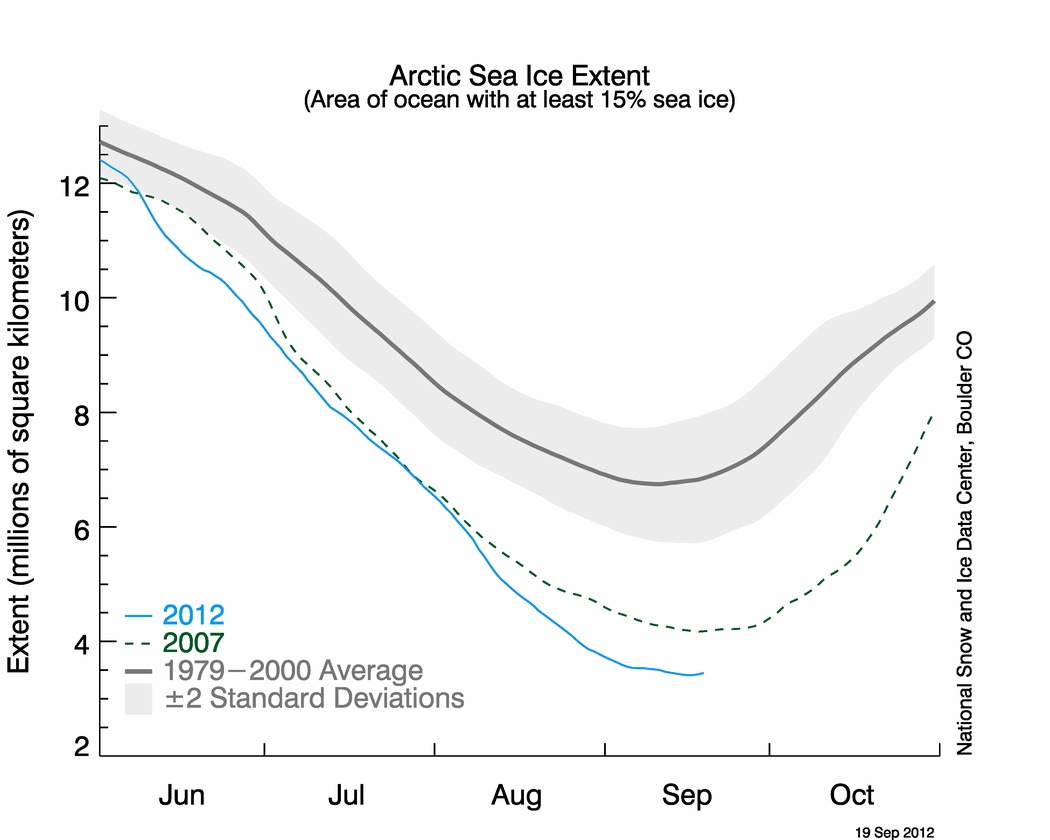
Arctic sea ice extent. Area of ocean with at least 15 percent sea ice as of Sept 12, 2012. Credit: National Snow and Ice Data Center.
Last summer, the Arctic sea ice shrunk to half of what it used to be during summers only three decades ago. Our planet’s weather is driven largely by the two cold polar regions and the warm tropics. With the Arctic defrosting, it should be no surprise our weather is getting weird. And that it’s not going to get better.
Our planet is heating up because we each year put thousands of millions of tonnes of carbon dioxide (CO2) into the atmosphere by burning coal, oil, and natural gas. CO2 acts as heating blanket keeping the planet warm by trapping some of the sun’s heat.
The amount of extra heat-energy being trapped is like exploding 400,000 Hiroshima atomic bombs per day 365 days per year, calculates James Hansen, a climate scientist who heads the NASA Goddard Institute for Space Studies.
Cautious scientists like Hansen are terrified of what’s coming. Conservative institutions like the World Bank and accounting giant Price Waterhouse Coopers (PwC) have warned we’re on a path to heating the entire surface of the planet by an average of four or five degrees C before 2100. That translates into eight to 12 degrees C hotter in places like Canada.
“The only way Keystone XL could be considered in the national interest is if you equate that with profits for the oil industry”
By Stephen Leahy
UXBRIDGE, Canada, Sep 2, 2011 (IPS)
With four times as many oil rigs pumping domestic oil today than eight years ago and declining domestic demand, the United States is awash in oil.
The country’s oil industry is primarily interested in who will pay the most on the global marketplace. They call that “energy security” when it suits, but in reality it is “oil company security” through maximising profits, say energy experts like Steve Kretzman of Oil Change International, an NGO that researches the links between oil, gas and coal companies and governments.
The only reason U.S. citizens may be forced to endure a risky, Canadian-owned oil pipeline called Keystone XL is so oil companies with billion-dollar profits can get the dirty oil from Canada’s tar sands down to the Gulf of Mexico to export to Europe, Latin America or Asia, according to a new report by Oil Change International released Wednesday.
“Keystone XL will not lessen U.S. dependence on foreign oil, but rather transport Canadian oil to American refineries for export to overseas markets,” concludes the report, titled “Exporting Energy Security“.
Little of the 700,000 to 800,000 barrels of tar sands oil pumped through the 2,400-kilometre, seven-billion-dollar Keystone XL will end up in U.S. gas tanks because the refineries on the Gulf Coast are all about expanding export markets. One huge refinery operator called Valero has been touting the potential export revenues of tar sands oil to investors, the report found.
Because Keystone XL crosses national borders, President Barack Obama has to issue a permit declaring the pipeline serves the “national interest” in order to be approved.
“The only way Keystone XL could be considered in the national interest is if you equate that with profits for the oil industry,” said Kretzman, who wrote the report.
Canada’s huge tar sands deposits, located mainly in the far north of the province of Alberta, are the world’s second largest oil reserves, but they are landlocked. It’s the industry’s biggest worry and also Alberta Energy Minister Ron Lieper’s biggest concern.
Lieper recently said that without new pipelines “our greatest risk in Alberta is that by 2020 we will be landlocked in bitumen”. Bitumen is thick tarry oil from the tar sands that needs lots of high-energy and chemical processing to be useable – one reason it’s widely considered the world’s dirtiest oil.
The shortest route to the big Asian markets is through the Rocky Mountains to Canada’s west coast via the proposed Northern Gateway pipeline. However, Canadian native people live on some of the land and are staunchly opposed, so the industry thought it would be easier to put an export pipeline right through the U.S. heartland, said Kretzman.
“The oil industry would have done the Northern Gateway first but gambled that resistance to the pipeline would be far weaker in the mid-west,” he told IPS.
They were wrong.
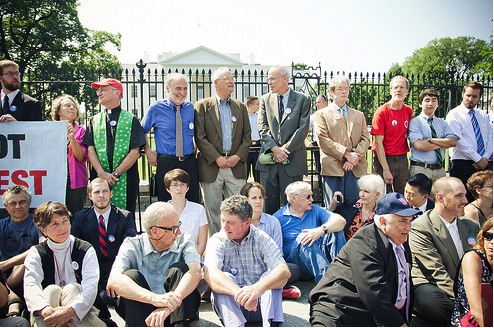
Thousands of people, including landowners and religious leaders, have gone to Washington DC in the past two weeks to tell President Obama to reject Keystone. Nearly 850 people have been arrested for standing on the sidewalk in front of the White House in what protesters call the largest civil disobedience in the history of the U.S. climate movement.
“It’s remarkable, a very dignified and moving protest much like the civil rights demonstrations in the 1960s,” said Maude Barlow, chairperson of the Council of Canadians, a large environmental NGO.
“This is about the rights of the environment and future generations. It is the blossoming of a new movement,” Barlow told IPS from Washington.
Other massive pipelines are being planned, including ones bringing tar sands crude to New England and the Great Lakes, she said. “Keystone is just the beginning. Once these are built they will have to put something in them.”
Infrastructure dictates policy, she stressed. Once pipelines, refineries or power plants are built, it is nearly impossible for governments to shut them down.
Last year, scientists writing in the journal Science concluded there is already enough fossil fuel burning capacity to raise global temperatures by 1.5 degrees C by 2060. Any additional power plants, vehicles, or other fossil fuel burning equipment built from 2011 onward puts humanity at ever greater risk of catastrophic climate change.
Carbon overload – have to stop expanding
“We conclude that sources of the most threatening emissions have yet to built,” the scientists wrote.
The Obama administration knows this but the powerful oil lobby can use its unlimited funds to attack Democratic officials during the next election cycle if they don’t approve the pipeline, says Kretzman.
Changes to U.S. law in 2010 allow corporations to spend as much as they want on elections, and there is no sector with more money than the oil industry.
“That scares the hell out of the Obama administration,” he said.
It’s never been clearer that corporations wield the real power in the United States and Canada, activists say.
“This is the beginning of a very big fight for the future,” Barlow told IPS.
The costs of car ownership and travel are far higher than anyone realizes: $8,000 to $12,000 a year. A 100 km total trip costs between 65 and 80 dollars when parking, fuel, wear and tear, insurance, depreciation, repairs are included. A car is usually parked and unused 22 hours a day but still incurs costs.
Cars are parked 22 hours a day on average yet world will have 2.5 billion cars in 2050
The costs of car ownership and travel are far higher than anyone realizes: a 100 km total trip costs between 65 and 80 dollars when parking, fuel, wear and tear, insurance, depreciation, repairs are included. A car is usually parked and unused 22 hours a day but still incurs costs. Why not let someone use the car when you’re not and make some money at the same time Robin Chase told me for this article. She’s launched Buzzcar in France as part of a strategy for reducing carbon emissions and congestion in cities. — Stephen
Why do car owners get so much more public space than bus riders, bicyclists or walkers?
By Stephen Leahy
BERLIN, Jun 2, 2011 (IPS)
The world’s more than 850 million cars and small trucks are parked…
Yields went up 214 percent in 44 projects in 20 countries in sub-Saharan Africa
“If we don’t radically transform the direction of the global food system we will never feed the billion who are hungry,” De Shutter warns.
“Nor will we be able to feed ourselves in the future.”
By Stephen Leahy
UXBRIDGE, Feb 8, 2011 (IPS)
Eco-farming could double food production in entire regions within 10 years while mitigating climate change, according to a new U.N. report released Tuesday in Geneva.
An urgent transformation to ‘eco-farming’ is the only way to end hunger and face the challenges of climate change and rural poverty, said Olivier De Schutter, U.N. Special Rapporteur on the right to food, following the presentation of his annual report focusing on agroecology and the right to food to the U.N. Human Rights Council.
“Agroecology mimics nature not industrial processes. It replaces the external inputs like fertiliser…
Industry spent more than $600 billion on new exploration and production in 2012
By Stephen Leahy
UXBRIDGE, Canada, Nov 15 2012 (IPS)
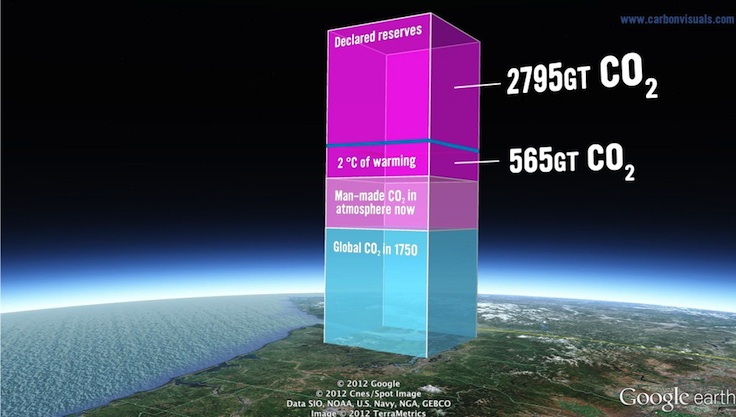
Two-thirds of the world’s proven fossil fuel reserves cannot be used without risking dangerous climate change, the International Energy Agency (IEA) warned this week.
Preventing the consumption of those two-thirds will be the primary task of the annual U.N. climate negotiations that resume at the end of this month.
Late Wednesday, U.S. President Barack Obama surprised many by saying climate change will be a personal mission in his second term.
“The re-election of President Obama guarantees continuity of the U.S. pledge of reducing emissions 17 percent below its carbon emissions in 2005 by 2020,” said Christina Figueres, executive secretary of the United Nations Framework Convention on Climate Change (UNFCCC).
“The U.S. is fully aware of the need to increase its ambition in terms of mitigation (emissions reduction) and finance to help developing countries adapt,” Figueres told IPS.
The U.S. emission reduction target is equivalent to a three-percent reduction compared to 1990 levels – a baseline most countries use. Global emissions need to be 25 to 40 percent below 1990 levels in the year 2020 to keep temperatures from rising beyond two degrees C, climate scientists have said.
By contrast, the United Kingdom is already 18 percent below its 1990s level and plans to be 34 percent below in 2020.
In 2010, there was a binding agreement to limit global warming to two degrees C at the U.N. climate conference in Cancun, Mexico, said Andrew Steer, president of the World Resources Institute, a Washington-based NGO.
“We are nowhere near to getting there. The situation is urgent. Climate change is not tomorrow’s problem, it is today’s problem. Superstorm Sandy was a wake-up call to the people of the United States,” Steer said at a press conference. Continue reading →
This is a re-post from June’11. A landmark study released Jan 15 2013 finds the direct influence of black carbon, or soot, on warming the climate could be about twice previous estimates. More information here — Stephen
There is a quick way to buy more time to make the switch from fossil fuels to alternatives. Serious reductions in air pollutants like soot and smog bring cleaner air, less asthma/lung disease/heart attacks and could cut warming by 30 per cent. No new technology needed as my article shows, just something like a Green Marshall Plan to bring simple things like $20 clean-burning cooking stove to hundreds of millions of people. (more at Global Alliance for Cookstoves) — Stephen
By Stephen Leahy
BONN, Jun 14, 2011 (IPS) – Clean the air, cool the planet and prevent millions of deaths with fast action on soot and smog, a new report urges.
Air pollutants like black carbon (soot) and ground-level ozone (smog) arise from incomplete combustion of fossil fuels and biomass like wood and charcoal.
Nations or regional blocks of nations could decide to put measures into place that…
Governments, the media and the public aren’t paying attention to the “planetary emergency” unfolding around them. The situation is like firefighters yelling “fire” in crowded room and still no listens.
“The situation is absolutely desperate and yet there’s nothing on the front pages or on the agenda of world leaders,” said Pat Mooney, executive director of the ETC Group, an international environmental organisation based in Ottawa.
“The lack of attention is a tragedy,” said Mooney, who has 40 years experience in international environment and development issues.
Humanity is failing in its stewardship of the planet. An incredible 85 percent of the world’s oceans are in trouble, said Susan Lieberman, director of international policy at the Pew Environment Group, a U.S. organisation.
“Planetary emergency” is how many in the world’s scientific community describe “the mess we are in“. They will detail their comprehensive state of the planet assessment at the “Planet Under Pressure” conference in London Mar. 26-29.
That assessment will summarise the overwhelming evidence that “the continued functioning of the Earth system as we know it is at risk,” conference organisers previously told IPS.
Climate change, which is overheating the planet and making the oceans more acidic, is just one of the major challenges. Another is the ongoing decline of biodiversity, where so many plants and animals are going extinct that the Earth’s living systems on which humanity depends are unraveling.
Fresh water is another “planetary boundary” humanity is pushing up against. Water use has increased six-fold in the past century and in many places the quality of water resources has been degraded. Other challenges include increasing poverty, food and energy security, and the current financial and economic instability.
A first and essential step in a green transition is for nations to commit to phasing out harmful and unsustainable subsidies for fossil fuels, fisheries and industrial agriculture.
According to Mooney, some countries and large corporations see the green economy in terms of a post-petroleum future where resources and energy for industrial production comes from biomass and other living things. Most of those “living resources” are in the global South and local people rightly fear a massive land grab, he said.
Foreign investors have already gained access to more than 35 million hectares in Africa, Asia and South America for food and biofuel production according to GRAIN, a small NGO working with small farmers and farming communities.
Fires already burn an area larger than India every year.
By Stephen Leahy
VANCOUVER, Feb 29, 2012 (IPS)
Rising temperatures are drying out northern forests and peatlands, producing bigger and more intense fires. And this will only get much worse as the planet heats up from the use of ever larger amounts of fossil fuels, scientists warned last week at the end of the major science meeting in Vancouver.
“In a warmer world, there will be more fire. That’s a virtual certainty,” said Mike Flannigan, a forest researcher at the University of Alberta, Canada.
“I’d say a doubling or even tripling of fire events is a conservative estimate,” Flannigan told IPS.
While Flannigan’s research reveals forest fire risk may triple in future, a similar increase in peat fires will be far more dangerous. There are millions of square kilometres of tundra…
Yet another study reveals fracking has a huge problem of gas leaks. Up to 9% of the gas pumped out of the ground leaks into the atmosphere according to a study by National Oceanic and Atmospheric Administration (NOAA) published in Nature Jan 3, 2013. Natural gas (methane) is a powerful greenhouse gas. If these leaks are widespread, fracking is worse than burning coal accelerating global warming.
In Jan 2012 I detailed new research showing that replacing coal with natural gas from fracking does little to fight climate change (see below). Two studies published in the months after that made an even stronger case that fracking for natural gas is very likely a HUGE MISTAKE:
Hundreds of thousands of shale gas wells are being “fracked” in the United States and Canada, allowing large amounts of methane, a highly potent greenhouse gas, to escape into the atmosphere, new studies have shown.
Shale gas production results in 40 to 60 percent more global warming emissions than conventional gas, said Robert Howarth of Cornell University in New York State.
“Shale gas also has a larger greenhouse gas footprint than oil or coal over the short term,” said Howarth, co-author of a study called “Venting and Leaking of Methane from Shale Gas Development” to be published in the journal Climatic Change.
This article has been picked up and widely reported around the web and that’s great as long as it continues to have my name on it with a link to my website. (And if you like it, please help this work continue) — Stephen
By Stephen Leahy
VANCOUVER, Canada, Feb 20, 2012 (IPS)
Humanity’s failure to halt the deepening planetary emergency of climate change, extinctions of species and overconsumption of resources is a failure of imagination and mistaken beliefs that we act rationally.
The path to a truly sustainable future is through the muddy waters of emotions, values, ethics and most importantly, imagination, said artists and social scientists at the American Academy for the Advancement of Science (AAAS) conference here in Vancouver, British Columbia.
“We don’t live in the real world but live only in the world we imagine,” said David Maggs, a concert pianist and Phd student at the







 Stephen Leahy, International Environmental Journalist