Earlier I called myself a hybrid storm: part nature, part human. That’s not quite right. Humans and Hurricanes are part of nature. We both thrive on this planet thanks to sunlight, water and carbon dioxide (CO2). Hurricanes and tropical storms have been around for millions of years. In the last 50 years things have changed. The oceans are warmer. This week the waters off the US east coast were 3 degrees C warmer than normal.
Without major reductions in the use of fossil fuels, sunlight will kill an unknown number of ocean phytoplankton, the planet’s most important organism, a new study reports this week.
Not only are phytoplankton, also known as marine algae, a vital component in the ocean’s food chain, they generate at least half of the oxygen we breathe.
In the not so distant future, sunlight, the very source of life for phytoplankton, will likely begin to kill them because of the ocean’s increasing acidity, researchers from China and Germany have learned.
“There’s a synergistic effect between increased ocean acidity and natural light,” says Ulf Riebesell of the Helmholtz Centre for Ocean Research in Kiel, Germany.
Riebesell added that it was also possible “phytoplankton could adapt”.
Researchers were surprised to discover that diatoms, one of the most important and abundant types of phytoplankton, fared very badly during shipboard experiments conducted by co-author Kunshan Gao, from the State Key Laboratory of Marine Environmental Science at Xiamen University, Xiamen China.
Previous experiments in labs like Riebesell’s found that diatoms actually did better in high-acid seawater, unlike most other shell- forming plankton. Burning fossil fuels has made the oceans about 30 percent more acidic researchers discovered less than 10 years ago. Oceans absorb one third of the carbon dioxide (CO2) emitted from using fossil fuels.
The good news is this has slowed the rate of global warming. The bad news is oceans are now more acidic and it will get worse as more CO2 is emitted. This is basic, well-understood ocean chemistry. Continue reading →
As the last of my winds and rains ebb I wish you a complete and climate-wise recovery. Our planet is not as it once was. You have seen some of the changes in your lifetime: the superstorms, floods, drought, heat waves, and the melting of the Arctic.
Other changes are invisible such as the30 percent increase in the acidity of the oceans. This rising acidity is harming coral reefs, fish and many other inhabitants of the oceans. One third of the carbon dioxide (CO2) emitted from burning fossil fuels has been absorbed by the oceans. When CO2 dissolves in seawater it makes them more acidic.
All of these changes and far more with only 0.8C (1F) rise in global temperature. You want to believe all of this is natural. It is true I am part of nature but I have felt and fed off the extra heat energy in the oceans and additional moisture in the air you have unintentionally put there. The air, oceans, landscape have changed. Some call this time of major human impacts on the planet “The Anthropocene”. A big word to describe a big change: the era when humanity is influencing every aspect of life on the planet.
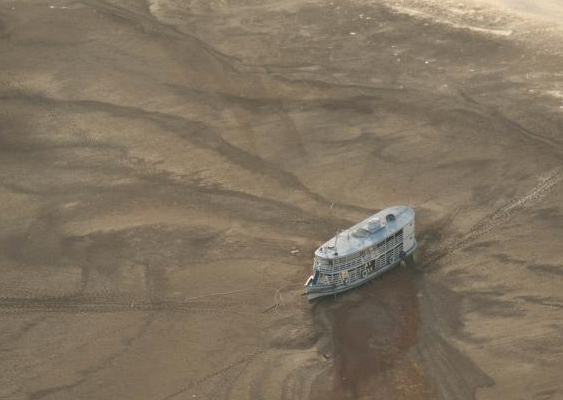
Mexico and Central America look like they are covered in dried blood on maps projecting future soil moisture conditions.
The results from 19 different state-of-the-art climate models project extreme and persistent drought conditions (colored dark red-brown on the maps) for almost all of Mexico, the midwestern United States and most of Central America.
If climate change pushes the global average temperature to 2.5 degrees Celsius above pre-industrial era levels, as many experts now expect, these regions will be under severe and permanent drought conditions.
Future conditions are projected to be worse than Mexico’s current drought or the U.S. Dust Bowl era of the 1930s that forced hundreds of thousands of people to migrate.
“Drought conditions will prevail no matter what precipitation rates are in the future,” said co-author Michael Wehner, a climate scientist at the Lawrence Berkeley National Laboratory, a U.S. government research centre in California.
“Even in regions where rainfall increases, the soils will get drier. This is a very robust finding,” Wehner told Tierramérica.
Without major reductions in carbon emissions from the burning of fossil fuels, global temperatures will increase to at least 2.5 degrees of warming between 2050 and 2090, depending on rates of emissions of greenhouse gases, climate sensitivity and feedbacks. Continue reading →
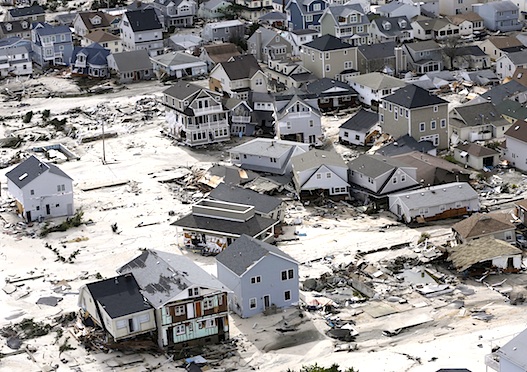
I am saddened by the damage and loss of life but am truly surprised you are so shocked by the extent and severity.
Haven’t you noticed hurricanes, cyclones and other storms have become more powerful in recent years? And that extreme weather events like record flooding, droughts and heat waves are happening more frequently? In 2012 extreme weather records were broken all over the US. In 2011 there were 14 separate billion-dollar-plus weather disasters in the US including flooding, hurricanes and tornados.
Climate change plays a role in all extreme weather now – atmosphere is 0.8C hotter and 4-6% wetter – turns out small increases can have big impacts. — Stephen
Extreme weather is fast becoming the new normal. Canada and much of the United States experienced summer temperatures during winter this year, confirming the findings of a new report on extreme weather.
For two weeks this March most of North America baked under extraordinarily warm temperatures that melted all the snow and ice and broke 150-year-old temperature records by large margins.
Last year the U.S. endured 14 separate billion-dollar-plus weather disasters including flooding, hurricanes and tornados.
A new report from the Intergovernmental Panel on Climate Change (IPCC), released Mar. 28, provides solid evidence that record-breaking weather events are increasing in number and becoming more extreme. And if current rates of greenhouse gas emissions are maintained, these events will reach dangerous new levels over the coming century.
Since 1950 there have been many more heat waves and record warm temperatures than in…
Climate change is making oceans warmer and more acidic…expect the worst
By Stephen Leahy
When the carbon dioxide absorbed by the oceans dissolves in seawater, carbonic acid is formed and calcium carbonate, vital for the formation of the skeletons and shells of many marine organisms, becomes scarcer.
Climate change will ruin Chilean sea snails’ ability to sniff out and avoid their archenemy, a predatory crab, according to Chilean scientists who presented their findings at an international science symposium here.
Researchers from Australia also revealed that as the oceans become more and more acidic, some fish become hyperactive and confused, and move towards their predators instead of trying to escape.
“The conditions in oceans are changing 100 times faster than at any time in the past,” said Jean-Pierre Gattuso, a marine biologist with CNRS-INSU and the Laboratoire d’Océanographie de Villefranche in France.
Climate change is making oceans warmer and more acidic. “We are beginning to understand what will happen. I think we can expect the worst,” Gattuso told Tierramérica*.
Gattuso is one of nearly 600 scientists from around the world who presented their research on Sep. 24-27 at the Third International Symposium on the Ocean in a High-CO2 World: Ocean Acidification in Monterey, California.
Researchers discovered only 10 years ago that burning fossil fuels like coal, oil and gas has made the oceans about 30 percent more acidic since the beginning of the Industrial Revolution. Continue reading →
This is an analysis piece from 2011. I will be interviewing experts around the world for a new article on this year’s record breaking melt of Arctic ice. — Stephen
Rapidly warming planet biggest threat to all nations
Military budget more than enough to convert USA to 100% renewable energy
Analysis by Stephen Leahy
UXBRIDGE, Canada, Sep 15, 2011 (IPS)
All the analysis and commentary about safety and security on the tenth anniversary of 9/11 ignored by far the biggest ongoing threat to global security: climate change.
Just days before Sunday’s commemoration of the attacks, German scientists pointed to yet another smoking gun of climate change: the Arctic sea ice reached a new historic minimum ice extent.
The rapidity with which the planet is losing its northern ice cap continues to astonish experts. The defrosting northern pole is one of the prime drivers of Earth’s climate system and is changing global weather patterns in unpredictable ways.
The Arctic ice melt is also accelerating the rate of climate change beyond what humanity is doing with every barrel of oil, tonne of…
Global temperatures are only 0.7C warmer — on pace for +4C!
By Stephen Leahy
UXBRIDGE, Canada, May 25, 2012 (IPS)
Climate-heating carbon emissions set a record high in 2011, in a 3.2 percent increase over the previous year, the International Energy Agency reported this week. The main reason for this dangerous increase is that governments are failing to implement policies to prevent catastrophic increases of global temperatures.
A new report released on the last days of international climate talks in Bonn, Germany this week reveals that the planet is heading to a temperature rise of at least 3.5 degrees Celsius, and likely more, according to the Climate Action Tracker (CAT), despite an international agreement to keep global temperature rise below two degrees Celsius.
Not only are pledges inadequate, but countries are unable to fulfill even those pledges, a new CAT analysis shows. CAT is a joint project of Dutch energy consulting organisation Ecofys, Germany’s Climate Analytics, and the Potsdam Institute for Climate Impact Research.
“When we compared the emission reduction pledges of countries like Brazil, Mexico and the U.S., we found they did not have the policies in place to meet those pledges,” said Niklas Höhne, director of energy and climate policy at Ecofys.
Höhne told IPS that they looked only at the policies of a few countries, but no country’s policies were enough to meet their targets. Continue reading →
Fires already burn an area larger than India every year.
By Stephen Leahy
VANCOUVER, Feb 29, 2012 (IPS)
Rising temperatures are drying out northern forests and peatlands, producing bigger and more intense fires. And this will only get much worse as the planet heats up from the use of ever larger amounts of fossil fuels, scientists warned last week at the end of the major science meeting in Vancouver.
“In a warmer world, there will be more fire. That’s a virtual certainty,” said Mike Flannigan, a forest researcher at the University of Alberta, Canada.
“I’d say a doubling or even tripling of fire events is a conservative estimate,” Flannigan told IPS.
While Flannigan’s research reveals forest fire risk may triple in future, a similar increase in peat fires will be far more dangerous. There are millions of square kilometres of tundra…








 Stephen Leahy, International Environmental Journalist