Arctic Hothouse Turns Europe into an Icebox

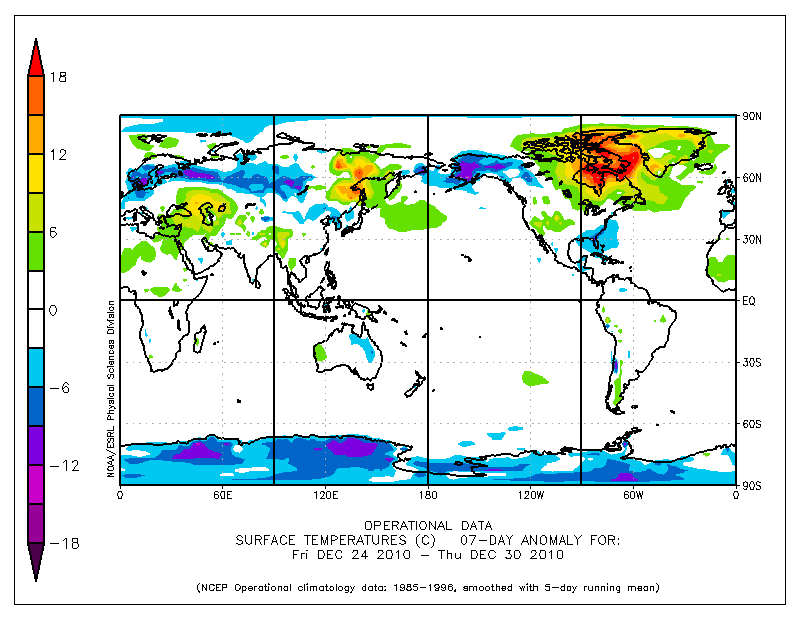
Here’s a temperature map from mid December illustrating the super warm Arctic region and the icy cold Europe in the mid-latitudes. [[ see also temp anomaly chart showing Hudson Bay to Greenland is 18C above normal this week]]

My previous post explains what is going on: East Coast Blizzard and Europe’s Snowmaggddon Reveal Fingerprints of Climate Change

— Stephen

And here is the Arctic sea ice extent – lowest ever for December.

As of Jan 2 Canada’s Hudson Bay is still not completely frozen over – likely the latest freeze up in a very long time. (10,000s of years?)


Reefs and Forests Burn as Climate Disruption Takes Hold NOW


A lot of coral reefs have died this year due to unprecedented ocean heating largely due to climate change. I broke that story last summer. Few coral reefs will survive the next 50 years most experts say without immediate action to reduce greenhouse gas emissions.


Forests are next in line according a new study in PNAS. Huge uncontrollable wildfires will dominate forest landscapes of the near future without dramatic reductions in the burning of fossil fuels the study found.

I would have done a full article explaining all this but simply can’t find a publication willing to pay me to do the work. That’s why I am trying community supported journalism where readers donate small amounts so these articles get done and made available for millions to read.

— Stephen (November 10 2010)

Biodiversity at the Cliff’s Edge – Nature’s ‘Free Services’ In Sharp Decline

By Stephen Leahy*

NAGOYA, Japan, Oct 18, 2010 (Tierramérica)

What nature gives us is often taken for granted, but if its basic elements disappear, human life on Earth would not be possible. The mission of the biodiversity summit under way in Nagoya is to reverse the headlong rush towards the precipice.

The 10th Conference of Parties (COP 10) to the Convention on Biological Diversity (CBD), Oct. 18-29 in this southern Japanese city, seeks to create a new set of international agreements to halve the rate of loss of natural habitat, end overfishing, achieve zero net deforestation, eliminate harmful subsidies, and ensure that agriculture is sustainable by 2020, among other goals.

Without a successful meeting in Nagoya, achieving the United Nations Millennium Development Goals (MDGs) will be impossible, Janez Potočnik, of the European Union’s Commission for the Environment, told a high-level UN meeting last month in New York.

“Biodiversity” is term used to describe the wide variety of the living things that comprise the planet’s biological infrastructure and provide us with health, wealth, food, water, fuel and other vital services.

Many people fail to understand how dependent humanity is on the many natural services provided by nature, says Hal Mooney, an environmental biologist at Stanford University, in California.

“Those services are considered ‘free’ and not valued under the current economic structures,” Mooney told Tierramérica.

Is this article of interest? It exists thanks to contributions from readers. Please click here to learn more about Community Supported Journalism.

via Biodiversity at the Cliff’s Edge – IPS ipsnews.net.

Oil Companies and Special Interests Spend Half a Billion Dollars to Defeat US Clean Energy – Study

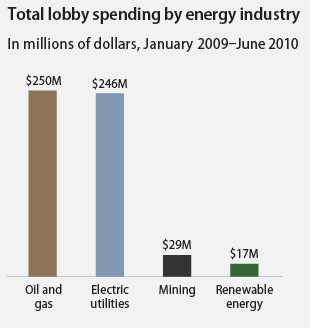
“Big oil companies and other special interests have spent millions of dollars in lobbying and campaign contributions to defeat clean energy and global warming legislation, according to a new analysis released today by the Center for American Progress Action Fund.

The study “Dirty Money” found that the top 35 spending companies and trade associations invested more than $500 million in lobbying and campaign contributions from January 2009 to June 2010 to defeat clean energy legislation. This political pressure spending convinced enough senators to oppose clean energy measures that would have created jobs, reduced oil use, and cut global warming pollution.”

[Source: The Center for American Progress Action Fund is the sister advocacy organization of the Center for American Progress. ]

My Articles on same topic:


Oily Politics of Influence: 3 of 4 oil and gas lobbyists used to work for US govt

Every Day Governments Give an Estimated $2 billion to Oil, Coal & Gas Industry

Fossil Fuel Subsidies Are 12X (more like 20X) Support for Renewables, Study Shows

New $Billion Cash Hand Out To Fossil Fuel Companies Under ‘Green’ Economic Stimulus Plans

The Future of Journalism: Adopt a Muckraker

I’m pretty damn angry that media companies are putting profits ahead of truth.

The media are deeply broken… That’s a real threat to democracy.”

— Stanford University climate scientist, Stephen Schneider


Renowned Swiss journalist Daniel Wermus and Director of the Media21 Global Journalism Network  discusses my launch of Community Supported Journalism in this article. — Stephen

“Should you and I pay for the kind of accurate news reporting that is needed to fill us in on what is happening to the planet?

If we’re not willing to pick up the tab to stay better informed, who will?”

Frontline Earth: Adopt a Muckraker?

By Daniel Wermus

“I meet international freelance journalists quite often. Most make it clear that budget cuts have made it increasingly difficult for just about anyone, especially freelancers, to get into print. It is usually the freelancers who are most willing to risk their lives to get the stories that need reporting the most. If the day arrives when they can no longer carry out their professions, we will all have a serious problem.

Muckraker: A reporter or writer who investigates and publishes reports involving a host of social issues, broadly including crime and corruption

Stephen Leahy, a Canadian, and one of the world’s best-known investigative reporters on environmental issues, has launched a challenge: if corporations won’t pay for the news, then it is up to communities and the public to fill the gap. A free society needs journalism, even if reporting the news is not commercially profitable.

Leahy’s model for supporting the news has the journalist make his pitch over the internet. The completed article can then be distributed by news agencies or magazines that are low on funds but high on public interest. That could be IPS, Reuters-Alertnet, Commondreams, InfoSud, The Essential Edge or any number of other publications and news outlets.

[edit: Wermus concludes]

Leahy observes that: “Many people tell me, we need individuals like you to get real information out.”

It may be too early to tell whether this really signals a new citizen’s approach to the need for hard information that may be crucial to society. In the best of all worlds it could bring together both consumers and media for promoting a better planet. The danger is that it could also produce yet another quagmire of holier-than-thou preaching.”

Learn more about Community Supported Journalism in the Public Interest

Adopt a Muckraker for only $10 a month

Update: Community Supported Journalism is working. However 50 people helping out has to become 500 so we all can get the crucial information we need.  Please consider becoming one of the 500. Thank you. — Stephen


Ice, Polar Bears & the Arctic Melt Down That’s Changing the World

polar-bear-snout-wwwfirstpeopleus-smlIce-free summer in the Arctic is just a matter of time – mostly likely within the next 5 years. Here’s a “six-pack” of my recent articles on how global warming is transforming the Arctic:

The Arctic — The Earth’s Freezer — Is Defrosting With Dire Results

The rapidly warming Arctic region is destabilising Earth’s climate in ways science is just beginning to comprehend.

Arctic Leaking Methane a Super-Potent Global Warming Gas — Reaching Feared Tipping Point?“The way we’re going right now, I’m not optimistic that we will avoid some kind of tipping point.ceberg-in-glacier-strait-nunavut-canada-image-credit-sandy-briggs

Arctic Ice Gone in 5 Years – First Time in One Million Years– “We’re going to see huge changes in the Arctic ecosystem”

Things Happen Much Faster in the Arctic — “Things are happening much faster in the Arctic. I think it will be summer ice-free by 2015,” said David Barber, an Arctic climatologist at the University of Manitoba.

Arctic Is the Canary in the Coalmine — The Arctic is “ground zero” for climate change, with temperatures rising far faster than anywhere else on the planet.

Arctic Oil and Gas Rush Alarms Scientists — As greenhouse gas pollution destroys Arctic ecosystems, countries like Canada are spending millions not to halt the destruction but to exploit it.

Oh yeah, and about those polar bears:

Polar Bear (Sow And Cub), Arctic National Wild...

Polar Bears Go Hungry as Icy Habitat Melts Away — The iconic animal of the frozen north, the polar bear, is starving to death because climate change is melting the Arctic Ocean sea ice.

Oil vs Polar Bears in Alaska — A coalition of environmental groups sued the George W. Bush administration Monday for delaying a decision to protect polar bears threatened with extinction

Polar Bears’ Future Bleak in Melting Arctic — “Without taking serious and urgent action to stabilize the climate, there is no future for polar bears” says Andrew Derocher, Chair of the World Conservation Union (IUCN), Polar Bear Specialist Group.

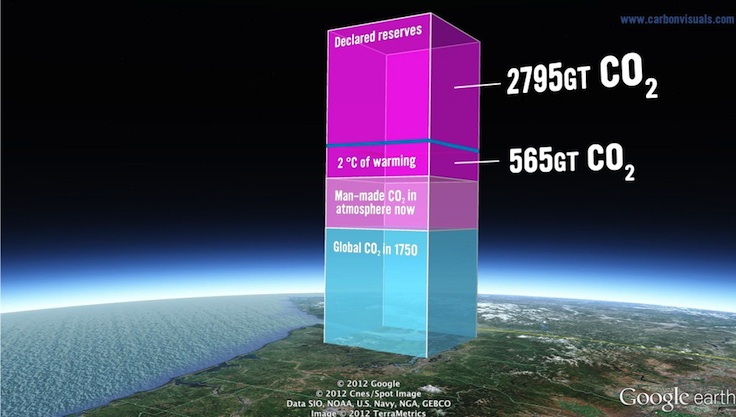
Heading for +2 degrees C (3.6 degrees F) Carbon Use Must Peak by 2015 Scientists Warn

Carbon overload - have to stop expanding
Carbon overload – have to stop expanding

By Stephen Leahy

“We shouldn’t forget that a 2-degree C global mean warming would take us far beyond the natural temperature variations that life on Earth has experienced since we humans have been around.”

ANCHORAGE, Alaska, Apr 30 (IPS)

Climate scientists are calling for a phase-out of fossil fuels because humans are now pumping so much carbon dioxide (CO2) into the atmosphere that the ‘2-degree-C climate balloon’ will burst otherwise, new studies show.

That 2-degree C climate balloon has a maximum capacity of less than 1,400 gigatonnes of CO2 total emissions from the year 2000 to 2050, Malte Meinshausen and colleagues report in the current issue of Nature. The European Union and others consider a global temperature rise of more than 2 degrees C as dangerous and potentially catastrophic. Temperatures are already 0.8 C warmer than the pre-industrial period.

UPDATE Nov 2009 Prospect of a four-degree Celsius rise in global average temperatures in 50 years is alarming – but not alarmist, climate scientists now believe. Four Degrees of Devastation

The reality is that global emissions for the last seven years amounted to almost 250 gigatonnes of these long-lived greenhouse gases, meaning that the current and growing rates of fossil fuel emissions would burst the balloon in about 20 years – or less. Even if emissions are held to 1,400 gigatonnes maximum for the next 40 years, there is still a 50-percent probability of exceeding 2 degrees C, said Meinshausen, lead author of the study and climate researcher at the Potsdam Institute for Climate Impact Research.

Indigenous peoples from around the world also called for a phase-out of fossil fuels at the conclusion of the first Indigenous Peoples’ Global Summit on Climate Change in Anchorage, Alaska, that concluded last week.

“That call is well-supported by the evidence in this study,” Meinshausen told IPS.

Is this article of interest? It exists thanks to contributions from readers. Please click here to learn more about Community Supported Journalism.

Continue reading

Ozone Hole is Back and Bigger Than Ever

ozone-hole-sept-16-2007-sml.jpgThe World Meteorological Organization is reporting this week that the hole is back and bigger than ever. And it could grow larger in as spring returns to the region. In the past two years ozone holes larger than Europe have opened over the Antarctic and Southern Ocean.

The hole and the entire ozone layer and life on Earth would be in far worse shape if not for the The Montreal Protocol.

See also my stories on ozone and Montreal Protocol:

Ozone Treaty Best Bet to Slow Climate Change

From 2006:

Skin Cancer and the Record-breaking Antarctic Ozone Hole
60 Years to Restore the Ozone Layer Over Antarctica