High Seas Represent $148 Billion Carbon Sink But Overfishing is Destroying It

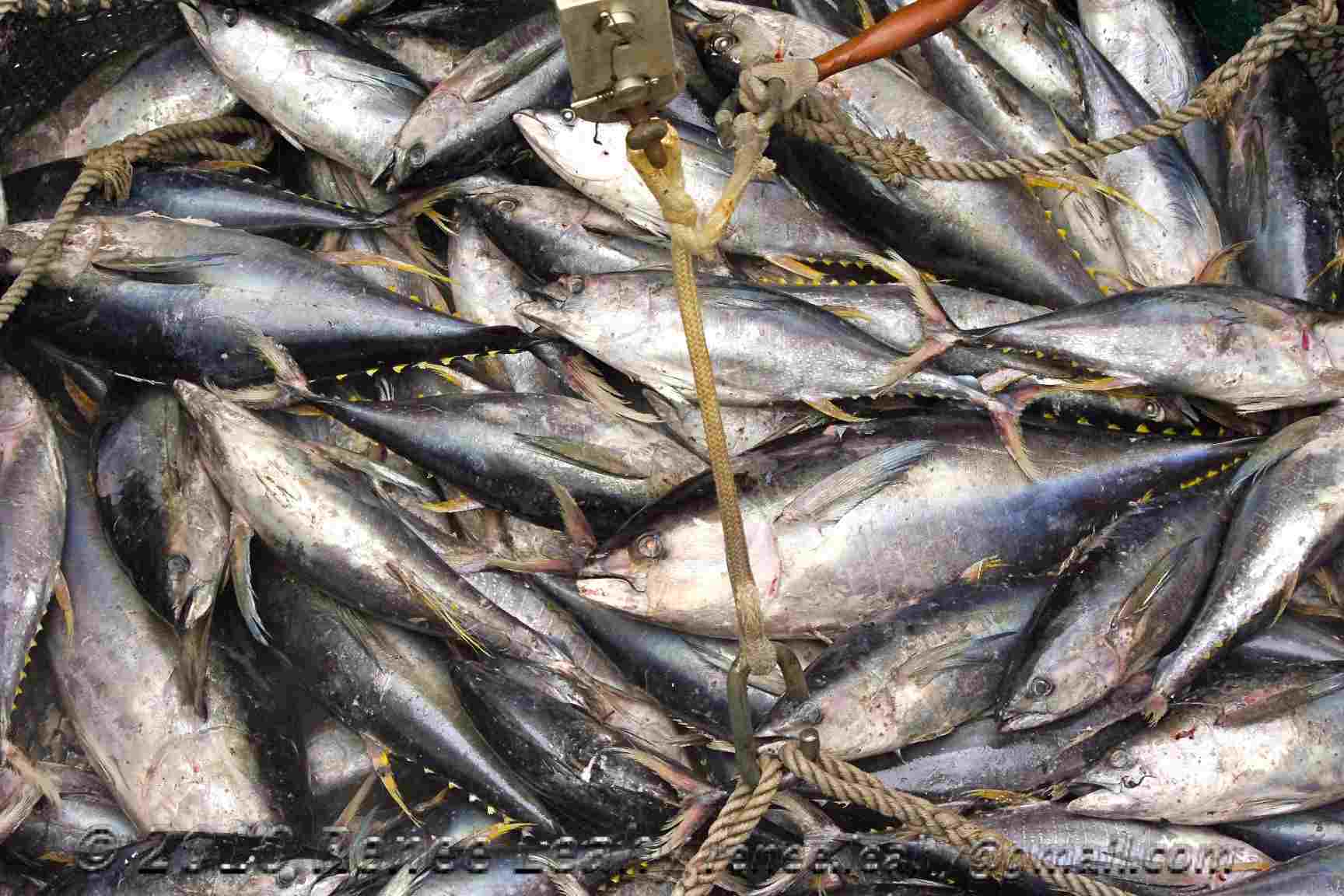
Tuna from the Spanish Purse Seiner

By STEPHEN LEAHY

Stephen Leahy's picture


Scientists estimate that phytoplankton absorb and bury more than 1.6 billion tonnes of CO2 in the seabed every year.

This would be news to readers of Canada’s Globe and Mail newspaper’s detailed two-page spread on the Global Ocean Commission report, which failed to mention this vitally important carbon reduction service (or that it is worth an estimated $148 billion a year).

Additionally, if governments ended fishing in the unclaimed oceans beyond 200-mile economic zones, near-shore fish catches would soar, even more carbon would be safely removed from the atmosphere and the oceans would be healthier said co-author of the study Rashid Sumaila of the University of British Columbia’s Fisheries Centre.

The high seas are like a failed state. Poor governance and the absence of policing and management mean valuable resources are unprotected or being squandered,” said David Miliband, co-chair of the commission and former foreign secretary of the United Kingdom.

The dollar value of all the fish caught in high seas is actually negative

Governments like Japan, Spain, the U.S. and China subsidize fishing fleets to destroy the high seas by overfishing and deep-sea bottom trawling to the tune of $152 million a year.

Here’s the kicker: The dollar value of all the fish caught way out there is actually negative when costs like fuel and subsidies are subtracted. Turns out high seas fishing fleets get 25 per cent of their income from subsidies according to a 2009 analysis by Sumaila.

Most would not be fishing the high seas without subsidies” Sumaila told DeSmog Canada.

Restoring ocean productivity

Fishing should be banned in the high seas, which represent 64 per cent of the world’s oceans just to protect and enhance its role as a carbon sponge, he said. But that is just one of 14 other valuable services the high seas provide humanity according their study, The High Seas And Us: Understanding The Value Of High Seas Ecosystems.

The study was commissioned by the Global Ocean Commission, an 18-month-old organization comprised of business leaders and former senior politicians including former Canadian prime minister Paul Martin.

The commission is calling for the negotiation of a new agreement under the UN Convention on the Law of the Sea to prioritize ocean health and resilience and restore ocean productivity. It also called for an elimination of subsidies on high seas fishing within five years.

The commission’s proposals also call for mandatory tracking of all vessels fishing in the high seas, a ban on the transshipment of fish at sea, measures to end plastics pollution and binding standards for the regulation and control of offshore oil and gas exploration and exploitation.

Carbon really does sink

Phytoplankton are the carbon-eating plants of the seas and pass on this carbon when they’re eaten. When organisms die in the deep seas, their organic matter ends up on the bottom of the ocean, which makes for an effective, natural carbon sequestration process.

Fishing is crippling this free carbon-removal system. This is especially true for bottom-trawlers that bulldoze the sea floor scooping up every living thing. Trawling is by far the most common fishing method and recent studies warn it’s destroying corals and the sea bottom leading to “long-term biological desertification.”

Last May, scientists writing in the journal Science called for an end to “the frontier mentality of exploitation” of the high seas and recommended a ban on trawling to protect the carbon-removal service and halt the decline in the productivity of the oceans. The amount of wild fish caught peaked 20 years ago.

About 70 per cent of fish caught inside the 200-mile limits spend some time in the high seas. If the high seas are protected those fish are likely to grow larger and become more numerous, benefitting near-shore fisheries, Sumaila said.

A number of studies of marine protected zones where fishing is banned or very limited show these areas act as baby-fish incubators increasing the overall population of fish.

If fishing was banned in the high seas, fisheries profits would more than double, the amount of fish would increase 30 per cent and the amount of ocean fish stock conservation would increase 150 per cent according to a study published in PLOS Biology last March.

Given the reality that fishing the high seas is a money loser, even a low carbon price could make a fishing ban valuable, not to mention the other potential benefits of regulating international fisheries. Sumaila said the $148 billion-a-year value of the high seas carbon sponge is a conservative estimate, and it could actually be as high as $222 billion.

Fishing and trawling bans have been proposed before. Last December the European parliament narrowly rejected a bottom-trawling ban on its vessels.

We need wide public understanding of the vital importance of the high seas to all of us,” concluded Sumaila.

Top 10 High Seas Fishing Nations (according to Sumaila’s study) in descending order:
Japan
South Korea
Taiwan
Spain
USA
Chile
China
Indonesia
Philippines
France
First published by DeSmog Canada Wed, 2014-06-25 10:01

Global Experts Call for Moratorium New Tarsands Development Until Climate, Environmental Impacts Assessed

Canada's tar sands projects visible from space
Canada’s tar sands projects visible from space

By STEPHEN LEAHY  Stephen Leahy's picture

A moratorium on any new oilsands expansion is imperative given Canada’s failure to properly assess the total environmental and climate impacts Canadian and U.S. experts say in the prestigious science journal Nature.

Even with a moratorium it will be very difficult for Canada to meet its international promise to reduce CO2 emissions that are overheating the planet according to government documents as previously reported by DeSmog.

Continuing to approve pipelines and new projects guarantees Canada will not meet the Harper government’s Copenhagen emissions reduction target,” said Wendy Palen, an ecologist at Simon Fraser University.

These are the plain facts Canadians need to be aware of,” Palen, a co-author of the Naturecommentary, told DeSmog.

Canadians also have no idea of the overall ‘big picture’ of the impacts of oilsands production and transport because each project is assessed in isolation.

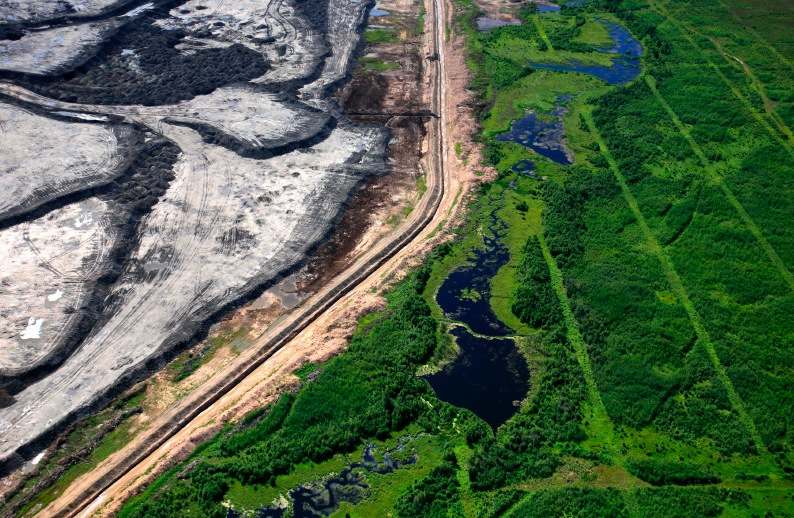
In total more than 280 square kilometres of boreal forest and peatlands have already been eliminated to make way for oilsands development. That amounts to an area more than twice the size of the City of Vancouver.

According to a 2012 study the destruction of this region of the boreal forest – a natural carbon sink –released about 100,000 tonnes of CO2 that had been safely stored underground. And it also meant the end of the region’s ability to absorb some 58,000 tonnes of CO2 every year. Over a 20-year time span that’s 1,161,000 tonnes of CO2 that stays in the atmosphere – close to half the annual emissions of the City of Vancouver.

This does not include CO2 emissions from developing oilsands projects themselves nor the emissions from burning millions of barrels of oil produced there each year.

This piecemeal approach is like determining the risk of cigarette smoking by only looking at the potential harm from smoking one cigarette, environmental economist Mark Jaccard said.

As critics have pointed out during recent pipeline review processes, regulators like the National Energy Board do not consider the climate impacts of pipelines and oilsands projects. It’s considered ‘out of bounds’ Jaccard, another coauthor of the report, said.  Each project is presented as an ultimatum: approve the project or lose an economic opportunity, he said.

This approach artificially restricts discussion to only a fraction of the consequences of oil development,” Jaccard and 7 co-authors argued in the report. The authors represent an interdisciplinary group of experts in environmental science, economics, policy development and decision science.

What Canada and the U.S. need is a “more coherent approach” to evaluate all oilsands projects and pipelines in the “context of broader, integrated energy and climate strategies.”

But first Canada and the U.S. need to impose an immediate halt to new oilsands developments and related pipeline construction, the authors write. (The U.S. is considering developing its own oilsands in Utah and elsewhere). Then the two countries can jointly develop a strategy that allows energy developments to proceed only if they are within environmental limits and respect other national commitments to human health, social justice and biodiversity protection.

However this strategy would need a formal, legislated acknowledgement of the reality that oilsands development impacts the climate. It also should create either a carbon tax or cap-and-trade mechanism to ensure the oil industry absorbs “the full social costs of carbon combustion.”

Finally this strategy should assess the full range of potential impacts compared to alternatives. And it should include the options of saying ‘no’ to a project.

Former Secretary of State Hillary Clinton said Canada and the U.S. need to co-ordinate their climate policies in an interview on the CBC’s The National last week. She acknowledged we need to get beyond project-by-project approvals.

With new regulations on power plants, the U.S. may be on its way to meeting its Copenhagen emission reduction target, which is identical to Canada’s.

While Prime Minister Harper “clearly doesn’t care about climate change,“ Jaccard told DeSmog,  President Obama does and could make approval of the Keystone XL pipeline contingent on Canada meeting its 2020 target.

Economists around the world now agree the costs of carbon pollution far outweigh the benefits,” Jaccard said.

First published by DeSmog Blog Canada Thu, 2014-06-26 12:19


Film Exposes Slick US Industry Behind Climate Denial

Robert Kenner’s forthcoming documentary lifts the lid on the ‘professional deceivers’ manipulating US debate on climate change

OPENS MARCH 6 in US

Shot from Merchants of Doubt film.
 Merchants of Doubt looks at professionals working for the fossil fuel industry to sow doubt in the US climate change debate.    Photograph: Sony Pictures Classics

By  for the Guardian

Who remembers that climate change was a top priority early in George W Bush’s first term as US president? 

Six months later everything changed. The film shows Republican party leader John Boehner calling the idea of global warming “laughable”, said Merchants of Doubt director Robert Kenner.

Framing Climate Science as Attack on Personal Freedoms

With the 9/11 attacks on the World Trade Center occupying attention, Americans For Prosperity, a powerful, fossil-fuel lobby group founded by the billionaire Koch Brothers, launched a decade-long, multi-pronged campaign to sow doubt about the reality of climate change.Screen Shot 2015-03-01 at 5.34.47 PM

By equating the findings of climate scientists as an attack on personal freedoms, they cleverly shifted the focus away from science to political opinion. “Creating a focus point away from what is actually going on is how magicians pull off their tricks,” said Kenner who directed the Oscar-nominated documentary Food Inc.

The deception has worked well. Few Americans know 97% of scientists agree climate change is caused by human activity and is happening now.

Inspired by the 2010 book of the same name, Kenner’s film is about deception and profiles many of the charming and always smiling professional deceivers who work for the tobacco, chemical, pharmaceutical, and fossil fuel industries. The tobacco industry knowingly and successfully deceived the public for 50 years about the connection between smoking and cancer, the 1988 tobacco lawsuit settlement revealed.

In a pattern of manipulation clearly evident today in the manufactured ‘debate’ over climate change, the tobacco industry used media-friendly pseudo-experts, doctored ‘science’ studies and attacked the credibility of scientists or experts who said otherwise, Kenner said.

If you can sell tobacco you can sell anything

Peter Sparber, one the tobacco industry’s most successful deceivers, told Kenner that he could get the public to believe a garbage man knew more about science than prominent climate scientist James Hansen.

“If you can sell tobacco you can sell anything,” Sparber tells Kenner.

Selling confusion and doubt around a complex issue like climate change was far easier than selling tobacco. Nearly all of those well-paid climate misinformers have no science background and often clear ties to industry lobby groups and yet are treated as expert commentators on climate science by media. It’s not just Fox News. Serious news outlets like CNN and the New York Times are complicit by featuring misinformers in news articles and on discussion panels, he said.

The film also focuses on the many self-described “grassroots” organisations that are actually promoting specific corporate and political interests. These organisations are often aided by, and passionately supported by, ordinary citizens who believe they are fighting for personal freedoms and libertarian or conservative values.

Kenner is hoping audiences “will realise they’ve been lied to” and develop better “bullshit detectors”.

First published at the Guardian

For an Ailing Planet, the Cure Already Exists

Measure of concentration of CO2 in the atmosphere by year

By Stephen Leahy

UXBRIDGE, Canada, Jun 1, 2012 (IPS)

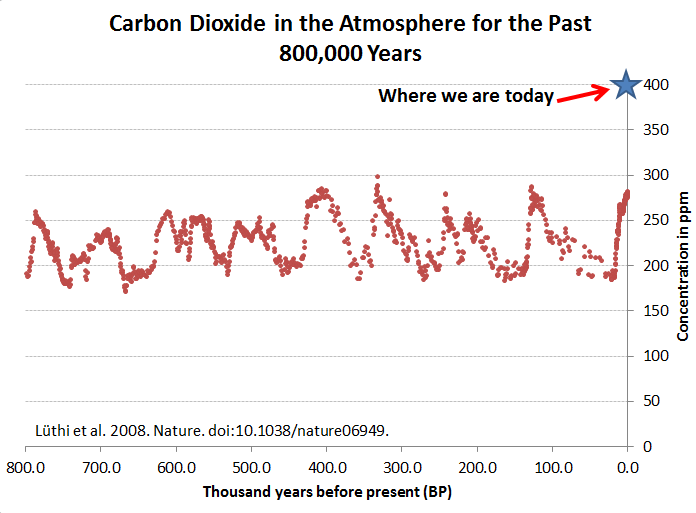
The planet’s climate recently reached a new milestone of 400 parts per million (ppm) of carbon dioxide in the Arctic.

The last time Earth saw similar levels of climate-heating carbon dioxide (CO2) was three million years ago during the Pliocene era, where Arctic temperatures were 10 to 14 degrees C higher and global temperatures four degrees C hotter.

Research stations in Alaska, Greenland, Norway, Iceland and even Mongolia all broke the 400 ppm barrier for the first time this spring, scientists reported in a release Thursday. A global average of 400 ppm up from the present 392 ppm is still some years off.

If today’s CO2 levels don’t decline – or worse, increase – the planet will inevitably reach those warmer temperatures, but it won’t take a thousand years. Without major cuts in fossil fuel emissions, a child born today could live in a plus-four-degree C superheated world by their late middle age, IPS previously reported. Such temperatures will make much of the planet unliveable.

In a four-degree warmer world, climate adaptation means “put your feet up and die” for many people in the world, said Chris West of the University of Oxford’s UK Climate Impacts Programme in 2009.

This week the International Energy Agency reported that the nations of the world’s CO2 emissions increased 3.2 percent in 2011 compared to 2010. This is precisely the wrong direction: emissions need to decline three percent per year to have any hope of a stable climate.

By 2050, in a world with more people, carbon emissions must be half of today’s levels.

Impossible? No. A number of different energy analyses show how it can be done. Continue reading

We Have Five Years to Stop Building Coal Plants and Gas-Powered Cars

Measurement of CO2 levels in atmosphere

By Stephen Leahy

[Authors note: One of the most difficult and important articles I’ve written in 20 years of environmental journalism. Originally published Sept 6 2014 @Vice Motherboard]


Here’s the frightening implication of a landmark study on CO2 emissions:

By 2018, no new cars, homes, schools, factories, or electrical power plants should be built anywhere in the world, ever again, unless they’re either replacements for old ones or carbon neutral. Otherwise greenhouse gas emissions will push global warming past 2˚C of temperature rise worldwide, threatening the survival of many people currently living on the planet.

Every climate expert will tell you we’re on a tight carbon budget as it is—that only so many tons of carbon dioxide (CO2) can be pumped into the atmosphere before the global climate will overheat. We’ve already warmed temperatures 0.85˚C from pre-industrial levels, and the number rises every year. While no one thinks 2˚ C is safeper se, it’s safer than going even higher and running the risk that global warming will spiral out of our control completely.

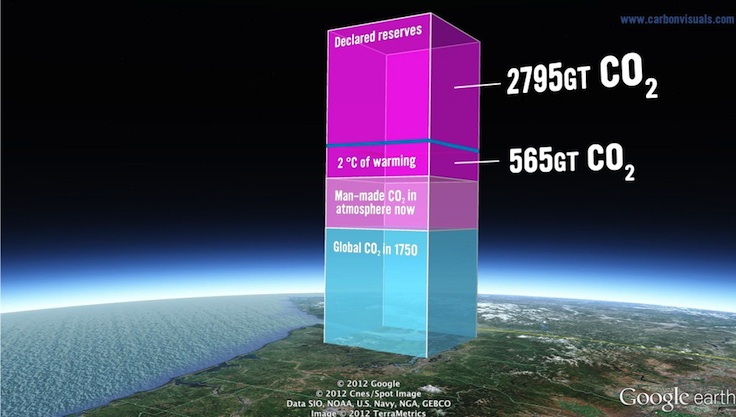
Last year, the latest Intergovernmental Panel on Climate Change (IPCC) report established a global carbon budget for the first time. It essentially stated that starting in 2014, the carbon we can afford is up to around 1,000 billion tons of CO2. In other words, our cars, factories, and power plants can only emit 1,000 billion tons (1,000 Gt, or gigatons) of CO2 into the atmosphere if we want to have a greater than 50/50 chance of keeping our climate below 2˚C of warming.

Even considering that humanity pumped 36 gigatons of CO2 into the atmosphere last year alone, 1,000 Gt still seems like a big budget. It might even seem like we have room to spare.

Maybe not.

WORLDWIDE, WE’VE BUILT MORE COAL-BURNING POWER PLANTS IN THE PAST DECADE THAN IN ANY PREVIOUS DECADE

New research shows that we may not have been paying attention to the entire CO2 emissions picture. We’ve only been counting annual emissions, and not the fact that building a new coal or gas power plant is in reality a commitment to pumping out CO2 for the lifespan of a given plant—which usually ranges from 40 to 60 years. These future emissions are known as a carbon commitment.

A new study has tallied the carbon commitments from all existing coal and gas power plants by looking at their annual CO2 emissions and current age. The study assumes an operating life of 40 years. A 38-year old coal plant will have far smaller future CO2 emissions, and thus smaller carbon commitment than one built today. The study, “Commitment accounting of CO2 emissions,” determined that most new power plants that went online in 2012 have a very large carbon commitment—19 Gt of CO2.

Building new power plants means more carbon commitments to eat into our 2˚C carbon budget. Build enough giant coal plants today, and their future emissions would tie up the entire budget, leaving no room for any other source of CO2 emissions.

Meanwhile, the rate at which new plants are built far outpaces the closure of old plants. Many US coal plants operate for longer than 40 years; the oldest is currently around 70 years.

“Worldwide, we’ve built more coal-burning power plants in the past decade than in any previous decade, and closures of old plants aren’t keeping pace with this expansion,” said study co-author Steven Davis of the University of California, Irvine.

Image: Flickr

Fossil Fuels Power Plant Carbon Commitment: 300 Gt

In the study, Davis and co-author Robert Socolow of Princeton University calculated that the existing coal and gas power plant carbon commitment turns out to be very large—more than 300 Gt.

Non-Power Plant Carbon Commitment: 400 Gt 

The reality of carbon commitment applies to any new fossil-fuel burning infrastructure, including office buildings and homes using gas heating or automobiles and planes burning jet fuel. All of these have an operating life of several or many years during which they will emit CO2 from now until they are ‘retired.’ These future emissions also count as a carbon commitment. In another upcoming study, Davis calculated the carbon commitments from other CO2 sources, including from the transport, industry, commercial and residential sectors. He estimates that as of 2013 this carbon commitment exceeded 400 Gt.

Together with the power plant commitment of 300 Gt laid out in the current study, that’s more than 700 Gt in carbon commitments on a global carbon budget of 1000 Gt. That leaves less than 300 Gt for future power plants, steel mills, cement plants, buildings, and other stuff that burns fossil fuels.

At current rates we’ll have accounted for the remainder of the budget in only five years.

Here’s how it breaks down:

Estimated Annual Emissions 2014-2018: 200 Gt

Global CO2 emissions from all sources amounted to 36 Gt in 2013. Annual emissions have been growing at a rate of 2 to 3 percent per year. Without major efforts to reduce emissions, another 200 gigatons of CO2 will be emitted between 2014 and 2018.

Estimated New Carbon Commitments 2014-2018: 100 Gt

Davis and Socolow determined that carbon commitments from new fossil fuel burning infrastructure will average at least 20 Gt per year, totaling 100 Gt over five years.

300 + 400 +200 +100 = 1,000 Gigatons of Carbon, Locked in by 2018

Unless coal and gas power plants or other major sources of CO2 are shut down before the end of their life span, the 1,000 Gt global carbon budget will be fully allocated sometime in 2018. No one will notice, because things won’t look or feel too much different than today. CO2 is akin to a slow, trans-generational poison. The climate impacts of blowing the carbon budget won’t be felt until 2030 or 2040 —and for a long time after.

WE’VE BEEN HIDING WHAT’S GOING ON FROM OURSELVES: A HIGH-CARBON FUTURE IS BEING LOCKED IN BY THE WORLD’S CAPITAL INVESTMENTS

Even the climate experts won’t notice much, because annual CO2 emissions have been the sole focus of countries and the United Nations process to address climate change said Davis.

“That’s like driving down the highway and only looking out of the side window,” Davis told me.

Politicians, business leaders, investors, planners, bureaucrats and whole lot of other people should be looking out the front window and paying attention to the hard reality of carbon commitments. If Davis and Socolow’s calculations are correct, it means no new coal or gas power plants can go online after 2018 unless they’re replacing retired plants. It means freezing the size of the global automobile fleet, and the industrial and commercial sectors, unless their energy efficiency increases. And so on.

The fact that much of our current and future infrastructure carries huge carbon commitments is blindingly obvious, but receives little attention.

Can’t solve a problem by making it worse

“If you build it, there will be emissions year after year. This should be a fundamental part of the decision to build most things,”” Davis said.

Ignoring the reality of carbon commitments means we’re investing heavily in technologies that make the problem worse, he said.

“We’ve been hiding what’s going on from ourselves: A high-carbon future is being locked in by the world’s capital investments,” said co-author Robert Socolow. Any plan or strategy to cut CO2 emissions has to give far greater prominence to those investments. Right now the data shows “we’re embracing fossil fuels more than ever,” Socolow told me.

So what can we do to begin to prepare for a jam-packed carbon budget? First, we need to stop building fossil fuel-reliant power plants.

Surprisingly, it appears the Australia is a pioneer here, despite recently rolling back its pioneering carbon tax. Thanks to wide-spread adoption of solar energy on homes and business the country’s electricity use is in steep decline. For the first time in its history, no new coal or gas power capacity will be needed to maintain supply over the next 10 years, according to the Australian Energy Market Operator. Germany too is rapidly adopting clean energy sources like wind and solar, so as to avoid building coal or nuclear power.

Next, we need to think about meeting energy demand by improving efficiency, instead of building more power generation.

Potential energy efficiency gains of 50 percent are possible across many sectors in most countries, Socolow said, and could reduce the number of fossil fuel energy power plants.

The US is the king of energy waste by most estimates. This costs Americans an estimated $130 billion a year, according to the Alliance to Save Energy. But despite the potential for huge cost and emission reductions, governments everywhere put nearly all their energy research efforts into new sources of energy like new power plants rather than helping to develop energy-efficient cars, buildingsm and appliances. It’s 2012 international study also found that improving energy efficiency provides by far the best bang-for-the-buck for energy security, improved air quality, reduced environmental and social impacts and carbon emission reductions.

However, efficiency improvements take time, and there is precious little time left to make the CO2 emissions cuts to stay below 2˚C, said Socolow.

While refusing to say a planet that’s 2˚C hotter is inevitable, he did say that all efforts to reduce emissions must be undertaken as soon as possible: “3˚C is a whole lot better than 5˚C, the current path we’re on.”

Stop All Investments in Fossil Fuel Infrastructure or All Will Suffer IPCC warns


Carbon overload - have to stop expanding
Carbon overload – have to stop expanding

By Stephen Leahy

UXBRIDGE, Canada, Apr 22 2014 (IPS) 

Hopefully, on Earth Day today, high-level ministers from all countries are thinking about what they can bring to the table at a key set of meetings on climate change in early May.

This will be the first opportunity for governments to discuss their proposed climate action plans in light of the finalIntergovernmental Panel on Climate Change (IPCC) report released last week.

“There is a clear message from science: To avoid dangerous interference with the climate system, we need to move away from business as usual.” — Professor Ottmar Edenhofer 

That report warned that carbon dioxide (CO2) emissions from burning fossil fuels are still rising far too fast, even with more than 650 billion dollars invested in renewable energy in the last three years. However, over the same time period even more money was invested in getting more fossil fuels out of the ground.

The latter investment is keeping humanity and the planet locked onto a devastating path of a global temperature increase of four to five degrees C, the IPCC’s Working Group III report warned.

Scientists and economists say that unlocking ourselves from disaster will require a massive reduction in emissions – between 40 percent and 70 percent – by midcentury. This is can be readily accomplished without inventing any new technology and at a reasonably low cost, reducing global economic growth by a comparatively tiny 0.06 percent.

“It doesn’t cost the world to save the planet,” economist Professor Ottmar Edenhofer, who led the IPCC team, said at a press conference.

It does mean an end to investments in expanding fossil fuel infrastructure as the annual growth in CO2 emissions from burning oil, coal and gas must peak and decline in the next few years. The atmosphere already has 42 percent more CO2 than it did prior to 1800.

This extra CO2 is trapping more heat from the sun, which is heating up the oceans and land, creating the conditions that spawn super storms and extreme weather. And it will do so for the next 1,000 years since CO2 is a very durable molecule.

“There is a clear message from science: To avoid dangerous interference with the climate system, we need to move away from business as usual,” Edenhofer said.

Continue reading

Carbon Emissions: Most Important Number in Human History

terrifying co2 graph

By Stephen Leahy

UXBRIDGE, Canada, Dec 17 2012 (IPS) (Re-posted)

The most important number in history is now the annual measure of carbon emissions. That number reveals humanity’s steady billion-tonne by billion-tonne march to the edge of the carbon cliff, beyond which scientists warn lies a fateful fall to catastrophic climate change.

With the global total of climate-disrupting emissions likely to come in at around 52 gigatonnes (billion metric tonnes) this year, we’re already at the edge, according to new research.

To have a good chance of staying below two degrees C of warming, global emissions should be between 41 and 47 gigatonnes (Gt) by 2020, said Joeri Rogelj, a climate scientist at Switzerland’s Institute for Atmospheric and Climate Science in Zurich.

Only when we see the annual global emissions total decline will we know we’re making the shift to climate protection,” Rogelj told IPS.

Making the shift to a future climate with less than two degrees C of warming is doable and not that expensive if total emissions peak in the next few years and fall into the 41-47 Gt “sweet spot” by 2020, Rogelj and colleagues show in their detailed analysis published Sunday in the journal Nature Climate Change.

The study is the first to comprehensively quantify the costs and risks of emissions surpassing critical thresholds by 2020.

This shift means 65 percent of existing coal power plants will have to be shut down in the next decade or two. Continue reading

2013 Carbon Emissions On Deadly Path to 5C

global-carbon-budget-2010-e1371236101998

By Stephen Leahy

WARSAW, Nov 19 2013 (IPS)

Burning of fossil fuels added a record 36 billion tonnes of CO2 to the atmosphere in 2013, locking in even more heating of the planet.

Global CO2 emissions are projected to rise 2.1 percent higher than 2012, the previous record high, according to a new report released Tuesday by the Global Carbon Project.

“Going beyond two degrees C is very risky, it’s completely unknown territory.” — Corinne Le Quéré

This increase is slightly less than the 2000-2013 average of 3.1 percent, said lead author Corinne Le Quéré of the Tyndall Centre for Climate Change Research in the UK.

“This is the second year in a row of below average emissions. Perhaps this represents cautious progress,” Le Quéré told IPS.

Still, these hard numbers demonstrate that the U.N. climate talks have failed to curb the growth in emissions. And there is little optimism that the latest talks known as COP19 here in Warsaw will change the situation even with the arrival of high-level ministers Wednesday.

Global emissions continue to be within the highest scenario of the Intergovernmental Panel on Climate Change (IPCC), she said.

“This is a five-degree C trajectory. It’s absolutely tragic for humanity to be on this pathway,” Le Quéré said.

For full story

Canada Has Become a Petro-State, Happily Drilling for Profits as the World Warms

tar sands - visible from space,tarnished earth

Thu, 2013-03-07 08:00 STEPHEN LEAHY

What’s happened to Canada? To the dismay of many a country with an international reputation for relatively progressive environmental policies (at least compared to the United States) is rushing headlong to dig up all the oil, gas, and coal it can. The country’s leaders can scarcely muster the effort to pretend to want to limit climate-heating carbon emissions.

And the Canadian business establishment and media have largely gone along with the program. Put it all together, and you have a country that has become a full-blown “petrostate.”

People are starting to notice. Last December at the UN climate talks in Doha, Qatar, Canada beat out tough contenders like Saudi Arabia to be elected “Colossal Fossil” by environmental organizations from around the planet. Canada had the dishonor of being the most uncooperative country out of 193 nations at the climate summit. It was the sixth year in a row that international environmental groups gave Canada their ‘highest’ award for its persistent efforts to block any agreement on reducing carbon emissions.

What’s happened to Canada is that it has experienced a steady takeover by the fossil fuel industry.

Canada’s is now the world’s fifth largest crude oil producer and the biggest supplier of oil to the US. Canada is also the third largest producer of natural gas and one of the top ten miners of coal. This enormous boom in fossil fuel production has been underway since the late 1990s. Like Saudi Arabia, fossil energy is by far Canada’s biggest export and has become the dominant economic and political focus.

Full story click below:

Blame Canada is a four part series revealing how Canada has become a fossil-fuelled energy superpower that’s going to wreck its future and the global climate.

Fossil Energy Interests Buy Politicians – and they’re cheap says economist

[This interview with economist Robert Repetto (now at Yale) was published two years ago. It is more relevant than ever in showing how fossil fuel money influences politics and prevents real action on climate. — Stephen]

‘What else can you do with coal except burn it? Railways make a lot of money shipping coal’

By Stephen Leahy

UXBRIDGE, Canada, Mar 2, 2011 (IPS)

Powerful fossil energy interests are preventing the United States from making the necessary transition to 21st century energy sources, one of the country’s leading environmental economists documents in a just-published book.

Fossil energy interests are spending “hundreds of millions of dollars” lobbying U.S. politicians in Congress and funding groups to confuse the public about the serious risks climate change poses, says Robert Repetto, author of  “America’s Climate Problem: The Way Forward”.

IPS climate and environment correspondent Stephen Leahy spoke with Repetto about his new book.

Q: Why did you write this book?

A: We’re running out of time. The latest science shows that climate change is coming faster and posing greater risks than previously thought. We are at risk of triggering positive feedbacks that will lead to uncontrollable climate change.

Meanwhile, America is locked in a climate-policy stalemate, with very few in the public comprehending the real risks climate change poses. Most don’t understand that climate change is happening now. They don’t link extreme weather events we’ve been experiencing with climate change. As a result they are not demanding that politicians take action.

Q: Why don’t most Americans understand the fact that climate change is already underway and poses serious risks? Continue reading