In a rejection of failed neoliberal economic policies, Panitchpakdi said strong national policies on investments, taxation, protection of local industries, including subsidies, and changes to less restrictive intellectual property regimes are what is needed to green economies in Africa and elsewhere.
“Green economic development underpins environmental protection, economic growth and development,” he said.
Here’s a startling fact based in a new energy study:
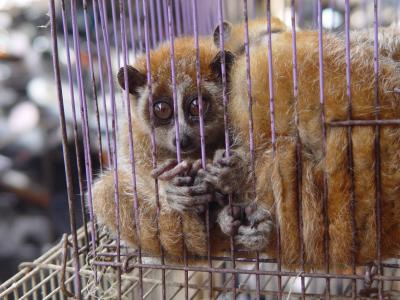
Slow loris from an illegal wildlife market in Southeast Asia
This story was featured on the IPS wire and on the Al Jazeera network . It’s about a study showing that national parks, conservation and protected areas have not and cannot halt the decline in biodiversity that is our life support system. It is hopeless without addressing the root cause of this and all other environmental problems: too many of us, taking too much and having too big of an impact. On our present course we’ll need 27 planet Earths by 2050 they conclude. — Stephen
By Stephen Leahy
UXBRIDGE, Canada, Jul 29, 2011 (IPS)
Protecting bits of nature here and there will not prevent humanity from losing our life support system. Even if areas dedicated to conserving plants, animals, and other species that provide Earth’s life support system increased tenfold, it would not be enough without dealing with the big issues of the 21st century: population, overconsumption and inefficient resource use.
Without dealing with those big issues, humanity will need 27 planet Earths by 2050, a new study estimates.
The size and number of protected areas on land and sea has increased dramatically since the 1980s, now totaling over 100,000 in number and covering 17 million square kilometres of land and two million square kilometres of oceans, a new study reported Thursday.
But impressive as those numbers look, all indicators reveal species going extinct faster than ever before, despite all the additions of new parks, reserves and other conservation measures, according to the study published in the journal Marine Ecology Progress Series.
“It is amazing to me that we haven’t dealt with this failure of protected areas to slow biodiversity losses,” said lead author Camilo Mora of University of Hawaii at Manoa.
“We were surprised the evidence from the past 30 years was so clear,” Mora told IPS.
The ability of protected areas to address the problem of biodiversity loss – the decline in diversity and numbers of all living species – has long been overestimated, the study reported. The reality is that most protected areas are not truly protected. Many are “paper parks”, protected in name only. Up to 70 percent of marine protected areas are paper parks, Mora said.
The study shows global expenditures on protected areas today are estimated at six billion dollars per year, and many areas are insufficiently funded for effective management. Effectively managing existing protected areas requires an estimated 24 billion dollars per year – four times the current expenditure.
“Ongoing biodiversity loss and its consequences for humanity’s welfare are of great concern and have prompted strong calls for expanding the use of protected areas as a remedy,” said co-author Peter Sale, a marine biologist and assistant director of the United Nations University’s Institute for Water, Environment and Health.
“Protected areas are a false hope in terms of preventing the loss of biodiversity,” Sale told IPS. Continue reading →
More than 16,000 people killed or injured on roads EVERY day
Health costs $500 billion ++
By Stephen Leahy
LEIPZIG, Germany, May 31, 2011 (IPS)
The leading killer of children over the age of five is not malaria or dysentery, but cars and trucks. And ninety percent of those children are killed on roads in developing countries.
Each day, 3,500 people are killed and 13,700 injured in road accidents around the world. That death and injury toll is expected to increase by nearly 50 percent over the next decade without serious efforts to improve road safety, says Etienne Krug, director of the Department of Violence and Injury Prevention and Disability at the World Health Organization (WHO).
Krug was here in Leipzig to the launch of the United Nations the Decade of Action for Road Safety at the Organisation for Economic Cooperation and Development’s annual International Transport Forum. The goal for the U.N. Decade is to stabilise the spiralling increase in death and injuries on the world’s roads.
“We have the potential to save five million of lives over the next decade through changes in road safety,” Krug told IPS.
“A cultural shift is needed to create the awareness of the need for road safety,” he said.
Around 90 percent of all road fatalities occur in emerging and developing countries, making it the sixth leading cause of death in those countries. The lack of road safety laws and enforcement combined with increasing vehicle usage and population growth are the major reasons for this, said Krug.
Only 15 percent of countries in the world have good legislation on drinking and driving or use of helmets when driving scooters and motorcycles. “We want to push that to 50 percent by the 2020,” he said.
Legislation and enforcement can make a huge difference. Vietnam enacted a helmet law two years ago and the use of helmets went from only 20 percent to over 90 percent, he said. Brazil recently enacted strict drinking and driving laws, while Mexico has made wearing seatbelts mandatory.
Negotiations over a new international climate agreement are on the brink as new analyses show that carbon emission reduction promises by industrialised nations are actually lower than those made by China, India, Brazil and other developing nations.
Even with all the promises or pledges added together they are still far short of cuts needed to prevent global temperatures from rising two degrees Celsius, experts reported here.
“It’s a very sad picture we see here,” said Marion Vieweg of Climate Analytics, a German NGO that analyses climate science and policy.
“The rich nations are doing nothing to improve their emissions pledges,” Vieweg told reporters during the final hours of the United Nations Framework Convention on Climate Change (UNFCCC) negotiating session here in Bonn. These meetings are intended to work out the details for a new international agreement for government ministers to consider at the 17th Conference of the Parties under the UNFCCC in Durban, South Africa in late November.
In a debate about the future of energy, the global south wants to spend tens of billions of dollars on nuclear plants while the global north looks to spend hundreds of millions on decentralised, renewable energy.
At least those were the positions taken by representatives during the BBC TV’s World Debate programme filmed at the 2011 Vienna Energy Forum.
“We must have nuclear energy if India is to develop,” said Srikumar Banerjee, the chair of India’s Atomic Energy Commission.
45- 50% of global warming emissions from industrial agriculture
By Stephen Leahy
UXBRIDGE, Feb 8, 2011 (IPS)
Eco-farming could double food production in entire regions within 10 years while mitigating climate change, according to a new U.N. report released Tuesday in Geneva.
An urgent transformation to ‘eco-farming’ is the only way to end hunger and face the challenges of climate change and rural poverty, said Olivier De Schutter, U.N. Special Rapporteur on the right to food, following the presentation of his annual report focusing on agroecology and the right to food to the U.N. Human Rights Council.
“Agroecology mimics nature not industrial processes. It replaces the external inputs like fertiliser with knowledge of how a combination of plants, trees and animals can enhance productivity of the land,” De Schutter told IPS, stressing that, “Yields went up 214 percent in 44 projects in 20 countries in sub-Saharan Africa using agro-ecological farming techniques over a period of 3 to 10 years… far more than any GM [genetically modified] crop has ever done.”
Other recent scientific assessments have shown that small farmers in 57 countries using agro-ecological techniques obtained average yield increases of 80 percent. Africans’ average increases were 116 percent.
“Today’s scientific evidence demonstrates that agroecological methods outperform the use of chemical fertilisers in boosting food production in regions where the hungry live,” De Schutter said. [Video Interviews with De Schutter]
No future in the “brown” economic system driven by fossil fuel energy and the serial depletion and degradation of natural resources and ecosystems
By Stephen Leahy
UXBRIDGE, Canada, Feb 23, 2011 (IPS)
Growth-obsessed markets and governments are pillaging the planet and it must stop, a new U.N. report warns.
The present “brown” economic system driven by fossil fuel energy and the serial depletion and degradation of natural resources and ecosystems has no future and must be replaced by a green economy, says the Green Economy report launched in Nairobi, Kenya this week by the United Nations Environment Programme (UNEP).
Investing just two percent of the global economy into a few key sectors will kick-start a transition towards a low- carbon, resource-efficient economy, the report says. With that relatively small investment, many of the world’s biggest challenges – climate change, poverty, hunger, jobs, sanitation, energy, food – could be successfully met within two generations.
“The Green Economy provides a vital part of the answer of how to keep humanity’s ecological footprint within planetary boundaries,” said Achim Steiner, UNEP executive director.
“It aims to link the environmental imperatives for changing course to economic and social outcomes,” Steiner said.
The report documents that a green, low-carbon, resource- efficient economy will be at least as prosperous as the old brown economy. Better still, a green economy will not have the inherent risks, shocks, scarcities and crises of the resource-depleting, high carbon ‘brown’ economy, it says. Continue reading →
“Hunger is not a food production problem. It is an income problem”
By Stephen Leahy
UXBRIDGE, Canada, Jan 28, 2011 (IPS)
Billions of dollars are being made by investors in a speculative “food bubble” that’s created record food prices, starving millions and destabilising countries, experts now conclude.
[This is the second of a multi-part series investigating what is driving food prices higher]
Wall Street investment firms and banks, along with their kin in London and Europe, were responsible for the technology dot-com bubble, the stock market bubble, and the recent U.S. and UK housing bubbles. They extracted enormous profits and their bonuses before the inevitable collapse of each.
Now they’ve turned to basic commodities. The result? At a time when there has been no significant change in the global food supply or in food demand, the average cost of buying food shot up 32 percent from June to December 2010, according to the U.N. Food and Agriculture Organisation (FAO).
Nothing but price speculation can explain wheat prices jumping 70 percent from June to December last year when global wheat stocks were stable, experts say.
“There is no food shortage in the world. Food is simply priced out of the reach of the world’s poorest people,” said Robert Fox of Oxfam Canada in reference to the estimated one billion people who go hungry.
“Hunger is not a food production problem. It is an income problem,” Fox told IPS. Continue reading →
“Africans have become share-croppers, exporting coffee, cotton, flowers and now food while going hungry”
By Stephen Leahy
UXBRIDGE, Canada, Jan 13, 2011 (IPS)
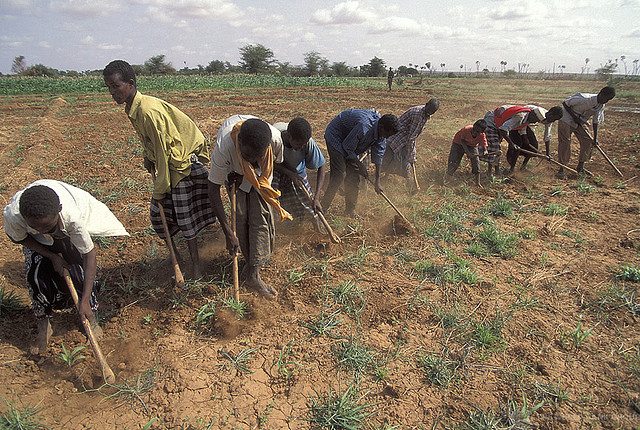
Famine-hollowed farmers watch trucks loaded with grain grown on their ancestral lands heading for the nearest port, destined to fill richer bellies in foreign lands. This scene has become all too common since the 2008 food crisis.
[This is the first of a multi-part series investigating what is driving food prices higher]
Food prices are even higher now in many countries, sparking another cycle of hunger riots in the Middle East and South Asia last weekend. While bad weather gets the blame for rising prices, the instant price hikes of recent times are largely due to market speculation in a corrupt global food system.
The 2008 food crisis awoke much of the world’s investment community to the profitable reality that hungry people will do almost anything, even sell their own children, in order to eat. And with the global financial crisis, food and farmland became the “new gold” for some of the biggest investors, experts agree.
In 2010, wheat futures rose 47 percent, U.S. corn was up more than 50 percent, and soybeans rose 34 percent.
On Wednesday, U.S.-based Cargill, the world’s largest agricultural commodities trader, announced a tripling of profits. The firm generated 1.49 billion dollars in three months between September and November 2010.
Meanwhile, U.S. Treasury Bills pay a return of less than one percent. Continue reading →
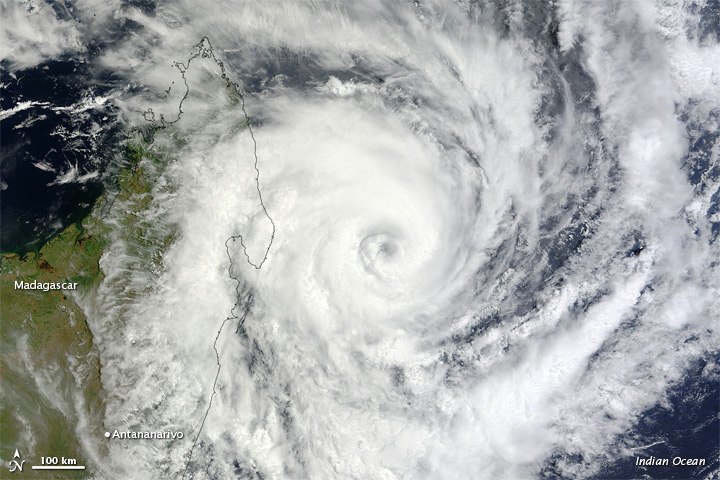
This is a big Cat 3 cyclone expected to affect 100,000’s of people. Sustained wind speeds of 160 kilometres per hour with gusts of up to 220 kilometres per hour, have been reported
NASA’s Terra satellite captured this image of Bingiza at 10:00 a.m. local time on Feb. 13, 2011. In the image, Bingiza’s eye approaches northern Madagascar, and a spiral arm grazes Antananarivo.






 Stephen Leahy, International Environmental Journalist