Local Decisions To Protect Nature Boosts Economy, Quality of Life and Secure Jobs — Global Study

Multi-trillion-dollar ecosystem services can boost local economies and quality of life

By Stephen Leahy

UXBRIDGE, Canada, Sep 10, 2010 (IPS)

What do New York City, Vienna, Quito and Rio de Janeiro have in common? They all get their high quality drinking water through aqueducts connected to protected areas in nearby hills and mountains.

Twenty years ago, a rapidly expanding New York City determined it was far cheaper to protect and restore the source of its water supply, the Catskill/Delaware forests and wetlands, than spend six to eight billion dollars on a water treatment plant.

Cities are dependent on nature. There are many examples of how the ecosystem services provided by nature can provide cost-effective solutions for local municipal services, according to a new major study titled “TEEB report for Local and Regional Policy Makers” released Thursday in India, Brazil, Belgium, Japan and South Africa.

Is this article of interest? It exists thanks to contributions from readers. Please click here to learn more about Community Supported Journalism.

However, the study notes that few politicians and public officials realise that factoring in the planet’s multi-trillion-dollar ecosystem services into their policy-making can help save cities and regional authorities’ money while boosting the local economy, enhancing quality of life, securing livelihoods and generating employment.

All economic activity and most of human well-being whether in an urban or non-urban setting is based on a healthy, functioning environment,” said Pavan Sukhdev, study leader of The Economics of Ecosystems and Biodiversity (TEEB) initiative hosted by the United Nations Environment Programme. Continue reading

Europe to cook the world’s tropical forests for biofuels — British told to back off targets by its climate advisors

UPDATE 13 Sept: UK must cut biofuels target “so that tropical forests are not cut down to make way for biofuel crops, government climate advisors said last Friday.”

“Europe is going to cook the world’s tropical forests to fight climate change; it’s crazy” — Millions of Trees Burned for ‘Green Energy’ Burning trees for energy produces 1.5 times as much carbon as coal – study shows

By Stephen Leahy*

UXBRIDGE, Canada, Sep 24 ’09 (Tierramérica) (Revised Sept 1’10)

Millions of trees, especially from the developing countries of the South, are being shipped to Europe and burned in giant furnaces to meet “green energy” requirements … Read More

via Stephen Leahy, International Environmental Journalist

The New Campus Cool: Water Fountains for Drinking – Uni bans bottled water

Water tastes much better in a steel or ceramic container than plastic. And it is a hell of lot healthier. See my previous posts about various studies about plastic container  –  Plastic Bottles Leach Estrogen – ‘Healthy’ Mineral Water  Contaminated by Plastic and Bring Back Glass – Ban BPA (bisphenol A) Plastic Containers Now

See also: Plastic chemical linked to female aggression

Not to mention Drowning the Oceans in Plastic Trash (Pacific Garbage Patch)

So big green thumbs up to the University of Ottawa and its student federation announcement — Stephen

No More Sales of Bottled Water

Students, faculty, staff and other members of the uOttawa community are encouraged to find alternatives to bottled water, such as filling up cups, glasses and re-usable bottles at the nearest fountain or tap on campus.

Since 2008, the University of Ottawa has invested over $100,000 to revitalize its water fountains. An additional $75,000 will be invested next year.

The improvements include gooseneck fountains for quick and easy filling of re-usable bottles, new fountains near food service outlets, upgrades to existing fountains. The fountains are wheelchair accessible, have increased waster pressure and better refrigeration.

via University of Ottawa marks the end bottled water sales on its campus | News Releases & Announcements | University of Ottawa Media Room.

Environmental Destruction Makes Money. Conservation Costs Money. This Global Dilemma Must Be Solved

Rich Countries Balk At Spending $ to Halt Biodiversity Crisis

By Stephen Leahy

NAIROBI, May 31, 2010 (IPS)

Developing countries rich in plants and animals but poor in financial and technical resources refused to make binding commitments to halt the unraveling of the planet’s biological infrastructure at the close of a major meeting Friday at the U.N.’s African headquarters in Nairobi.

For their part, rich countries balked at a 50-fold increase in funding to support efforts to slow and reverse the loss of species and ecosystems.

“Anything to do with finance has been a big problem here at this meeting,” said James Seyani, a delegate from Malawi and spokesperson for the African countries.

It takes money to protect, conserve and enhance biodiversity – the term for all living things that make up Earth’s ecosystems that are our life support system. Exploitation and destruction of vital ecosystems like forests and peatlands generates millions of dollars in revenue, but conserving or using these lands in ways that preserves biodiversity often costs governments money.

Do you find this article interesting? It is funded by contributions from readers. Please click here to learn more about Community Supported Journalism.

Reversing the declines in biodiversity is a matter of great urgency and countries with much of the world’s remaining species and intact ecosystems “are prepared to meet their commitments but we need the technical, human and financial resources to do this”, the delegate from Mexico said at the conclusion of the meeting that began May 10.

The absence of such resources is why biodiversity is in its current crisis, he said.

“The developing world needs to remember their previous commitments and provide new additional finances and resources. Those promises are not being adhered to,” Seyani told delegates late Friday afternoon at the end of the U.N. Convention on Biological Diversity’s (CBD) meeting to establish targets and an action plan to end the biodiversity crisis over the next decade. Continue reading

Oceans on the Brink: Dying Plankton, Dead Zones, Acidification

A number of marine diatom cells

By Stephen Leahy

VIENNA, Jul 31, 2010 IPS

The oceans are the lifeblood of our planet and plankton its red blood cells. Those vital “red blood cells” have declined more than 40 percent since 1950 and the rate of decline is increasing due to climate change, scientists reported this week.

Phytoplankton are a critical part of our planetary life support system. They produce half of the oxygen we breathe, draw down surface CO2, and ultimately support all of our fisheries,” said

Boris Worm of Canadas Dalhousie University and one of the worlds leading experts on the global oceans.

“An ocean with less phytoplankton will function differently,” said Worm, the co-author of a new study on plankton published this week in Nature. Plankton are the equivalent of grass, trees and other plants that make land green, says study co-author Marlon Lewis, an oceanographer at Dalhousie.

“It is frightening to realise we have lost nearly half of the oceans’ green plants,” Lewis told IPS.

“It looks like the rate of decline is increasing,” he said.

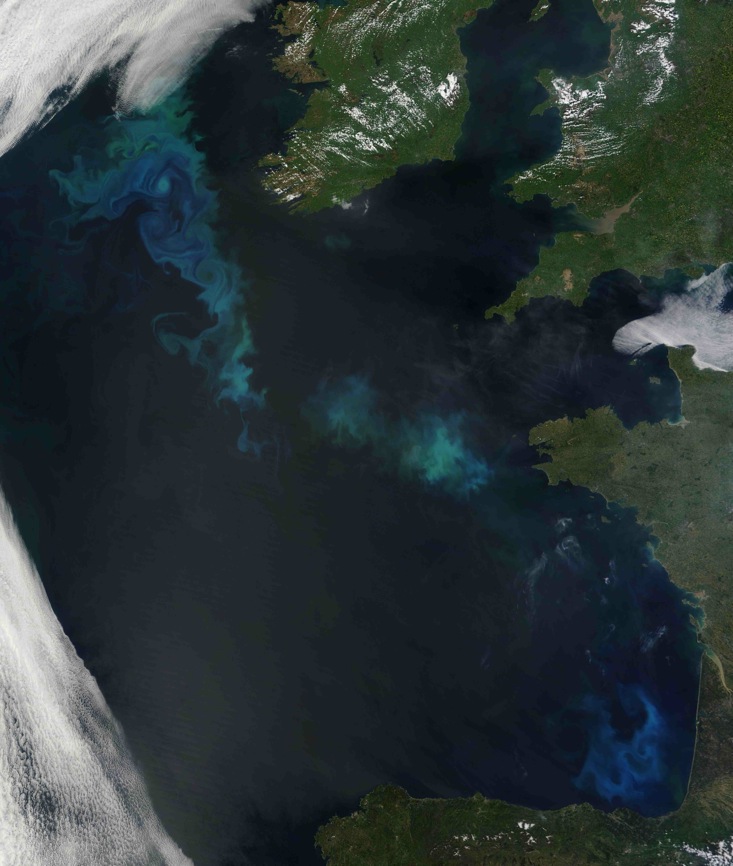
A large phytoplankton bloom in the Northeast Atlantic -NASA Earth Observatory Collection.

[See also my series of articles on ocean acidification]

Independent environmental journalism now depends on public support, learn more about how this works and how you can help, click here.

Climate change is warming the oceans about 0.2C per decade on average. This warmer water tends to stay on top because it is lighter and essentially sits on top of a layer of colder water. This layering, or stratification, is a problem for light-loving plankton because they can only live in the top 100 to 200 meters.

Eventually they run out of nutrients to feed on unless the cold, deeper waters mix with those near the surface. Ocean stratification has been widely observed in the past decade and is occurring in more and larger areas of the world’s oceans. Continue reading

‘Tourists Please Don’t Go To Home of Canada’s Dirty Oil Sands’ Ad Campaign

Beautiful Alberta, Canada??

US enviro group is putting up billboards in four U.S. cities urging Americans to exclude Alberta from their travel plans, saying it is “one of the world’s dirtiest destinations”.

Let’s be clear here: I am not a supporter of this use of  a big “economic” club to hit govt over the head to get their attention. It will hurt many Albertans who are in the tourist biz where many likely support a moratorium on new tar sands development. Indeed most Albertans have said they want a “time out” in the tar sands. But big oil says no way and are pushing for faster approvals of new projects with “streamlined environmental reviews” of course.

In their  Re-Think Alberta Campaign enviro groups say they are trying to counter Alberta and Canadian government propaganda. Canada is lobbying the US  to prevent any cleaner-fuel regulations because the tar sands has the world’s highest CO2 levels and is the most destructive form of oil production. Yes worse, than off shore drilling – see here for more

And they are also down here lobbying for infrastructure, new pipelines, refineries, which would keep us addicted to high-carbon oil for another 50 years.” Corporate Ethics International Executive Director Michael Marx told Reuters.

1.3 million barrels of dirty oil is shipped  from tar sands region  to the US every day

Corporate Ethics also has a powerful video about the ongoing environmental mess that can easily be seen from space it is so big.

See also International Stop the Tar Sands Day commencing July 17 (more on this later).

You can learn more on enviro impacts of the tar sands in my short ebook:

Oil Stains in the Boreal Forest: The Environmental Cost of Canada’s Oil Sands

And from my recent articles:

Canada’s “Mordor” Ensures Climate Treaty Failure in Copenhagen

Tar Sands, Riot Police & Hope in Copenhagen

— Green wishes, Steve

Fish Companies Push Hard to Halt Tuna Collapse

By Stephen Leahy*

VICTORIA, Seychelles, Feb 8, 2010 (IPS)

In the Seychelles’ only cannery, the din of thousands of empty tuna cans rattling on narrow metal troughs is incredible as they bustle along, soon to be filled with Skipjack tuna that only days ago were swimming freely in the inky blue Indian Ocean.

At one end of the Indian Ocean Tuna Limited processing plant – the world’s second largest – cranes offload nets full of frozen tuna from huge international fishing boats called purse seiners while at the other end of the plant, 5,000 cans of tuna roll off the line every minute.

That’s a lot of tuna – roughly 400 metric tonnes a day. Can the Indian Ocean tuna bounty, which amounts to more than 20 percent of the world’s tuna, be sustained?

That was the key question at the first-ever Seychelles Tuna Conference that ended last weekend. It brought together nearly 200 scientists, fishers, environmentalists and policy makers here in Victoria, Africa’s smallest capital city, located 1,800 km east of Somalia and practically in the middle of the Indian Ocean.

“The boats are much more efficient today and the tuna stocks are declining and there is much less tuna than before, ” said Alain Fonteneau, a scientist with the L’Institut de recherche pour le développement, in Montpellier, France, who opened the conference. Continue reading

Scientists Face Death Threats, Democracy at Risk

[A personal note from Stephen]

There’s something strange in the air when a highly-respected US scientist says he or a colleague will likely be killed for saying climate change is happening.

That’s what Stanford’s Stephen Schneider told me last week. He’s not an alarmist, he’s a pro with 40 years under his belt. These days climate scientists receive all kinds of hate mail and even death threats. I even get hate mail. Bizarre times.

At the same time traditional media are complicit, giving ‘face time’ to those who smear scientists with no evidence, just nonsensical conspiracy allegations. Schneider says simply:

I’m pretty damn angry that media companies are putting profits ahead of truth. The media are deeply broken… That’s a real threat to democracy.”

I couldn’t agree more. We’re in a dangerous trap. Schneider, Victoria Tauli-Corpuz, Chair, UN Permanent Forum on Indigenous Issues, and many other experts have recently told me: ‘we need people like you to write about these issues’.

I could do far more but my time is largely gobbled up trying to figure out how to put bread on the table. Last year writing about these issues put my family $10,000 in the red despite about $4000 in donations which mostly went towards travel costs. (And we have a pretty modest lifestyle, living in my in-law’s basement apt)

Put plainly, writing honestly about important issues is not rewarded in our current economic system, even though it’s in our best interests. Writing junk mail to sell crap that people don’t need is rewarded 100X more. (I know, I used to do it)

Community Supported Journalism

Community Supported Journalism is the only way forward that I can see. That means reciprocity: You help support the investigation, research, writing about what’s important for all of us to know so we can make informed decisions. In an earlier age I would have come to your village, taught your children and told you useful stories about what I’d learned from wise elders in other villages. Today I send out those stories to you and many others in our global village and rely more and more on you to provide the financial equivalent of a place to sleep and a meal to eat.

Reciprocity, co-operation and community are some of the key values we need to escape the trap we are in.

On a practical level supporting or funding individual story ideas isn’t working mainly because it takes too much time to put together and generate support. It’s not nimble enough to respond to breaking news, but it could work for larger, long term projects. Instead what’s needed is ‘bread and butter’ funding — contributions that help cover the everyday costs of living and doing environmental journalism.

A “Bread and Butter Environmental Journalism Support Fund” if you will. That fund will need about $15,000 in 2010 for the work to continue.

It has taken me three days to find the words to ask because it is a lot of money. Please consider $50, $100 or more — less than cost of a newspaper or cable TV subscription — for coverage of important issues that shape our world and our future.

Contributions can be made safely and easily via PayPal or Credit Card. Or  contact me at writersteve [AT] gmail [DOT] com (no spaces) to send a cheque.

Please also pass this along to interested family, friends and organizations. My continued appreciation to those who have contributed in the past.

Thanks and best wishes, Steve

A Tipping Point on Species Loss?

By Stephen Leahy

UXBRIDGE, Canada, Jan 13, 2010 (IPS)

Humanity is destroying the network of living things that comprise our life support system. While this sawing-through-the-branch-we’re-perched-on is largely unintentional, world leaders can’t say they didn’t know what’s going on: 123 countries promised to take urgent action in 2003 but have done little to stem the rising tide of extinctions in what’s known as the extinction or biodiversity crisis.

Species are going extinct at 1,000 times their natural pace due to human activity, recent science has documented, with 35 to 40 species vanishing each day, never to be seen again.

“The question of preserving biological diversity is on the same scale as climate protection,” German Chancellor Angela Merkel said in a speech in Berlin Monday at the official launch of the United Nations’ International Year of Biodiversity.

This week’s official launch will be followed by the first major event of the International Year, a high-profile meeting at the Paris headquarters of the U.N. Educational, Scientific and Cultural Organisation, Jan. 20-21.

“We need a sea change. Here, now, immediately – not some time in the future,” Merkel said.

While climate has been the focus in 2009, this year will be a global celebration of and action on biodiversity, Ahmed Djoghlaf, executive secretary of the Convention on Biological Diversity (CBD), told IPS from Berlin.

Continue reading

Canada’s “Mordor” Ensures Climate Treaty Failure in Copenhagen

[Hello from snowy and cold Copenhagen. Tensions have ramped up as political leaders arrived but are mainly meeting in secret.

Ashamed to say Canada is a widely acknowledged as a public embarrassment here. And called a climate criminal by some. Several protests like the one I covered below and a smaller one earlier have focused on the Athabasca Tar Sands perhaps the world’s biggest source of carbon emissions.

Outside the artificial reality of the Bella Center ordinary people get it. Here is good video summary of what happened on Wed as civil society were gradually banned from the conference. It accords with my son’s version who was in the middle of all this as an observer. — Steve]


By Stephen Leahy

COPENHAGEN (IPS/TerraViva) Dec 14 2009

Climate activists jammed a small square near the police-barricaded Canadian Embassy here Monday for the second day of protests over the country’s tar sands development.

Simultaneous protests were held at the Canadian Embassy in London because British oil companies and financial institutions are deeply invested in the Canadian mega-project.

“As indigenous people, we are here at the international climate negotiations to speak about threats to our cultural survival and the direct life-threatening impacts of climate change in our communities,” said Clayton Thomas Muller, tar sands campaigner for the Indigenous Environmental Network.

“Canada has been blocking the climate negotiations and hasn’t kept Kyoto commitments…because of the tar sands,” he told a crowd of 75 to 100 people surrounded by four squads of riot police.

Boreal forests and wetlands the size of Greece are been destroyed in northern Alberta in an industrial project that turns millions of tonnes of sand and earth into oil, mainly for the U.S. market he said.

“All the efforts by Canadians to reduce their carbon emissions are undone by the tar sands,” said Canadian writer and activist Naomi Klein.

The tar sands are Canada’s largest single source of carbon dioxide (CO2) emissions and the major reason why Canada has refused to live up to its commitments to reduce emissions and is blocking negotiations, Klein told protesters.

“Canada is making a mockery of international law and of developing countries’ need for urgent emission reductions in rich countries,” she said.

Canadian Prime Minister Stephen Harper is here at the Dec. 7-18 U.N.-sponsored climate summit under false pretences, Klein charged.

Harper does not have the Canadian people’s permission to promote the tar sands or to favour Canadian interests over those of the planet,” she said.

The tar sands are “Canada’s Mordor”, said Maude Barlow, head of the Council of Canadians, the largest citizens’ group in Canada. She was referring to the devastated land of rock and fire in the “Lord of the Rings” trilogy.

“What else can you call a project that leaks 11 million litres of toxic waste a day into rivers and groundwater?” Barlow said in this very un-Mordor upscale shopping district of downtown Copenhagen.

The tar sands project has the largest toxic waste containment ponds on the planet – easily visible from space. Last week, a report revealed the extent of the leaks to be an estimated 11 million litres a day.

Shockingly, this is based on the oil companies’ own self-reported data, says Environmental Defence, the Canadian advocacy, research and education group that compiled the report.

It calculated that four billion litres of leakage a year will grow to 25 billion in a decade based on current growth of the tar sands and aging of the enormous dams that hold back the waste.

“There is no question Harper will stand up for  the oil sector [in the climate talks here],” Barlow said.

Their [oil industry] footprints are all over this negotiation and that is why it will fail.”

-30-

Corrected 2/2/12

For more on the Tar Sands see:

Oil Stains in the Boreal Forest: The Environmental Cost of Canada’s Oil Sands – Revised V2.1Oil Stains in the Boreal Forest: The Environmental Cost of Canada’s Oil Sands – Revised V2.1