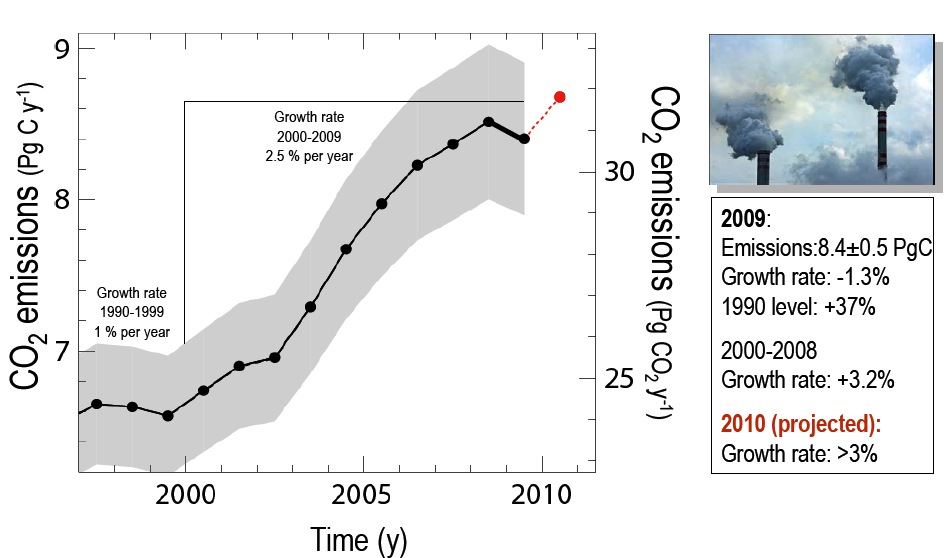
“We’re facing a planetary emergency” The Road to Rio (+20 years)

“Humanity is facing major challenges…urgent actions are needed”

Can we act as a true community?

By Stephen Leahy

UXBRIDGE, Canada, Jan 11, 2012 (IPS)

Humanity is driving Earth’s climate and ecosystems towards dangerous tipping points, requiring radical new forms of international cooperation and governance, experts say.

“We’re facing a planetary emergency,” said Owen Gaffney of the International Geosphere-Biosphere Programme based in Stockholm.

“We need to have a ‘constitutional moment’ in world politics, akin to the major transformative shift in governance after 1945 that led to the establishment of the United Nations and numerous other international organisations,” said Frank Biermann of VU University Amsterdam and director of the Earth System Governance Project.

“Humanity is facing major challenges…urgent actions are needed,” Biermann told IPS.

              Be a Partner in Independent Enviro Journalism

Those challenges include, but are not limited to, increasing poverty, food, water and energy security, the financial crisis, climate change, ocean acidification, the loss of biodiversity. All of these challenges and their solutions are interconnected.

Normally, the complex, mutually dependent systems of the Earth can self-correct and are remarkably stable. However, they can reach thresholds or tipping points and then unexpectedly and abruptly shift, Gaffney said in an interview.

“We need only recall how the U.S. sub-prime mortgage crisis nearly collapsed the global financial system,” he said.

The upcoming Rio+20 conference on sustainable development needs to be the moment in human history when the nations of the world come together to find ways to ensure “the very survival of humanity”, he said. Continue reading

Become a Partner in Independent Enviro Journalism

A personal message from Stephen Leahy

“Journalism and media are society’s mirror providing accurate and essential information.

That is no longer the case.

Media are now controlled by a few major corporations like Murdoch’s News Corp. Coverage of environment and science has been gutted. If there is coverage it rarely digs below the surface. It’s not just TV, it’s all media.

After 18 years of being published in major publications on two continents I now count myself lucky to get $150 to $200 for an in-depth article. The few independent media outlets are either non-profits or struggling.

Urgent environmental issues didn’t go away just because most media stopped covering them.

More than 20,000 people attended the international climate meeting in Cancun, Mexico and it received one ten second clip on US network TV according to a Drexel University media study. (Coverage was even worse at last climate meet in Durban)

Nearly every indicator proves things are getting worse but less and less people know about this.

Many people, including leading scientists, tell me: ‘we need people like you to write about these issues‘. I’d like to do far more but it is impossible to continue without your help in what I’m calling Community Supported Journalism. People directly support independent journalists who craft honest and thoughtful articles about important subjects the mainstream media ignores or gloss over.

Community Supported Environmental Journalism Works

In 2010 dozens of people offered their help, donating $5,750 which helped ensure many breaking international stories were covered including the first media reports on the global die-off of corals and how climate change may be bringing colder winters to Europe and eastern North America. Those donors — I prefer to call them partners — enabled me to cover important international meetings like the UN Convention on Biodiversity, UNFCCC climate change conference and much more.

Thanks for reading.” — Stephen

Please join us. Consider a donation of just $10 a month to support enviro journalism that serves the public interest.

Contributions can be made safely and easily via PayPal* or Credit Card*. [You can cancel at any time, automatically. No need to contact me] 

Monthly support options starting @ $10 a month

One-time donations are most welcome. Click and enter the amount.

*More than 100,000 non-profits safely use PayPal Donate service

If you’d like a mailing address or contact me with story ideas, please complete this comment form.

Letters of Support:

We need people like you. In tough economic times, where information flow is increasingly channeled and controlled, you perform a simply critical role. Hang in there. You are an admirable role model for the future.”

– E. Ann Clark, Associate Professor, University of Guelph.

“Stephen Leahy has done a superb job exposing the enormous sums the US government is spending on corporate welfare for big oil.”

Ross Gelbspan, Pulitzer-prize winning editor and author of The Heat is On

My continued appreciation to those who have contributed in the past.

Fracking and Shale Gas Accelerating Global Warming

UPDATE Jan 2013:

Yet another study reveals fracking has a huge problem of gas leaks. Up to  9% of the gas pumped out of the ground leaks into the atmosphere according to a study by National Oceanic and Atmospheric Administration (NOAA) published in Nature this week. Natural gas (methane) is a powerful greenhouse gas. If these leaks are widespread, fracking is worse than burning coal, accelerating global warming.

In Jan 2012 I detailed new research in the article below showing that replacing coal with natural gas from fracking does little to fight climate change (see below). Now two studies published that since then make an even stronger case that fracking for natural gas is a HUGE MISTAKE:

From Nature: Air sampling reveals high emissions from gas field. Methane leaks during production may offset climate benefits of natural gas.

From Environmental Research Letters: New study demonstrates switching to natural gas is the path to climate disaster. What’s needed is an aggressive deployment of zero-carbon technologies and conservation. Joe Romm explains. — Stephen

Shale Gas Worse Than Coal Study Finds

By Stephen Leahy

UXBRIDGE, Canada, Jan 24, 2012 (IPS)

Hundreds of thousands of shale gas wells are being “fracked” in the United States and Canada, allowing large amounts of methane, a highly potent greenhouse gas, to escape into the atmosphere, new studies have shown.

Shale gas production results in 40 to 60 percent more global warming emissions than conventional gas, said Robert Howarth of Cornell University in New York State.

“Shale gas also has a larger greenhouse gas footprint than oil or coal over the short term,” said Howarth, co-author of a study called “Venting and Leaking of Methane from Shale Gas Development” to be published in the journal Climatic Change.

(Audio of news conference)http://of%20news%20conference

This latest study follows up on Howarth and colleagues’ controversial April 2011 paper that provided the first comprehensive analysis of greenhouse gas emissions from shale gas obtained by hydraulic fracturing. That study found that when gas wells are “fracked”, they leak large amounts of methane and pose a significant threat to the global climate.

“We stand by the conclusion of our 2011 research,” said Howarth.

That research undercuts the logic of energy sector claims that shale gas is a “bridge” to a low-carbon energy future. Those claims are based on the fact that natural gas (which is mainly methane) has half the carbon content of coal, and when burned for electricity it is more energy efficient than coal.

This independent  journalism depends on public support. Click here learn more.

However, those climate gains are more than negated by methane leaks both at the well during the fracking process (called flow-back), and through the gas delivery and distribution system. Howarth and colleagues estimate that between 3.6 and 7.9 percent of all shale gas produced leaks – called “fugitive emissions” – into the atmosphere, making it worse than burning coal or oil.

Please throw something in the tip jar before reading on.
This is how I make my living.

Continue reading

Toxic Electronic Waste Grows by 40 Million Tonnes a Year — Poisons Kids in Africa

A worker cooks computer motherboards over solder to remove chips and valuable metals at a makeshift e-waste workshop.

‘Public largely unaware of the e-waste impacts on human health and environment’

By Stephen Leahy

UXBRIDGE, Canada, Nov 1, 2011 (IPS)

Mountains of hazardous waste grow by about 40 million tons every year. This waste, mostly from Europe and North America, is burned in developing countries like Ghana in a hazardous effort to recover valuable metals.

A children’s school in Accra, Ghana’s capital, was recently found to be contaminated by lead, cadmium and other health-threatening pollutants at levels over 50 times higher than risk-free levels. The school is located directly beside an informal electronic waste salvage site.

“Poor people in Africa cannot afford to process Europe’s or America’s electronic wastes,” said Ghanaian researcher Atiemo Sampson.

“Those wastes are poisoning our children,” Sampson told IPS from Accra.

Ghana does not regulate the importation and management of electronic waste, or e-waste. The government hopes to have rules in place next year, he said.

Sampson, a Ph.D. student at the University of Ghana, was involved in testing the school and other areas in Accra near the Agbogbloshie scrap metal site, where more than 100 people break apart and burn electronic trash by hand to obtain valuable metals like copper.

Schoolchildren as young as six years old work around bonfires of circuitry, plastic and other leftover high-tech trash, he said.

A nearby produce market, a church headquarters and a soccer field were similarly polluted, to varying degrees. The soil around the school site had measurements for lead 12 times higher than the levels at which intervention is required. Lead is acutely toxic to children and can permanently damage their growing brains and nervous systems, even at very low levels of exposure.

“We don’t know what the immediate health impacts are. We are hoping to test the children’s blood for contaminants but we have not secured the necessary funding,” Sampson said.

International shipments of electronic trash are outlawed by the Basel Convention. However, European and North American e-waste is often shipped as “electronics for reuse” or hidden with legitimate cargo.

Continue reading

Shale Gas a Bridge to More Global Warming

Shale Gas Worse Than Coal Study Finds

By Stephen Leahy

UXBRIDGE, Canada, Jan 24, 2012 (IPS)

Hundreds of thousands of shale gas wells are being “fracked” in the United States and Canada, allowing large amounts of methane, a highly potent greenhouse gas, to escape into the atmosphere, new studies have shown.

Shale gas production results in 40 to 60 percent more global warming emissions than conventional gas, said Robert Howarth of Cornell University in New York State.

“Shale gas also has a larger greenhouse gas footprint than oil or coal over the short term,” said Howarth, co-author of a study called “Venting and Leaking of Methane from Shale Gas Development” to be published in the journal Climatic Change.

(Audio of news conference)http://of%20news%20conference

This latest study follows up on Howarth and colleagues’ controversial April 2011 paper that provided the first comprehensive analysis of greenhouse gas emissions from shale gas obtained by hydraulic fracturing. That study found that when gas wells are “fracked”, they leak large amounts of methane and pose a significant threat to the global climate.

“We stand by the conclusion of our 2011 research,” said Howarth.

That research undercuts the logic of energy sector claims that shale gas is a “bridge” to a low-carbon energy future. Those claims are based on the fact that natural gas (which is mainly methane) has half the carbon content of coal, and when burned for electricity it is more energy efficient than coal.

This independent  journalism depends on public support. Click here learn more.

However, those climate gains are more than negated by methane leaks both at the well during the fracking process (called flow-back), and through the gas delivery and distribution system. Howarth and colleagues estimate that between 3.6 and 7.9 percent of all shale gas produced leaks – called “fugitive emissions” – into the atmosphere, making it worse than burning coal or oil. Continue reading

“Fracking” for Shale Gas: The Bridge to Global Warming Disaster

Switching from coal to gas can increase global warming – NCAR

[UPDATE JAN 20 2012: New study published in journal Climatic Change shows large volumes of methane released during fracking]

By Stephen Leahy 

DURBAN, South Africa, Dec 5, 2011 (Tierramérica)

Hydraulic fracturing or “fracking” is being used to tap the last remaining natural gas deposits across large areas of the United States and western Canada, fueling continued dependence on hydrocarbons instead of a shift to genuinely clean energy sources to cool the planet.

Called shale gas, these deposits represent a new and enormous source of fossil fuel.

“Fracking is driving exploration and drilling all over the United States,” said Gwen Lachelt of the non-governmental organisation Earthworks’ Oil & Gas Accountability Project.

“The oil and gas industry is marching across America from Texas to North Dakota and from the east coast to California,” Lachelt told Tierramérica.

There may be as much as 23,427 billion cubic metres (bcm) in recoverable gas from U.S. shale formations, according to the Annual Energy Outlook 2011, released in April by the U.S. Energy Information Administration (EIA).

The United States will consume 650 bcm of natural gas this year, the EIA projected. Globally, it estimates reserves of “unconventional gas” – the oil and gas industry term for shale gas and coal bed methane – at 915,000 bcm, with 100,000 bcm in Latin America.

However, that estimate is already out of date due to developments in fracking technology and exploration. The EIA estimate of shale gas in the United States in 2009 was less than half the 2011 estimate.

Fracking uses horizontal drilling and hydraulic fracturing with high pressure water and chemicals to fracture gas-bearing shale rock.

Holes are drilled vertically as little as 100 metres and as much as 3,000 metres into the shale, and then horizontally 1,000 metres along the shale formation. Chemicals and large amounts of water are pumped underground at high enough pressure to fracture the shale, releasing the gas into the pipeline.

The “dash for gas” as the industry pundits like to say is being driven by potential exports to Asia and the mistaken belief that natural gas is the “transition fuel” from coal to a low-carbon economy.

It is true that natural gas is “cleaner” in that it releases about 40 to 45 percent less carbon dioxide than coal does to produce the same amount of energy.
However, gas from fracking has a higher carbon footprint because more energy is needed to get the gas and because methane leaks out.

Methane has 25 times the warming impact of carbon dioxide.

Switching from coal to gas as an energy source could result in increased global warming, not less, according to the study “Coal to Gas: The Influence of Methane Leakage”, released in September by the U.S. National Center for Atmospheric Research (NCAR).

This is mainly due to the methane leakage problem, which is common but unregulated.

[UPDATE JAN 20 2012: New study published in journal Climatic Change shows large volumes of methane released during fracking]

Canada’s Harper Government Guts Environment, Science and Monitoring Programs

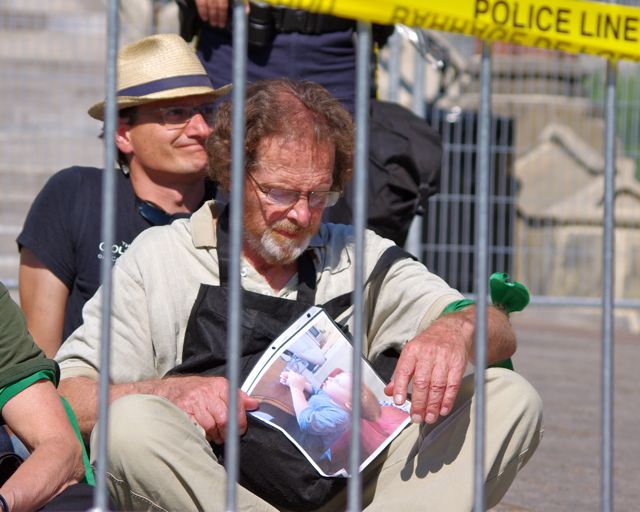
Man w picture of grandchild was arrested for protesting against tar sands expansion, Sept 2011 Ottawa, Canada - Pix by R Leahy

Environment budget slashed while PM Harper’s office places a gag order on government scientists. (And a $60 billion order for military equipment)

By Stephen Leahy

UXBRIDGE, Canada, Nov 9, 2011 (IPS)

Canada’s Stephen Harper government is spending more than 60 billion dollars on new military jets and warships while slashing more than 200 million dollars in funding for research and monitoring of the environment.

Amongst the programmes now crippled is Canada’s internationally renowned ozone monitoring network, which was instrumental in the discovery of the first-ever ozone hole over Canada last spring. Loss of ozone has been previously linked to increases in skin cancer.

“The proposed cuts go so far the network won’t be able to do serious science,” said Thomas Duck, an atmospheric scientist at Halifax’s Dalhousie University.

Canada was the pioneer in ozone monitoring, developing the first accurate ozone measuring tool that led to the discovery that the world’s ozone layer was dangerously thinning in the 1970s, which in turn led to the successful Montreal Protocol on Ozone Depleting Substances.

Canada has about one-third of the ozone monitoring stations in the Arctic region. It also hosts the world archive of ozone data, which is heavily relied on by scientists around the world.

“There’s only one guy running the entire archive, and he’s received a lay-off notice letter,” Duck told IPS.

Ozone monitoring and research is part of Environment Canada, the government department charged with protecting the environment, conservation and providing weather and meteorological information.

“Canada can’t afford to pay scientists but we can line the pockets of big oil?

That is totally backwards.”

Continue reading

Selling Nature to Save Nature and Ourselves?

Humanity faces unprecedented challenge of climate change combined with food, water and energy shortages

“Markets are preconditioned on inequality and will only make matters worse”

By Stephen Leahy

THE HAGUE, Jul 5, 2011 (IPS)

Avoiding the coming catastrophic nexus of climate change, food, water and energy shortages, along with worsening poverty, requires a global technological overhaul involving investments of 1.9 trillion dollars each year for the next 40 years, said experts from the U.N. Department of Economic and Social Affairs (UN-DESA) in Geneva Tuesday.

“The need for a technological revolution is both a development and existential imperative for civilisation,” said Rob Vos, lead author of a new report, “The Great Green Technological Transformation”.

Absent in the U.N. report is a call for the other necessary transformation: what to do with the market-driven economic system that has put humanity on this catastrophic collision course? Attempts to “green” capitalism are failing and will fail, according to many of the more than 200 social science researchers at a groundbreaking international conference in The Hague titled NATURE INC? QUESTIONING THE MARKET PANACEA IN ENVIRONMENTAL POLICY AND CONSERVATION Jun. 30 to Jul. 2.

“We must start tackling and questioning some core capitalist dictums, such as consumerism, hyper-competition, the notion that ‘private’ is always better, and especially economic growth,” says Bram Büscher, the conference co-organiser and researcher at the Institute of Social Studies (ISS) at Erasmus University in The Hague, Netherlands.

Equally important is to stop looking at nature as a collection of economic objects and services that “must only benefit some specific idea of human economic progress”, Büscher told IPS.

Governments, the World Bank, the United Nations and development agencies, international conservation organisations and others have all come to see markets as the only way to mobilise enough money to end deforestation, increase the use of alternative energy, boost food production, alleviate poverty, reduce pollution and solve a host of other serious and longstanding problems.

Started as a small gathering of academics, Nature Inc? became a major event as hundreds of experts from around the world wished to participate. Büscher believes the main reason for this is that many are actively doing research on environmental and conservation issues and are increasingly running into new market schemes like carbon credit trading, payments for ecosystem services, biodiversity derivatives and new conservation finance mechanisms, and so on.

“Payments for ecosystem services are the newest tropical ‘miracle’ crop,” said Kathleen McAfee of San Francisco State University.

The market is putting new values on tropical forests as carbon sinks, reservoirs of biodiversity or ecotourism destinations, McAfee said during the conference. Continue reading

Cook Islands Aims for 100 Percent Green Energy by 2020

President of Cook Islands – Henry Puna
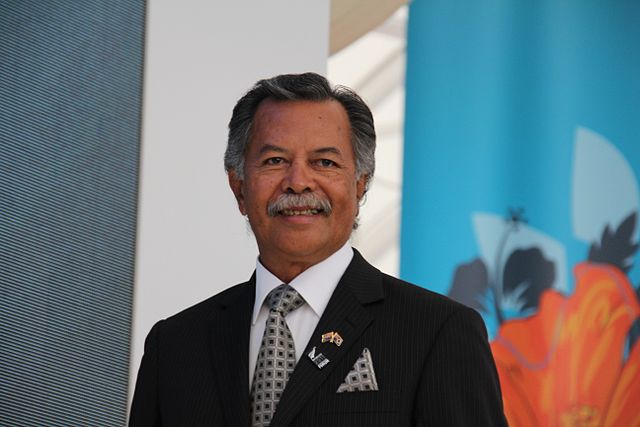
 Cook Islands’ Carbon Footprint is the size of a town of 3,000 in America

Stephen Leahy interviews HENRY PUNA, Prime Minister of the Cook Islands

VIENNA, Jul 13, 2011 (IPS) –

“One hundred percent renewable energy by 2020… It is ambitious but it is not impossible,” Henry Puna, prime minister of the Cook Islands, told IPS in a recent interview.

The Cook Islands is one of those low-lying island countries that will drown without serious cuts in the carbon emissions that are warming the planet and melting the world’s ice sheets.

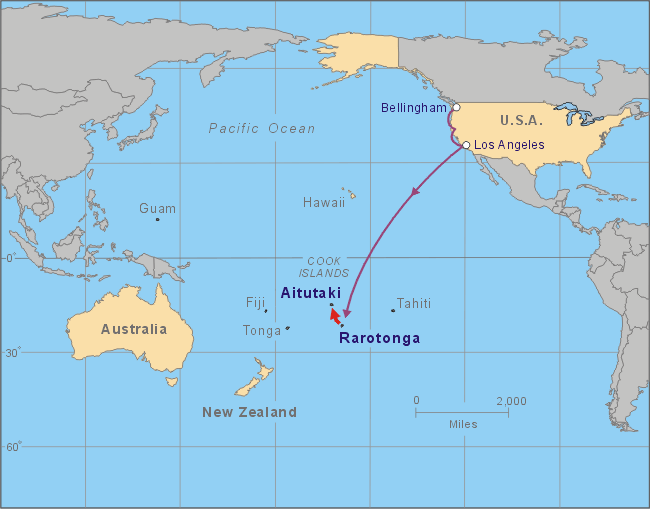
Home to just 14,000 people, the Cook Islands is made up of 15 small islands spread over an area the size of India in the middle of the South Pacific. The entire country’s carbon emissions are about equal to those of the average U.S. or Canadian town of 3,000 people.

With an action plan born of desperation, it wants to be the world’s first zero-carbon emissions country by 2020. With little renewable energy at present and dependent on foreign aid, the Cook Islands plans to generate half of its energy with renewables just four years from now and reach 100 percent by 2020.

IPS senior environmental correspondent Stephen Leahy spoke with Prime Minister Puna at the Vienna Energy Forum in June, where 1,200 delegates from 120 countries and over 40 government ministers discussed how to bring clean, reliable and affordable energy services to everyone on the planet.

Excerpts from the interview follow.

Q: The Cook Islands have a tiny carbon footprint. Why are you making this commitment to be 100-percent renewable?

A: Statistically, our carbon emissions don’t register. As a people we want to do something about climate change, if not for the world than for ourselves.

Nearly all of our energy comes from oil [diesel and petrol] and we spend half of our national budget on oil. That’s tens of millions of dollars that leaves our islands. We want to keep those millions in our local economy. Cook Islanders people are strongly supportive of our dream is to be the cleanest and greenest destination in the world. One day the world will want to know how we got to 100 percent.

Q: Are you hopeful the international community will finally agree to make the necessary carbon emissions cuts to keep global warming to less than two degrees C?

A: The reality is that things move very slowly at the international level. At the [Vienna] forum, I urged the international community to ensure that global carbon emissions peak by 2015 and begin to decline. We need to act fast. This is the decade where we must bring emissions of climate change under control.

Our circumstances differ, we have different life experiences….but we are all part of Mother Earth and should share responsibility to keep her livable for all of us and not just for some.

Q: Are Cook Islanders worried about climate change?

A: The Cooks are already suffering from sea level rise, coral bleaching, more frequent and stronger cyclones, changes in precipitation, and increases in coastal erosion. We live off the sea and the land – we depend on nature for our livelihoods. Anything affecting nature causes alarm amongst people. Climate change threatens our very survival. There is a general sense of apprehension about the future.

Q: What makes you believe you can achieve your ambitious target?

A: Yesterday, I visited Güssing [in Austria], an impoverished town in the 1990s that re-made itself by going 100-percent renewable energy. They got rid of fossil fuels and achieved energy independence. They also attracted lots of clean and green businesses and become a tourist centre.

I spent time with the mayor. They’re going to come to the Cooks and give us advice. They are willing to share their experience. I’m absolutely excited by this.

Q: Your country has few financial resources. Do you really think the Cooks can do what Güssing has done?

A: It’s a small town and we’re a small country. What I learned from Güssing is that if there is the political will backed by public support, then anything can happen. We already have a plan for a two- megawatt solar plant in one of our islands. We have support from Japan, New Zealand and UNDP [the United Nations Development Programme].

Q: What are some of the obstacles you have to overcome?

A: The technology to generate all of our energy already exists but energy storage is the key. We also need to make sure some of this will be able to be used and maintained by isolated communities without the technical skills.

Q: Any final thoughts?

A: Knowing we are taking action helps us feel good even if the world does nothing. We’re not doing this just for the Cook Islands. It is our contribution to improve the overall global environment.

First published as Q&A: Cook Islands Aims for 100 Percent Green Energy by 2020 – IPS ipsnews.net.


Carbon Markets Are NOT Cooling the Planet

Carbon markets have failed – prone to fraud – experts report

Climate change is the world’s biggest market failure so why would we expect carbon markets to save the day? There isn’t going to be a climate treaty for some years yet.It is simply too complex and politically charged. Don’t be too depressed about this. We are in uncharted waters as a species in trying to find an equitable way to manage the climate of our planet. But action is needed now and the best place is at our local neighbourhood level to save energy, use alternatives, build communities and inform people IMHO. — Stephen

By Stephen Leahy*

BONN, Jun 22, 2011 (Tierramérica)

Carbon markets have been widely promoted as the only way to generate enough money to enable industries and countries to reduce their carbon dioxide emissions, which are largely responsible for global warming. The only problem is that nearly 20 years after their conception, they have failed to work, and have also been subject to fraud and other financial crimes.

Interpol, the world’s leading policing agency, has warned that carbon market schemes are easily taken advantage of by organised crime.

Earlier this year, carbon credits worth 38 million dollars went missing in the European Union’s carbon market after funds were transferred by computer hackers from the Czech Republic to Poland, Estonia and Liechtenstein before disappearing. That was the fourth time funds had been stolen or mislaid.

“A lawyer formerly involved in carbon trading told me that if markets are still trading carbon 10 or 15 years from now, then the global environment will be in very big trouble,” Steve Suppan, senior policy analyst at the U.S.-based Institute for Agriculture and Trade Policy (IATP), told Tierramerica.

“Carbon markets are open to fraud, misrepresentation and deceptive promotion,” Suppan said in an interview at the United Nations Framework Convention on Climate Change (UNFCCC) negotiating sessions held in Bonn Jun. 6-17.

These markets have had huge support from governments and they still do not work to effectively reduce greenhouse gas emissions, said Suppan, whose organisation works on trade, agriculture and environmental issues.
Continue reading