Canada Slashes Charity’s Funding To Protect Giant Tar Sands Project P.S. Oil companies get $2+ billion in subsidies

Please read this eloquent piece from Toronto Star columnist Catherine Porter on how the Harper govt cut funding of Kairos, a renowned church charity for telling the truth about Canada’s tar sands.

How can Canadians in good conscience try to help African women get water when it is carbon emissions from the tar sands are part of the reason they face drought?

And then Harper and his Minister Bev Oda lied and tried to cover up their vindictive actions claiming they want to improve the lives of the poor “efficiently”. (This from a govt giving billions in public subsidies to oil companies)

Here’s the first paras of Porter’s column:

A few years back, the staff at Kairos planned a trip to Nigeria’s oilfields to examine environmental damage, corporate responsibility and human rights abuses.

The board of the faith-based development organization rejected the idea. It sent them to Alberta’s tar sands instead.

“I remember saying, ‘They’ll kill us — that will be considered very political,’ ” recalls Mary Corkery, Kairos’ passionate executive director. “The churches said, ‘This is our work. Our work is inspired by faith to tell the truth. It’s a development issue if it’s far away. It’s a political issue if it’s at home. Or if it offends anyone.’ ”

Think it’s a stretch to compare Canada to Nigeria? A government that forges documents, that makes things up, that smothers dissenting opinions, that accuses the media of lying.

via Porter: Kairos does important work; we should all support it – thestar.com.

About Subsidies:
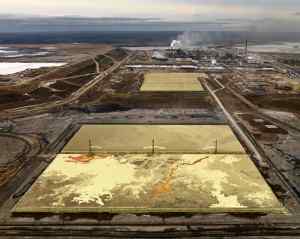
Every Day Governments Give an Estimated $2 billion to Oil, Coal & Gas Industry
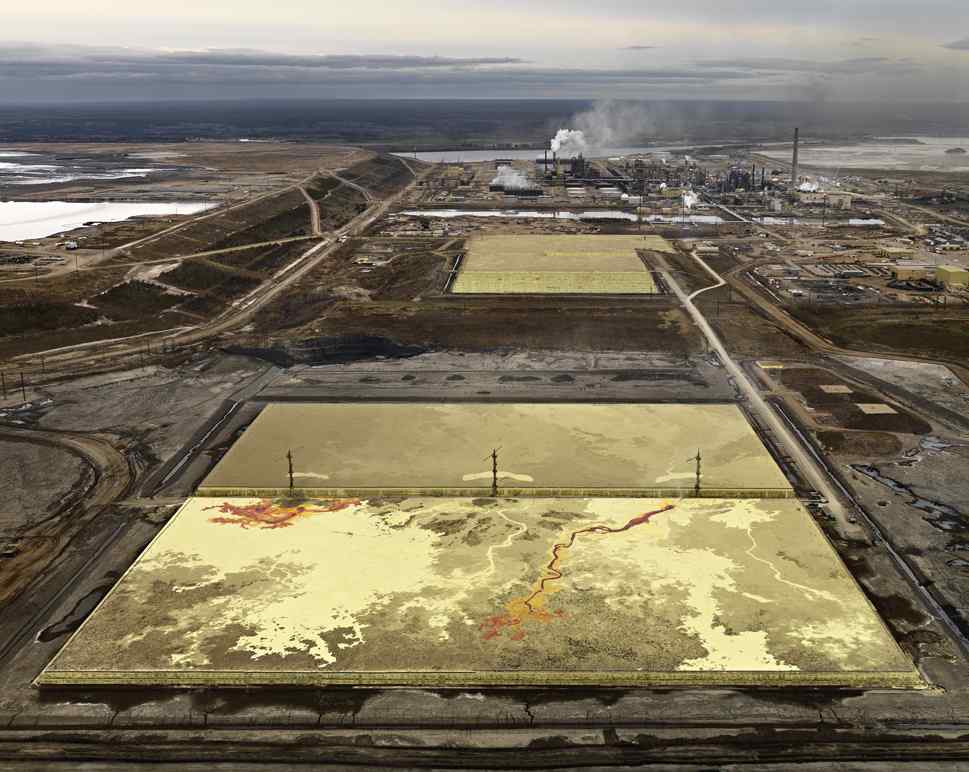
About the Tar Sands:

30 Page e-book:_Oil Stains in the Boreal Forest: The Environmental Cost of Canada’s Tar Sands

Europeans stopped Canada’s Slaughter of Baby Seals – Can They Stop Canada’s Tar Sands?

Canada’s “Mordor” Ensures Climate Treaty Failure in Copenhagen
Sir Nicholas Stern: On Our Way to Calamitous +5

Hundreds of Millions of Climate Refugees

‘Governments Fail to Understand Gravity of the Situation’ – Stern

By Stephen Leahy

COPENHAGEN (IPS/TerraViva)

[I wrote this piece 16 December 2009 and it remains fully relevant today and is posted here for 1st time. And please note that the +5C cited here is the global average which means the warming could easily be 10 C warmer where you live. All of this is well beyond anything humanity has ever faced — Stephen]

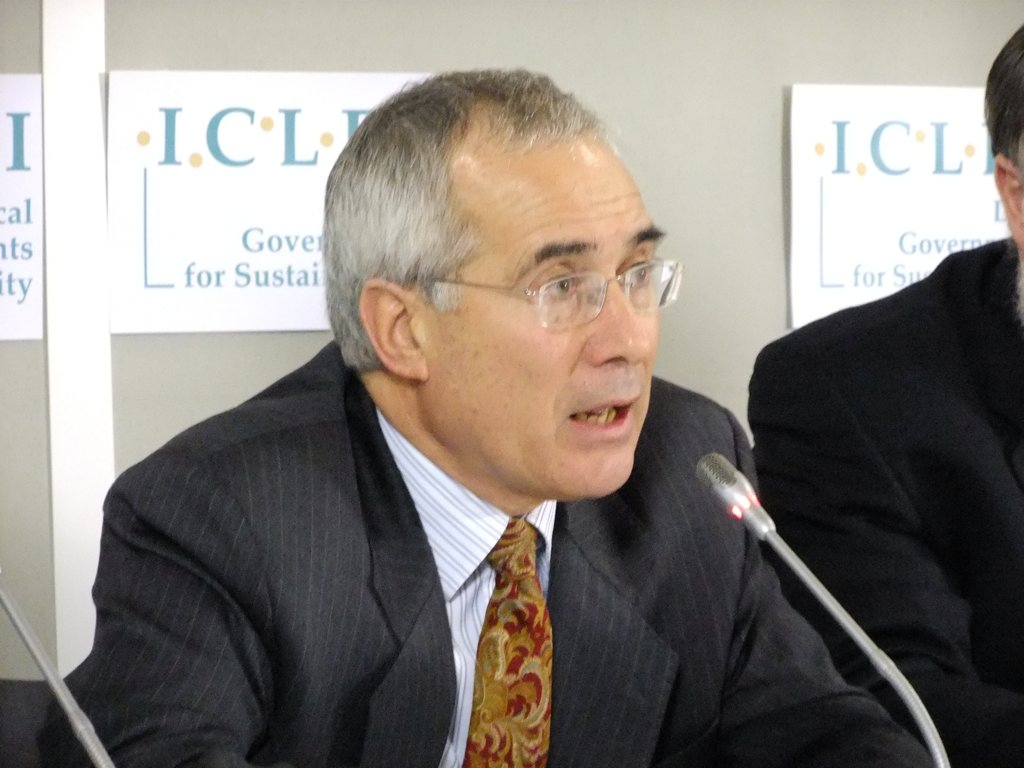
On its current carbon emissions path, humanity faces a 50-percent chance of warming the planet a whopping 5.0 degrees C by the end of this century, warned Nicholas Stern, an economist who is chair of the Grantham Institute for Climate Change and the Environment at the London School of Economics.

“Hundreds of millions of people will be forced to move. It will be the most severe global conflict in human history. That is what the science is telling us,” said Stern, author of the well-known Stern Review, the 2006 report that documented the effect of global warming on the world economy.

Humanity’s other option is to embrace a new energy revolution unlike anything ever seen.
And cities will be on the leading edge of this revolution, he said.

Cities use 80 percent of all energy and are responsible for the bulk of emissions. The good news is that cities are also the easiest places to get major emissions reductions because energy services are centralised and collaboration is easier.

This independent environmental journalism depends on public support. Click here learn more.

“Local mayors and councils can more easily agree on policies and direct their administration to take action,” he said.

“Cities are already doing the work of national governments on climate,” said David Cadman, president of ICLEI – Local Governments for Sustainability, an international association of local governments that is hosting a mayors’ conference featuring mayors from more than 100 cities as part of the climate negotiations here.

Copenhagen to be carbon-neutral by 2025

Continue reading

Be a Partner in Independent Enviro Journalism

More than 20,000 people from 190 nations attended the international climate meeting in Cancun, Mexico and it received one ten second clip on US network TV 

Coverage of environment and science has been gutted. If there is coverage it rarely digs below the surface. It’s not just TV, it’s all media. After 18 years of being published in major publications on two continents, I now count myself lucky to get $150 to $200 for an in-depth article. The few independent media outlets are either non-profits or struggling.

Urgent environmental issues didn’t go away just because most media stopped covering them.

Many, many people tell me:we need people like you to write about these issues”.

I’d like to do more but it is impossible to continue without your support for what I call Community Supported Journalism. People directly support independent journalists who craft honest and thoughtful articles about important subjects the mainstream media ignores or gloss over.

Community Supported Environmental Journalism Works

In 2010 dozens of people offered their help, donating $5,750 which helped ensure many breaking international stories were covered including the first media reports on the global die-off of corals and how climate change may be bringing colder winters to Europe and eastern North America. Those donors — who are really partners — enabled me to cover important international meetings like the UN Convention on Biodiversity, UN climate change conference, scientific meetings and much more.

Please join us. Consider a donation of just $10 a month to support enviro journalism that serves the public interest.

Contributions can be made safely and easily via PayPal* or Credit Card*. [You can cancel at any time, automatically. No need to contact me] 

Monthly support options starting @ $10 a month

One-time donations are most welcome. Click and enter the amount.

*More than 100,000 non-profits safely use PayPal Donate service

If you’d like a mailing address or contact me with story ideas, please complete this comment form.

Thanks for reading. — Stephen

Letters of Support:

We need people like you. In tough economic times, where information flow is increasingly channeled and controlled, you perform a simply critical role. Hang in there. You are an admirable role model for the future.”

– E. Ann Clark, Associate Professor, University of Guelph.

“Stephen Leahy has done a superb job exposing the enormous sums the US government is spending on corporate welfare for big oil.”

Ross Gelbspan, Pulitzer-prize winning editor and author of The Heat is On

My continued appreciation to those who have contributed in the past.

Ending Africa’s Hunger Means Listening to Local Farmers Instead of Agribusiness

Africa is hungry – 240 million people are undernourished.

“Africa has enormous quantities of land and resources…and now there is a stampede to lock those up.”

By Stephen Leahy

NAGOYA, Japan, Oct 16, 2010 (IPS)

Africa is hungry – 240 million people are undernourished. Now, for the first-time, small African farmers have been properly consulted on how to solve the problem of feeding sub-Saharan Africa. Their answers appear to directly repudiate a massive international effort to launch an African Green Revolution funded in large part by the Bill and Melinda Gates Foundation.

Instead of new hybrid seeds, chemical fertilisers and pesticides, family farmers in West Africa said they want to use local seeds, avoid spending precious cash on chemicals and most importantly to direct public agricultural research to meet their needs, according to a multi-media publication released on World Food Day (Oct. 16).

“There is a clear vision from these small farmers. They are rejecting the approach of the Alliance for a Green Revolution in Africa,” said report co-author Michel Pimbert of the International Institute for Environment and Development (IIED), a non-profit research institute based in London.

“These were true farmer-led assessment where small farmers and other food producers listened and questioned agricultural and other experts and then came up with their own recommendations,” Pimbert told IPS.

“Food and agriculture policy and research tend to ignore the values, needs, knowledge and concerns of the very people who provide the food we all eat — and often serve instead powerful commercial interests such as multinational seed and food retailing companies,” he said.

This independent environmental journalism depends on public support. Click here learn more.
Continue reading

Final Update: COP 16 Cancun Climate Conference

19 Dec 2010

On reflection there was some progress at COP 16. Small island states, whose very existence is threatened, were satisfied the world is on its way to a significant climate treaty so that is something. Last year in Copenhagen, hardly anyone happy with the outcome. There is still a long and difficult road ahead. Not least because there remains a powerful and well-funded opposition to emission reductions in many countries.

In 2011 I hope to uncover more about that opposition while continuing to write about how the physical processes of climate change are not waiting for us to get our act together. Substantial changes are already underway. Changes to the global water cycle have been shown in the first global study of evapotranspiration rates as detailed in my article: “Climate Changes Herald a Future of Widespread Drought – Water Left High and Dry in Climate Talks”

The article also looks at some fairly dire drought projections for the coming decades.

For those experiencing a rough, early winter, I did the first article revealing how the melting Arctic may be bringing earlier and harsher winters to the UK, parts of Europe and North America. That story happened because of donations to help cover my costs of attending a polar science conference in Oslo were those new findings were presented. Science journalism isn’t easy or cheap to do. I was one of  few journalists in Oslo because hardly any media outlet covers travel costs any more – never mind paying a decent fee for a story. That’s why I am trying Community Supported Journalism where people support my efforts to inform people about the great issues of our time.

A warm thank you to those who sponsored some of the Cancun articles, contributing some much needed cash to help cover my costs.  Supporters names are prominently listed in the articles here. I can no longer continue to do environmental and science journalism without your help so thank you for helping out.

— Stephen

Just click the button to go to the PayPal Secure Donation* page & enter your sponsorship amount (fully secure, major Credit Cards accepted)

Your one-time or monthly contributions are vital for Community Supported Environmental Journalism (click for more info)

*More than 100,000 non-profits safely use PayPal Donate service

Cancún Climate Summit Gives Fossil Fuels a Free Pass

Burning just 25 per cent of proven reserves is road to climate disaster scientists say

By Stephen Leahy*

CANCÚN, Mexico, Dec 7, 2010 (Tierramérica)

The main cause of climate change is the burning of fossil fuels, so why are billions of dollars being invested to find and produce more oil, coal and natural gas?

That is the question posed by Canadian indigenous representatives at the alternative civil society meet, Klimaforum, held parallel to the United Nations-sponsored climate summit under way in the Mexican resort city of Cancún.

“Canada’s tar sands project emits 40 million tonnes of carbon every year, with ambitious growth plans pushing that to nearly 140 million tonnes by 2020. The entire country of Denmark emits just 52 million tonnes,” said Melina Laboucan- Massimo.

The activist comes from the Lake Lubicon Cree band of First Nations in the province of Alberta, where thousands of square kilometres of tar-laden soil and sands underlying pristine boreal forests and marshes are being mined.

Canada is not being censured for this flagrant disregard for the global climate at the 16th Conference of Parties (COP 16) to the UN Framework Convention on Climate Change, she said.

The nearly 200 national delegations gathered for COP 16 (Nov. 29-Dec. 10) aim to stabilise emissions of greenhouse- effect gases to prevent climate change, but there is little hope of success.

In fact, at the Cancún summit no country is being challenged for expanding operations of oil, coal or natural gas or looking for new deposits.

Burning just one-quarter of the proven reserves of oil, gas and coal will push the global climate beyond the two degrees Celsius of average warming, scientists have predicted.

This article was brought to you in part by J. Bowers of the United Kingdom

Due to the high costs of covering such important events, support is needed from readers like you. Please consider making a small automatic monthly contribution as a fair exchange for these articles – for more information.

Continue reading

A Reporter’s Diary: EXCLUSIVE COVERAGE OF UN CONVENTION ON BIOLOGICAL DIVERSITY FROM NAGOYA, JAPAN

NOTE: The following are excerpts from my personal notes to friends and supporters written during the heat, confusion and massive information dump of a major international conference. Often written late at night I attempted to offer some personal perspective into what was going on and what I was up to. — Stephen

Tuesday, 19 Oct – Geopolitical obstacles getting in the way

I’m here at the big UN conference on biodiversity. It’s 430 am here, the first day ended about 9 pm. It’s 12-ring cat circus like the Copenhagen climate meeting but the mood here is more positive. There are similar geopolitical obstacles getting in the way of slowing the loss of species and ecosystems. Another major difference is the lack of little public awareness of the fact that we cannot continue to shred nature’s web of life without suffering dire consequences.

I’ll try and do my bit – write 10 -12 articles over next two weeks. I wanted to thank a couple of supporters who helped out to cover some of the travel costs. I want to keep you informed of what’s going on here but these notes take a couple of hours to do.

This week is a story about an important development in Africa: In sincere efforts to make one last major attempt to transform Africa’s poverty and hunger are we imposing our worldview on Africa yet again? Bill Gates and others are donating hundreds of millions to create a New Green Revolution for Africa. This difficult and controversial story took over a week to do and wrote the final draft during my 17 hr flight here.

My other story connects the dots between extreme weather this summer and climate change. No single storm is directly attributable to CC BUT without CC it is unlikely the Russian heat wave and floods in Pakistan would have occurred. (PS those were events were two sides of the same coin)

Finally I received a number of letters, mostly positive but a couple saying I was too negative in last week’s article ‘Don’t Worry Be Happy’ Canada Sees Global Warming “Prosperity” Instead of Calamity’. Any organization that puts out a chart of climate impacts at 4 – 5C of global warming and fails to mention the scale of the calamity that would result is delusional or deceptive. Some take the stunningly selfish and naive view we can ‘adapt’ by turning up the AC.

Do consider making a small automatic monthly contribution as a fair exchange for these articles.

Greenest wishes, Steve


Wednesday, 20 Oct – Diversity R Us

There is an astonishing diversity of people here. Last nite I talked to an Amazonian Indian who took 10 days to get here, had wine accidentally spilled on me by a reindeer herder from Finland and found the lost passport of a Brazilian diplomat. And that is a five minute snap shot. It is a very big world with so many different people it is incredible they have all come here to try and address a common issue. That they can’t agree on what kinds of actions and how to implement should not come as a surprise.

Sunday, 24 Oct – Canada won’t play nice (yet again)

Canada is blocking agreement on a key measure to get a new international agreement to protect biodiversity here. This is not new. In recent years Canada has gone out its way to snub international UN agreements including the outright refusal to fulfill its legal obligations under the Kyoto Protocol. Hard to believe the same government lobbied hard for a seat on the UN security council and actually expected to be rewarded.

Sadly there is no one reporting for Canadian publications to document the irony. (And as a result Canadian’s aren’t really aware of what their government is up to.) Continue reading

An Awakening to the Unravelling of the Web Life – Will Action Follow?

Youth Demand Need a Voice.  Halting Biodiversity Decline Impossible Without Economic Transformation

Analysis by Stephen Leahy 

NAGOYA, Japan, Nov 1, 2010 (IPS)

The international community has finally awoken to the other great trans-boundary challenge of our time, with a new international agreement to halt the unravelling of the web of life that sustains humanity.

The new agreement by 193 nations that are part of the U.N. Convention on Biological Diversity includes a commitment to reduce the rate of species loss by half by 2020, as well as the historic Nagoya Protocol on access and benefit sharing of genetic resources.

This awakening only applies to the few early risers. The vast majority remain asleep, unaware of our utter dependence on the living things that are the one and only source of oxygen, water, food and fuel. And unaware that nature is our reality while the economy is simply a complicated game we created.

Japan imports more than 60 percent of its food and most of Europe’s ecosystems have been trashed, with only 17 percent in reasonable shape, according to a first-ever assessment. The only reason those countries haven’t collapsed is they are rich enough to help themselves to nature’s ecological resources and services like food, timber, materials from the rest of the world.

Put a glass lid over Japan, Germany or England and they wouldn’t last long.

“We exploited the biological resources abroad, especially in the South. This is why we, the people of Aichi, Nagoya, must apologise…for the deterioration of the ecosystems and biodiversity we have caused,” says a public appeal by civil society from Nagoya, the host city of the U.N. Convention on Biological Diversity (CBD) for the last two weeks of October.

The Japanese government wanted no part of this apology, says Kinhide Mushakoji, one of the organisers and a professor at the Osaka University of Economics and Law. The appeal was signed by 156 organisations in Japan.
Continue reading

“Do you want an economy, or a planet we can all live on? I don’t want my future compromised by inaction on climate” — 16 year old from India

Children begged world leaders to craft a new climate treaty and left Copenhagen empty-handed. Their story.

By Stephen Leahy

COPENHAGEN, Dec 5 2009 (IPS/TerraViva)

Young people from 44 countries are demanding that world leaders take decisive action on climate change. The time for talk is over, they declared at the end of a weeklong Children’s Climate Forum here.

“Our plates are empty due to drought. Our future is at risk, and we demand that something be done,” they wrote in a declaration titled “Our World, Our Future” signed by 164 participants aged 14 to 17 at the conclusion of the forum.

I don’t want my future compromised by inaction on climate,” said Bipra Biswambhara, 16, of India.

Biswambhara and many of her fellow delegates were “shocked to learn how many people and parts of the world are already affected by climate change”, she told TerraViva. “We youth are committed to taking action in our home communities,” she said.

“We must have pity for future generations to come,” said Mohamed Axam Maumoon, 15, of the Maldives, a low-lying chain of islands that will likely vanish under rising oceans if temperatures rise two degrees C.

Is this article of interest? It exists thanks to contributions from readers. Please click here to learn more about Community Supported Journalism.

“We are not alone, everyone is being affected,” Maumoon said. As a result there was a strong feeling of cooperation and common cause throughout the week, he said. “If we all work together we can have a bright future.” Continue reading

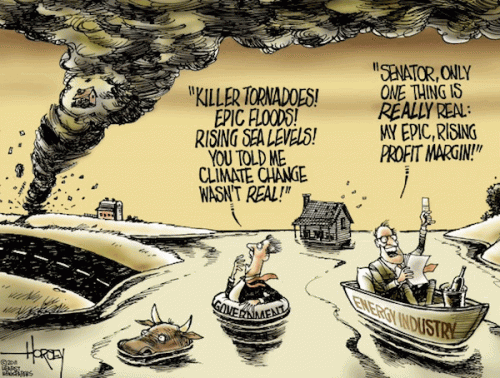
Oil Companies and Special Interests Spend Half a Billion Dollars to Defeat US Clean Energy – Study

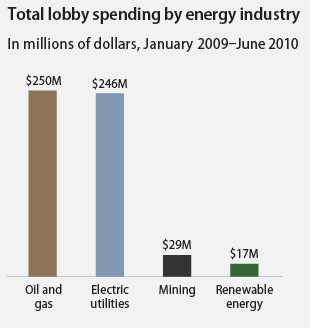
“Big oil companies and other special interests have spent millions of dollars in lobbying and campaign contributions to defeat clean energy and global warming legislation, according to a new analysis released today by the Center for American Progress Action Fund.

The study “Dirty Money” found that the top 35 spending companies and trade associations invested more than $500 million in lobbying and campaign contributions from January 2009 to June 2010 to defeat clean energy legislation. This political pressure spending convinced enough senators to oppose clean energy measures that would have created jobs, reduced oil use, and cut global warming pollution.”

[Source: The Center for American Progress Action Fund is the sister advocacy organization of the Center for American Progress. ]

My Articles on same topic:


Oily Politics of Influence: 3 of 4 oil and gas lobbyists used to work for US govt

Every Day Governments Give an Estimated $2 billion to Oil, Coal & Gas Industry

Fossil Fuel Subsidies Are 12X (more like 20X) Support for Renewables, Study Shows

New $Billion Cash Hand Out To Fossil Fuel Companies Under ‘Green’ Economic Stimulus Plans