Drug Wars Make Societies More Violent Not Safer Studies Show
By Stephen Leahy
UXBRIDGE, Canada, Apr 29, 2010 (IPS)
The war on drugs is a complete failure everywhere, according a comprehensive review of 20 years of scientific literature released at the Harm Reduction 2010 conference in Liverpool, England that wraps up Thursday.
“The war on drugs does not work, period,” said Dr. Julio Montaner, president of the International AIDS Society.
“We must take an evidence-based approach to dealing with the drug market, because current strategies are not working and people are paying for ill-considered policies with their lives,” Montaner said in a release.
An examination of all English-language scientific literature dating back more than 20 years reveals that drug law enforcement dramatically escalates drug-market violence. Contrary to conventional wisdom, a startling 82 percent of the studies found the various wars on drugs in countries and internationally simply increase violence. Continue reading →
Multi-trillion-dollar ecosystem services can boost local economies and quality of life
By Stephen Leahy
UXBRIDGE, Canada, Sep 10, 2010 (IPS)
What do New York City, Vienna, Quito and Rio de Janeiro have in common? They all get their high quality drinking water through aqueducts connected to protected areas in nearby hills and mountains.
Twenty years ago, a rapidly expanding New York City determined it was far cheaper to protect and restore the source of its water supply, the Catskill/Delaware forests and wetlands, than spend six to eight billion dollars on a water treatment plant.
Cities are dependent on nature. There are many examples of how the ecosystem services provided by nature can provide cost-effective solutions for local municipal services, according to a new major study titled “TEEB report for Local and Regional Policy Makers” released Thursday in India, Brazil, Belgium, Japan and South Africa.
However, the study notes that few politicians and public officials realise that factoring in the planet’s multi-trillion-dollar ecosystem services into their policy-making can help save cities and regional authorities’ money while boosting the local economy, enhancing quality of life, securing livelihoods and generating employment.
“All economic activity and most of human well-being whether in an urban or non-urban setting is based on a healthy, functioning environment,” said Pavan Sukhdev, study leader of The Economics of Ecosystems and Biodiversity (TEEB) initiative hosted by the United Nations Environment Programme. Continue reading →
New study from Britain’s Centre for Ecology & Hydrology concludes: Organic agriculture better for fungi that are a key to healthy ecosystems. [press release below]
This is just one of dozens of different studies that demonstrate the benefits of organic over conventional as I’ve previously posted. Despite the benefits to society organic farmers receive little government support or are marginalized in most countries. Wonder why? — Stephen
Farming practices have a significant impact on the diversity of beneficial microbial fungi known to play important roles in crop productivity, soil recovery and maintenance of healthy ecosystems, according to new research published today (14 September 2010) in the journal Environmental Microbiology. The conclusions could have important implications for the way humans manage the agricultural landscape and tackle food security issues. Continue reading →
So big green thumbs up to the University of Ottawa and its student federation announcement — Stephen
No More Sales of Bottled Water
Students, faculty, staff and other members of the uOttawa community are encouraged to find alternatives to bottled water, such as filling up cups, glasses and re-usable bottles at the nearest fountain or tap on campus.
Since 2008, the University of Ottawa has invested over $100,000 to revitalize its water fountains. An additional $75,000 will be invested next year.
The improvements include gooseneck fountains for quick and easy filling of re-usable bottles, new fountains near food service outlets, upgrades to existing fountains. The fountains are wheelchair accessible, have increased waster pressure and better refrigeration.
[Updated May 11 2012: At last a serious plan to phase out these subsidies will be on the table at the Rio+20 meet in June. I will be following this closely – with your help – Stephen ]
Experts say the subsidy madness must stop. With unemployment high can governments facing recession summon the will to end the fossil fuel industries’ FREE RIDE?
By Stephen Leahy
BERLIN, Jun 29, 2010 (IPS)
Every day, governments give away an estimated two billion dollars of taxpayer money to the fossil fuel industry. This unmatched largesse to a highly profitable sector by countries verging on bankruptcy or unable to feed large numbers of their own people is “complete madness”, according to many experts.
In Toronto Sunday, at the conclusion of G20 summit, countries agreed the madness must be constrained if not stopped.
“With countries committed to cutting their deficits, it is hard to ignore giving billions of real money away to the fossil fuel industry or to keep fuel prices low,” Halle said in an interview.
The two-billion-dollars-a-day public subsidy for carbon- based fuels is a very conservative estimate based on the extensive research conducted by the IISD’s Global Subsidies Initiative, said Halle. Not only do such huge subsidies undermine policies on energy efficiency, they make it impossible for alternative energy sources to compete, he said. [See also Fossil Fuel Subsidies Are 12X (more like 20X) Support for Renewables, Study Shows — Stephen]
“We can’t make the transition to low-carbon economies nor can the energy playing field be leveled without the elimination of fossil fuels. And time for that has finally come,” he said.
Others are less optimistic given the G8 and G20 track record for broken promises.
“It (the G20 commitment) fell short of vision and courage that is expected from global leaders in the light of the disastrous oil spill” in the Gulf of Mexico, said Darek Urbaniak of Friends of the Earth Europe. Urbaniak noted that BP, the company responsible for the spill, receives British and EU public subsidies.
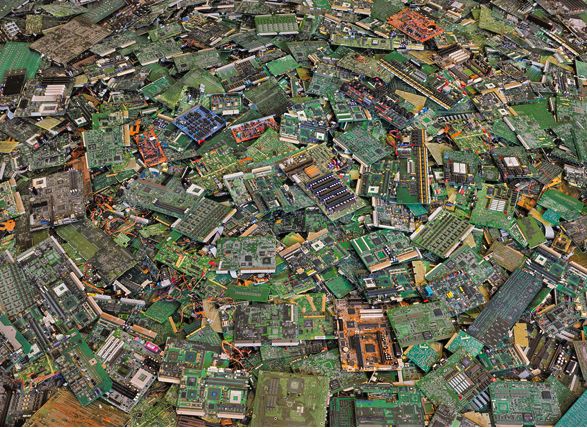
Circuit Boards – Chris Jordan “Intolerable Beauty: Portraits of American Mass Consumption http://www.chrisjordan.com
By Stephen Leahy
BERLIN, Jun 3, 2010 (IPS)
Rising global wealth spells disaster for the planet, with environmental impacts growing roughly 80 percent with a doubling of income, reports the first comprehensive study of consumption.
It adds to the mountain of evidence that the gospel of economic growth must be urgently transformed into the new gospel of resource-efficient green economies, a U.N. expert panel concluded Wednesday.
What are the biggest planetary criminals?
Fossil fuel use and agriculture, the study found. Ironically, these are also the two most heavily subsidised sectors, noted Ernst von Weizsaecker of Norwegian University of Science and Technology, and co-chair of the International Panel for Sustainable Resource Management.
“In the case of CO2, a doubling of wealth typically increases environmental pressure 60 to 80 percent, sometimes more in emerging economies,” von Weizsaecker said in an interview.
Rising affluence has also triggered a shift in diets towards meat and dairy products so that livestock now consumes much of the world’s crops and indirectly consumes 70 percent of the fresh water and produce much of the fertiliser pollution, von Weizsaecker said from Brussels.
“It is clear that a meat-based diet uses more land and fertiliser and emits far more CO2 than a vegetarian diet,” said von Weizsaecker.
The study also found that rich countries like Japan, the United States and many in the European Union are now “exporting” a large part or most of their true environmental impacts to developed countries by importing goods and food from those countries.
In a spiral of destructive co-dependency, China’s rising CO2 emissions and deforestation in Malaysia are in part a direct result of North American and European consumption of the goods made there.
“International trade clearly shows rich countries are outsourcing their impacts,” von Weizsaecker said.
“Given this fact, perhaps the current way of structuring agreements on emission reduction targets is becoming obsolete,” said Ashok Khosla, co-chair of the panel and president of the World Conservation Union (IUCN)
At the household level, it is the goods and services consumed, not the fossil fuel used for cars or homes, that accounts for most of the environmental impacts. This is despite energy and material efficiency gains over the past two decades. Efficiency has improved on a per dollar expenditure basis but people are consuming more, which drowns out any efficiency gains, said panel expert Sangwon Suh of the University of California, Santa Barbara.
“Policy makers cannot just look at direct emissions, they need to look at a full life cycle of their consumption and incorporate those impacts into their decision making,” Suh told IPS.
Representing the world’s foremost experts, the panel synthesised a comprehensive library of the most authoritative global studies to provide science-based assessments of products, materials and economic and lifestyle activities, producing the greatest harm to the planet.
“It is the first global assessment of what kind of consumption activities have the biggest impacts,” Suh said.
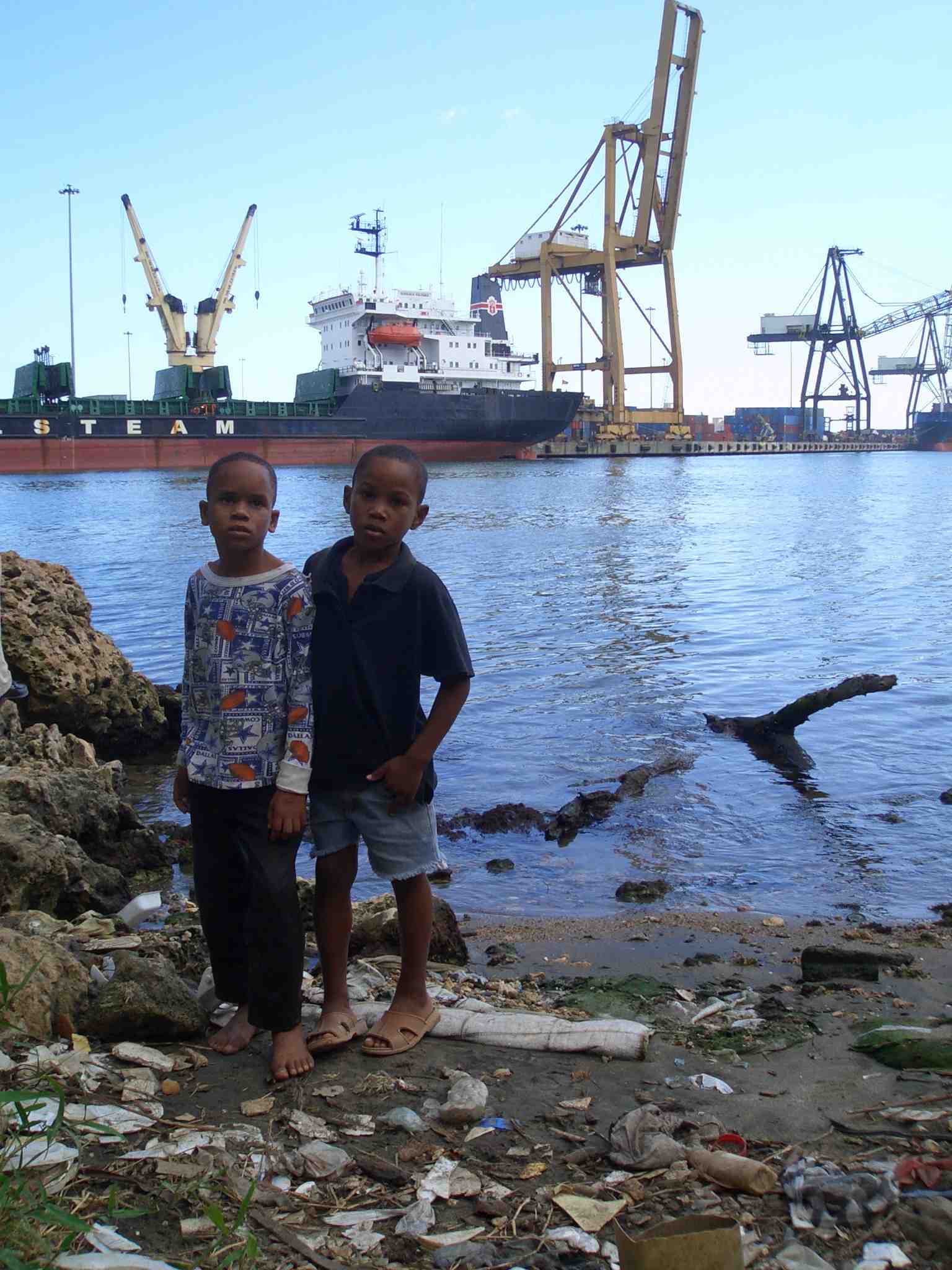
Children poisoned by lead from battery waste in Dominican Republic
Fossil fuel use and agriculture topped the list in the149-page report, followed by the heavily subsidised industrial fishing industry and the production and consumption of materials like metals and plastics. While the latter do cause severe damage locally all over the world, shockingly these are not that significant compared to global impacts of fossil fuel and agriculture, the report noted.
The purpose of this U.N. Environment Programme-sponsored study was to identify the “hot spots” in terms of environmental impacts so that policy makers can use this information to reform policies, said Suh.
“Setting priorities would seem prudent and sensible in order to fast track a low-carbon, resource-efficient green economy,” said Achim Steiner, UNEP’s executive director, which hosted the panel.
“Decoupling growth from environmental degradation is the number one challenge facing governments,” Steiner said in a statement.
However, this decoupling is not happening, the report shows. And it will not happen in the future without strong policy interventions, said von Weizsaecker.
Policy makers and economists will need to abandon their obsession with economic growth as the solution to all problems, writes Clive Hamilton in a new book “Requiem for a Species”. Growth has become a powerful symbol of success and modernity even though in reality it is neither, says Hamilton, a writer and academic at the Australian National University.
If someone is murdered, it adds about one million dollars to the GDP of rich countries when costs of police, courts, and prisons are factored in, according to his research.
“Murder is good for the economy. So is environmental destruction,” he writes.
It will take extraordinary leadership to reverse the consumption-driven society where children are bombarded with advertising – 17 billion dollars annually in the U.S. alone, Hamilton notes.
The same over-consumption brainwashing is well underway in the developing world. Shopping has become a form of recreation amongst China’s growing middle class and wealthy elite, who bought more than 12 percent of the world’s luxury goods in 2005, second only to the U.S., he says.
“Faced with the scale of the challenge, far more transformational measures need to be taken. Currently, we are fiddling – or fiddling around the edges – while Rome burns,” said Khosla.
60 percent of children — as many as 20,000 — displaced by Hurricane Katrina 5 years ago either have serious emotional disorders, behavioral issues or are experiencing significant housing instability according to new report.
Five years ago Hurricane Katrina and the flooding of New Orleans caused the evacuation of 1.5 million Gulf Coast residents. After a year, 500,000 people remained displaced, many residing in highly transitional shelters, including the notorious FEMA trailer parks. Now at the five-year mark, substantial consequences from this prolonged displacement have resulted in widespread mental health issues in children living in the region, according to a new study by the National Center for Disaster Preparedness (NCDP).
Economic experts consistently underestimate the real and long term impacts of weather disasters that are worsening and become more frequent due to climate change. We have yet to really comprehend those impacts and dangerously underestimate the real costs of climatic change. — Stephen
The enormous fossil fuel subsidies are rarely acknowledged when complaints are raised about costs of renewable energy. This report shown below says subsidies for fossil fuel are 12X that for green energy but this is a gross underestimate based on the experts I’ve interviewed in June for this article Free Ride for Oil and Coal Industry May Be Over.
Subsidies experts in Switzerland told me that “two-billion-dollars-a-day public subsidy for carbon-based fuels is a very conservative estimate..”
In reality big oil and coal get more like 20X the money green energy. So let’s do some real pricing: electricity from coal 5 cents kWh X 20 for subsidies (not to mention free use of the atmosphere /environment for its CO2, mercury etc waste products.) Corporate welfare at its best.
Wind 5-6 cents kWh; Solar 10-15 cents kWh…
Fossil energy continues to get NEW subsidies seeNew $Billion Cash Hand Out To Fossil Fuel Companies Under ‘Green’ Economic Stimulus Plans.
— Stephen
Global subsidies for fossil fuels dwarf support given to renewable energy sources such as wind and solar power and biofuels, Bloomberg New Energy Finance said.
Governments last year gave $43 billion to $46 billion of support to renewable energy through tax credits, guaranteed electricity prices known as feed-in tariffs and alternative energy credits, the London-based research group said today in a statement. That compares with the $557 billion that the International Energy Agency last month said was spent to subsidize fossil fuels in 2008.
“One of the reasons the clean energy sector is starved of funding is because mainstream investors worry that renewable energy only works with direct government support,” said Michael Liebreich, chief executive of New Energy Finance. “This analysis shows that the global direct subsidy for fossil fuels is around ten times the subsidy for renewables.”
A billion people go hungry every day, food prices have climbed 30 to 40 percent, climate change is reducing agricultural production – and for the past two decades, the world has slashed investments in publicly-funded agriculture until it is a pittance in most countries.
“Moral outrage is needed. We must abolish this… It can be done. It must be done,”Ismail Serageldin Website, Egypt and a former World Bank economist, told nearly 700 World Food Prize laureates, ministers, scientists and a few representatives from development and farmer organisations at the first Global Conference on Agricultural Research for Development (GCARD) last month here in southern France.
“This is the launching pad to transform hunger in our time,” Serageldin concluded.
The “rocket” on the launching pad is a major transformation of the 500 million dollars of public funds for international agricultural research carried out by the Consultative Group on International Agricultural Research (CGIAR), an alliance comprising some 8,000 researchers in 100 countries.
For the past year, a global consultation process involving over 2,000 stakeholders from 200 countries has produced a draft plan for reform that promises to meet the needs of the world’s 500 million poor small farmers who feed the two billion poorest people.
Called ambitious and far-reaching by proponents, the “Montpellier Road Map” sets the priorities for “linking science and innovation to the needs of farmers and the rural poor”.
Critics say it resembles little more than a passionate shuffling of the status quo. As the French say like to say: “Plus ça change; plus c’est la même chose” (the more things change, the more they stay the same). Continue reading →
Costs of nuclear skyrocket while costs of renewables falling quickly say energy experts
BERLIN, Jul 31, 2009 (IPS)
Why is nuclear energy back on the table?
One reason is a powerful U.S. lobby where 14 energy companies spent 48 million dollars in 2007 alone to convince American politicians to give the industry huge loan guarantees because they cannot get financing anywhere else, says Ellen Vancko, a nuclear energy analyst at the Union of Concerned Scientists, a U.S.-based non governmental organisation (NGO).
This lavish lobbying effort by the energy and nuclear power sector has been ongoing since the mid-1990s, according to the Center for Responsive Politics, a U.S. NGO and now totals at least 953 million dollars.
Even more has been spent to convince the public that nuclear is one of the keys to energy security so that there is significant public support for new reactors, a Gallup Environment Poll reported this year.
“There are lots of senators and members of congress talking about nuclear as a clean, renewable energy resource,” Vancko says.



 No More Sales of Bottled Water





 Stephen Leahy, International Environmental Journalist