Drought and New Deserts by 2060: Most of Mexico, Central America and half of US

Projected drought and dry regions in 2060-2069

By Stephen Leahy

UXBRIDGE, Canada, May 22, 2012 (Tierramérica)

Mexico and Central America look like they are covered in dried blood on maps projecting future soil moisture conditions.

The results from 19 different state-of-the-art climate models project extreme and persistent drought conditions (colored dark red-brown on the maps) for almost all of Mexico, the midwestern United States and most of Central America.

If climate change pushes the global average temperature to 2.5 degrees Celsius above pre-industrial era levels, as many experts now expect, these regions will be under severe and permanent drought conditions.

Future conditions are projected to be worse than Mexico’s current drought or the U.S. Dust Bowl era of the 1930s that forced hundreds of thousands of people to migrate.

These are some of the conclusions of the study “Projections of Future Drought in the Continental United States and Mexico”, which was published in the December 2011 issue of the American Meteorological Society’s Journal of Hydrometeorology and has gone largely unnoticed.

“Drought conditions will prevail no matter what precipitation rates are in the future,” said co-author Michael Wehner, a climate scientist at the Lawrence Berkeley National Laboratory, a U.S. government research centre in California.
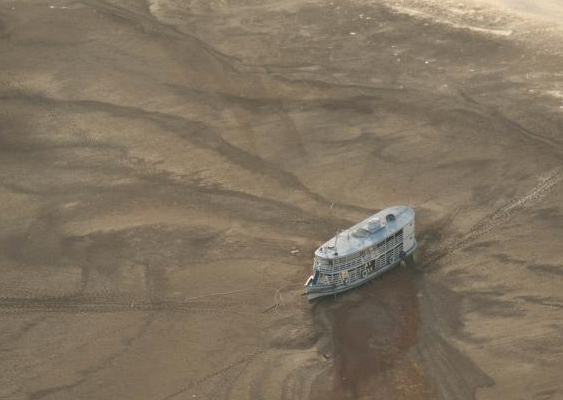
“Even in regions where rainfall increases, the soils will get drier. This is a very robust finding,” Wehner told Tierramérica.

Without major reductions in carbon emissions from the burning of fossil fuels, global temperatures will increase to at least 2.5 degrees of warming between 2050 and 2090, depending on rates of emissions of greenhouse gases, climate sensitivity and feedbacks. Continue reading

From Sandy: ‘Saddened by Damages; Surprised You are Shocked’

I am saddened by the damage and loss of life but am truly surprised you are so shocked by the extent and severity.

Haven’t you noticed hurricanes, cyclones and other storms have become more powerful in recent years?  And that extreme weather events like record flooding, droughts and heat waves are happening more frequently? In 2012 extreme weather records were broken all over the US. In 2011 there were 14 separate billion-dollar-plus weather disasters in the US including flooding, hurricanes and tornados.

Read full post at Hurricane Sandy Speaks (crosspost)

Sandy: Don’t Curse Me, I Have Been Pumped Full of Fossil-fuel Steroids

There are estimates that I might cause $20 billion in damages in the US in addition to the $2+ billion in costs in the Caribbean. That’s a lot of money — enough to give every human on the planet $3. But it is only a fraction of the $600 billion the oil and gas industry is spending this year alone [2012 Harvard study, pg 8] in exploration and new production. That $600 billion investment in fossil fuels will bring far greater storms than I.

Read full post at Hurricane Sandy Speaks (crosspost)

Sandy: We are the Anthrostorms of the 21st century

Earlier I called myself a hybrid storm: part nature, part human. That’s not quite right. Humans and Hurricanes are part of nature. We both thrive on this planet thanks to sunlight, water and carbon dioxide (CO2). Hurricanes and tropical storms have been around for millions of years. In the last 50 years things have changed. The oceans are warmer. This week the waters off the US east coast were 3 degrees C warmer than normal.

Read full post at Hurricane Sandy Speaks (crosspost)

Hurricane Sandy Speaks: Don’t Forget Haiti, Cuba, Bahamas, Puerto Rico, Dominican Republic and Jamaica

Hard to believe I was born only a week ago south of Jamaica. I grew very quickly over the hot Carribbean sea and last Wednesday swept into Jamaica west of Kingston with winds of 130 kph. Damage was extensive cutting power to half the country. One person died.

Read full post at Hurricane Sandy Speaks (crosspost)

Hurricane Sandy Speaks: Storm Surge Flooding Warning: “I have too much energy”

I’m sorry to say that I have so much wind energy from the warm ocean water I am pushing the sea into your living rooms along the mid-Atlantic coast. The ocean is like a bowl full of water, blow hard enough on an angle and it will readily spill over.

Read full post at Hurricane Sandy Speaks (crosspost)

Sandy Says: Not “Targeting” New York or Anywhere Else

To be absolutely clear: I am not “targeting” New York City or anywhere else. I am pushed and pulled by temperature and pressure differences. My winds are powered by warm water and moisture. And there is enough heat and moisture for my winds to make 12-foot high waves over a 3 million sq km area – one third the size of the US.

Read full post at Hurricane Sandy Speaks (crosspost)

Historic SuperStorm Sandy Heading for New York City

Sandy here again. Early this morning I turned north-northwest and am about 500 km (300 mi) southeast of New York City. I am probably the largest storm on record, spanning 3,200 km (2000 mi). I wanted to stay out at sea but a massive band of cold air and low pressure over the Great Lakes region has pulled me in this direction. The coming collision between very cold and moist, warm air will make me more powerful and dangerous: a historic SuperStorm.

Read full post at Hurricane Sandy Speaks (crosspost)

Hothouse Needed for Green Energy, Green Ideas Revolution

Concentrated Solar Power plant of Ain Beni Mathar, Morocco is a first in the world.

Countries cannot afford to miss the green wave of Rio+20

No alternative to low-carbon, resource-efficient economies

By Stephen Leahy

UXBRIDGE, Canada, May 25, 2012 (IPS)

Think of Rio+20 as the hothouse to grow the green ideas and values humanity needs to thrive in the 21st century.

No one is expecting, or even wants, a big new international treaty on sustainable development said Manish Bapna, interim president of the World Resources Institute, a global environmental think tank based in Washington, D.C.

“The important action will be on the sidelines of the formal negotiations,” Bapna told IPS in an interview.

Blocs of countries, civil society organisations and representatives of business will meet, create coalitions and make commitments on specific issues and on regional concerns.

“There could be some exciting specific commitments coming out of Rio,” Bapna said.

Perhaps the most important outcome from Rio+20 would be to put to rest the erroneous belief that protecting the environment comes at the cost of economic growth when it is in fact the opposite. Without a healthy, functioning environment, humanity loses the benefits of the environment’s “free products”: air, water, soil to grow food, stable climate and so on.

“One of the big hurdles to a sustainable future is that officials in many countries think they can’t afford to move onto a more sustainable pathway,” he said.

Bapna hopes Rio+20 will generate a “new narrative” – a wider understanding that there is no viable alternative to the transition to low-carbon, resource-efficient economies that alleviate poverty and create more jobs. Continue reading

Hurricane Sandy Speaks: “People call me Frankenstorm, SuperStorm, WeatherBomb…”

Hi, this is Sandy. People are calling me ‘Frankenstorm’, ‘Superstorm’ and even ‘Weatherbomb’.

I don’t mean to hurt anyone but the record moisture in the atmosphere and heat in the ocean has given me uncontrollable power. I probably will cause billions of dollars of damage in Washington, New York City Boston and other parts of the Northeast. And I will kill some people, I already have. At least 66 people died when I swept through Jamaica and Cuba a few days ago.

I am a force of nature but you have to understand this is not all my fault.

Read full post at Hurricane Sandy Speaks (crosspost)