Millions of trees, especially from the developing countries of the South, are being shipped to Europe and burned in giant furnaces to meet “green energy” requirements that are supposed to combat climate change.
In the last two months alone, energy companies in Britain have announced the construction of at least six new biomass power generation plants to produce 1,200 megawatts of energy, primarily from burning woodchips.
At least another 1,200 megawatts of wood-fired energy plants, including the world’s largest, in Port Talbot, Wales, are already under construction.
Those energy plants will burn 20 to 30 million tonnes of wood annually, nearly all imported from other regions and equivalent to at least one million hectares of forest.
“Europe is going to cook the world’s tropical forests to fight climate change; it’s crazy,”Simone Lovera, of the non-governmental Global Forest Coalition, which has a southern officed in Asunción, Paraguay, told Tierramérica.
Europe has committed to reducing its carbon emissions 20 percent by 2020 in an effort to fight climate change. Biofuels and biomass energy will have key roles in achieving those goals, experts say.
[UPDATE: New story details regarding subsidies, increased air pollution from wood burning and the big lie that says ‘burning wood is carbon-neutral’: see Europe’s Green Energy Portfolio Up in Smoke?]
“Biomass is a very promising sector for energy companies,” says Jarret Adams, a spokesperson for Adage, a joint venture between French nuclear power giant Areva and the U.S.-based Duke Energy.
Adage is building a 50-megawatt, wood-burning power plant in the southeastern U.S. state of Florida, the first of 12 such “green energy” plants to be built over the next six years, Adams told Tierramérica.
“Burning wood for energy is considered carbon neutral by U.S. federal and state authorities,” he said. In other words, the process of generating electricity by burning wood emits an equal or lesser amount of carbon dioxide than the quantity absorbed by the trees through photosynthesis.
When Tierramérica questioned the assumption of carbon neutrality, Adams replied, “It is, but who knows for certain?”
[Updated May 11 2012: At last a serious plan to phase out these subsidies will be on the table at the Rio+20 meet in June. I will be following this closely – with your help – Stephen ]
Experts say the subsidy madness must stop. With unemployment high can governments facing recession summon the will to end the fossil fuel industries’ FREE RIDE?
By Stephen Leahy
BERLIN, Jun 29, 2010 (IPS)
Every day, governments give away an estimated two billion dollars of taxpayer money to the fossil fuel industry. This unmatched largesse to a highly profitable sector by countries verging on bankruptcy or unable to feed large numbers of their own people is “complete madness”, according to many experts.
In Toronto Sunday, at the conclusion of G20 summit, countries agreed the madness must be constrained if not stopped.
“With countries committed to cutting their deficits, it is hard to ignore giving billions of real money away to the fossil fuel industry or to keep fuel prices low,” Halle said in an interview.
The two-billion-dollars-a-day public subsidy for carbon- based fuels is a very conservative estimate based on the extensive research conducted by the IISD’s Global Subsidies Initiative, said Halle. Not only do such huge subsidies undermine policies on energy efficiency, they make it impossible for alternative energy sources to compete, he said. [See also Fossil Fuel Subsidies Are 12X (more like 20X) Support for Renewables, Study Shows — Stephen]
“We can’t make the transition to low-carbon economies nor can the energy playing field be leveled without the elimination of fossil fuels. And time for that has finally come,” he said.
Others are less optimistic given the G8 and G20 track record for broken promises.
“It (the G20 commitment) fell short of vision and courage that is expected from global leaders in the light of the disastrous oil spill” in the Gulf of Mexico, said Darek Urbaniak of Friends of the Earth Europe. Urbaniak noted that BP, the company responsible for the spill, receives British and EU public subsidies.
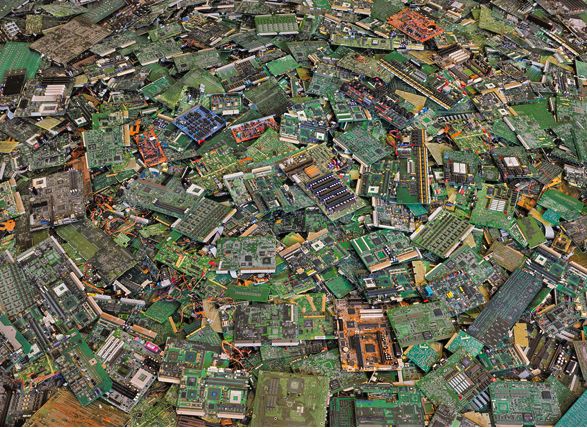
Circuit Boards – Chris Jordan “Intolerable Beauty: Portraits of American Mass Consumption http://www.chrisjordan.com
By Stephen Leahy
BERLIN, Jun 3, 2010 (IPS)
Rising global wealth spells disaster for the planet, with environmental impacts growing roughly 80 percent with a doubling of income, reports the first comprehensive study of consumption.
It adds to the mountain of evidence that the gospel of economic growth must be urgently transformed into the new gospel of resource-efficient green economies, a U.N. expert panel concluded Wednesday.
What are the biggest planetary criminals?
Fossil fuel use and agriculture, the study found. Ironically, these are also the two most heavily subsidised sectors, noted Ernst von Weizsaecker of Norwegian University of Science and Technology, and co-chair of the International Panel for Sustainable Resource Management.
“In the case of CO2, a doubling of wealth typically increases environmental pressure 60 to 80 percent, sometimes more in emerging economies,” von Weizsaecker said in an interview.
Rising affluence has also triggered a shift in diets towards meat and dairy products so that livestock now consumes much of the world’s crops and indirectly consumes 70 percent of the fresh water and produce much of the fertiliser pollution, von Weizsaecker said from Brussels.
“It is clear that a meat-based diet uses more land and fertiliser and emits far more CO2 than a vegetarian diet,” said von Weizsaecker.
The study also found that rich countries like Japan, the United States and many in the European Union are now “exporting” a large part or most of their true environmental impacts to developed countries by importing goods and food from those countries.
In a spiral of destructive co-dependency, China’s rising CO2 emissions and deforestation in Malaysia are in part a direct result of North American and European consumption of the goods made there.
“International trade clearly shows rich countries are outsourcing their impacts,” von Weizsaecker said.
“Given this fact, perhaps the current way of structuring agreements on emission reduction targets is becoming obsolete,” said Ashok Khosla, co-chair of the panel and president of the World Conservation Union (IUCN)
At the household level, it is the goods and services consumed, not the fossil fuel used for cars or homes, that accounts for most of the environmental impacts. This is despite energy and material efficiency gains over the past two decades. Efficiency has improved on a per dollar expenditure basis but people are consuming more, which drowns out any efficiency gains, said panel expert Sangwon Suh of the University of California, Santa Barbara.
“Policy makers cannot just look at direct emissions, they need to look at a full life cycle of their consumption and incorporate those impacts into their decision making,” Suh told IPS.
Representing the world’s foremost experts, the panel synthesised a comprehensive library of the most authoritative global studies to provide science-based assessments of products, materials and economic and lifestyle activities, producing the greatest harm to the planet.
“It is the first global assessment of what kind of consumption activities have the biggest impacts,” Suh said.
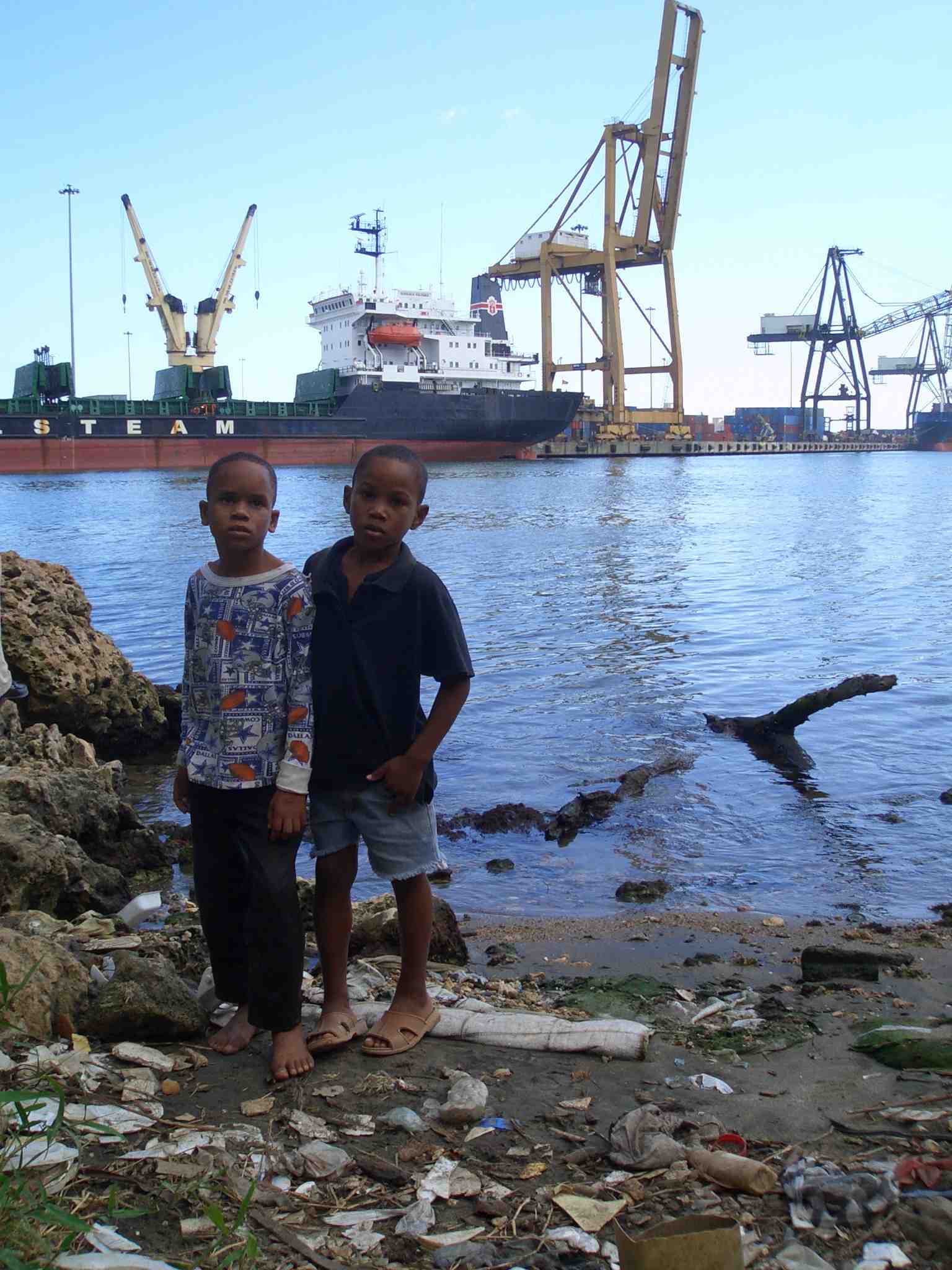
Children poisoned by lead from battery waste in Dominican Republic
Fossil fuel use and agriculture topped the list in the149-page report, followed by the heavily subsidised industrial fishing industry and the production and consumption of materials like metals and plastics. While the latter do cause severe damage locally all over the world, shockingly these are not that significant compared to global impacts of fossil fuel and agriculture, the report noted.
The purpose of this U.N. Environment Programme-sponsored study was to identify the “hot spots” in terms of environmental impacts so that policy makers can use this information to reform policies, said Suh.
“Setting priorities would seem prudent and sensible in order to fast track a low-carbon, resource-efficient green economy,” said Achim Steiner, UNEP’s executive director, which hosted the panel.
“Decoupling growth from environmental degradation is the number one challenge facing governments,” Steiner said in a statement.
However, this decoupling is not happening, the report shows. And it will not happen in the future without strong policy interventions, said von Weizsaecker.
Policy makers and economists will need to abandon their obsession with economic growth as the solution to all problems, writes Clive Hamilton in a new book “Requiem for a Species”. Growth has become a powerful symbol of success and modernity even though in reality it is neither, says Hamilton, a writer and academic at the Australian National University.
If someone is murdered, it adds about one million dollars to the GDP of rich countries when costs of police, courts, and prisons are factored in, according to his research.
“Murder is good for the economy. So is environmental destruction,” he writes.
It will take extraordinary leadership to reverse the consumption-driven society where children are bombarded with advertising – 17 billion dollars annually in the U.S. alone, Hamilton notes.
The same over-consumption brainwashing is well underway in the developing world. Shopping has become a form of recreation amongst China’s growing middle class and wealthy elite, who bought more than 12 percent of the world’s luxury goods in 2005, second only to the U.S., he says.
“Faced with the scale of the challenge, far more transformational measures need to be taken. Currently, we are fiddling – or fiddling around the edges – while Rome burns,” said Khosla.
60 percent of children — as many as 20,000 — displaced by Hurricane Katrina 5 years ago either have serious emotional disorders, behavioral issues or are experiencing significant housing instability according to new report.
Five years ago Hurricane Katrina and the flooding of New Orleans caused the evacuation of 1.5 million Gulf Coast residents. After a year, 500,000 people remained displaced, many residing in highly transitional shelters, including the notorious FEMA trailer parks. Now at the five-year mark, substantial consequences from this prolonged displacement have resulted in widespread mental health issues in children living in the region, according to a new study by the National Center for Disaster Preparedness (NCDP).
Economic experts consistently underestimate the real and long term impacts of weather disasters that are worsening and become more frequent due to climate change. We have yet to really comprehend those impacts and dangerously underestimate the real costs of climatic change. — Stephen
The enormous fossil fuel subsidies are rarely acknowledged when complaints are raised about costs of renewable energy. This report shown below says subsidies for fossil fuel are 12X that for green energy but this is a gross underestimate based on the experts I’ve interviewed in June for this article Free Ride for Oil and Coal Industry May Be Over.
Subsidies experts in Switzerland told me that “two-billion-dollars-a-day public subsidy for carbon-based fuels is a very conservative estimate..”
In reality big oil and coal get more like 20X the money green energy. So let’s do some real pricing: electricity from coal 5 cents kWh X 20 for subsidies (not to mention free use of the atmosphere /environment for its CO2, mercury etc waste products.) Corporate welfare at its best.
Wind 5-6 cents kWh; Solar 10-15 cents kWh…
Fossil energy continues to get NEW subsidies seeNew $Billion Cash Hand Out To Fossil Fuel Companies Under ‘Green’ Economic Stimulus Plans.
— Stephen
Global subsidies for fossil fuels dwarf support given to renewable energy sources such as wind and solar power and biofuels, Bloomberg New Energy Finance said.
Governments last year gave $43 billion to $46 billion of support to renewable energy through tax credits, guaranteed electricity prices known as feed-in tariffs and alternative energy credits, the London-based research group said today in a statement. That compares with the $557 billion that the International Energy Agency last month said was spent to subsidize fossil fuels in 2008.
“One of the reasons the clean energy sector is starved of funding is because mainstream investors worry that renewable energy only works with direct government support,” said Michael Liebreich, chief executive of New Energy Finance. “This analysis shows that the global direct subsidy for fossil fuels is around ten times the subsidy for renewables.”
A wind turbine on an acre of northern Iowa farmland could generate 300,000 dollars worth of greenhouse-gas-free electricity a year. Instead, the U.S. government pays out billions of dollars to subsidise grain for ethanol fuel that has little if any impact on global warming, according to Lester Brown.
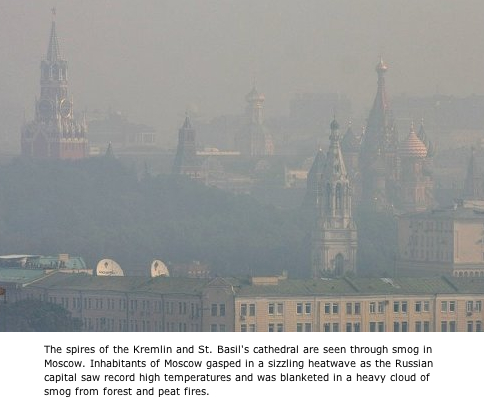
“The smartest thing the U.S. could do is phase out ethanol subsidies,” says Brown, the founder of the Washington-based Earth Policy Institute, in reference to rising food prices resulting from the unprecedented heat wave in western Russia that has decimated crops and killed at least 15,000 people.
“The lesson here is that we must take climate change far more seriously, make major cuts in emissions and fast before climate change is out of control,” Brown, one of the world’s leading experts on agriculture and food, told IPS.
Average temperatures during the month of July were eight degrees Celsius above normal in Moscow, he said, noting that “such a huge increase in temperature over an entire month is just unheard of.”
On Monday, Moscow reached 37 C when the normal temperature for August is 21 C. It was the 28th day in a row that temperatures exceeded 30 C. Continue reading →
The oceans are the lifeblood of our planet and plankton its red blood cells. Those vital “red blood cells” have declined more than 40 percent since 1950 and the rate of decline is increasing due to climate change, scientists reported this week.
“Phytoplankton are a critical part of our planetary life support system. They produce half of the oxygen we breathe, draw down surface CO2, and ultimately support all of our fisheries,” said
Boris Worm of Canadas Dalhousie University and one of the worlds leading experts on the global oceans.
“An ocean with less phytoplankton will function differently,” said Worm, the co-author of a new study on plankton published this week in Nature.Plankton are the equivalent of grass, trees and other plants that make land green, says study co-author Marlon Lewis, an oceanographer at Dalhousie.
“It is frightening to realise we have lost nearly half of the oceans’ green plants,” Lewis told IPS.
“It looks like the rate of decline is increasing,” he said.
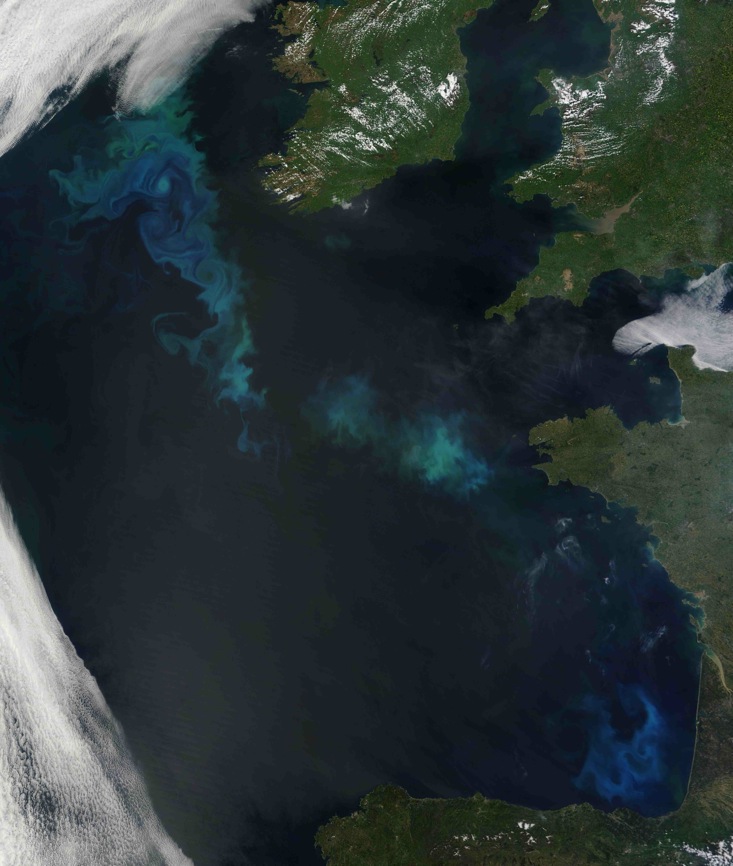
A large phytoplankton bloom in the Northeast Atlantic -NASA Earth Observatory Collection.
Climate change is warming the oceans about 0.2C per decade on average. This warmer water tends to stay on top because it is lighter and essentially sits on top of a layer of colder water. This layering, or stratification, is a problem for light-loving plankton because they can only live in the top 100 to 200 meters.
Eventually they run out of nutrients to feed on unless the cold, deeper waters mix with those near the surface. Ocean stratification has been widely observed in the past decade and is occurring in more and larger areas of the world’s oceans. Continue reading →
Some will say this study is just a wild assumption – that you can’t untangle ‘normal’ droughts from impacts of climate change. First remember climate change is a force multiplier: it makes droughts and floods far worse than normal. And secondly it is pretty obvious that if temps climb much higher in most parts of Mexico there will be major crop failures and then what are people supposed to do? Lay down and die? They are going to move — wouldn’t you? — Stephen
From Sci Am magazine:
A reduction in crop yields could spur even more migration from south to north, a new analysis finds
By David Biello
Climate change’s impacts on crop yields may force as many as seven million Mexicans to emigrate to the U.S. over the next 70 years, according to research published July 26 in the Proceedings of the National Academy of Sciences. The study is among the first to attempt to put hard numbers on questions about “environmental refugees” that may be caused by climate change.
“There is a significant response of emigration from Mexico to past climate variations,” says atmospheric scientist Michael Oppenheimer of Princeton University, an author of the study. “Climate changes predicted by the global circulation models would cause several percent of the Mexican population to move north [if] all other factors are held constant.”
Yet another study that confirms the urgent need to switch to cleaner energy sources for health reasons. Here we have unborn children affected by the air pollution their mothers breathe. Burning fossil fuels releases polycyclic aromatic hydrocarbons (PAHs) which we all breathe in but these chemicals affect the mental development of unborn children. Other new studies show smog causes increases in heart attacks, and reduces blood’s ability to transport oxygen.
So why the high-profile fight over climate change and urgent need to reduce fossil fuel use? Might it happen that fossil energy companies desperate to protect hundreds of billions of dollars of profits, actively encourage (if not directly fund) confusion regarding the inconvenient scientific results on climate and public health? — Stephen
April 2010 — A study by the Columbia Center for Children’s Environmental Health (CCCEH) carried out in Krakow, Poland has found that prenatal exposure to pollutants can adversely affect children’s cognitive development at age 5, confirming previous findings in a New York City (NYC) study.
Researchers report that children exposed to high levels of polycyclic aromatic hydrocarbons (PAHs) in Krakow had a significant reduction in scores on a standardized test of reasoning ability and intelligence at age 5. The study findings are published today online in Environmental Health Perspectives. Continue reading →
Is this why there is no independent assessment of the BP oil well cap and surrounding sea floor?
Three of every four oil and gas lobbyists worked for federal government that’s probably why oil spill liability was capped at a ridiculous $50 million – an amount that wouldn’t cover the cost of a couple of oil spill skimmers.
Three out of every four lobbyists who represent oil and gas companies previously worked in the federal government, a proportion that far exceeds the usual revolving-door standards on Capitol Hill, a Washington Post analysis shows.
Key lobbying hires include 18 former members of Congress and dozens of former presidential appointees. For other senior management positions, the industry employs two former directors of the Minerals Management Service, the since-renamed agency that regulates the industry, and several top officials from the Bush White House. Federal inspectors once assigned to monitor oil drilling in the Gulf of Mexico have landed jobs with the companies they regulated.
Surprise, surprise BP threw even more money — +$1.7 million April to June –– at its lobbyists. And it works. Money unfortunately does buy influence in DC otherwise why aren’t US govt and/or independent science submersibles on the scene of the spill to verify BPs claims??
How could any level of government take the word a polluter that everything is cleaned up without bothering to CHECK to see if it is?
Even worse in my opinion: Why isn’t the media screaming for independent assessment of the leaking well head and surrounding area? (Twenty years ago they would have.)










 Stephen Leahy, International Environmental Journalist