State of Denial: The Real Global Warming Fantasy

What ever happened to common sense?
(based on a true story)

By Stephen Leahy

Two guys were sitting in a bar one evening. The first one says: “Climate change is a complete hoax you know. There’s lots information on the internet proving that.”

“No it’s not” the second guy replies. “I’ve talked to dozens and dozens of climate scientists around the world and read hundreds of reports and studies.”

The first guy responds saying: “All my friends agree with me. This global warming thing was just scam to make money for Al Gore.”

“But I’ve seen the vanishing glaciers, melting Arctic ice, rising temperatures and sea levels and extreme weather events with my own eyes,” says the second.

The first guy, pauses for a few seconds and says: “Well, I guess you’re entitled to your opinion. So let’s just say the jury is still out on global warming.”

The two fall silent for awhile. Finally the second asks: “Let’s say I’m driving you home and it’s foggy out. You tell me to slow down a bit because there’s a sharp curve in the road coming up. Now I’ve never been on this road before and could acknowledge you might know the road well but instead of slowing down I say: ‘you’re entitled to your opinion, but the road looks straight enough to me’ and then step on the gas.”

The first guy gets up and puts on his coat saying: “You’d have to be crazy not to slow down just in case. I don’t think we’re talking about the same thing now.”

“But we are,” says the second as the first guy walks out the door.

Even if the world’s best scientists are wrong about climate change taking action now will create new jobs, save money, clean the air and water, improve energy efficiency, boost the health of our children, reduce our dependency on big oil companies, create more sustainable communities and many more benefits to all.

So you have to wonder why people oppose this.

And should 30 years of climate research done in dozens of countries be correct, the “bonus” in taking action is keeping rising temperatures to no more than 2 degrees C hopefully ensuring our children and grandchildren have a reasonable climate system to live with.

My wish for the new decade is that common sense will come back in fashion.

Related:

Denial & Delay: Global Warming B.S. Detector Tips

Greed Stalls 21st Century Bio-Economy

Interview With One of the Last Environmental Journalists Left Standing

Is Privatizing Air & Water Only Way to Save the Planet? — Copenhagen Talks

By Stephen Leahy*

COPENHAGEN, Dec 17 (Tierramérica)

In the last two years, the conclusion among decision-makers has been that the only way to solve the climate crisis is to turn carbon into a commodity and privatise the atmosphere.

Similar market-based solutions will be used to “solve” the growing water crisis, warned experts at the Klimaforum09, a parallel meeting a few kilometres away from the official 15th Conference of Parties (COP15) to the United Nations Framework Convention on Climate Change, held Dec. 7-18 in Copenhagen.

“Corporations do not want regulations and have convinced governments that they can deliver continued economic growth and save the planet,” said Maude Barlow, chair of the Council of Canadians, the largest citizens group in Canada and author of several books about water issues.

“It shows the power of the corporate lobby that nearly everyone, including many big NGOs, all see the market as the solution to climate change,” Barlow told Tierramérica.

Meanwhile, the climate justice movement is fighting against carbon trading and carbon offsets and advocating for real emissions cuts, while recognising that the commons – air and water – are a public trust, she said

See No Water in Copenhagen Talks

Learn About Community Supported Journalism

Canada’s “Mordor” Ensures Climate Treaty Failure in Copenhagen

[Hello from snowy and cold Copenhagen. Tensions have ramped up as political leaders arrived but are mainly meeting in secret.

Ashamed to say Canada is a widely acknowledged as a public embarrassment here. And called a climate criminal by some. Several protests like the one I covered below and a smaller one earlier have focused on the Athabasca Tar Sands perhaps the world’s biggest source of carbon emissions.

Outside the artificial reality of the Bella Center ordinary people get it. Here is good video summary of what happened on Wed as civil society were gradually banned from the conference. It accords with my son’s version who was in the middle of all this as an observer. — Steve]


By Stephen Leahy

COPENHAGEN (IPS/TerraViva) Dec 14 2009

Climate activists jammed a small square near the police-barricaded Canadian Embassy here Monday for the second day of protests over the country’s tar sands development.

Simultaneous protests were held at the Canadian Embassy in London because British oil companies and financial institutions are deeply invested in the Canadian mega-project.

“As indigenous people, we are here at the international climate negotiations to speak about threats to our cultural survival and the direct life-threatening impacts of climate change in our communities,” said Clayton Thomas Muller, tar sands campaigner for the Indigenous Environmental Network.

“Canada has been blocking the climate negotiations and hasn’t kept Kyoto commitments…because of the tar sands,” he told a crowd of 75 to 100 people surrounded by four squads of riot police.

Boreal forests and wetlands the size of Greece are been destroyed in northern Alberta in an industrial project that turns millions of tonnes of sand and earth into oil, mainly for the U.S. market he said.

“All the efforts by Canadians to reduce their carbon emissions are undone by the tar sands,” said Canadian writer and activist Naomi Klein.

The tar sands are Canada’s largest single source of carbon dioxide (CO2) emissions and the major reason why Canada has refused to live up to its commitments to reduce emissions and is blocking negotiations, Klein told protesters.

“Canada is making a mockery of international law and of developing countries’ need for urgent emission reductions in rich countries,” she said.

Canadian Prime Minister Stephen Harper is here at the Dec. 7-18 U.N.-sponsored climate summit under false pretences, Klein charged.

Harper does not have the Canadian people’s permission to promote the tar sands or to favour Canadian interests over those of the planet,” she said.

The tar sands are “Canada’s Mordor”, said Maude Barlow, head of the Council of Canadians, the largest citizens’ group in Canada. She was referring to the devastated land of rock and fire in the “Lord of the Rings” trilogy.

“What else can you call a project that leaks 11 million litres of toxic waste a day into rivers and groundwater?” Barlow said in this very un-Mordor upscale shopping district of downtown Copenhagen.

The tar sands project has the largest toxic waste containment ponds on the planet – easily visible from space. Last week, a report revealed the extent of the leaks to be an estimated 11 million litres a day.

Shockingly, this is based on the oil companies’ own self-reported data, says Environmental Defence, the Canadian advocacy, research and education group that compiled the report.

It calculated that four billion litres of leakage a year will grow to 25 billion in a decade based on current growth of the tar sands and aging of the enormous dams that hold back the waste.

“There is no question Harper will stand up for  the oil sector [in the climate talks here],” Barlow said.

Their [oil industry] footprints are all over this negotiation and that is why it will fail.”

-30-

Corrected 2/2/12

For more on the Tar Sands see:

Oil Stains in the Boreal Forest: The Environmental Cost of Canada’s Oil Sands – Revised V2.1Oil Stains in the Boreal Forest: The Environmental Cost of Canada’s Oil Sands – Revised V2.1

+4 Degrees C By 2060? Alarming But Not Alarmist

07_00_01_News_Panonoramica

By Stephen Leahy

UXBRIDGE, Canada, Oct 9, 2009 (IPS)

The prospect of a four-degree Celsius rise in global average temperatures in 50 years is alarming – but not alarmist, climate scientists now believe.

Eighteen months ago, no one dared imagine humanity pushing the climate beyond an additional two degrees C of heating, but rising carbon emissions and inability to agree on cuts has meant science must now consider the previously unthinkable.

“Two degrees C is already gone as a target,” said Chris West of the University of Oxford’s UK Climate Impacts Programme.

“Four degrees C is definitely possible…This is the biggest challenge in our history,” West told participants at the “4 Degrees and Beyond, International Climate Science Conference” at the University of Oxford last DeadTrees CO2 release naturalweek.

A four-degree C overall increase means a world where temperatures will be two degrees warmer in some places, 12 degrees and more in others, making them uninhabitable.

It is a world with a one- to two-metre sea level rise by 2100, leaving hundreds of millions homeless. This will head to 12 metres in the coming centuries as the Greenland and Western Antarctic ice sheets melt, according to papers presented at the conference in Oxford.

Four degrees of warming would be hotter than any time in the last 30 million years, and it could happen as soon as 2060 to 2070.

“Political reality must be grounded in physical reality or it’s completely useless,” John Schellnhuber, director of the Potsdam Institute for Climate Impact Research, told the conference.

Schellnhuber recently briefed U.S. officials from the Barack Obama administration, but he says they chided him that his findings were “not grounded in political reality” and that “the [U.S.] Senate will never agree to this”.

He had told them that the U.S. must reduce its emissions from its current 20 tonnes of carbon per person average to zero tonnes per person by 2020 to have an even chance of stabilising the climate around two degrees C.

China’s emissions must peak by 2020 and then go to zero by 2035 based on the current science, he added.

“Policymakers who agreed to a two-degree C goal at the G20 summit easily fool themselves about what emission cuts are needed,” Schellnhuber said.

Even with a two-degree rise, most of the world’s coral reefs will be lost, large portions of the ocean will become dead zones, mountain glaciers will largely vanish and many other ecosystems will be at risk, Schellnhuber warned. And there is the risk of reaching a tipping point where the warming rapidly accelerates. Continue reading

Lavish US Lobbying Pushes Nuclear Energy — Taxpayers on the hook for 360 billion to 1.6 trillion dollars (again)

windmill winter poniesBy Stephen Leahy*

BERLIN, Jul 31 (IPS)

Climate change and the resulting need for low-carbon energy sources is driving the current interest in nuclear energy despite the industry’s near universal legacy of staggering cost-overruns, technical difficulties and dependence on enormous government subsidies.

Government interest in new nuclear energy plants seems far more political than practical or economic in light of the fact that Europe’s latest nuclear plant under construction in Finland is four years behind schedule and 50 to 70 percent over budget.

Any claims that nuclear is a viable low-carbon or clean energy source are negated by its extraordinary costs that have increased at least five-fold in the past decade.

Nuclear energy has always been heavily subsidised by governments around the world,” Ellen Vancko, a nuclear energy analyst at the Union of Concerned Scientists, a U.S.-based non governmental organisation.

Under proposed U.S. legislation to reduce greenhouse gas emissions (Waxman-Markey Energy Bill), billions more dollars are headed the nuclear industry’s way in the form of research and development funding, production tax credits, and 20 billion dollars in loan guarantees.

Added to that a major push by some politicians in the U.S. Senate to dramatically expand government-backed loan guarantees to subsidise the construction of 100 new nuclear plants in the U.S. over the next 20 years, Vancko told IPS.

“The U.S. taxpayer could be on the hook for 360 billion to 1.6 trillion dollars. This potentially is as large or larger than the U.S. financial crisis,” she says. Continue reading

“Europe is going to cook the world’s tropical forests to fight climate change; it’s crazy,” — Millions of Trees Burned for ‘Green Energy’

forest fire

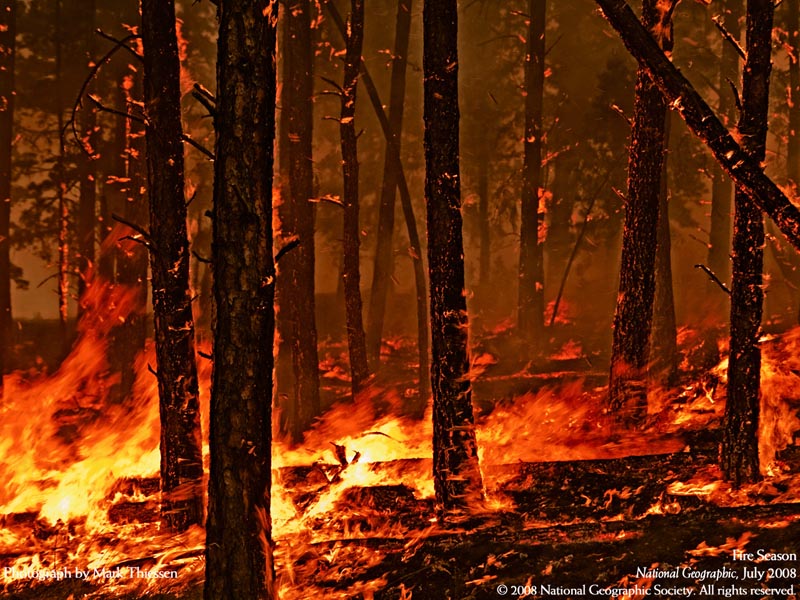
Burning trees for energy produces 1.5 times as much carbon as coal – study shows

By Stephen Leahy*

UXBRIDGE, Canada, Sep 24 ’09 (Tierramérica)

Millions of trees, especially from the developing countries of the South, are being shipped to Europe and burned in giant furnaces to meet “green energy” requirements that are supposed to combat climate change.

In the last two months alone, energy companies in Britain have announced the construction of at least six new biomass power generation plants to produce 1,200 megawatts of energy, primarily from burning woodchips.

At least another 1,200 megawatts of wood-fired energy plants, including the world’s largest, in Port Talbot, Wales, are already under construction.

Those energy plants will burn 20 to 30 million tonnes of wood annually, nearly all imported from other regions and equivalent to at least one million hectares of forest.

“Europe is going to cook the world’s tropical forests to fight climate change; it’s crazy,” Simone Lovera, of the non-governmental Global Forest Coalition, which has a southern office in Asunción, Paraguay, told Tierramérica.

This independent environmental journalism depends on public support. Click here learn more.

Europe has committed to reducing its carbon emissions 20 percent by 2020 in an effort to fight climate change. Biofuels and biomass energy will have key roles in achieving those goals, experts say.

Continue reading

Carbon Emissions Can Be Reduced 80% by 2020 – Lester Brown has a plan and he’s not crazy

LesterBrown smlStephen Leahy interviews LESTER BROWN, founder of the Earth Policy Institute

UXBRIDGE, Canada, Oct 7 2009 (IPS)

Lester Brown says his views sometimes appear extreme – because the mainstream media largely doesn’t understand the urgency and challenges in avoiding catastrophic climate change.

The founder and president of the Washington-based Earth Policy Institute, he is also considered by many to be one of the world’s most influential thinkers.

“It looks like I’m a radical because the mainstream media aren’t reflecting the reality of our situation,” Brown says.

A farmer from the eastern U.S. state of New Jersey, Brown entered the U.S. Civil Service in the 1960s, becoming an expert on foreign agricultural policy before leaving to found the Worldwatch Institute in 1974.

The winner of many awards and honourary degrees, Brown is the author of 50 books. In 2001, he founded the Earth Policy Institute to provide a roadmap for achieving an environmentally sustainable economy.

His most recent book is “Plan B 4.0: Mobilizing to Save Civilization”, the fourth and perhaps most urgent version of the Plan B series, available for download at the institutes’s website. In Plan 4.0, Brown calls for carbon emissions cuts of 80 percent by 2020.

“We cannot afford to let the planet get much hotter,” he explains simply. Continue reading

G8 Failure to Launch on Potential Climate Catastrophe

SN851128.JPG

Analysis by Stephen Leahy

BERLIN, Jul 13 (IPS)

The G8’s failure to make meaningful commitments on climate last week pushes the world ever closer to global climate catastrophe, experts warn. Without commitments to take action, there is little comfort in G8 countries’ agreement to keep overall global warming below 2.0 degrees Celsius.

“If they took the 2.0-degree commitment seriously, it would imply a vigourous and immediate carbon emission reduction programme, said Michael Oppenheimer, a professor of Geosciences and International Affairs at Princeton University in the U.S.

“It would mean carbon emissions would have to peak by 2020 and decline. That’s a tall order but that’s what needs to happen to stabilise at around 2.0 degrees C,” Oppenheimer told IPS.

The Group of Eight of the world’s largest economies comprises Britain, France, Germany, Italy, Russia, Canada, Japan and the United States.

Climate experts stress that 2.0 degrees is not in any way a guarantee of safety. There are already significant impacts currently from climate change. However, from what scientists know today, risks increase markedly over 2.0 degrees of warming, Oppenheimer warned.

Global temperatures have already risen 0.8 C in the last hundred years and will reach 1.2 to 1.5 C based on emissions already in the atmosphere.

“The climate system is unpredictable. Two degrees is just a guideline,” Oppenheimer said. Continue reading

Time Running Out on Vows to Act on Climate Scientists Warn

Alleyway, RLeahy 2007

By Stephen Leahy

COLUMBUS, Ohio, Sep 24 (IPS)

Promises are easy to make.

But promises by world leaders will not halt the heat-trapping carbon emissions that are dialing-up global temperatures and altering the climate, say critics and climate researchers meeting in this U.S. Midwestern city.

As evidenced at the U.N. leader’s summit on climate change in New York Tuesday, the world’s big economies are refusing to commit to actions that will prevent this and future generations from inheriting a hostile climate no other humans have ever faced.

Do we have the social and political will to deal with a problem that we will only see partially in our lifetimes?” wonders Don McConnell, president of Battelle Energy Technology, the world’s largest non-profit research centre.

“What most don’t realise is that the biggest impact from climate change will be shifts in precipitation, not temperature increase,” McConnell told IPS at the McCormick Energy Solutions Conference at Ohio State University this week.

Continue reading

Solar Dreams – To Fly Around the World – Without Fuel By 2012

solar impulse3

By Stephen Leahy*

DÜBENDORF, Switzerland, Sep 16 (Tierramérica)

A solar-powered aircraft will take flight next month from Switzerland with hopes ultimately to circle the Earth in 2012, without fuel, and stopping every five days only to change pilots.

“I’m intrigued by the vision of perpetual flight,” mechanical engineer Andre Borschberg, chief executive of the 100-million-dollar Solar Impulse project, told Tierramérica.

Designed to use only energy from the sun during the day and run on sun-charged batteries at night, it could stay aloft perpetually, like a giant version of the thin-winged Arctic tern that migrates annually from the Antarctic to the Arctic, non-stop.

“The big lesson of the Wright brothers is that if you don’t try you never succeed,” Borschberg told Tierramérica in the Dübendorf Airfield hanger outside of Zurich, where the first prototype was being assembled for a test flight in October or November.

solar impulse2The U.S. inventors Orville and Wilber Wright are credited with the first airplane flight in 1903. “They never dreamed that a plane could cross the Atlantic Ocean, and yet less than 25 years later (in 1927) Charles Lindbergh flew from New York to Paris,” Borschberg said.

“It is our hope that the Solar Impulse will be a symbol to the world and create awareness about our own energy use,” he added.

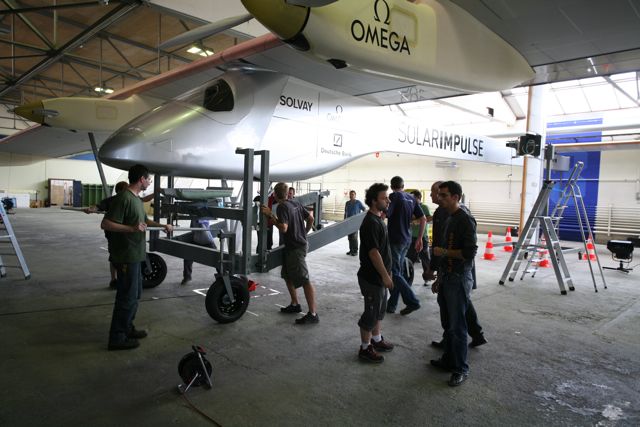
The Solar Impulse HB-SIA prototype plane is essentially a 64-metre long thin wing with four small propellers and narrow pilot pod and tail attached underneath.

Sitting in the airport hangar, even with its inner workings exposed, it doesn’t look like much more than a big paper glider – not much for 100 million dollars. Continue reading