Ethanol and Biofuels: Almost Everything You Need to Know

“The U.S. has led the fight to stem global hunger, now we are creating hunger,” said Lester Brown, president of the Earth Policy Institute.

Series of the latest articles that provide almost everything you need to know about why ethanol and biofuels will not reduce global warming but simply drive up fuel and food costs.

maize - mexicoEthanol Worse Than Gasoline

Only Green Part of Most Biofuels is the Wealth (Subsidies) They Generate

Ethanol: The Great Big Green Fraud

International Enviro Standards Needed for Biofuels

Six Experts On Why Ethanol is a Dumb Idea

Food & Fuel: Can Sorghum Be The New Magic Bullet Biofuel??

Biofuels: Another Good Reason to Hate American Policy

(Cellulosic) Greenest Ethanol Still Unproven

Massive subsidies to oil companies continue – Podcast

redeyePodcast from REDEYE RADIO:

Oil companies are some of the most profitable corporations in the world. Yet they receive between 20 and 40 billion dollars a year in subsidies, according to a report produced for the OECD by Earth Track, an independent energy information research organisation in Boston, Massachusetts.

LORRAINE CHISHOLM interviews Stephen Leahy an environmental journalist who documented these facts in a recent article. Listen to podcast

Read article: ‘Bailout’ for Oil Companies $20-40 Billion (and maybe more) every year

Speaking of subsidies, here’s my articles on ethanol and biofuels :

Quotes From Six Experts On Ethanol

Biofuels: Another Good Reason to Hate American Policy

Ethanol: The Great Big Green Fraud

Record $Financing For Biofuels, Not Food


Do Incinerators Kill Goal of Zero Waste?

zero-waste-conceptby Stephen Leahy

The Uxbridge Cosmos Apr 30 2009

Shawn Williamson took out 2.4 bags of trash last year. Williamson hopes to trim that to 1.6 bags of garbage this year from his family of three living in a typical newer home in nearby Brooklin.

“It’s easy,” says Williamson, a consultant and Director at Durham Sustain Ability, who also uses his home as an office. The secret is buying in bulk and “not buying crap”. The family buys 50lb bags of rice, uses glass jars for storage of other bulk food items and does its own backyard composting. [living zero waste – you tube video]

“It makes more sense to compost food waste in your backyard than transport it all over the Region.”

Uxbridge and Durham Region residents may not realize there is a looming garbage crisis. Virtually all of the Region’s more than 100,000 tonnes of trash goes to Michigan. But those landfills will be closed to Ontario’s garbage in 2010. In response Durham Region Council voted last year to build an estimated $230 million incinerator, or energy-from-waste (EFW) facility in Clarington near Lake Ontario.

“No incinerator is clean. Why let the Region blow toxic smoke into your lungs?” Dr. Sean Godfrey, Chief of Pediatrics, Lakeridge Health Oshawa asked about 80 people attending an information session in Whitby in early April. The event was part of a series of sessions organized by a group of Durham residents called ZeroWaste4ZeroBurning who oppose Durham’s proposed incinerator. Continue reading

Earth’s Arctic Freezer Turning Into Hothouse

meltwater-ponds-on-sea-ice-off-coburg-island-nunavut-canada-arctic-warming-has-been-associated-with-a-rapid-decline-in-arctic-summer-sea-ice-extent-image-credit-sandy-briggs1By Stephen Leahy

UXBRIDGE, Apr 10 (IPS) – The world is losing its northern freezer as Arctic winter ice is in sharp decline, NASA scientists reported this week. Even with below average winter temperatures, Arctic ice is thinner and covers less area than it did a decade ago.

Arctic sea ice is the cooling mechanism for the global climate system. As it declines and the region warms – already three to five degrees Celsius warmer – then inevitably there are local, regional and hemispheric climate impacts.

“We’ve already lost one third of the summer ice cover since the 1980s. There are already impacts from this,” says Ron Kwok of NASA’s Jet Propulsion Laboratory in Pasadena.

“A completely ice-free summer by 2013 is not impossible,” Kwok said in a telephone news conference. “You would have been laughed out the room if you suggested this five years ago.”

The new study shows that the maximum extent of the 2008-2009 winter sea ice cover was the fifth-lowest since researchers began collecting such information 30 years ago. The past six years have produced the six lowest maximums in that record.

More stunning, and indicative of the rapid warming of the region, is the decline in the thick, hard-to-melt multi-year ice, says Walter Meier, research scientist at the National Snow and Ice Data Centre in Boulder, Colorado. Multiyear ice is ice that is two or more years old and therefore doesn’t melt in the summer.

“Less than 10 percent is multiyear now. It used to be 30 percent in 1981,” Meier said at the news conference.

via ENVIRONMENT: Earth’s Arctic Freezer Turning Into Hothouse.

Smart, Realistic Action on Climate Will Bring Long Term Prosperity

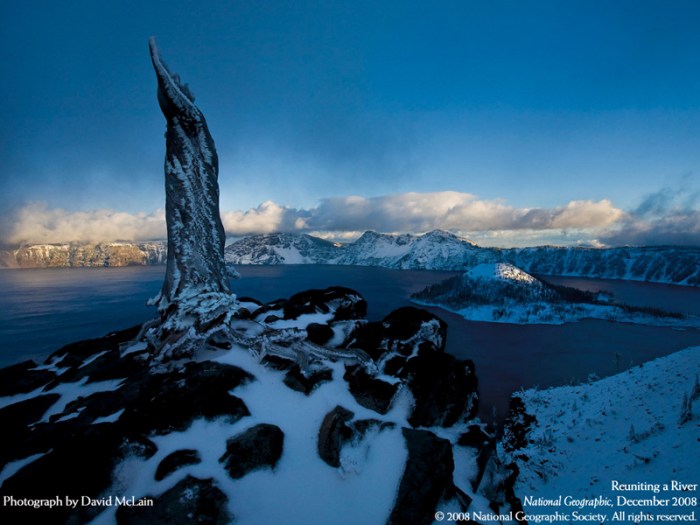
crater-lake-cascade-mtns-nat-geo

By Stephen Leahy

UXBRIDGE, Canada, Mar 16 (IPS) – The high-level scientific climate conference that concluded last week in Copenhagen warned that humanity is rapidly approaching an irreversible, 1,000-year-long climate catastrophe.

The good news is that this dark future has an escape hatch: make major and immediate reductions in carbon emissions.

However, climate change activists worry that instead, trillions of dollars, endless hours of media coverage and all of policy-makers’ attention are being devoted to the economic crisis. That’s a bit like trying to get a clearer channel on the radio as your car is about to slam full speed into a bridge abutment, they say.

And while the current economic crisis affects tens of millions of people, the economic system has long been nothing but a “global Ponzi scheme,” as Paul Reitan, a geologist and climate expert at the University of Buffalo, commented recently.

This system, rooted in the concept of never-ending growth, was always guaranteed to collapse because humanity is living off Earth’s limited capital – natural resources and services provided by healthy ecosystems.

“Let’s be practical, we live on ‘Lifeboat Earth'” and need to base our values, norms and institutions on this reality, asserts Reitan. Continue reading

Canada Refuses to Support Wind Energy

windmill-winter-ponies

First World Wind Energy Conference held in Canada but Federal Government Refuses to Participate

Canada’s federal government refused to participate or support the wind energy conference. It was up to other countries and institutions, including Germany and the United Nations, to provide funding for delegates from the global South to attend.

“I’m embarrassed and ashamed,” Volker Thomsen, one of the chief conference organisers, told delegates at the opening of the meeting.

Governments fail to vigourously switch over to renewables because the way things are works for them, said Scheer. The extremely powerful fossil fuel lobby also wants no changes so they can continue to profit from their investments in the current energy infrastructure. And that’s why letting the conventional power companies, utilities and experts take charge of renewables will lead to very little change, he warns.

Not only is 100 percent renewable energy possible, it can be done much faster and cheaper than building coal or nuclear power plants, said Scheer. Multi-megawatt wind turbine farms and solar arrays can be up in running in 18 months. But when energy is needed, the first thing most governments want to build are big, expensive power plants.

“The public and renewable energy sector must push governments and push them hard to change this,” Scheer stressed.

[Excerpt from my IPS June 25/08 article Failure on Global Warming “Un-American”]

Burning Down Our House

chilee28094the-fury-of-chaiten-volcano-nat-geoAnalysis by Stephen Leahy

QUEBEC CITY, Canada, Dec 15 (IPS)

The roof of our house is on fire while the leaders of our family sit comfortably in the living room below preoccupied with “political realities”.

That was essentially the message from 1,000 scientists from around the world along with northern indigenous leaders gathered in Quebec City for the International Arctic Change conference that concluded last weekend.

“Climate change and its impacts are accelerating at unexpected rates with global consequences,” delegates warned in a statement.

Presenting data from hundreds of studies and research projects detailing the Arctic region’s rapid meltdown and cascading ecological impacts, participants urged governments to take “immediate measures to reduce greenhouse gas emissions”.

By happy coincidence, 190 governments were meeting at the same time in Poznan, Poland to do just that: reach an agreement on how much to reduce emissions from the burning of fossil fuels. Except that they decided to do nothing. Continue reading

Bush’s “Midnight Regs” Chains Obama to Anti-Environmental Course

wed-outdoor-disp-low-res_pa1By Stephen Leahy

UXBRIDGE, Canada, Dec 1 (IPS) – As the world community meets in Poland this week to find solutions to the climate crisis, the George W. Bush White House is chaining the United States’ tiller to prevent a change of course by President-elect Barack Obama by passing new anti-environmental rules and regulations at a furious pace.

Nearly a million hectares of public wildlands in Wyoming and Utah are being opened up to oil shale extraction, the Endangered Species Act is being gutted, as are regulations regarding factory farm operations, the Clean Air Act, and removing mountaintops to dig for coal and more, said a coalition of environmental groups.

“There are many last-minute changes and some are draconian,” said Josh Dorner of the Sierra Club, an environmental NGO. Continue reading

Arctic Is the Canary in the Coalmine

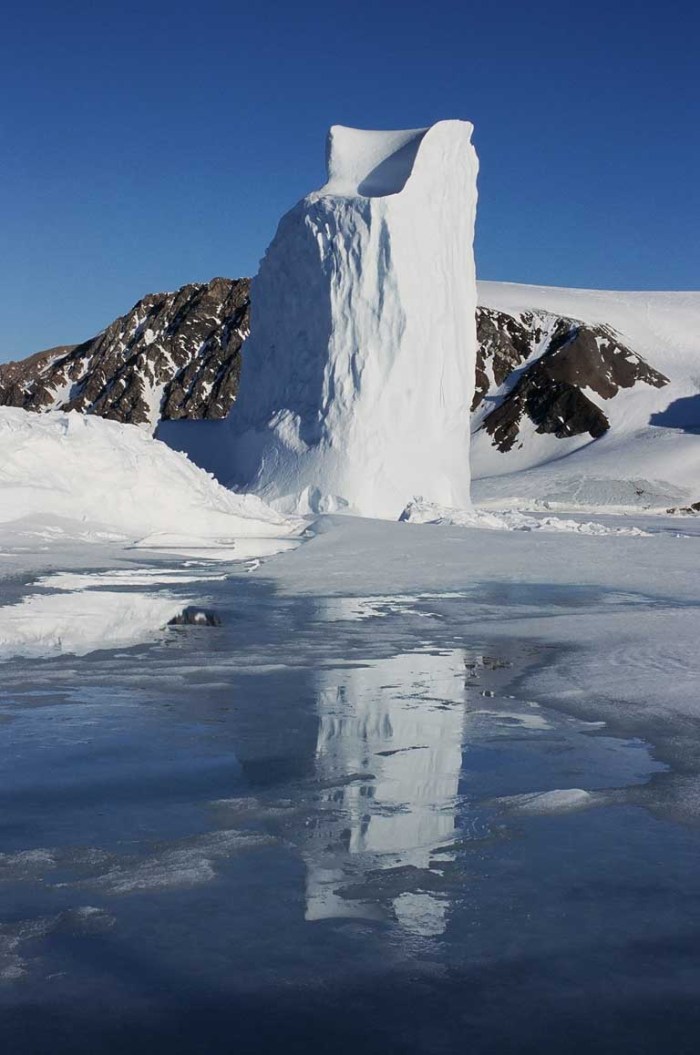
ceberg-in-glacier-strait-nunavut-canada-image-credit-sandy-briggsBy Stephen Leahy

QUEBEC CITY, Canada, Dec 12 (IPS) – Nearly 1,000 scientists and representatives of indigenous peoples from 16 countries have braved a major winter storm to share their findings and concerns about the rapidly warming Arctic region at the International Arctic Change conference in Quebec City.

The Arctic is “ground zero” for climate change, with temperatures rising far faster than anywhere else on the planet. Some predict an ice-free summer Arctic in less than five to 10 years — the first time the Arctic Ocean will be exposed to the sun in many hundreds of thousands of years.

The speed of change has scientists scrambling to understand the impacts on indigenous people, wildlife and ecology.

“The Arctic will be full of future surprises,” said David Carlson, an oceanographer and director of the International Polar Year programme office.

“Protected by its cover of sea ice, the Arctic Ocean is the last unblemished ocean on the planet,” Carlson told IPS.

Continue reading

Oceans Passing Critical CO2 Threshold

a-brittle-stare28094barely-as-big-as-a-nickele28094-crawls-across-the-arm-of-an-18-inch-wide-blue-sea-star-nat-geo

By Stephen Leahy

UXBRIDGE, Canada, Nov 24 (IPS)

An apparent rapid upswing in ocean acidity in recent years is wiping out coastal species like mussels, a new study has found.

“We’re seeing dramatic changes,” said Timothy Wootton of the Department of Ecology and Evolution at the University of Chicago, lead author of the study published Monday in the Proceedings of the National Academy of Sciences. The study shows increases in ocean acidity that are more than 10 times faster than any prediction.

“It appears that we’ve crossed a threshold where the ocean can no longer buffer the effects of CO2 in the atmosphere,” Wootton told IPS.

For millions of years, the levels of carbon dioxide in the atmosphere and the ocean were in balance, but the burning of fossil fuels and deforestation has put more CO2 into the atmosphere over the last 150 years. The oceans have absorbed one-third — about 130 billion tonnes — of those human emissions and have become 30 percent more acidic as the extra CO2 combines with carbonate ions in seawater, forming carbonic acid.

Each day, the oceans absorb 30 million tonnes of CO2, gradually and inevitably increasing their acidity. There is no controversy about this basic chemistry; however, there is disagreement about the rate at which the oceans are becoming acidic and the potential impact. Continue reading