Costs You $50-75 To Drive 100 Km (62 miles) – Don’t Blame Gas Prices

cost_of_vehicle_ownership

Smartest Thing You Can Do Is Dump Your Car

By Stephen Leahy

Uxbridge Cosmos, Feb 2013

Cars and trucks are extraordinarily expensive. The full cost of driving 100 km is between between $50 and $75 when fuel, wear and tear, insurance, depreciation, and repairs are included. The cost of owning and operating a car, van, SUV or truck ranges between $9,000 to $15,000 a year depending on the purchase price of the vehicle according to automobile clubs like the CAA . That’s a big chunk of aftertax income spent each and every year. Double this for two-car families.

If you pay $50 at the pump about $33 will go directly to oil companies. The gas station gets around a dollar and the rest is for provincial and federal taxes.

Finally ask yourself how many hours a day your vehicle isn’t being used? Most are parked 22 hours a day.

Why not give your car a day off once a week? A ‘No Car Day’ is easy to do, saves money and reduces emissions of climate-heating carbon dioxide (CO2). The average passenger vehicle emits around 4.8 tonnes of CO2 a year.

The biggest savings by far is to get rid of one vehicle. When you consider the full costs of ownership, the $9 000 to $15,000 saved will let you rent vehicles or taking taxi as needed with plenty of cash left over. For maximum savings use the bus or train. A bus from Uxbridge is only $10 to downtown Toronto — 75 km one way. Using your car that 75 km trip really costs $45 not including parking.

New study – drive less lose weight guaranteed: If drivers nationwide traveled 1 mile less by car each day, not only would fuel consumption fall, but annual health care costs could drop by billions of dollars as fewer people would be classified as obese or overweight, Jacobson estimates.

My related articles:

EcoMobility Gaining Ground As Cars/Roads Become Too Expensive

Cars Kill More Children Than Malaria — Leading Cause of Death Ages 5 to 14

Lend Your Car, Save, and Save the World

Bike vs Car on a Hot Planet

70% of C02 Emissions from Cities But Fighting to be Climate Leaders

David Cadman and Park Won Soon at the ICLEI World Congress 2015 in Seoul, South Korea

By Stephen Leahy

Report from 2015 World Congress: National Governments Should Be Helping Green Cities  

Cities are responsible for 70 per cent of global CO2 emissions but they can save the planet by greening one community at a time said Vancouver’s David Cadman at the close of the ICLEI World Congress 2015, the triennial sustainability summit of local governments in Seoul, South Korea.

“We can do it. We must do it,” Cadman, the retiring president of Local Governments for Sustainability, told some 1,500 delegates from nearly 1,000 cities and local governments in 96 countries on April 11.

The majority of climate actions and most plans to reduce CO2 emissions are happening at the city level, Cadman told DeSmog Canada in Seoul.

Vancouver and 50 other cities have committed to 100 per cent renewable energy and 500 more are part of ICLEI’s Cities Climate Registry that documents verifiable CO2 emission reduction actions and commitments that amounted to 2.8 billion tons a year in 2014.

Cadman, a former City of Vancouver councillor, has been president of ICLEI since 2006. It’s an international organization headquartered in Bonn, Germany, with 280 staff and 23 other offices scattered around the globe. ICLEI, which stands for International Council for Local Environmental Initiatives, started 25 years ago in Toronto to help cities become more sustainable. It now goes by the more manageable name of “Local Governments for Sustainability,” but still uses the original acronym.

Canada’s federal and provincial governments were very strong supporters in the early days but the past decade has been very different.

Canada Chained to Fossil Fuel Sector

“We seem to be chained to the fossil energy industry in Canada and it’s pulling us down. Cities and organizations can hardly dare to speak out about this now,” he said.

Germany was only too happy to bring ICLEI to Bonn eight years ago and has been generous with its support, along with the European Union. Now the organization is experiencing what is being called an “Asian pivot,” with the mayor of Seoul, Park Won Soon, as the new president.

Park has helped Seoul to become one of the world’s leaders on sustainable development. With 11 million people and growing fast, Seoul will reduce its energy use and increase renewable generation including rolling out 40,000 solar panels to households by 2018 and 15,000 electric vehicles. By 2030, CO2 emissions will be cut 40 per cent.

“Action on climate will be by local governments no matter what national governments decide,” Park Won Soon told DeSmog Canada.

“We need to act quickly, we need to act energetically,” the mayor said.

China’s megacities are also joining ICLEI. At the congress, Hailong Li, deputy secretary general of the China Eco-city Council said the country will have 100 low-carbon eco-cities by 2017. That will drive down the costs of energy efficiency and renewable energy, Li said.

China also intends to become an expert on eco-construction and to market its expertise to the rest of the developing world.

By 2030 another 3.5 billion people will be living in cities so it is absolutely critical that the infrastructure be sustainable said Cadman who will continue to be active as special representative to the new ICLEI President.

“I’m 70 now and need to reduce my workload. My wife says she’d like me to be around a bit longer.”

Canadian cities could also do more and sooner if they had the support of provincial and federal governments, he said. That may be changing at the provincial level with growing support for various forms of carbon taxes that will help generate funds and financial incentives to reduce emissions.

“The provinces are doing the heavy-lifting on climate while the Harper government sits on the sidelines.”

Fossil fuels are in decline — divestment is taking off and investments are shifting to renewable energy. There’ll be no pipelines to the West Coast and no new investments in the oilsands, Cadman said.

Even in B.C., the hoped-for markets for LNG may not exist with China building gas pipelines to tap reserves in Iran and Russia, he said.

“Canada needs to move away from selling raw resources, but is any political party ready to go there?”

“It doesn’t cost the world to save the planet” — Economist

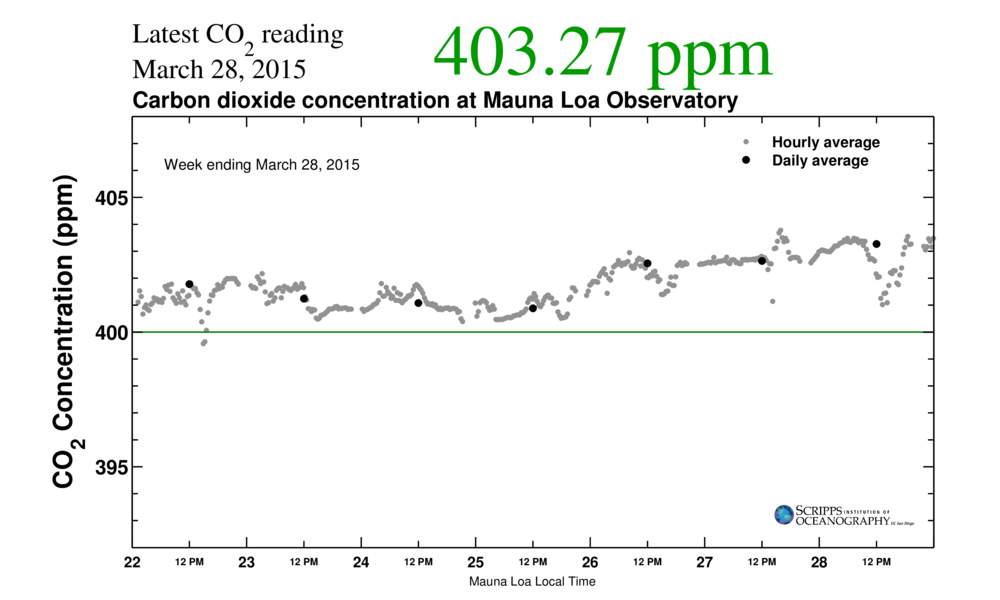
mar 28 2015 mona loa C02 png

UXBRIDGE, Canada, Apr 22 2014 (IPS)

Hopefully, on Earth Day today, high-level ministers from all countries are thinking about what they can bring to the table at a key set of meetings on climate change in early May.

This will be the first opportunity for governments to discuss their proposed climate action plans in light of the final Intergovernmental Panel on Climate Change (IPCC) report released last week.

“There is a clear message from science: To avoid dangerous interference with the climate system, we need to move away from business as usual.” — Professor Ottmar Edenhofer

That report warned that carbon dioxide (CO2) emissions from burning fossil fuels are still rising far too fast, even with more than 650 billion dollars invested in renewable energy in the last three years. However, over the same time period even more money was invested in getting more fossil fuels out of the ground.

The latter investment is keeping humanity and the planet locked onto a devastating path of a global temperature increase of four to five degrees C, the IPCC’s Working Group III report warned.

Scientists and economists say that unlocking ourselves from disaster will require a massive reduction in emissions – between 40 percent and 70 percent – by midcentury. This is can be readily accomplished without inventing any new technology and at a reasonably low cost, reducing global economic growth by a comparatively tiny 0.06 percent.

“It doesn’t cost the world to save the planet,” economist Professor Ottmar Edenhofer, who led the IPCC team, said at a press conference.

It does mean an end to investments in expanding fossil fuel infrastructure as the annual growth in CO2 emissions from burning oil, coal and gas must peak and decline in the next few years. The atmosphere already has 42 percent more CO2 than it did prior to 1800.

This extra CO2 is trapping more heat from the sun, which is heating up the oceans and land, creating the conditions that spawn super storms and extreme weather. And it will do so for the next 1,000 years since CO2 is a very durable molecule.

Current emissions are adding two percent more heat-trapping CO2 each year. That will push humanity’s ‘CO2 contribution’ to 50 percent four years from now.

“There is a clear message from science: To avoid dangerous interference with the climate system, we need to move away from business as usual,” Edenhofer said.

The IPCC’s first report released last September as part of its Fifth Assessment Report (AR5) clearly stated once again that the climate is changing rapidly as a result of human activity and urgent action is needed.

This was followed last month with a strong confirmation that climate impacts are already occurring on every continent and throughout the world’s oceans. This second report warned that one of the major impacts will be declines in food production unless emissions begin to decline.

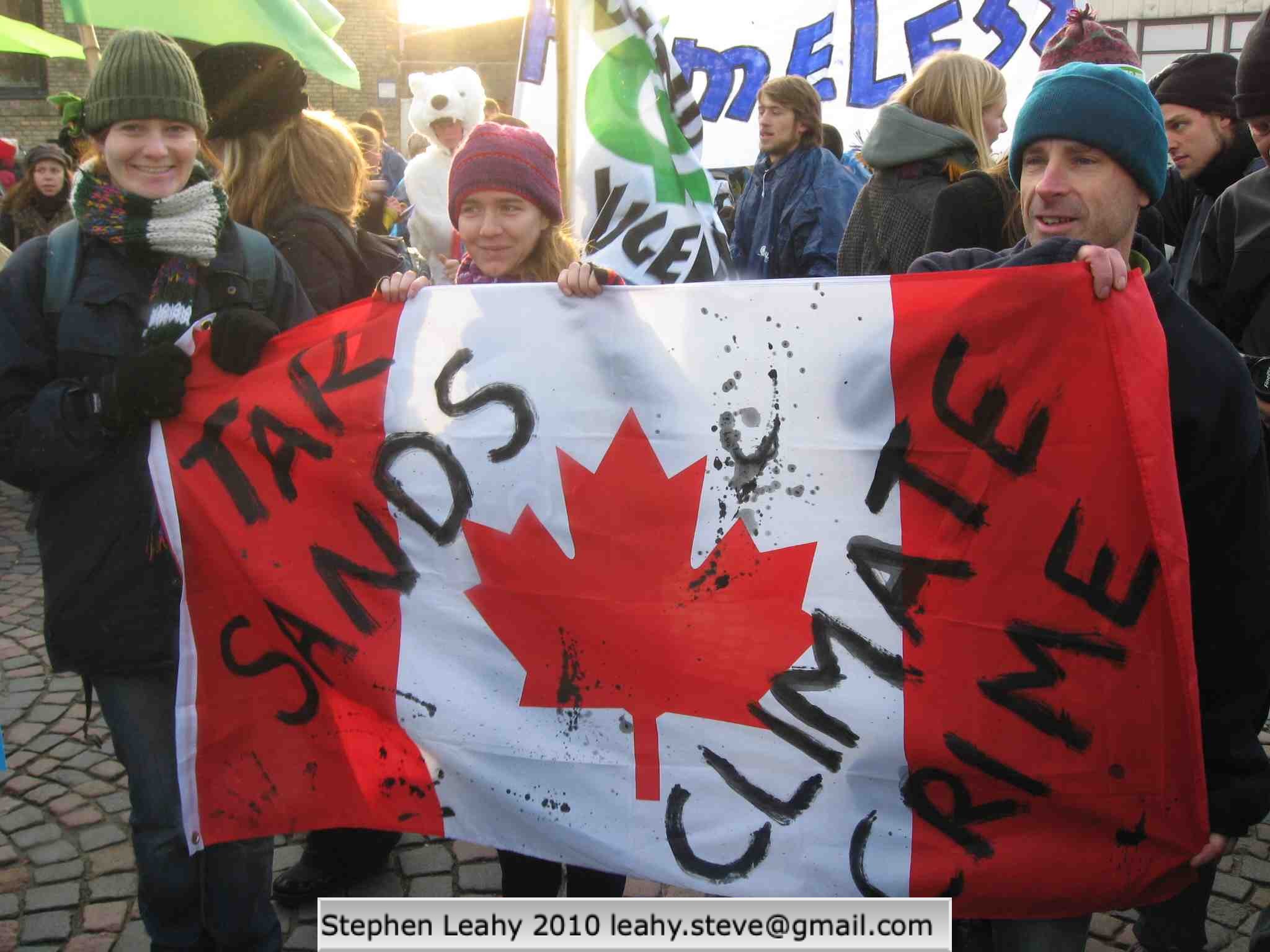
The fossil fuel sector, the richest in human history, appears to be ignoring the IPCC warnings.tar sands flag copenhagen sml0000

Earlier this month, oil giant ExxonMobil issued a report to its shareholders saying it does not believe the world will curb CO2 emissions and plans to extract and sell all of its 25.2 billion barrels worth of oil and gas in its current reserves. And it will continue investments hunting down more barrels.

“All of ExxonMobil’s current hydrocarbon reserves will be needed, along with substantial future industry investments, to address global energy needs,” said William Colton, ExxonMobil’s vice president in a statement.

The IPCC agrees oil, gas and coal will still be used in future but there is a CO2 maximum to have a reasonable chance of staying below two degrees C. That fossil energy cap won’t be enough to meet global energy needs so Working Group III recommends shifting to large-scale bioenergy and biofuels, waste incineration, nuclear power and carbon capture and storage (CCS).

These energy sources are controversial and risky. Large-scale bioenergy and biofuels needs huge areas of land and vast quantities of water and will compete with food production.

Studies show ethanol results in more emissions than burning gasoline. Even making ethanol from the leftovers of harvested corn plants released seven percent more CO2 than gasoline while depleting the soil, a new study revealed in Nature Climate Change this week.

The IPCC acknowledges bioenergy and biofuels can increase emissions, destroy livelihoods and damage the environment, says Rachel Smolker of Biofuelwatch, an environmental NGO.

“It is a shame they put so much stock in something that would make things worse rather than better,” Smolker told IPS.

Given all this, what climate action plans are governments going to propose when they meet in Abu Dhabi on May 4 and 5th? This is an informal ‘put your cards on the table’ regarding a new set of commitments on emission reduction targets and action plans to be made public at the U.N. Climate Summit in September.

Current reduction targets will not avoid four degrees C, most experts agree.

In hopes of getting countries to increase their reduction targets, U.N. Secretary-General Ban Ki-moon asked governments to bring new proposals to New York City in September. With the current U.N. Climate Change Convention meetings deadlocked on key issues, the New York Summit is intended to kick-start political momentum for an ambitious, global, legal climate treaty in 2015.

The May get-together titled the “Abu Dhabi Ascent” is the only meeting before the Summit where governments, and invited members of the private sector and civil society will come together to explore how to get ambitious action to reduce emissions.

The Abu Dhabi meeting will be a window into the future of humanity: ascent or descent?

first published as Charting a Course for Survival, or Oblivion?

‘We Have Nothing Without Water’ – Treehugger Interviews Author of Your Water Footprint

Screen Shot 2014-11-23 at 11.06.18 AM

Why care about your water footprint?

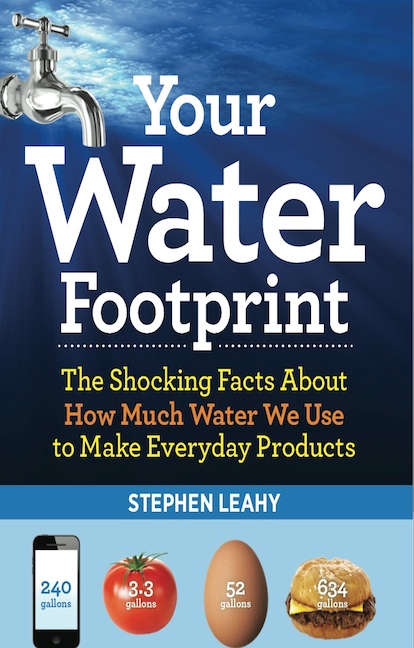
"Your water footprint" by Stephen Leahy

© “Your water footprint” by Stephen Leahy. Groundwater comes from aquifers that take thousands of years to fill. Globally, aquifers are being drained faster than then can refill.

Margaret Badore (@mbadore) Science / Clean Water

November 18, 2014

We learn in elementary school that water is in a constant cycle of evaporation and precipitation, making our crops grow and flowing from rivers into oceans. While the amount of water on Earth remains fairly stable, its distribution around the globe is changing, and this change is being accelerated by human activities.

A new book, “Your Water Footprint,” by environmental reporter Stephen Leahy, takes a close look at the “virtual water” that surrounds us in everyday life. This isn’t just the water we use to boil pasta or take a shower, it’s the water that’s used to grow our coffee beans and power the local energy plant. As the demand for this kind of water increases, the more threatened our access to fresh water becomes. At the same time, pollution makes vast amounts of water unusable.

I had the opportunity to catch up with Leahy over Skype.

TreeHugger: What were your goals for writing this book?

Stephen Leahy: To help people understand this other aspect of water that we use, that we don’t see. This virtual water concept: the water it takes to make things, the water it takes to grow our food, to make our products, to make our clothing. This is that unseen water that we don’t think about, and because we don’t see it, we’re not really aware of it.

It’s an enormous amount of water that we end up consuming every day without realizing it.

TreeHugger: The book is very number heavy, which makes it easy to compare how much water is used in different things. How did you go about finding all the data?

Leahy: It was a nightmare actually, the numbers. Especially for a person who’s a writer, not a numbers guy.

What I did, and this was based on covering science for many years, was figure out a baseline. Who is the best researcher? Who has the best data collection of water footprints? It turned out to be the University of Twente in the Netherlands, and they actually pioneered the concept of water footprints. They’ve developed a whole methodology about how you calculate it, and they’ve done piles of studies of the various water footprints of various products. Sometimes not in the way we think of products. So, they would do a water footprint for wheat, but that doesn’t necessarily translate into a burger bun or bread, so I did that. I figured out how much wheat goes into a loaf of bread and did that part of the calculation myself.

So, University of Twente was a godsend, because there are lots of different ways of calculating water footprints, and there’s different numbers out there.

TreeHugger: In the introduction, you discuss this concept of the “water-food-energy nexus.” I’m hoping to can tell us a little more about that.

Leahy: Most people realize that we need water for food, but what most people don’t understand is that we also need water for energy. There’s no form of energy that doesn’t need water. We have a growing population, and a growing shift in diets from vegetable-based to meat-based, which uses a lot more water. At the same time, there’s a billion people who don’t have access to electricity and they of course want to get electricity. As we look to produce more energy and more food, we’re going to need more water. This is the point of the nexus: we don’t have enough water to do all that in the future.

TreeHugger: So, looking forward, we need to reduce our water footprint. I think a lot of our readers are going to be familiar with the concept of reducing a carbon footprint, and in a lot of ways these concepts overlap. So, from your perspective, what are the ways the two footprints don’t overlap?

Leahy: Certainly on the energy side they overlap a lot. But on the food side, that’s probably the best example. If you switch from a meat-based diet to a vegetarian diet, you could reduce your daily water footprint by 1,300 liters. So, that’s an enormous amount of water when you put it over a year, nearly half a million liters in savings.

The other thing you can do is swapping beef for chicken. Swapping beef for chicken for a family of four would save 900 liters of water.

Food waste is another example, 38 to 40 percent of food in North America is wasted, and that’s a huge amount of water embedded in that food. The “best before” dates are actually problematic in that regard, because it doesn’t really mean the food is bad, it just means the company’s not guaranteeing the flavor.

TreeHugger: I also wanted to ask you about how you think about the trade-offs between the water impact of a product and some of the other impacts of a product. I was thinking about tee-shirts, because I write about clothes a lot. So, on one hand, we could say cotton is natural, it can be low in toxins if we use natural dyes and it’s biodegradable. On the other hand, cotton has a high water footprint. Then if we look at polyester, it has a lower water footprint, but there are concerns about it releasing toxins as it breaks down and contributing to micro plastic pollution. So, how do you look at these kinds of trade-offs? Do you have advice for weighing them?

Leahy: This gets a little bit complicated, because a big number for a water footprint is not necessarily indicative of something that’s bad. If you’re in a water-rich area and need a lot of water, and you’re not polluting this water, that’s going to be okay.

It’s kind of site-specific and product-specific, so this does make it quite a bit more complicated. On the clothing side of things, if you’re growing cotton in a country that has reasonable amounts of rainfall and preferably it’s grown organically, that is it’s grown without pesticides and chemicals, you’re greatly reducing the contamination of water. And if you’re using rain-fed cotton and not depleting an underground source, those are some conditions under which we could talk about products being truly sustainable, because you could continue this for quite a while.

TreeHugger: So, as we look to the future, there are many areas that will soon be facing the collapse of “water bubbles.” Do you think we need to see a shift in water policies or do we need to reduce our personal water consumption? Or is it both?

Leahy: It’s both. From a government policy point of view, water needs to be respected a lot more in terms of managing it long-term. There are places like California that don’t have any rules about how much ground water you can take. Anyone can take as much groundwater as they like—and that’s not uncommon.

The other side of course is consumers. I think consumers need to raise the issue more with both their elected leaders but also the industry. Some industries have responded, Levi’s has greatly reduced their water use for the production side, although it’s not exactly waterless since it takes a lot of water to grow cotton. So, that’s a role for consumers: asking, ‘Where is this product made? Where did it come from?’

Because there are certain things that don’t make any sense. For instance, Egypt is the number two exporter of oranges in the world. Egypt, well it’s is basically a desert, so why are they exporting all these oranges? There are actually all these economic reasons that don’t make any sense from a sustainability point of view. So consumers can make a decision and say, I’m not going to buy a product that requires a lot of water from the desert, because that’s just dumb.

The point about the virtual water is that we have very little without water. So, we’re extraordinarily dependent on water in ways we just don’t realize. And yet, we under-price water, water is very cheap, and water doesn’t get the respect it deserves.

This interview has been shortened and condensed.

Original post

Your Water Footprint:  The Shocking Facts About How Much Water We Use To Make Everyday Products

October 2014 Firefly Books, 160 Pages, 125 Unique Infographics only $19.95 Paperback (Also avail in hardcover) Order today

In US:  AmazonPowell’s Books; Barnes&NobleIndiebound

Canada:  Chapters-Indigo Signed copies avail at Blue Heron Books – Stephen’s home town bookstore

UK:  WH SmithAmazonWaterstones

Australia: Angus & RobertsonBooktopia

New Zealand: Mighty Ape

High Seas Represent $148 Billion Carbon Sink But Overfishing is Destroying It

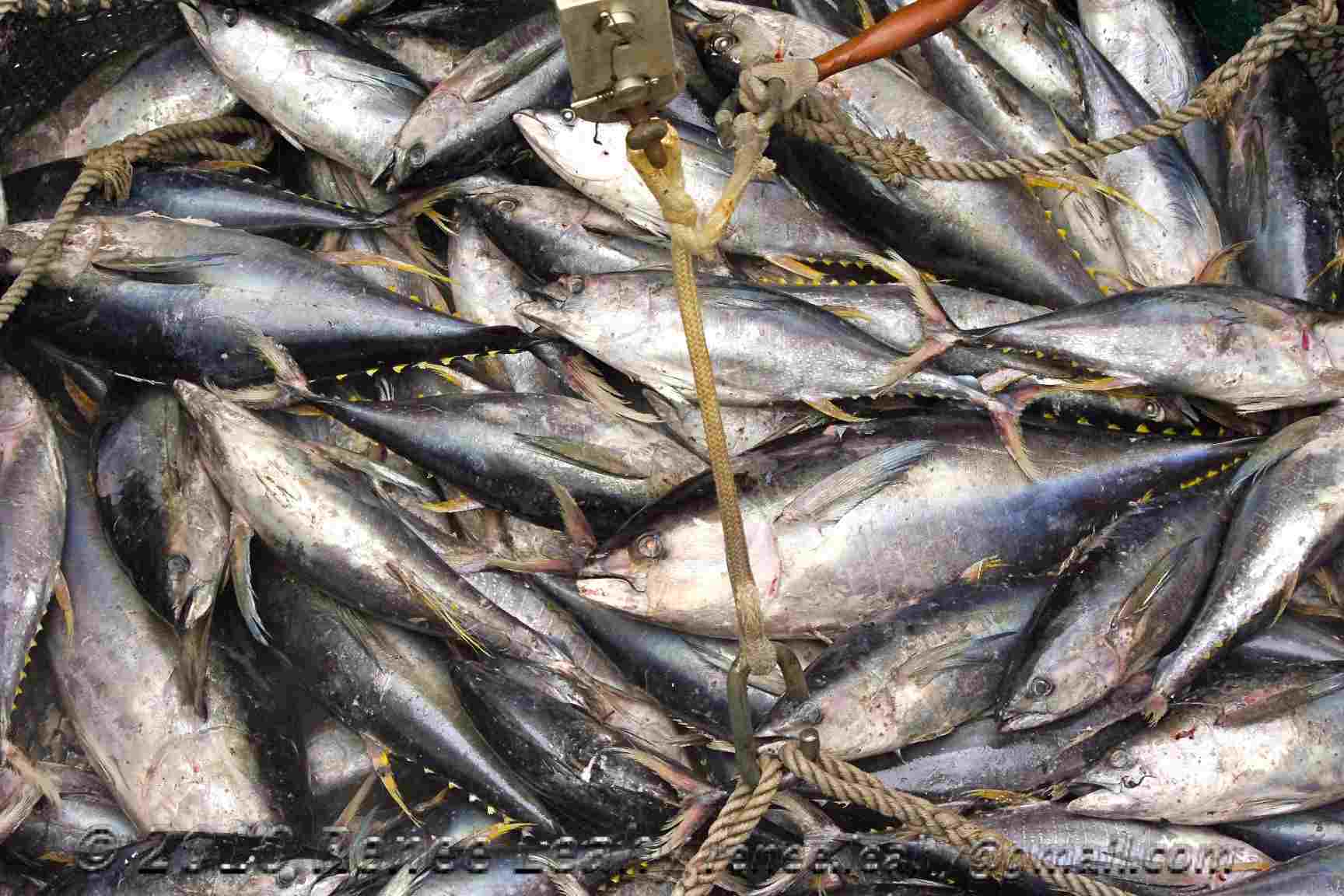
Tuna from the Spanish Purse Seiner

By STEPHEN LEAHY

Stephen Leahy's picture


Scientists estimate that phytoplankton absorb and bury more than 1.6 billion tonnes of CO2 in the seabed every year.

This would be news to readers of Canada’s Globe and Mail newspaper’s detailed two-page spread on the Global Ocean Commission report, which failed to mention this vitally important carbon reduction service (or that it is worth an estimated $148 billion a year).

Additionally, if governments ended fishing in the unclaimed oceans beyond 200-mile economic zones, near-shore fish catches would soar, even more carbon would be safely removed from the atmosphere and the oceans would be healthier said co-author of the study Rashid Sumaila of the University of British Columbia’s Fisheries Centre.

The high seas are like a failed state. Poor governance and the absence of policing and management mean valuable resources are unprotected or being squandered,” said David Miliband, co-chair of the commission and former foreign secretary of the United Kingdom.

The dollar value of all the fish caught in high seas is actually negative

Governments like Japan, Spain, the U.S. and China subsidize fishing fleets to destroy the high seas by overfishing and deep-sea bottom trawling to the tune of $152 million a year.

Here’s the kicker: The dollar value of all the fish caught way out there is actually negative when costs like fuel and subsidies are subtracted. Turns out high seas fishing fleets get 25 per cent of their income from subsidies according to a 2009 analysis by Sumaila.

Most would not be fishing the high seas without subsidies” Sumaila told DeSmog Canada.

Restoring ocean productivity

Fishing should be banned in the high seas, which represent 64 per cent of the world’s oceans just to protect and enhance its role as a carbon sponge, he said. But that is just one of 14 other valuable services the high seas provide humanity according their study, The High Seas And Us: Understanding The Value Of High Seas Ecosystems.

The study was commissioned by the Global Ocean Commission, an 18-month-old organization comprised of business leaders and former senior politicians including former Canadian prime minister Paul Martin.

The commission is calling for the negotiation of a new agreement under the UN Convention on the Law of the Sea to prioritize ocean health and resilience and restore ocean productivity. It also called for an elimination of subsidies on high seas fishing within five years.

The commission’s proposals also call for mandatory tracking of all vessels fishing in the high seas, a ban on the transshipment of fish at sea, measures to end plastics pollution and binding standards for the regulation and control of offshore oil and gas exploration and exploitation.

Carbon really does sink

Phytoplankton are the carbon-eating plants of the seas and pass on this carbon when they’re eaten. When organisms die in the deep seas, their organic matter ends up on the bottom of the ocean, which makes for an effective, natural carbon sequestration process.

Fishing is crippling this free carbon-removal system. This is especially true for bottom-trawlers that bulldoze the sea floor scooping up every living thing. Trawling is by far the most common fishing method and recent studies warn it’s destroying corals and the sea bottom leading to “long-term biological desertification.”

Last May, scientists writing in the journal Science called for an end to “the frontier mentality of exploitation” of the high seas and recommended a ban on trawling to protect the carbon-removal service and halt the decline in the productivity of the oceans. The amount of wild fish caught peaked 20 years ago.

About 70 per cent of fish caught inside the 200-mile limits spend some time in the high seas. If the high seas are protected those fish are likely to grow larger and become more numerous, benefitting near-shore fisheries, Sumaila said.

A number of studies of marine protected zones where fishing is banned or very limited show these areas act as baby-fish incubators increasing the overall population of fish.

If fishing was banned in the high seas, fisheries profits would more than double, the amount of fish would increase 30 per cent and the amount of ocean fish stock conservation would increase 150 per cent according to a study published in PLOS Biology last March.

Given the reality that fishing the high seas is a money loser, even a low carbon price could make a fishing ban valuable, not to mention the other potential benefits of regulating international fisheries. Sumaila said the $148 billion-a-year value of the high seas carbon sponge is a conservative estimate, and it could actually be as high as $222 billion.

Fishing and trawling bans have been proposed before. Last December the European parliament narrowly rejected a bottom-trawling ban on its vessels.

We need wide public understanding of the vital importance of the high seas to all of us,” concluded Sumaila.

Top 10 High Seas Fishing Nations (according to Sumaila’s study) in descending order:
Japan
South Korea
Taiwan
Spain
USA
Chile
China
Indonesia
Philippines
France

First published by DeSmog Canada Wed, 2014-06-25 10:01

Water is far more valuable and useful than oil

Average water footprint of bottle of cola

The water footprint of a half-litre bottle of water is 5.5 litres – yet well over a billion people live in areas with chronic scarcity

By Stephen Leahy

I have a confession: I knocked back 320 pints at the pub last night. I actually only had two shots of a decent single malt but it took 320 pints of water to grow and process the grain used to make the whisky. That’s a whole lot of water considering the average bathtub holds 60 to 80 litres.

Even after 20 years of covering environmental issues in two dozen countries I had no idea of the incredible amounts of water needed to grow food or make things. Now, after two years working on my book Your Water Footprint: the shocking facts about how much water we use to make everyday products, I’m still amazed that the t-shirt I’m wearing needed 3,000 litres to grow and process the cotton; or that 140 litres went into my morning cup of coffee. The rest of my breakfast swallowed 1,012 litres: small orange juice (200 litres); two slices of toast (112 litres); two strips of bacon (300 litres); and two eggs (400 litres).

Water more valuable and useful than oil

Researching all this I soon realised that we’re surrounded by a hidden world of water. Litres and litres of it are consumed by everything we eat, and everything we use and buy. Cars, furniture, books, dishes, TVs, highways, buildings, jewellery, toys and even electricity would not exist without water. It’s no exaggeration to say that water is far more valuable and useful than oil.

front cover resized1A water footprint adds up the amount of water consumed to make, grow or produce something. I use the term consumed to make it clear that this is water that can no longer be used for anything else. Often water can be cleaned or reused so those amounts of water are not included in the water footprints in the book. The water footprint of 500ml of bottled water is 5.5 litres: 0.5 for the water in the bottle and another five contaminated in the process of making the plastic bottle from oil. The five litres consumed in making the bottle are as real water as the 500ml you might drink but hardly anyone in business or government accounts for it.

The incredible amounts of water documented in Your Water Footprint are based primarily on research done at the University of Twente in the Netherlands, where Arjen Hoekstra originated the concept of water footprints. The amount consumed to make something varies enormously depending on where the raw materials come from and how they are processed. Wheat grown in dry desert air of Morocco needs a lot more water than wheat grown in soggy Britain. For simplicity, the amounts in the book are global averages.

One of the biggest surprises was learning how small direct use of water for drinking, cooking and showering is by comparison. Each day the average North American uses 300 to 400 litres. (Flushing toilets is the biggest water daily use, not showers.) 400 litres is not a trivial amount; however, the virtual water that’s in the things we eat, wear and use each day averages 7,500 litres in North America, resulting in a daily water footprint of almost 8,000 litres. That’s more than twice the size of the global average. Think of running shoes side by side: the global shoe is a size 8; the North American a size 18. By contrast, the average water footprint of an individual living in China or India is size 6.

Peak water is here

Water scarcity is a reality in much of the world. About 1.2 billion people live in areas with chronic scarcity, while 2 billion are affected by shortages every year. And as the ongoing drought in California proves, water scarcity is an increasing reality for the US and Canada. Water experts estimate that by 2025 three in five people may be living with water shortages.

While low-flow shower heads and toilets are great water savers, the water footprint concept can lead to even bigger reductions in water consumption. For example green fuels may not be so green from a water consumption perspective. Biodiesel made from soybeans has an enormous water footprint, averaging more than 11,000 litres per litre of biodiesel. And this doesn’t include the large amounts of water needed for processing. Why so much water? Green plants aren’t “energy-dense,” so it takes a lot of soy to make the fuel.

Beef also has a big footprint, over 11,000 litres for a kilo. If a family of four served chicken instead of beef they’d reduce their water use by an astonishing 900,000 litres a year. That’s enough to fill an Olympic size pool to a depth of two feet. If this same family of opted for Meatless Mondays, they’d save another 400,000 litres. Now they could fill that pool halfway.

We can do nearly everything using less water. It’s all about smart substitutions and changes, rather than sacrifice and self-denial, but we can’t make the right choices unless we begin to see and understand the invisible ways in which we rely on water.

First published at The Guardian

Career Choice: Abandon Journalism for Public Relations or….?

Screen Shot 2014-09-25 at 3.25.37 PM

Freelancer Stephen Leahy on crowdfunding his environmental journalism

by Rachel Sanders

Stephen Leahy was at a conservation conference in Mexico five years ago when the dire state of freelance journalism became clear to him. After the event, he spoke with several other freelancers, all of whom had received travel awards to attend the event. Most of them had not been able to sell a single story about the conference.

copenhagen-press-pass“These other freelancers were supremely experienced. The former bureau chief from Asia from the New York Times, the former chief of some bureau at Reuters AFP, all these guys had really impressive credentials. And they couldn’t sell any stories as freelancers,” Leahy told Story Board during a recent phone interview.

“And one of the big pronouncements there was the need to protect 50% of the planet. Which is a number that is outrageous and had never ever been uttered before. And I was like ‘wow that’s a really good story.’ But they couldn’t sell any stories. I was the only one who had sold two or three stories.”

Leahy, who is based in Uxbridge, Ontario, says that several of those journalists quit freelancing after this dismal experience. Some made the switch to PR. But he wasn’t prepared to give up.

“People say to me all the time ‘my God, this is amazing stuff, how come I never knew about these things?’ So people want it and I want to keep doing it. How do we make this happen? The only solution I could come up with was, well, they have to pay me directly. Publishers aren’t going to pay, and many of the places I write for can’t pay. Who benefits from this stuff, who wants to see it? The readers. And so why not ask them?”

Over the next few years, Leahy built up an email contact list. The members on his mailing list now number around a thousand. Once a week he sends out a newsletter with links to his most recent stories. Approximately 10% of his newsletters also include a direct pitch for financial support.

“When I first started it was probably a much higher percentage than that. It was probably 50% pitches included with these newsletters. Now it’s declined quite a bit because it’s been pretty stable and I’ve been getting lots of assignments so I haven’t needed it so much,” he said.

Leahy has been freelancing for 22 years. His work has been published in National Geographic, The Guardian, Vice Magazine, Al Jazeera, and The Toronto Star among many others. But with ad revenues dropping, and freelance budgets shrinking, the market is tighter than ever for environmental reporting. Leahy has succeeded in making up some of the income shortfall with crowdfunding. These days, reader contributions account for approximately 20 to 25% of his income.

Leahy believes that his funding model would work with any subject that people care passionately about. But he says it’s also vital that readers feel a connection to the writer in question.

“The subject’s one thing but you also have to want to see more stuff from this writer. It’s a relationship between reader and writer. It’s difficult to do, it takes a long time to build up that relationship. You have to know your audience, you have to build a relationship with them and there has to be some sense of reciprocity. In return for me doing my thing, you help me out. It’s an exchange,” he said.

Leahy int Tom Goldtooth sml - cancun march - renee leahy 2010

To build those relationships, Leahy has had to open up to his readers about his finances and his personal life.

“It’s hard to donate to a person you don’t really know. So I had to open up and explain the situation, the reality of freelancing. Sometimes you get $150 for a story you might have spent two weeks on. Any sensible person would not do that,” he said.

He has tried a number of different funding models – such as asking for weekly contributions and making project-based funding requests – but has found the most success by asking his readers for monthly contributions. And although only a small percentage of his readers offer him financial support, some support him in other ways.

“There are people who do not make financial contributions but they make information contributions or will help me out if I say ‘I’m going to X, Y, and Z to cover this subject. I can’t afford any hotels. Anybody know anyone who could let me stay at their place?’ And that worked out two or three years ago in Bonn, Germany to cover a UN climate meeting,” he said.

Though his published work covers weighty topics, Leahy says some of the most difficult writing he does is in his weekly email newsletters.

“The asking for money thing, of course, was difficult. But it was definitely as difficult to be open and more personable with other people. To be a real person, not just a byline. To say ‘yes I welcome your comments and ideas and I want to have a dialogue,” he said.

“I spend a lot of time editing my own stuff and thinking ‘I’ve got to get this into 200 words or less.’ Nobody wants more email spam, right? So it’s important to be really interesting every time, not just once in a while.”

Despite the difficulties involved in making a living as a freelancer, Leahy is committed to the career.

“You get to meet really interesting people,” he said.

“I had a corporate career for a few years and one of the reasons I gave it up is because I found the folks in the business community not particularly interesting. When I started freelancing, I started writing about farming and agriculture. And I thought ‘my God, farmers are way more interesting than these corporate CEOs. There’s much more to them.’”

And the people aren’t the only thing that Leahy finds interesting about freelancing.

“You get to learn all the time. And because I’ve been lucky enough to mostly write about what I’m interested in, it’s never boring. It’s never easy, but it’s never boring. And I get to choose not only what’s interesting but what I think is important,” he said.

“Freelancing allows you to use your time in the way you want to use it.”

You can contact Stephen Leahy through his website to join his mailing list or ask questions about his crowdfunding model. And you can find him on Twitter at @StephenLeahy.

Help Sustain Independent Environmental Journalism

Freelance environmental journalist Stephen Leahy: Going it alone and making it work

Stephen Leahy speaking at Toronto Climate March 2014


With little demand for environmental stories in Canadian mainstream publications, freelance journalist Stephen Leahy faced two options: Give up the beat, or find a new way to make ends meet. Paul Weinberg explains why the 20-year veteran chose the latter and how he is faring.

[Published by the Canadian Journalism Project in 2012]

A committed freelance environmental journalist has discovered a way to cover important—and often unreported—stories and stay electronically in touch with readers without going through a mainstream media intermediary.

Not that Stephen Leahy had any choice in the matter, after finding fewer newspapers and magazines in Canada and abroad buying his stories a few years ago. It was a problem he saw his American colleagues facing in their domestic market as well.

Based in Uxbridge, east of Toronto, he has also found himself one of the few Canadian reporters still covering international conferences where scientists convene over the latest findings on climate, resources depletion, weather, energy, conservation or other environmental issues.

It all came to a head at the 9th World Wilderness Congress (WWC), in Mérida, Yucatán, on November 6, 2009. Leahy and some other fellow freelance journalists —working for such outlets as Reuters and The New York Times—sat down feeling quite discouraged.  Amidst them was the excitement of a weighty conference featuring the likes of high-profile scientist Jane Goodall.

These “highly motivated” journalistic veterans, recounts Leahy, could not sell a single story from this major conference to their traditional mainstream media outlets across North America.

“These guys were making no money. [Most] of us freelancers were making zero money. Fortunately, our hotel and flight costs were covered [by the conservation conference organizers] but we were not making money,” he recalls.

Leahy was the exception, having one regular client, alternative Rome-based global news agency Inter Press Service, which was still keen on receiving his latest story from the conservation meeting for its largely developing world audience.

Searching for alternatives

During that session in Mexico, Leahy and his fellow freelancers engaged in the kind of soul searching that one does when the writing is on the wall. Freelance work involving the covering of international scientific conferences for money had virtually dried up, and so most of these journalists specializing in the environmental were considering packing it in and opting instead for public relations work or a job in academia.

In fact, many of Leahy’s freelancer colleagues had had better contacts among the major buyers of environmental stories in the media during the good times—when the state of the climate and the planet’s fauna and flora was fashionable, he says.  “If they could not make it, how was I supposed to make a go of it?”

Leahy had started covering the environment about 20 years by writing entirely for Canadian newspapers and magazines before expanding eventually into international outlets such as Inter Press, The GuardianNew ScientistAudubon Magazine, Al Jazeera and National Geographic News Watch.

But in the last several years the environmentally-focused publications which had been his bread and butter had either disappeared or were (in the case of Audubon) coming out less frequently because of diminished advertising dollars.

Funding his way—with some help

Earning less freelance income meant that Leahy could not afford to attend as many of the international scientific conferences, which had been his major beat for years.

Rather than give up, Leahy was determined to prove that a market still exists for “independent” environmental journalism and he adopted a funding model to allow him to continue.

Leahy has asked his readers to defray his expenses from travelling and staying in the cities around the world where these international gatherings of scientists continue to meet. Each supporter is asked to send in $10 a month via PayPal or a credit card on his web site to help him continue his work in “community supported environmental journalism.”

“I made a commitment to people that obviously the money is going to be used strictly for journalistic purposes and to stay in touch with them,” he says.

Currently, Leahy has upwards of 300 readers who are offering financial support and feedback on his reporting.

Surprisingly enough, Leahy has not fully taken advantage of Twitter which could really expand his legion of supporters.

“I have been thinking about [social media]. Doing it right takes time. In fact I do spend a significant amount of time fundraising. One of the downsides [of this funding model],” he maintains.

Today, Leahy says he still generates an income below the poverty line. On the other hand, he lives frugally, with support from his long term spouse and family back home. “I don’t have any debts,” he says simply.

Leahy’s funding model was unique at the start but other journalists including those new to the profession are taking a serious gander at doing something similar to financially support their work and in some cases get themselves established.

One of Leahy’s colleagues, for instance, is using an appeal to readers to raise close to $3,000 to pay for a six-week trip to the Democratic Republic of the Congo to research its internal conflicts for an upcoming book.

But Leahy, who is close to 60, says the toll of travelling to eight to ten international conferences annually (often resulting in being outside Canada close to five months a year) and sleeping on supporters’ couches has taken a physical toll on him in the past   year.

“My ultimate hope is to have 10, 20 or 30 younger people doing something similar. I do get quite a few calls from journalism students from around the world and I always have time for them. Folks younger than me understand social media better and they can use it.”

Diminishing coverage of environmental issues

A perennially-losing candidate for the Green Party in federal elections for the Ontario constituency of Durham—where Minister of International Cooperation Bev Oda holds the seat—Leahy has discovered among prospective voters “a hunger” for information on the environment.

“People are really concerned about environmental issues and the state of our democracy. And the second thing is they are so unaware of what is going on in the world, which I think is astonishing,” he says.

The blame for this comes from the disappearance of science issues from the general news programs, Leahy states. He cites as the latest manifestation of this trend—the recent cancellation of CBC News Network’s Connect with Mark Kelly. “It was one of the few sources [for the environment] on broadcast. This is a big blow.”

One of Leahy’s regrets is that with the exception of the alternative online site, Straightgoods.com (which reprints his IPS stories) his articles are largely published outside Canada.

“I started off in Canada, more than 20 years ago, writing 100 per cent for Canadian publications. I used to do weekly columns on environmental issues for daily newspapers that don’t exist,” he said.

Leahy is one of those people who cannot imagine doing anything but journalism.

His funding model, he adds, “has enabled me to continue doing what I think is a pretty useful public service, providing people around the world with information about the important environmental issues.”

CORRECTION: A previous version of this article incorrectly stated that Leahy had been interviewed on Connect with Mark Kelly a couple of times. Though he had been asked to appear, due to scheduling changes or bumps, Leahy has never actually been interviewed on the show.


Help Sustain Independent Environmental Journalism

We Have Five Years to Stop Building Coal Plants and Gas-Powered Cars

Measurement of CO2 levels in atmosphere

By Stephen Leahy

[Authors note: One of the most difficult and important articles I’ve written in 20 years of environmental journalism. Originally published Sept 6 2014 @Vice Motherboard]


Here’s the frightening implication of a landmark study on CO2 emissions:

By 2018, no new cars, homes, schools, factories, or electrical power plants should be built anywhere in the world, ever again, unless they’re either replacements for old ones or carbon neutral. Otherwise greenhouse gas emissions will push global warming past 2˚C of temperature rise worldwide, threatening the survival of many people currently living on the planet.

Every climate expert will tell you we’re on a tight carbon budget as it is—that only so many tons of carbon dioxide (CO2) can be pumped into the atmosphere before the global climate will overheat. We’ve already warmed temperatures 0.85˚C from pre-industrial levels, and the number rises every year. While no one thinks 2˚ C is safeper se, it’s safer than going even higher and running the risk that global warming will spiral out of our control completely.

Last year, the latest Intergovernmental Panel on Climate Change (IPCC) report established a global carbon budget for the first time. It essentially stated that starting in 2014, the carbon we can afford is up to around 1,000 billion tons of CO2. In other words, our cars, factories, and power plants can only emit 1,000 billion tons (1,000 Gt, or gigatons) of CO2 into the atmosphere if we want to have a greater than 50/50 chance of keeping our climate below 2˚C of warming.

Even considering that humanity pumped 36 gigatons of CO2 into the atmosphere last year alone, 1,000 Gt still seems like a big budget. It might even seem like we have room to spare.

Maybe not.

WORLDWIDE, WE’VE BUILT MORE COAL-BURNING POWER PLANTS IN THE PAST DECADE THAN IN ANY PREVIOUS DECADE

New research shows that we may not have been paying attention to the entire CO2 emissions picture. We’ve only been counting annual emissions, and not the fact that building a new coal or gas power plant is in reality a commitment to pumping out CO2 for the lifespan of a given plant—which usually ranges from 40 to 60 years. These future emissions are known as a carbon commitment.

A new study has tallied the carbon commitments from all existing coal and gas power plants by looking at their annual CO2 emissions and current age. The study assumes an operating life of 40 years. A 38-year old coal plant will have far smaller future CO2 emissions, and thus smaller carbon commitment than one built today. The study, “Commitment accounting of CO2 emissions,” determined that most new power plants that went online in 2012 have a very large carbon commitment—19 Gt of CO2.

Building new power plants means more carbon commitments to eat into our 2˚C carbon budget. Build enough giant coal plants today, and their future emissions would tie up the entire budget, leaving no room for any other source of CO2 emissions.

Meanwhile, the rate at which new plants are built far outpaces the closure of old plants. Many US coal plants operate for longer than 40 years; the oldest is currently around 70 years.

“Worldwide, we’ve built more coal-burning power plants in the past decade than in any previous decade, and closures of old plants aren’t keeping pace with this expansion,” said study co-author Steven Davis of the University of California, Irvine.

Image: Flickr

Fossil Fuels Power Plant Carbon Commitment: 300 Gt

In the study, Davis and co-author Robert Socolow of Princeton University calculated that the existing coal and gas power plant carbon commitment turns out to be very large—more than 300 Gt.

Non-Power Plant Carbon Commitment: 400 Gt 

The reality of carbon commitment applies to any new fossil-fuel burning infrastructure, including office buildings and homes using gas heating or automobiles and planes burning jet fuel. All of these have an operating life of several or many years during which they will emit CO2 from now until they are ‘retired.’ These future emissions also count as a carbon commitment. In another upcoming study, Davis calculated the carbon commitments from other CO2 sources, including from the transport, industry, commercial and residential sectors. He estimates that as of 2013 this carbon commitment exceeded 400 Gt.

Together with the power plant commitment of 300 Gt laid out in the current study, that’s more than 700 Gt in carbon commitments on a global carbon budget of 1000 Gt. That leaves less than 300 Gt for future power plants, steel mills, cement plants, buildings, and other stuff that burns fossil fuels.

At current rates we’ll have accounted for the remainder of the budget in only five years.

Here’s how it breaks down:

Estimated Annual Emissions 2014-2018: 200 Gt

Global CO2 emissions from all sources amounted to 36 Gt in 2013. Annual emissions have been growing at a rate of 2 to 3 percent per year. Without major efforts to reduce emissions, another 200 gigatons of CO2 will be emitted between 2014 and 2018.

Estimated New Carbon Commitments 2014-2018: 100 Gt

Davis and Socolow determined that carbon commitments from new fossil fuel burning infrastructure will average at least 20 Gt per year, totaling 100 Gt over five years.

300 + 400 +200 +100 = 1,000 Gigatons of Carbon, Locked in by 2018

Unless coal and gas power plants or other major sources of CO2 are shut down before the end of their life span, the 1,000 Gt global carbon budget will be fully allocated sometime in 2018. No one will notice, because things won’t look or feel too much different than today. CO2 is akin to a slow, trans-generational poison. The climate impacts of blowing the carbon budget won’t be felt until 2030 or 2040 —and for a long time after.

WE’VE BEEN HIDING WHAT’S GOING ON FROM OURSELVES: A HIGH-CARBON FUTURE IS BEING LOCKED IN BY THE WORLD’S CAPITAL INVESTMENTS

Even the climate experts won’t notice much, because annual CO2 emissions have been the sole focus of countries and the United Nations process to address climate change said Davis.

“That’s like driving down the highway and only looking out of the side window,” Davis told me.

Politicians, business leaders, investors, planners, bureaucrats and whole lot of other people should be looking out the front window and paying attention to the hard reality of carbon commitments. If Davis and Socolow’s calculations are correct, it means no new coal or gas power plants can go online after 2018 unless they’re replacing retired plants. It means freezing the size of the global automobile fleet, and the industrial and commercial sectors, unless their energy efficiency increases. And so on.

The fact that much of our current and future infrastructure carries huge carbon commitments is blindingly obvious, but receives little attention.

Can’t solve a problem by making it worse

“If you build it, there will be emissions year after year. This should be a fundamental part of the decision to build most things,”” Davis said.

Ignoring the reality of carbon commitments means we’re investing heavily in technologies that make the problem worse, he said.

“We’ve been hiding what’s going on from ourselves: A high-carbon future is being locked in by the world’s capital investments,” said co-author Robert Socolow. Any plan or strategy to cut CO2 emissions has to give far greater prominence to those investments. Right now the data shows “we’re embracing fossil fuels more than ever,” Socolow told me.

So what can we do to begin to prepare for a jam-packed carbon budget? First, we need to stop building fossil fuel-reliant power plants.

Surprisingly, it appears the Australia is a pioneer here, despite recently rolling back its pioneering carbon tax. Thanks to wide-spread adoption of solar energy on homes and business the country’s electricity use is in steep decline. For the first time in its history, no new coal or gas power capacity will be needed to maintain supply over the next 10 years, according to the Australian Energy Market Operator. Germany too is rapidly adopting clean energy sources like wind and solar, so as to avoid building coal or nuclear power.

Next, we need to think about meeting energy demand by improving efficiency, instead of building more power generation.

Potential energy efficiency gains of 50 percent are possible across many sectors in most countries, Socolow said, and could reduce the number of fossil fuel energy power plants.

The US is the king of energy waste by most estimates. This costs Americans an estimated $130 billion a year, according to the Alliance to Save Energy. But despite the potential for huge cost and emission reductions, governments everywhere put nearly all their energy research efforts into new sources of energy like new power plants rather than helping to develop energy-efficient cars, buildingsm and appliances. It’s 2012 international study also found that improving energy efficiency provides by far the best bang-for-the-buck for energy security, improved air quality, reduced environmental and social impacts and carbon emission reductions.

However, efficiency improvements take time, and there is precious little time left to make the CO2 emissions cuts to stay below 2˚C, said Socolow.

While refusing to say a planet that’s 2˚C hotter is inevitable, he did say that all efforts to reduce emissions must be undertaken as soon as possible: “3˚C is a whole lot better than 5˚C, the current path we’re on.”

Keystone XL Pipeline Carbon Emissions Top 100 Million Tons a Year

The Keystone XL oil pipeline could put up to 110 million tons of additional climate-heating CO2 into the atmosphere every year for 50 years, according a study publishedSunday in the journal Nature Climate Change.

If Keystone XL was a country, its 110 million tons of CO2 emissions would be comparable to those of the Czech Republic, Greece, and a number of other mid-sized European nations. And it could have a real shot at making the top 35 worst carbon polluting countries in the world.

The study notes that 110 million tons of CO2 is four times more emissions than the US State Department’s highest estimate for the controversial pipeline, which is currently undergoing an environmental review.

The State Department failed to account for the potential emissions from the increase in the global supply of oil, said study co-author Peter Erickson, a researcher with the US office of the Stockholm Environment Institute (SEI), an independent international research institute.

This new study is an update to an SEI working paper Motherboard reported on last December. At that time the estimated CO2 emissions from Keystone were 93 million tons, but that’s climbed higher with the benefit of updated information.

“This time it’s gone through the ringer of peer-review and is a far clearer and more direct version of the previous paper,” Erickson said in an interview. “It’s also generated a lot more media interest this time.”

The study shows how Keystone XL’s projected daily volume of 830,000 barrels of Canada’s bitumen oil could slightly lower oil prices on the global market and increase global consumption. More precisely, for every barrel of increased production, global oil consumption could increase by 0.6 barrels owing to the incremental decrease in global oil prices, Erickson said.

This finding is potentially crucial because of President Obama’s prior statement that he will only approve Keystone, “if this project does not significantly exacerbate the problem of carbon pollution.”

The decision remains largely in Obama’s hands because Keystone XL crosses national borders. The current plan is for a 1,200-mile, 36-inch diameter pipe to be built from Hardisty, Alberta to Steele City, Nebraska. The $7 billion pipeline will bring tar sands bitumen from under the frozen forests and lakes of northern Alberta to the world market, and will help the region’s booming oil operations expand even further. XL is part of a larger 2,500-mile Keystone pipeline system that terminates on the Texas Gulf Coast and is owned and operated by energy company TransCanada.

In 2012, Obama rejected TransCanada’s application because the pipeline route was through Nebraska’s environmentally sensitive Sandhills region. A few months later, TransCanada re-applied with a new pipeline route. The State Department is now doing an environmental review using energy consulting company Environmental Resources Management, which is expected to be completed next year.

Building more oil infrastructure is exactly the wrong thing to be doing when the world is struggling to reduce CO2 emissions. The SEI report pegs global investment in oil and gas infrastructure at $700 billion per year for the next 20 years, based on data from the International Energy Agency, along with considerable investment in coal.

That investment will only burn through our carbon budget faster than we are now. According to the IEA’s 2013 World Energy Outlook, which is one of the top energy reports annually, some two-thirds of our proven fossil fuel reserves must stay in the ground to avoid heating the planet by more than two degrees Celsius by 2050. That’s a threshold set by the US and other nations who have made climate change mitigation pledges.

However, SEI study co-author Michael Lazarus said last December that the CEOs, board members, bankers, and government officials who make the decisions to build new infrastructure won’t even talk about cutting back. “It seems to be off limits to talk about cutting back on fossil fuel extraction,” he said.

Presumably, these folks also aren’t talking about the disastrous environment all of us will be trapped in if we heat the planet by those two degrees and beyond. We can’t quit oil immediately because it will take time to build an alternative energy infrastructure. However, at this point it makes little environmental sense to build new pipelines like Keystone XL to increase access to tar sands bitumen, the world’s dirtiest form of oil.