“It is unacceptable that the Canadian public sits back and allows access to the science they’re funding to be denied them,” said Andrew Weaver, a climate scientist.

Stephen's avatarStephen Leahy, International Environmental Journalist

Canadian media coverage of climate change has fallen by 80 percent

By Stephen Leahy

VANCOUVER, Canada, Feb 21, 2012 (IPS)

Amid revelations of a well-funded U.S. organisation’s plans to deliberately distort climate science, scientists and journalists at a major scientific conference called on the Canadian government to stop its muzzling of scientists.

For the past four years, the Canadian government has been denying timely access to government scientists even when their findings are published in leading scientific journals, said scientists and journalists in a special session of the American Academy for the Advancement of Science meeting here in Vancouver, British Columbia.

“The Canadian public doesn’t know as much as they could about science and climate change,” said Margaret Munro, who is a science writer for Postmedia News, based in Vancouver.

“The more controversial the story, the less likely you are to talk to the scientists,” Munro told IPS.

Last…

View original post 582 more words

Canadian Scientists Denounce Climate Change Denial, Government Censorship

read the report here

Canadian media coverage of climate change has fallen by 80 percent

By Stephen Leahy

VANCOUVER, Canada, Feb 21, 2012 (IPS)

Amid revelations of a well-funded U.S. organisation’s plans to deliberately distort climate science, scientists and journalists at a major scientific conference called on the Canadian government to stop its muzzling of scientists.

For the past four years, the Canadian government has been denying timely access to government scientists even when their findings are published in leading scientific journals, said scientists and journalists in a special session of the American Academy for the Advancement of Science meeting here in Vancouver, British Columbia.

“The Canadian public doesn’t know as much as they could about science and climate change,” said Margaret Munro, who is a science writer for Postmedia News, based in Vancouver.

“The more controversial the story, the less likely you are to talk to the scientists,” Munro told IPS.

Last year, journalists from around the world were denied access to Canadian government scientist Kristi Miller, who had published a groundbreaking paper on the decline of salmon populations in western Canada in the journal Science.

However, lobbyists for the oil and gas industry appear to have direct access to scientists, according to emails obtained under access to information legislation. Internal government documents reported an 80-percent decline in Canadian media coverage of climate change since 2007 when the new Stephen Harper Conservative government put restrictive policies into place.

“It is unacceptable that the Canadian public sits back and allows access to the science they’re funding to be denied them,” said Andrew Weaver, a climate scientist at the University of Victoria.
Continue reading

Become a Partner in Independent Enviro Journalism

A personal message from Stephen Leahy

“Journalism and media are society’s mirror providing accurate and essential information.

That is no longer the case.

Media are now controlled by a few major corporations like Murdoch’s News Corp. Coverage of environment and science has been gutted. If there is coverage it rarely digs below the surface. It’s not just TV, it’s all media.

After 18 years of being published in major publications on two continents I now count myself lucky to get $150 to $200 for an in-depth article. The few independent media outlets are either non-profits or struggling.

Urgent environmental issues didn’t go away just because most media stopped covering them.

More than 20,000 people attended the international climate meeting in Cancun, Mexico and it received one ten second clip on US network TV according to a Drexel University media study. (Coverage was even worse at last climate meet in Durban)

Nearly every indicator proves things are getting worse but less and less people know about this.

Many people, including leading scientists, tell me: ‘we need people like you to write about these issues‘. I’d like to do far more but it is impossible to continue without your help in what I’m calling Community Supported Journalism. People directly support independent journalists who craft honest and thoughtful articles about important subjects the mainstream media ignores or gloss over.

Community Supported Environmental Journalism Works

In 2010 dozens of people offered their help, donating $5,750 which helped ensure many breaking international stories were covered including the first media reports on the global die-off of corals and how climate change may be bringing colder winters to Europe and eastern North America. Those donors — I prefer to call them partners — enabled me to cover important international meetings like the UN Convention on Biodiversity, UNFCCC climate change conference and much more.

Thanks for reading.” — Stephen

Please join us. Consider a donation of just $10 a month to support enviro journalism that serves the public interest.

Contributions can be made safely and easily via PayPal* or Credit Card*. [You can cancel at any time, automatically. No need to contact me] 

Monthly support options starting @ $10 a month

One-time donations are most welcome. Click and enter the amount.

*More than 100,000 non-profits safely use PayPal Donate service

If you’d like a mailing address or contact me with story ideas, please complete this comment form.

Letters of Support:

We need people like you. In tough economic times, where information flow is increasingly channeled and controlled, you perform a simply critical role. Hang in there. You are an admirable role model for the future.”

– E. Ann Clark, Associate Professor, University of Guelph.

“Stephen Leahy has done a superb job exposing the enormous sums the US government is spending on corporate welfare for big oil.”

Ross Gelbspan, Pulitzer-prize winning editor and author of The Heat is On

My continued appreciation to those who have contributed in the past.

Wrote this nearly fours year ago, can’t believe it is more relevant than ever.

Stephen's avatarStephen Leahy, International Environmental Journalist

truth-over-fear.jpg

100,000 repetitions of a lie is still a lie

Many of those who deny that burning fossil fuels is altering the climate work diligently to confuse and delay action that would in reality benefit nearly all of us. These professional deniers and their followers can be convincing, citing well-known experts and twisting their views and findings.

So here’s a couple of common sense tips to add to your BS detection system.

Denier Tip #1:Check out suspect claims/sources with a simple Google search

100,000 repetitions or variations of a lie is still a lie. A reader recently told me global warming is really caused by variations in the sun’s activity. His proof was a “science” article from Investor’s Business Daily that said this was the conclusion of the Max Planck Institute for Solar System Research, a well-known research centre in Germany. A quick check of the Institute’s website…

View original post 216 more words

A Very Inconvenient Truth: Gore Got It Right on Global Warming

[Reposted from 2006, nearly six years ago. It offers interesting perspective about the continuing (worsening?) political insanity of inaction  – Stephen]

By Stephen Leahy

BROOKLIN, Canada, Jun 20 (IPS)

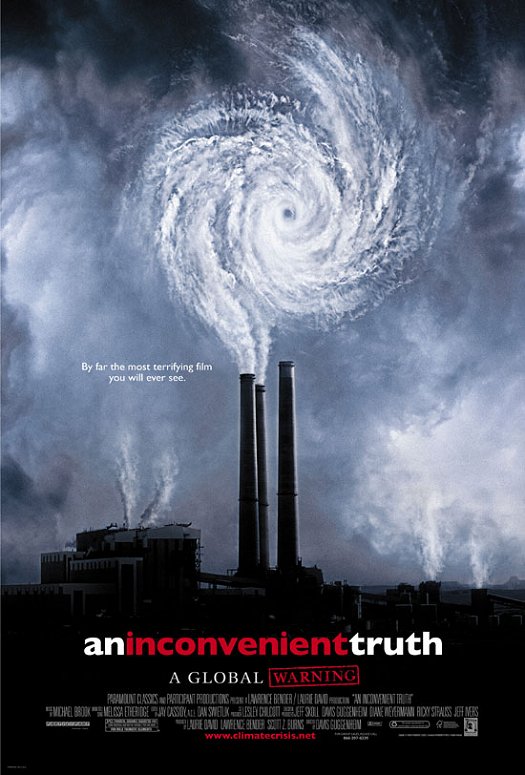
Former U.S. Vice President Al Gore’s documentary on global warming, “An Inconvenient Truth”, is filling theatres across North America – and gets the science right, according to climate experts.

“I saw it last night and was impressed with the climate science presented in the film,” said David Archer, a climatologist at the University of Chicago.

“I left the theatre profoundly depressed because of the political insanity in this country that denies global warming is a concern,” Archer told IPS.

Gore’s personal passion about global warming can be traced to the early 1980s. After losing the election to George W. Bush in 2000, Gore dedicated himself to warning the public about the devastating impacts climate change will have on hundreds of millions of people.

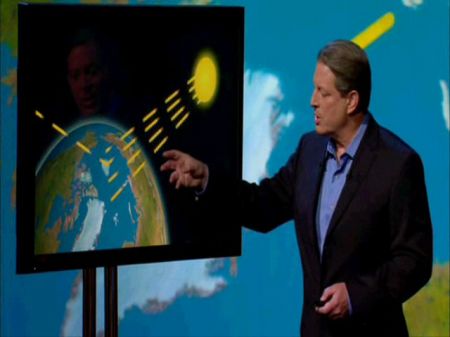
“An Inconvenient Truth” is a 98-minute documentary comprised mainly of highlights from Gore’s high-tech slide show explaining the science documenting global climate change.

Some truths are hard to hear, because if you really hear them – and understand that they are in fact true – then you have to change. And change can be quite inconvenient,” Gore says in the film.

Using an impressive set of graphics, he carefully illustrates changes underway such as receding glaciers, collapsing ice sheets, devastating floods and droughts. One memorable scene shows a graph of carbon-dioxide levels in the atmosphere going back 650,000 years that varies only a little until fifty years ago when it skyrockets. Gore mounts a motorised platform to lift him up high up the chart so he can place his finger on the current level of CO2. Continue reading

The Future of Journalism: Adopt a Muckraker

“Should you and I pay for the kind of accurate news reporting that is needed to fill us in on what is happening to the planet?

If we’re not willing to pick up the tab to stay better informed, who will?”

Renowned Swiss journalist Daniel Wermus and Director of the Media21 Global Journalism Network in Geneva asks those questions in an April 2010 article about my launch of Community Supported Journalism in 2009. [Updated from Sept 2010] — Stephen

Frontline Earth: Adopt a Muckraker?

By Daniel Wermus

I meet international freelance journalists quite often. Most make it clear that budget cuts have made it increasingly difficult for just about anyone, especially freelancers, to get into print. It is usually the freelancers who are most willing to risk their lives to get the stories that need reporting the most. If the day arrives when they can no longer carry out their professions, we will all have a serious problem.

Muckraker: A reporter or writer who investigates and publishes reports involving a host of social issues, broadly including crime and corruption

Stephen Leahy, a Canadian, and one of the world’s best-known investigative reporters on environmental issues, has launched a challenge: if corporations won’t pay for the news, then it is up to communities and the public to fill the gap. A free society needs journalism, even if reporting the news is not commercially profitable.

Leahy’s model for supporting the news has the journalist make his pitch over the internet. The completed article can then be distributed by news agencies or magazines that are low on funds but high on public interest. That could be IPS, Reuters-Alertnet, Commondreams, InfoSud, The Essential Edge or any number of other publications and news outlets.

[edit: Wermus concludes] Continue reading

Welcome to Bizarro World: Canada and US Spending $billions to Create Climate Chaos

President Obama and Prime Minister Stephen Harper (left) say they’re worried about climate change, but neither the U.S. nor Canada has cut emissions.

Analysis by Stephen Leahy

UXBRIDGE, Canada, Aug 10, 2011 (IPS)

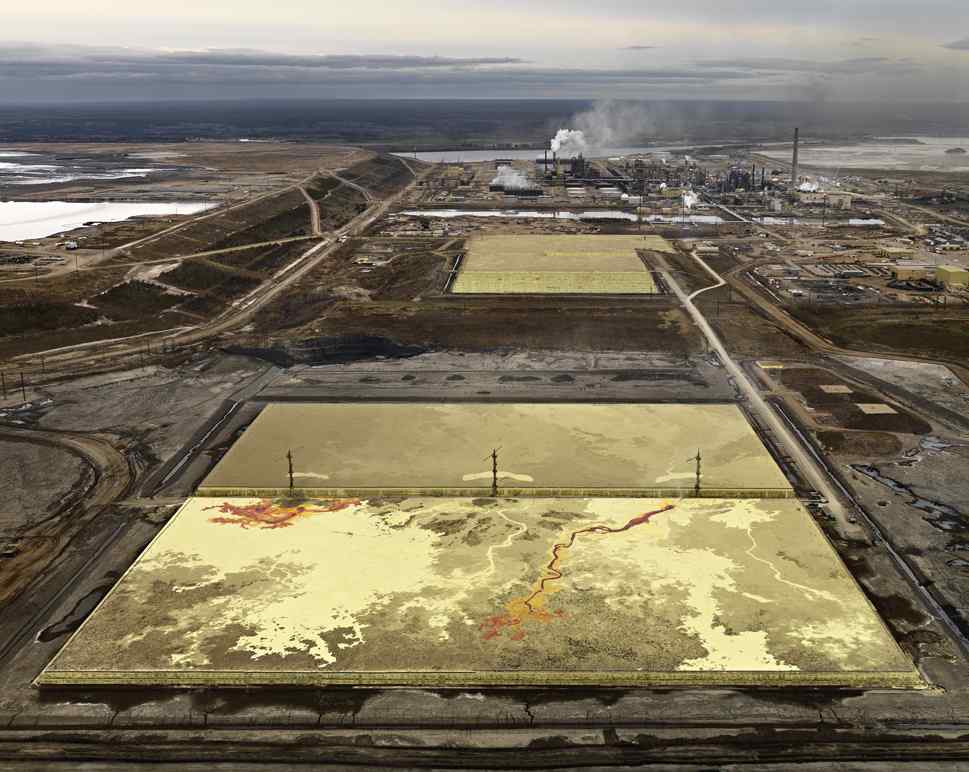
Canada and the United States are now the centre of Bizarro World. This is where leaders promise to reduce carbon emissions but ensure a new, supersized oil pipeline called Keystone XL is built, guaranteeing further expansion of the Alberta tar sands that produce the world’s most carbon-laden oil.

“It’s imperative that we move quickly to alternate forms of energy – and that we leave the tar sands in the ground,” the U.S.’s leading climate scientists urged President Barack Obama in an open letter Aug. 3.

“As scientists… we can say categorically that it’s [the Keystone XL pipeline] not only not in the national interest, it’s also not in the planet’s best interest.”

The letter was signed by 20 world-renowned scientists, including NASA’s James Hansen, Ken Caldeira of the Carnegie Institution, Ralph Keeling of the Scripps Institution of Oceanography, and George Woodwell, founder of the Woods Hole Research Center.  Continue reading

Canada Slashes Charity’s Funding To Protect Giant Tar Sands Project P.S. Oil companies get $2+ billion in subsidies

Please read this eloquent piece from Toronto Star columnist Catherine Porter on how the Harper govt cut funding of Kairos, a renowned church charity for telling the truth about Canada’s tar sands.

How can Canadians in good conscience try to help African women get water when it is carbon emissions from the tar sands are part of the reason they face drought?

And then Harper and his Minister Bev Oda lied and tried to cover up their vindictive actions claiming they want to improve the lives of the poor “efficiently”. (This from a govt giving billions in public subsidies to oil companies)

Here’s the first paras of Porter’s column:

A few years back, the staff at Kairos planned a trip to Nigeria’s oilfields to examine environmental damage, corporate responsibility and human rights abuses.

The board of the faith-based development organization rejected the idea. It sent them to Alberta’s tar sands instead.

“I remember saying, ‘They’ll kill us — that will be considered very political,’ ” recalls Mary Corkery, Kairos’ passionate executive director. “The churches said, ‘This is our work. Our work is inspired by faith to tell the truth. It’s a development issue if it’s far away. It’s a political issue if it’s at home. Or if it offends anyone.’ ”

Think it’s a stretch to compare Canada to Nigeria? A government that forges documents, that makes things up, that smothers dissenting opinions, that accuses the media of lying.

via Porter: Kairos does important work; we should all support it – thestar.com.

About Subsidies:

Every Day Governments Give an Estimated $2 billion to Oil, Coal & Gas Industry

About the Tar Sands:

30 Page e-book:_Oil Stains in the Boreal Forest: The Environmental Cost of Canada’s Tar Sands

Europeans stopped Canada’s Slaughter of Baby Seals – Can They Stop Canada’s Tar Sands?

Canada’s “Mordor” Ensures Climate Treaty Failure in Copenhagen

Report: +2.4C by 2020 leaves Billions Hungry? Scary but Untrue. Inside Story of Good Intentions Gone Wrong (and how the media fell for it)

Food Report Released Knowing the Science Was Wrong

By Stephen Leahy

Jan 19 2011

In the year 2020 climate change will devastate much of the world’s harvest leaving one in five people starving because the global temperature will have shot up an average of 2.4 degrees C a new report released Tuesday shows.

Shocking. Stunning. Scary even. And completely untrue.

Days before the report’s release I told the author Liliana Hisas of the Universal Ecological Fund (FEU), an Argentina-based NGO, it was impossible to get to 2.4 degrees of warming by 2020. Global temperatures have increased 0.8C in the last century and the 64-page report, “The Impacts of Climate Change on Food Production: A 2020 Perspective,” is based on additional 1.6C degree increase in just nine years time.

I asked several climate experts if it was possible to reach a +2.4 degree average global temperature by 2020. Their answer: “No way”.

This independent environmental journalism depends on public support. Click here learn more.

The reason is that the oceans absorb 93 per cent of the additional heat being trapped in the atmosphere due to the burning fossil fuels. If we stopped burning all fossil fuels and emitting other greenhouse gases today, the atmosphere would still continue to slowly heat up over the next 50 to 100 years as the oceans released that stored heat.

So ‘thank God for the oceans’ I said to Hisas who is also Executive Director of FEU-US when I explained all this via emails. And in an interview with Hisas on Monday I suggested the report be withdrawn. She refused, saying her organization had worked on the report for more than a year and the science was solid. It was all based on the Intergovernmental Panel on Climate Change (IPCC) 2007 report and had been vetted by Osvaldo Canziani, a former co-chair of the IPCC she said.

Unfortunately Canziani was in hospital and unavailable for an interview. Continue reading

Media Fails on Climate Change in 2010 – How You Can Ensure 2011 Will Be Better

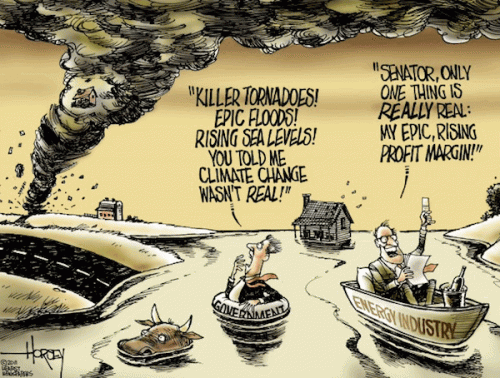
Few people understand the serious danger climate change poses all of us largely because media have done a poor job in covering it. In 2010, US TV media pretended it had all gone away – no more global warming…poof, bad dream, moving on.

From the must-bookmark The Daily Climate:

Drexel University professor Robert Brulle has analyzed nightly network news since the 1980s. Last year’s climate coverage was so miniscule, he said, that he’s doubting his data.

….

Coverage of December’s United Nations climate talks in Cancun is Exhibit A: Total meeting coverage by the networks consisted of one 10-second clip, Brulle said. By contrast, 2009’s Copenhagen talks generated 32 stories totaling 98 minutes of airtime. “I’m trying to check it again and again,” Brulle said of the 2010 data. “It’s so little, it’s stunning.”

Newspapers do little better with a huge decline in the US/Canada in 2010 which had some of the lowest level of coverage in the world, lower than Asia and the Pacific according to this graph. Continue reading