“We’re facing a planetary emergency” The Road to Rio (+20 years)

“Humanity is facing major challenges…urgent actions are needed”

Can we act as a true community?

By Stephen Leahy

UXBRIDGE, Canada, Jan 11, 2012 (IPS)

Humanity is driving Earth’s climate and ecosystems towards dangerous tipping points, requiring radical new forms of international cooperation and governance, experts say.

“We’re facing a planetary emergency,” said Owen Gaffney of the International Geosphere-Biosphere Programme based in Stockholm.

“We need to have a ‘constitutional moment’ in world politics, akin to the major transformative shift in governance after 1945 that led to the establishment of the United Nations and numerous other international organisations,” said Frank Biermann of VU University Amsterdam and director of the Earth System Governance Project.

“Humanity is facing major challenges…urgent actions are needed,” Biermann told IPS.

              Be a Partner in Independent Enviro Journalism

Those challenges include, but are not limited to, increasing poverty, food, water and energy security, the financial crisis, climate change, ocean acidification, the loss of biodiversity. All of these challenges and their solutions are interconnected.

Normally, the complex, mutually dependent systems of the Earth can self-correct and are remarkably stable. However, they can reach thresholds or tipping points and then unexpectedly and abruptly shift, Gaffney said in an interview.

“We need only recall how the U.S. sub-prime mortgage crisis nearly collapsed the global financial system,” he said.

The upcoming Rio+20 conference on sustainable development needs to be the moment in human history when the nations of the world come together to find ways to ensure “the very survival of humanity”, he said. Continue reading
Become a Partner in Independent Enviro Journalism

A personal message from Stephen Leahy

“Journalism and media are society’s mirror providing accurate and essential information.

That is no longer the case.

Media are now controlled by a few major corporations like Murdoch’s News Corp. Coverage of environment and science has been gutted. If there is coverage it rarely digs below the surface. It’s not just TV, it’s all media.

After 18 years of being published in major publications on two continents I now count myself lucky to get $150 to $200 for an in-depth article. The few independent media outlets are either non-profits or struggling.

Urgent environmental issues didn’t go away just because most media stopped covering them.

More than 20,000 people attended the international climate meeting in Cancun, Mexico and it received one ten second clip on US network TV according to a Drexel University media study. (Coverage was even worse at last climate meet in Durban)

Nearly every indicator proves things are getting worse but less and less people know about this.

Many people, including leading scientists, tell me: ‘we need people like you to write about these issues‘. I’d like to do far more but it is impossible to continue without your help in what I’m calling Community Supported Journalism. People directly support independent journalists who craft honest and thoughtful articles about important subjects the mainstream media ignores or gloss over.

Community Supported Environmental Journalism Works

In 2010 dozens of people offered their help, donating $5,750 which helped ensure many breaking international stories were covered including the first media reports on the global die-off of corals and how climate change may be bringing colder winters to Europe and eastern North America. Those donors — I prefer to call them partners — enabled me to cover important international meetings like the UN Convention on Biodiversity, UNFCCC climate change conference and much more.

Thanks for reading.” — Stephen

Please join us. Consider a donation of just $10 a month to support enviro journalism that serves the public interest.

Contributions can be made safely and easily via PayPal* or Credit Card*. [You can cancel at any time, automatically. No need to contact me] 

Monthly support options starting @ $10 a month

One-time donations are most welcome. Click and enter the amount.

*More than 100,000 non-profits safely use PayPal Donate service

If you’d like a mailing address or contact me with story ideas, please complete this comment form.

Letters of Support:

We need people like you. In tough economic times, where information flow is increasingly channeled and controlled, you perform a simply critical role. Hang in there. You are an admirable role model for the future.”

– E. Ann Clark, Associate Professor, University of Guelph.

“Stephen Leahy has done a superb job exposing the enormous sums the US government is spending on corporate welfare for big oil.”

Ross Gelbspan, Pulitzer-prize winning editor and author of The Heat is On

My continued appreciation to those who have contributed in the past.

Fracking and Shale Gas Accelerating Global Warming

UPDATE Jan 2013:

Yet another study reveals fracking has a huge problem of gas leaks. Up to  9% of the gas pumped out of the ground leaks into the atmosphere according to a study by National Oceanic and Atmospheric Administration (NOAA) published in Nature this week. Natural gas (methane) is a powerful greenhouse gas. If these leaks are widespread, fracking is worse than burning coal, accelerating global warming.

In Jan 2012 I detailed new research in the article below showing that replacing coal with natural gas from fracking does little to fight climate change (see below). Now two studies published that since then make an even stronger case that fracking for natural gas is a HUGE MISTAKE:

From Nature: Air sampling reveals high emissions from gas field. Methane leaks during production may offset climate benefits of natural gas.

From Environmental Research Letters: New study demonstrates switching to natural gas is the path to climate disaster. What’s needed is an aggressive deployment of zero-carbon technologies and conservation. Joe Romm explains. — Stephen

Shale Gas Worse Than Coal Study Finds

By Stephen Leahy

UXBRIDGE, Canada, Jan 24, 2012 (IPS)

Hundreds of thousands of shale gas wells are being “fracked” in the United States and Canada, allowing large amounts of methane, a highly potent greenhouse gas, to escape into the atmosphere, new studies have shown.

Shale gas production results in 40 to 60 percent more global warming emissions than conventional gas, said Robert Howarth of Cornell University in New York State.

“Shale gas also has a larger greenhouse gas footprint than oil or coal over the short term,” said Howarth, co-author of a study called “Venting and Leaking of Methane from Shale Gas Development” to be published in the journal Climatic Change.

(Audio of news conference)http://of%20news%20conference

This latest study follows up on Howarth and colleagues’ controversial April 2011 paper that provided the first comprehensive analysis of greenhouse gas emissions from shale gas obtained by hydraulic fracturing. That study found that when gas wells are “fracked”, they leak large amounts of methane and pose a significant threat to the global climate.

“We stand by the conclusion of our 2011 research,” said Howarth.

That research undercuts the logic of energy sector claims that shale gas is a “bridge” to a low-carbon energy future. Those claims are based on the fact that natural gas (which is mainly methane) has half the carbon content of coal, and when burned for electricity it is more energy efficient than coal.

This independent  journalism depends on public support. Click here learn more.

However, those climate gains are more than negated by methane leaks both at the well during the fracking process (called flow-back), and through the gas delivery and distribution system. Howarth and colleagues estimate that between 3.6 and 7.9 percent of all shale gas produced leaks – called “fugitive emissions” – into the atmosphere, making it worse than burning coal or oil.

Please throw something in the tip jar before reading on.
This is how I make my living.

Continue reading

Wrote this nearly fours year ago, can’t believe it is more relevant than ever.

Stephen's avatarStephen Leahy, International Environmental Journalist

truth-over-fear.jpg

100,000 repetitions of a lie is still a lie

Many of those who deny that burning fossil fuels is altering the climate work diligently to confuse and delay action that would in reality benefit nearly all of us. These professional deniers and their followers can be convincing, citing well-known experts and twisting their views and findings.

So here’s a couple of common sense tips to add to your BS detection system.

Denier Tip #1:Check out suspect claims/sources with a simple Google search

100,000 repetitions or variations of a lie is still a lie. A reader recently told me global warming is really caused by variations in the sun’s activity. His proof was a “science” article from Investor’s Business Daily that said this was the conclusion of the Max Planck Institute for Solar System Research, a well-known research centre in Germany. A quick check of the Institute’s website…

View original post 216 more words

Faith Groups Call for African Spirit of “Ubuntu”; End Sinful, American-style Greed

South African Bishop Geoff Davies (L) and Mardi Tindal, Moderator of the United Church of Canada

By Stephen Leahy

DURBAN, South Africa, Dec 9 (IPS)

African and international faith leaders urged governments attending the final day of climate change negotiations to do what is right and necessary to keep global temperature from rising no more than 1.5 degrees Celsius.

“The two degrees Celsius target is unacceptable because temperatures in much of Africa will be far higher,” said South African Bishop Geoff Davies.

Oil and coal companies along with other major polluting corporations are engaged in “crimes against humanity and the planet” because they continue to pollute the atmosphere when they have ability to do otherwise, said David Le Page of the Southern African Faith Communities’ Environment Institute (SAFCEI).

More than 130 African faith leaders have signed a declaration offering specific recommendations based science, honesty, morality and equity. They called on delegates negotiating a new climate treaty here at the 17th Conference of Parties to live up to the African spirit of “ubuntu” – a way of living focused on people’s allegiances and relations with each other.

The current economic system encourages “people to get as rich as they can and forget about anyone else,” said Davies. “It’s an immoral system.”

“Historic polluters like the United States have to reduce their emissions dramatically” and their position here is “shocking” and “reprehensible”, he said. The children and grandchildren of U.S. congressmen will ask what they were doing to be so selfish and irresponsible, Davies said.

The U.S is the most religious society in the world but their behaviour is “sinful” in their refusal to reduce emissions that causing so much suffering among people, he said.

“When lifestyles of the wealthy hurt the lives of the poor….and future generations it is wrong,” Mardi Tindal, Moderator of the United Church of Canada, the country’s largest Protestant denomination.

“Climate change is a moral, ethical and spiritual issue. We need moral leadership not political leadership,” Tindal told IPS.

“South Africa has had courageous, moral leaders like Ghandi and Mandela. If our leadership shows the same moral courage the people will follow them.” Continue reading

Every six seconds a hungry child dies | UN Tries to Halt Land Degradation Crisis

By Stephen Leahy

CHANGWON, South Korea, Oct 25, 2011 (IPS)

Every six seconds a child dies of hunger-related causes.

That disturbing reality seems as remote as the moon here in the ultra-modern Changwon Convention Centre, where delegates struggled to create effective ways to stem the ongoing decline of food-producing lands.

Each year, 12 million hectares of land are lost where 20 million tonnes of grain might have been grown, according to the United Nations Convention to Combat Desertification. And that loss of food-producing lands is unlikely to change in the near future, even as the final gavel fell in the early morning hours of Oct. 22 at the end the two-week biannual 10th Conference of the Parties (COP 10).

“This conference has been highly successful,” said Lee Don Koo, minister of the Korean Forest Service and COP 10 president and host.

It was certainly the largest international gathering on land degradation, with 6,450 participants from 161 countries, including 83 ministers and deputy ministers. Lee Don Koo said this meeting sent a strong message to the world community about the need for strong, sustainable land management and for the pressing need to set targets to reduce land degradation.

“Our goal is to build a land-degradation-neutral world,” said Luc Gnacadja, executive secretary of the UNCCD. The target date to reach that goal is 2030, Gnacadja told IPS.

Gnacadja would like countries to officially adopt this goal at the RIO+20 conference in June 2012 in Brazil.

It has taken nearly 20 years to get to the point where there is agreement on 11 scientific indicators to measure land degradation and its impacts. Development and implementation of those indicators will take some years yet. The Convention has yet to address the economic and policy drivers of land degradation, acknowledged Antonio Rocha Magalhães, chair of the Committee on Science and Technology. Continue reading

Truth and Wisdom From Spiritual Leaders at Durban Climate Talks

Why do countries at the international climate talks accomplish so little when they apparently understand the science and risks of global warming?

Here is the knowledgeable, depressing and yet inspiring answer from three remarkable spiritual leaders:


That was a press conference on one the last days of the 2011 climate talks in Durban. And here is the article I wrote about this and the “ubuntu” declaration by more than 130 African faith leaders. — Stephen 

Cars are only used 90 minutes a day on average. Peer-to-peer car sharing makes money for car owners and reduces need for car ownership.

Stephen's avatarStephen Leahy, International Environmental Journalist

Cars are parked 22 hours a day on average yet world will have 2.5 billion cars in 2050

The costs of car ownership and travel are far higher than anyone realizes: a 100 km total trip costs between 65 and 80 dollars when parking, fuel, wear and tear, insurance, depreciation, repairs are included. A car is usually parked and unused 22 hours a day but still incurs costs. Why not let someone use the car when you’re not and make some money at the same time Robin Chase told me for this article. She’s launched Buzzcar in France as part of a strategy for reducing carbon emissions and congestion in cities.   — Stephen

Why do car owners get so much more public space than bus riders, bicyclists or walkers?

By Stephen Leahy

BERLIN, Jun 2, 2011 (IPS)

The world’s more than 850 million cars and small trucks are parked…

View original post 1,085 more words

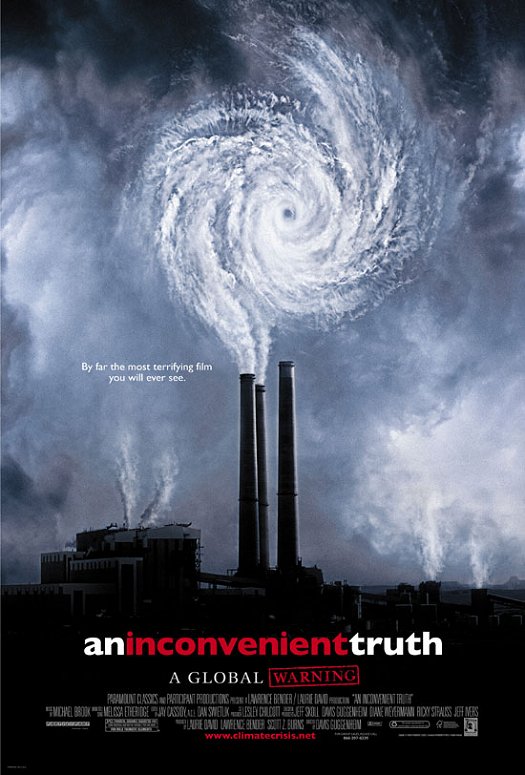
A Very Inconvenient Truth: Gore Got It Right on Global Warming

[Reposted from 2006, nearly six years ago. It offers interesting perspective about the continuing (worsening?) political insanity of inaction  – Stephen]

By Stephen Leahy

BROOKLIN, Canada, Jun 20 (IPS)

Former U.S. Vice President Al Gore’s documentary on global warming, “An Inconvenient Truth”, is filling theatres across North America – and gets the science right, according to climate experts.

“I saw it last night and was impressed with the climate science presented in the film,” said David Archer, a climatologist at the University of Chicago.

“I left the theatre profoundly depressed because of the political insanity in this country that denies global warming is a concern,” Archer told IPS.

Gore’s personal passion about global warming can be traced to the early 1980s. After losing the election to George W. Bush in 2000, Gore dedicated himself to warning the public about the devastating impacts climate change will have on hundreds of millions of people.

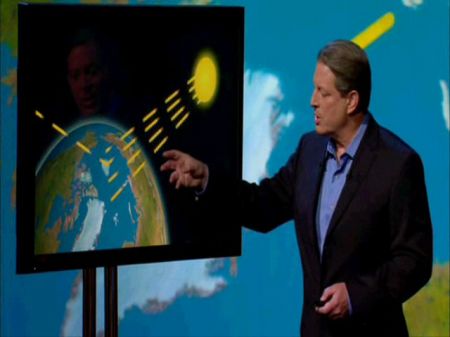
“An Inconvenient Truth” is a 98-minute documentary comprised mainly of highlights from Gore’s high-tech slide show explaining the science documenting global climate change.

Some truths are hard to hear, because if you really hear them – and understand that they are in fact true – then you have to change. And change can be quite inconvenient,” Gore says in the film.

Using an impressive set of graphics, he carefully illustrates changes underway such as receding glaciers, collapsing ice sheets, devastating floods and droughts. One memorable scene shows a graph of carbon-dioxide levels in the atmosphere going back 650,000 years that varies only a little until fifty years ago when it skyrockets. Gore mounts a motorised platform to lift him up high up the chart so he can place his finger on the current level of CO2. Continue reading