“We Are a Harbinger of What Is to Come” – Global Warming is Already Affecting Millions – Video

[Those living closest to the land – small farmers, pastoralists, indigenous peoples — are already suffering from impacts of climate change. They have made a series of short videos to show people like you and me who are insulated from these impacts how our emissions of carbon are changing the world.

This is both a plea for help and a warning of what’s coming for all of us.

I found it remarkable those I spoke with are not angry. They simply want us to understand what is happening to them because if we understand, if we know what we are doing to them, then we will act. I hope they are right. — Steve]

By Stephen Leahy

COPENHAGEN, Dec 3 (IPS)

A small group of indigenous people have travelled here to the historic Copenhagen climate talks to show negotiators dramatic documentary videos they made about the immediate impacts of climate change on their homelands and way of life.

“We want to show policymakers what the three-year long drought in my country is doing to our communities,” said Stanley Selian Konini, a Maasai from Oltepesi in Kajiado district, Kenya.

“Our animals are all dead. The zebras and the monkeys are dying even in the forests,” Konini told IPS. “Leaders need to change policies to help us.”

The Kenyan video documents the impact of an intense drought hitting the Maasai community. During these extremely hard times, pastoralists have been losing their cattle – their main and sometimes only livelihood.

“It’s affecting our culture. There can be no dowry payments because we have no animals,” said Konini, one of the young Maasai who made the video.

“The elders say they have never seen anything like this drought. It is something beyond their understanding and experience of the Maasai people,” he said. Continue reading

Is Privatizing Air & Water Only Way to Save the Planet? — Copenhagen Talks

By Stephen Leahy*

COPENHAGEN, Dec 17 (Tierramérica)

In the last two years, the conclusion among decision-makers has been that the only way to solve the climate crisis is to turn carbon into a commodity and privatise the atmosphere.

Similar market-based solutions will be used to “solve” the growing water crisis, warned experts at the Klimaforum09, a parallel meeting a few kilometres away from the official 15th Conference of Parties (COP15) to the United Nations Framework Convention on Climate Change, held Dec. 7-18 in Copenhagen.

“Corporations do not want regulations and have convinced governments that they can deliver continued economic growth and save the planet,” said Maude Barlow, chair of the Council of Canadians, the largest citizens group in Canada and author of several books about water issues.

“It shows the power of the corporate lobby that nearly everyone, including many big NGOs, all see the market as the solution to climate change,” Barlow told Tierramérica.

Meanwhile, the climate justice movement is fighting against carbon trading and carbon offsets and advocating for real emissions cuts, while recognising that the commons – air and water – are a public trust, she said

See No Water in Copenhagen Talks

Learn About Community Supported Journalism

Canada’s “Mordor” Ensures Climate Treaty Failure in Copenhagen

[Hello from snowy and cold Copenhagen. Tensions have ramped up as political leaders arrived but are mainly meeting in secret.

Ashamed to say Canada is a widely acknowledged as a public embarrassment here. And called a climate criminal by some. Several protests like the one I covered below and a smaller one earlier have focused on the Athabasca Tar Sands perhaps the world’s biggest source of carbon emissions.

Outside the artificial reality of the Bella Center ordinary people get it. Here is good video summary of what happened on Wed as civil society were gradually banned from the conference. It accords with my son’s version who was in the middle of all this as an observer. — Steve]


By Stephen Leahy

COPENHAGEN (IPS/TerraViva) Dec 14 2009

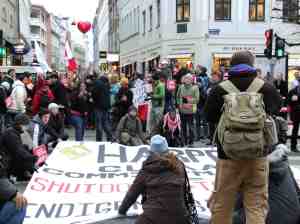
Climate activists jammed a small square near the police-barricaded Canadian Embassy here Monday for the second day of protests over the country’s tar sands development.

Simultaneous protests were held at the Canadian Embassy in London because British oil companies and financial institutions are deeply invested in the Canadian mega-project.

“As indigenous people, we are here at the international climate negotiations to speak about threats to our cultural survival and the direct life-threatening impacts of climate change in our communities,” said Clayton Thomas Muller, tar sands campaigner for the Indigenous Environmental Network.

“Canada has been blocking the climate negotiations and hasn’t kept Kyoto commitments…because of the tar sands,” he told a crowd of 75 to 100 people surrounded by four squads of riot police.

Boreal forests and wetlands the size of Greece are been destroyed in northern Alberta in an industrial project that turns millions of tonnes of sand and earth into oil, mainly for the U.S. market he said.

“All the efforts by Canadians to reduce their carbon emissions are undone by the tar sands,” said Canadian writer and activist Naomi Klein.

The tar sands are Canada’s largest single source of carbon dioxide (CO2) emissions and the major reason why Canada has refused to live up to its commitments to reduce emissions and is blocking negotiations, Klein told protesters.

“Canada is making a mockery of international law and of developing countries’ need for urgent emission reductions in rich countries,” she said.

Canadian Prime Minister Stephen Harper is here at the Dec. 7-18 U.N.-sponsored climate summit under false pretences, Klein charged.
Harper does not have the Canadian people’s permission to promote the tar sands or to favour Canadian interests over those of the planet,” she said.

The tar sands are “Canada’s Mordor”, said Maude Barlow, head of the Council of Canadians, the largest citizens’ group in Canada. She was referring to the devastated land of rock and fire in the “Lord of the Rings” trilogy.

“What else can you call a project that leaks 11 million litres of toxic waste a day into rivers and groundwater?” Barlow said in this very un-Mordor upscale shopping district of downtown Copenhagen.

The tar sands project has the largest toxic waste containment ponds on the planet – easily visible from space. Last week, a report revealed the extent of the leaks to be an estimated 11 million litres a day.

Shockingly, this is based on the oil companies’ own self-reported data, says Environmental Defence, the Canadian advocacy, research and education group that compiled the report.

It calculated that four billion litres of leakage a year will grow to 25 billion in a decade based on current growth of the tar sands and aging of the enormous dams that hold back the waste.

“There is no question Harper will stand up for  the oil sector [in the climate talks here],” Barlow said.

Their [oil industry] footprints are all over this negotiation and that is why it will fail.”

-30-

Corrected 2/2/12

For more on the Tar Sands see:

Oil Stains in the Boreal Forest: The Environmental Cost of Canada’s Oil Sands – Revised V2.1Oil Stains in the Boreal Forest: The Environmental Cost of Canada’s Oil Sands – Revised V2.1

Copenhagen: Rich Nations Betraying Poor In Climate Talks (surprised?)

By Stephen Leahy

COPENHAGEN, Dec 7 (IPS/TerraViva)

Betrayal and backsliding by rich countries marks the beginning of the final negotiations for a global climate treaty, according to many developing world participants at the U.N.-sponsored talks here.

“Developed countries express deep concern and commitment to action in their public statements, but it is completely different in the negotiating rooms,” said Algerian negotiator Kamel Djemouai, chair of the Africa group, which represents more than 50 African countries.

“What you hear in public is not what is being done,” Djemouai told delegates at a side meeting at the COP 15 climate meetings here.

At the last round of climate talks in Barcelona, African countries boycotted the meetings, saying that industrialised countries had set carbon-cutting targets too low to substantially reduce global greenhouse gas emissions. Climate change is already having significant impact on Africa and those impacts are a form of discrimination, Djemouai said.

“Science tells us that when the global average temperature is one degree C. higher, it will be two degrees C. hotter in Africa,” he added. Continue reading

The simple truth: “The whole thing unravels without protecting at least half of the planet”

Job #1. end government subsidies that drive economic activity that damages the environment

By Stephen Leahy

MÉRIDA, Mexico, Nov 17 IPS

At least half the planet must be protected if humanity is to survive the next century, declared conservationists at the conclusion of 9th World Wilderness Congress on Friday, Nov. 13.

“That is what the science said, this is what many aboriginal people say,” said Harvey Locke, the Wild Foundation's vice president of conservation strategy.

“It’s time to speak the simple truth: The whole thing unravels without protecting at least half of the planet,” said Locke.

A leading economic report released in Brussels also on Nov. 13 pegged the cost of the ongoing loss and degradation of nature’s “infrastructure” at a staggering 2.5 trillion to 4.5 trillion dollars a year.

The enormous challenges humanity faces this century – like a warming planet, freshwater shortages, pollution, declining fisheries, desertification and unsustainable food production – cannot be solved without protecting more than 50 percent of Earth’s land and oceans, Locke told IPS.

Protection doesn’t necessarily mean more national parks, but a ban on resource extraction and all forms of development.

Is this article of interest? It exists thanks to contributions from readers. Please click here to learn more about Community Supported Journalism.

“We all know we aren’t sustainably managing the Earth,” he told participants at the WILD9 congress, a partnership between the WILD Foundation, an international, non-governmental non-profit based in the United States, and Unidos para la Conservación, a conservation organisation in Mexico.

“It is time for us to state clearly the scale of conservation intervention needed to make the 21st century one of hope instead of despair,” he said. Continue reading

Plants Finally Get DNA Barcodes — Genetic profiles to fight illegal logging

By Stephen Leahy*

MÉRIDA, Mexico, Nov 20 (Tierramérica)

Advances made in genetic profiling could be used to fight illegal timber trading, provide authentication of herbal medicines and map entire food chains, according to experts at a conference of the Mexican Academy of Sciences.

“It’s taken four years, but the new science of DNA (deoxyribonucleic acid) barcoding now has the crucial 'marker' for plants,” said David Schindel, executive secretary of the Consortium for the Barcode of Life (CBOL).

“Biodiversity scientists are using DNA technology to unravel mysteries, much like detectives use it to solve crimes,” Schindel told Tierramérica from Mexico City, where CBOL was co-host of the Nov. 10-12 conference of the Mexican Academy of Sciences with the Biology Institute of the Autonomous National University of Mexico (UNAM).

“This work in Mexico and elsewhere is enormously important,” says Patricia Escalante, chair of the Institute’s zoology department.

“Barcoding is a tool to identify species faster, more cheaply, and more precisely than traditional methods,” Escalante stated in a press release. Continue reading

Conserve Nature – Best Way We Have To Cope With Climate Change & Survive This Century

“….nature is sick, which threatens the survival of the human species”

“Conservation of nature is the first order strategy for climate change and carbon capture sequestration”

The only way forward is that “we must learn to live a simple life that is spiritually based”

By Stephen Leahy

MÉRIDA, Mexico, Nov 12 (IPS)

Lawrence Amos travelled from the Arctic at the top of the world to the tropical middle to recite in a soft voice the ongoing destruction of his home by climate change.

The ice is rougher and not as thick, and melts in May instead of June. There is less snow, more coastal erosion, and permafrost is melting, threatening to swallow homes, said Amos, an Inuit who lives in Sachs Harbour in Canada’s High Arctic, one of the remotest communities on the planet.

Amos was speaking here on Memorial Day at the 9th World Wilderness Congress from Nov. 6-13, where many other indigenous peoples, scientists and conservationists from more than 50 countries documented the escalating impacts of climate change on the land and in the oceans.

Like the roll call of the names of those fallen at Memorial or Remembrance Day ceremonies, Amos’ list of impacts experienced by the people of the western Arctic was tragically long.

Insects, birds and fish never seen before are now appearing in the region. “Grizzly bears are mating with polar bears… Our traditional knowledge about the land is becoming worthless,” he told IPS.

“Mother Nature does not use language. We must be aware of the signs, the changes in species, the melting of glaciers to inform us that nature is sick, which threatens the survival of the human species,” said Bittu Sahgal, founder of Sanctuary Asia, India’s leading environmental conservation magazine and book publisher.

“Nature will not talk to us, it will give us consequences,” he told more than 1,500 participants at the WILD9 congress, a partnership between the WILD Foundation, an international, non-governmental non-profit based in the United States, and Unidos para la Conservación, a conservation organisation in Mexico. Continue reading

Amateur Biologists Join Global Bid to Catalog All the Species on the Planet – Join the Fun

By Stephen Leahy

UXBRIDGE, Canada, Aug 25 (IPS)

(all images courtesy of EOL)

Save the living environment and the physical environment will automatically be saved, according to E.O. Wilson, the world’s leading biologist and father of the online Encyclopedia of Life, which plans to create a web page for every known species – all 1.8-plus million.

Climate and water are parts of the physical environment that rely on the living environment – trees, insects, animals – to keep them clean, healthy and in balance.

But that fundamental reality is not well understood by the public and little progress has been made in preventing the destruction of ecosystems and species, Wilson recently told the New Scientist magazine. That’s why Wilson came up with the idea in 2003 to create a publicly accessible, interactive Encyclopedia of Life (EOL).

Launched in 2008, the EOL is growing quickly with 170,000 entries, over 30,000 still images and video – with some provided by members of the public.

“We want to engage the public. With the EOL they can survey the species in their yard and neighbourhoods and report what they find,” said James Edwards, EOL’s executive director based at the Smithsonian Institution in Washington.

“We’d love to see everyone become a ‘field biologist’ and submit what they’ve found,” he said.

Societal understanding and support is crucial to slow and reverse the loss of ecosystems and species, Edwards told IPS.

“If we can’t do that, we all will be in deep trouble,” he said.

Continue reading

Dwindling Fish Catch Could Leave a Billion Hungry

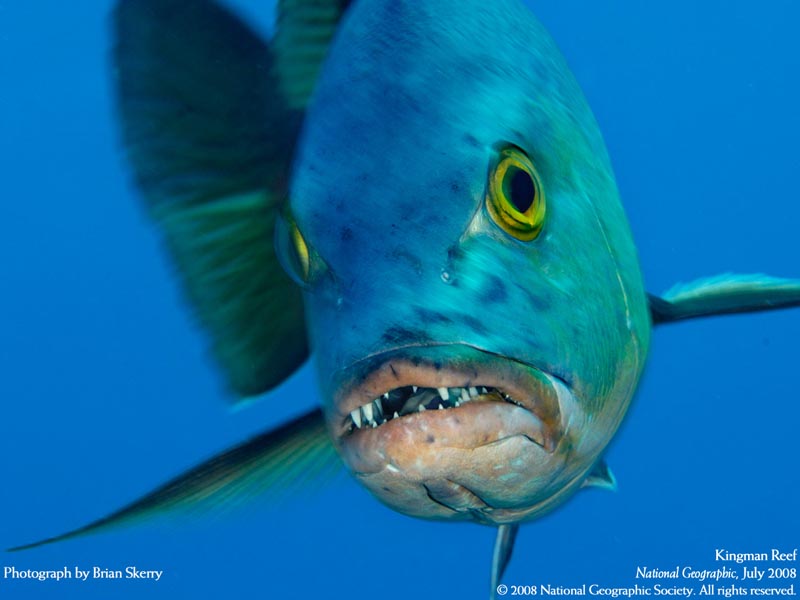
red snapper -- reef fish w teethBy Stephen Leahy

UXBRIDGE, Canada, Oct 9 (IPS)

Without action on climate change “The collapse of fisheries in much of the world would be a sideshow,” Daniel Pauly.

Fish catches are expected to decline dramatically in the world’s tropical regions because of climate change, but may increase in the north, said a new study published Thursday.

This mega-shift in ocean productivity from south to north over the next three to four decades will leave those most reliant on fish for both food and income high and dry.

“The shift is already happening, we’ve been measuring it for the last 20 years,” said Daniel Pauly, a renowned fisheries expert at the University of British Columbia (UBC).

“Major shifts in fish populations will create a host of changes in ocean ecosystems likely resulting in species loss and problems for the people who now catch them,” Pauly told IPS.

In the first major study to examine the effects of climate change on ocean fisheries, a team of researchers from UBC and Princeton University discovered that catch potential will fall 40 percent in the tropics and may increase 30 to 70 percent in high latitude regions, affecting ocean food supply throughout the world by 2055.

The study, published in the journal Global Change Biology, examined the impacts of rising ocean temperatures, changes in salinity and currents resulting from a warming climate. Continue reading

+4 Degrees C By 2060? Alarming But Not Alarmist

07_00_01_News_Panonoramica

By Stephen Leahy

UXBRIDGE, Canada, Oct 9, 2009 (IPS)

The prospect of a four-degree Celsius rise in global average temperatures in 50 years is alarming – but not alarmist, climate scientists now believe.

Eighteen months ago, no one dared imagine humanity pushing the climate beyond an additional two degrees C of heating, but rising carbon emissions and inability to agree on cuts has meant science must now consider the previously unthinkable.

“Two degrees C is already gone as a target,” said Chris West of the University of Oxford’s UK Climate Impacts Programme.

“Four degrees C is definitely possible…This is the biggest challenge in our history,” West told participants at the “4 Degrees and Beyond, International Climate Science Conference” at the University of Oxford last DeadTrees CO2 release naturalweek.

A four-degree C overall increase means a world where temperatures will be two degrees warmer in some places, 12 degrees and more in others, making them uninhabitable.

It is a world with a one- to two-metre sea level rise by 2100, leaving hundreds of millions homeless. This will head to 12 metres in the coming centuries as the Greenland and Western Antarctic ice sheets melt, according to papers presented at the conference in Oxford.

Four degrees of warming would be hotter than any time in the last 30 million years, and it could happen as soon as 2060 to 2070.

“Political reality must be grounded in physical reality or it’s completely useless,” John Schellnhuber, director of the Potsdam Institute for Climate Impact Research, told the conference.

Schellnhuber recently briefed U.S. officials from the Barack Obama administration, but he says they chided him that his findings were “not grounded in political reality” and that “the [U.S.] Senate will never agree to this”.

He had told them that the U.S. must reduce its emissions from its current 20 tonnes of carbon per person average to zero tonnes per person by 2020 to have an even chance of stabilising the climate around two degrees C.

China’s emissions must peak by 2020 and then go to zero by 2035 based on the current science, he added.

“Policymakers who agreed to a two-degree C goal at the G20 summit easily fool themselves about what emission cuts are needed,” Schellnhuber said.

Even with a two-degree rise, most of the world’s coral reefs will be lost, large portions of the ocean will become dead zones, mountain glaciers will largely vanish and many other ecosystems will be at risk, Schellnhuber warned. And there is the risk of reaching a tipping point where the warming rapidly accelerates. Continue reading