Skin Cancer and the Record-breaking Antarctic Ozone Hole

Ailments Surge as Ozone Hole Widens

stc_0196.jpg
The increase in skin cancer from sun exposure is alarming, scientists say. Residents of southern Chile and Argentina are advised to take extra care in protecting themselves from solar rays this spring season in the southern hemisphere.


By Stephen Leahy

TORONTO, Nov 11’06 (Tierramérica) – Skin cancer, eye lesions and other infections are on the rise, a reminder that the Antarctic ozone hole continues to be a serious problem, especially for southern Argentina and Chile, where ultraviolet radiation during the spring months increases 25 percent.

The ozone layer covers the entire planet at an altitude of between 15 and 30 kilometres, and protects living organisms from the sun’s harmful rays.

According to the U.S. National Oceanic and Atmospheric Administration (NOAA), the dramatic thinning of the ozone layer over the Antarctic — an annual phenomenon — sprawled to an average of 29.5 million square kilometres Sep. 21 to Sep. 30.

“This year’s Antarctic ozone ‘hole’ is the largest on record,” said Achim Steiner, executive director of the United Nations Environment Programme (UNEP).

“Governments need to reduce and shut down the remaining sources of ozone-depleting chemicals,” Steiner said in a statement.

The rates of sunburn increase during the southern hemisphere springtime, when the Antarctic ozone hole is large enough to extend over the city of Punta Arenas at the southern tip of Chile, according to studies conducted by Chile’s Universidad de Magallanes.

Fully Story here

My More Recent Ozone Articles:

2008 – Monster Ozone Hole (Again) – But your skin would fry in 3 mins without 20-yr old Ozone Treaty

2007 – Skin Cancer Rising Despite New Ozone Deal to Cut CO2 Emissions 

Ozone Hole is Back and Bigger Than Ever

Ozone Treaty Best Bet to Slow Climate Change

The Real Cost of US Strawberries

From Mosques to Mollusks, No Haven From Rising CO2

By Stephen Leahy

BROOKLIN, Canada, Nov 10 (IPS) – Three hundred and eighty parts per million. That’s the current concentration of carbon dioxide going into your lungs with each breath. Our parents or grandparents’ first breaths at birth contained about 290 parts per million (ppm), as it was for everyone born before them.

What does it really mean when in the not so distant future our children or grandchildren will inhale 450, perhaps 500 ppm or more of carbon dioxide?

Evidently, breathing in a bit more carbon dioxide (CO2) isn’t bad for human health — oxygen at sea level is 200,000 ppm, after all — but the changing atmosphere is having profound impacts on the climate of the planet.

The changing climate has many consequences, among them the potential loss of ancient ruins in Thailand, coral reefs in Belize, 13th century mosques in the Sahara, the Cape Floral Kingdom in South Africa and other irreplaceable natural and historic sites around the world, experts reported this week.

“Climate changes are impacting on all aspects of human and natural systems, including both cultural and natural World Heritage properties, “said Koichiro Matsuura, director-general of the U.N. Educational, Scientific and Cultural Organisation, which hosts the World Heritage Centre.

— Full Story here

Billions Needed to Climate-Proof Africa

By Stephen Leahy

BROOKLIN, Canada, Nov 6 (IPS) – Climate change will devastate Africa without substantial help from the world community, according to a new report released at the opening of a major U.N. climate change conference in Nairobi, Kenya Monday.

“Africa is the least responsible for climate change but will be hit the hardest,” said Nick Nuttall, spokesperson for the United Nations Environment Programme (UNEP).

New scientific data shows that Africa is more vulnerable to the impacts than previously thought, Nuttall told IPS from Nairobi.

Seventy million people and 30 percent of Africa’s coastal infrastructure face the risk of coastal flooding by 2080 linked to rising sea levels, the report found. More than one-third of the habitats that support African wildlife could be lost. Crop yields will fall due to warmer temperatures and more intense droughts.

By 2025, some 480 million people in Africa could be living in water-scarce or water-stressed areas.

“If Africa’s weather gets any more fickle, then they are in very deep trouble,” said Steve Sawyer of Greenpeace International. Sawyer is one of 6,000 people in Nairobi attending the United Nations Climate Change Conference.

Full story here

TRUTH TELLING – JOURNALISTS RISK THEIR LIVES

“I am not afraid of being killed,” says Egyptian journalist Abeer Al-Askary

cjfe_banner_a.jpg

Honouring the Best Who Cover the Worst

By Stephen Leahy

TORONTO, Nov 3 (IPS) – “I am not afraid of being killed,” says Egyptian journalist Abeer Al-Askary, who has been repeatedly threatened and beaten by Egyptian government security forces.

“The journey towards full freedom of expression is long and it is difficult,” Al-Askary told IPS.

Al-Askary was in Toronto Wednesday to receive one of this year’s three International Press Freedom Awards from the Canadian Journalists for Free Expression (CJFE).

Colombian print and television journalist Hollman Morris and Pakistani writer and photographer Hayat Ullah Khan were the other award recipients.

Khan’s family will receive the 3,000-dollar award because he was abducted on Dec. 5, 2005. His body was found in North Waziristan near Afghanistan on Jun. 16 this year. He had been handcuffed and shot in the head. Pakistani intelligence services are suspected since Khan was kidnapped four days after reporting on and releasing photos about a missile attack on North Waziristan by what may have been a U.S. drone.

complete story

*Photo Courtesy of Canadian Journalist for Free Expression

Oceans on the Brink of No Return

yellow-fin-tua-galapagos.jpg

By Stephen Leahy Nov 2 ’06 (IPS) – Every single commercial fishery in the world will be wiped before 2050 and the oceans may never recover if over-fishing continues at its current rate, a four-year scientific investigation has found.

“By the time my nine-year-old son is my age, there would be no wild seafood left,” said Emmett Duffy, a scientist at the Virginia Institute of Marine Sciences in the United States.

In this grim, not-to-far-off future, not only will there be no fish to eat, humans will also lose the vital services oceans provide, including processing wastes, cleaning beaches, controlling flooding and absorbing carbon dioxide from the atmosphere. Continue reading

Free Markets Cause Chronic Hunger in Africa — There’s Plenty of Food but No Money

By Stephen Leahy

BROOKLIN, Canada, Oct 20, 2006 (IPS)

[World Bank and International Monetary Fund free-market doctrines responsible for much of Africa’s hunger experts say]


It is a world of paradox and plenty:

852 million people are starving while one billion people are overweight, with 300 million of them considered medically obese.

And the numbers of people whose health are at serious risk due to starvation or from obesity is rising rapidly.

While what the World Health Organisation calls a global epidemic of obesity is a health issue of the modern world, hunger and malnutrition are old and bitterly intractable problems.

More than 50 million Africans currently need food assistance, according to the U.N. World Food Programme. More than 120 million Africans are living permanently on the edge of emergency food aid, says the British charity CARE International.

Why is hunger chronic in Africa?

“There is enough food, but people don’t have enough money to buy it,” says Anuradha Mittal, executive director of the Oakland Institute, a U.S.-based policy think tank on social, economic and environmental issues.

“Sixty-three percent of people in Niger live on less than a dollar a day,” Mittal told IPS.

Hunger is mainly the result of poverty.

Rome-based Food and Agriculture Organisation (FAO) reports that th

ere is enough food to give everyone in the world more than 2,700 calories a day, she says. Continue reading

CANADA BAD: New Environment Policy Ignores Science

Critics Say New Environment Policy Ignores Science

By Stephen Leahy

Canada has officially turned its back on the Kyoto Protocol and climate change in its new “green plan” introduced Thursday, environmentalists say.

The new Conservative government’s environmental legislation called the Clean Air Act does not offer specific reduction targets other than a goal of cutting emissions of greenhouse gases 45-65 percent below 2003 levels by 2050.

“It’s a green scam, a delaying tactic that involves three more years of consultations,” said Claire Stockwell of the Canadian Youth Climate Coalition.

“We have already had six years of consultations and under existing legislation we could regulate emissions of greenhouse gases tomorrow,” Stockwell told IPS.

About 40 youth groups formed the non-partisan coalition this past September because of the realisation that the Conservative government will not comply with Canada’s commitments under the Kyoto Protocol, she said.

The coalition organised mock “funerals for the future” in 14 Canadian cities last week to protest the lack of urgent action on “the most pressing issue of our time”.

IPS News – published October 20 2006

Russia Leads the Most Poisonous Places on Earth

dzerzhinsk-factories[I have added more of the story in this post but the full article remains for subscribers only, sorry.]

By Stephen Leahy

Russia tops the list of the 10 most polluted places on the planet, while more investigation into Latin American and African pollution sites is needed, according to a U.S. environmental group.

Lead and other heavy metals, along with buried chemical weapons and radiation hazards from sites like Chernobyl in Ukraine, are the main sources of pollution affecting the health of 10 million people in different locations around the world.

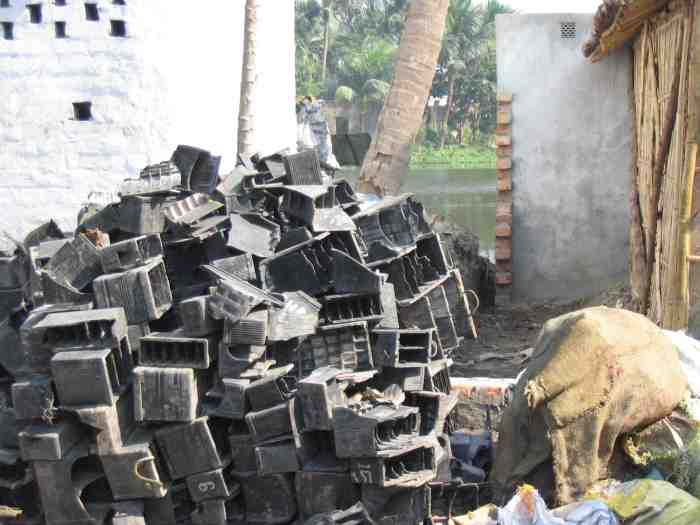
empty-car-battery-casings-india-photo-by-blacksmith-institute-sml

“These extremely toxic areas are mostly unknown even in their own countries,” said Richard Fuller, director of the New York-based Blacksmith Institute.

Continue reading