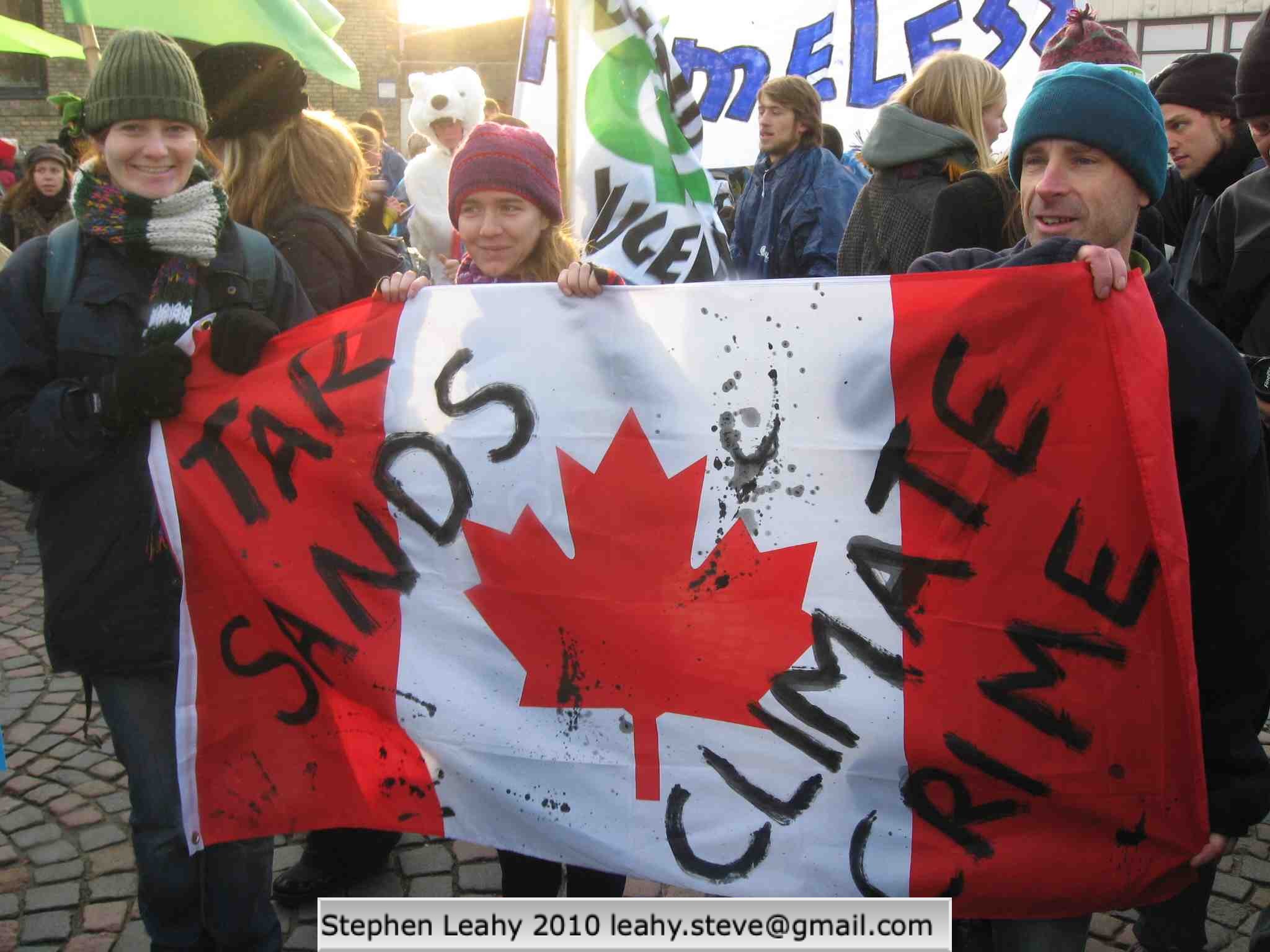
Canada Spurns Climate Treaty in Favour of Tar Sands (and lies about its emissions)

‘Oil companies are in the driver’s seat when it comes to Canadian federal energy policy’

By Stephen Leahy

BONN, Jun 13, 2011 IPS

Canada was roundly criticised by other nations at a major U.N. climate meeting last week after being caught underreporting carbon emissions from its tar sands oil production facilities, one of the countrys biggest and fastest growing sources of global warming gases.

But even the “full emissions” data that Canada finally released represents only about half of the actual emissions, according to a new report.

“Small oil sands companies are not required to report their emissions. And oil-refining emissions are not included in tar sands emissions,” said independent Canadian researcher Michelle Mech.

Canada likes to claim the city-sized tar sands project in the western province of Alberta represents only five percent of the country’s entire emissions, but the real number is closer to 10 percent, Mech told IPS.

Getting oil out of the tar sands requires extraordinary efforts, including enormous amounts of energy, and has been labeled ‘dirty oil’ as a result.

“Average emissions for oil sands production and upgrading (well-to- pump) are estimated to be 3.2 to 4.5 times as carbon intensive as conventional crude produced in North America,” concluded Mech’s report, “A Comprehensive Guide to the Alberta Oil Sands”.

“The tar sands are huge in terms of their impact on the environment but also on Canadian democracy. Oil is starting to run the country now,” she said.

Continue reading

Can Obama Take First Step to Break Addiction to Oil? (And Win First Battle Against Big Oil?)

Sept 3 protest at white house

‘…unless river of money from Big Oil is diverted there is no way to deal with climate change’

Analysis by Stephen Leahy

UXBRIDGE, Canada, Aug 31, 2011 (IPS)

The United States’ biggest environmental groups put aside their differences last week to make an urgent intervention on the country’s addiction to oil. The first step on the long road to recovery, they say, is to stop the proposed construction of the Keystone XL pipeline that will “mainline” the world’s dirtiest oil from northern Canada into the U.S. heartland.

“This (Keystone) is a terrible project,” they wrote in a letter to President Barack Obama, citing dangers to the climate, the risks of disastrous spills and leaks, and the economic damage that will come from continued dependence on fossil fuel.

Oil from the Keystone XL will dump an estimated 150 million tonnes of carbon dioxide (CO2) annually into the atmosphere – more than most countries. Scientists warn that approval of the project will further fuel the extreme weather that has already resulted in over one billion dollars in damages recorded this year in nine separate extreme weather events in the U.S.

And that doesn’t include the estimated 20 to 45 billion dollars in costs from Hurricane Irene last weekend, mainly due to extensive flooding.

Carbon dioxide (CO2) emissions from fossil fuels do not cause hurricanes, tornados or droughts, but they do trap additional heat and water vapour that fuels those events, climate scientists have proven time and time again.

Asked about the impacts of adding another 150 million tonnes of CO2 into the atmosphere, German climate scientist Malte Meinshausen, a researcher at the Potsdam Institute for Climate Impact Research, told IPS that it will warm the planet for hundreds of years and lead to higher sea levels and “more pronounced droughts and floods”.

Continue reading

Welcome to Bizarro World: Canada and US Spending $billions to Create Climate Chaos

President Obama and Prime Minister Stephen Harper (left) say they’re worried about climate change, but neither the U.S. nor Canada has cut emissions.

Analysis by Stephen Leahy

UXBRIDGE, Canada, Aug 10, 2011 (IPS)

Canada and the United States are now the centre of Bizarro World. This is where leaders promise to reduce carbon emissions but ensure a new, supersized oil pipeline called Keystone XL is built, guaranteeing further expansion of the Alberta tar sands that produce the world’s most carbon-laden oil.

“It’s imperative that we move quickly to alternate forms of energy – and that we leave the tar sands in the ground,” the U.S.’s leading climate scientists urged President Barack Obama in an open letter Aug. 3.

“As scientists… we can say categorically that it’s [the Keystone XL pipeline] not only not in the national interest, it’s also not in the planet’s best interest.”

The letter was signed by 20 world-renowned scientists, including NASA’s James Hansen, Ken Caldeira of the Carnegie Institution, Ralph Keeling of the Scripps Institution of Oceanography, and George Woodwell, founder of the Woods Hole Research Center.  Continue reading

Who Controls the Nuclear Control Agencies?

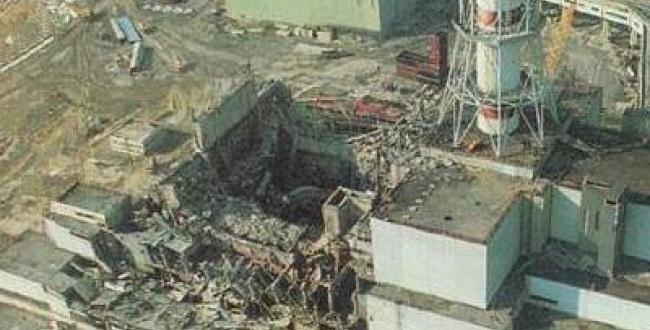
April 1986 disaster at the Chernobyla nuclear power plant in Ukraine

“There are few independent nuclear experts in the world. Everyone either works in the industry or used to and are now regulators.”

Canadian Government fired chief regulator for trying to improve safety standards — Greenpeace

By Stephen Leahy*

UXBRIDGE, Canada, Mar 23, 2011 (Tierramérica)

As Japan struggles to confront a nuclear disaster that could be the worst in history, it seems clear that any discussion about the safety of nuclear energy should address the independence of regulatory agencies.

On Apr. 26, 1986 a series of explosions and fires at the Chernobyl nuclear power plant in Ukraine released radioactive fallout that spread over eastern and western Europe, particularly affecting Ukraine itself, Byelorussia (now Belarus) and Russia, all Soviet republics at the time.

Twenty-five years later, Chernobyl’s reactor number 4 continues to emit high levels of radioactivity even though it is buried under a thick but decaying layer of concrete.

Europe and the United States are trying to raise more than two billion dollars to build a permanent sarcophagus to contain the radiation.

The Chernobyl disaster is usually attributed to obsolete technology and the secrecy characteristic of the Soviet regime.

The accident at the Tokyo Electric Power Co. (TEPCO) Fukushima I Nuclear Power Plant was triggered by the damage resulting from the 9.0-magnitude earthquake and subsequent tsunami on Mar. 11.

But “TEPCO doesn’t have the best record for safety or disclosure of information,” said Mycle Schneider, a Paris-based energy and nuclear policy analyst who also works in Japan.
Continue reading

April Heat Wave and Drought Breaks European Records

From the coldest December ever recorded to the warmest, driest April  Britain is just one of the countries being whipsawed by extreme weather. Normally wet Scotland is experiencing rare wildfires outbreaks this week. Europe’s wheat crop is at high risk due to very hot and dry temps.

My recent science articles explaining why weather extremes are becoming more common:

Why Our Weather is Weird ‘n Wild and Why It Is Getting Worse

The Yin and Yang of Climate Extremes We Will See More of

Will Year of Climate Extremes End Without Progress on Tackling Climate Change?

Coral Reefs In Dire Peril – 75% May Die In Coming Years

One of the most incredible natural wonders of our world is being decimated by our actions: burning fossil fuel, pollution of land and sea, overfishing. The most recent estimate shows 75% of the world’s coral reefs are threatened according to new report by the World Resources Institute (WRI) and 24 other organizations. The report is “Reefs at Risk Revisited“.

Here’s one thing you can do to help. Follow and encourage others to live by these Three Simple Rules:

1. Reduce.

Reduce fossil fuel consumption everywhere.

2. Eliminate.

Eliminate all non-essential activities and products that involve burning fossil fuel.

3. Demand.

Demand that business and government provide transport, activities and products that minimize fossil fuel use.

Reduce. Eliminate. Demand. R.E.D.

More on the Corals, Ocean Acidification, Bleaching, Overfishing.

I have written more than 15 articles in last few years about the serious threats corals face:

Record Heat Killing Caribbean and Indian Ocean Corals

What if our air was 30% more acidic like the Oceans? May be 120% more acidic by 2060

Coral Reefs and Acid Oceans Series

Reefs and Forests Burn as Climate Disruption Takes Hold NOW

Permafrost Melt Soon Irreversible Without Major Fossil Fuel Cuts

Thawing Permafrost Will Accelerate Climate Disruption

By Stephen Leahy

UXBRIDGE, Canada, Feb 17, 2011 (IPS)

Thawing permafrost is threatening to overwhelm attempts to keep the planet from getting too hot for human survival.

Without major reductions in the use of fossil fuels, as much as two-thirds of the world’s gigantic storehouse of frozen carbon could be released, a new study reported. That would push global temperatures several degrees higher, making large parts of the planet uninhabitable.

Once the Arctic gets warm enough, the carbon and methane emissions from thawing permafrost will kick-start a feedback that will amplify the current warming rate, says Kevin Schaefer, a scientist at the National Snow and Ice Data Center (NSIDC) in Boulder, Colorado. That will likely be irreversible.

This independent environmental journalism depends on public support. Click here learn more.

And we’re less than 20 years from this tipping point. Schaefer prefers to use the term “starting point” for when the 13 million square kilometres of permafrost in Alaska, Canada, Siberia and parts of Europe becomes a major new source of carbon emissions.

“Our model projects a starting point 15 to 20 years from now,” Schaefer told IPS. Continue reading

Why Our Weather is Weird ‘n Wild and Why It Is Getting Worse

Burning Fossil Fuels Bringing Heavy Rains and Flooding

(Bonus: How we can kick the fossil fuel addiction)


By Stephen Leahy

UXBRIDGE, Canada, Feb 16, 2011 (IPS)

Human-induced heating of the planet has already made rainfall more intense, leading to more severe floods, researchers announced Wednesday.

Two new studies document significant impacts with just a fraction of the heating yet to come from the burning of fossil fuels. Fortunately, another new report shows the world can end its addiction to climate-wrecking fossil-fuel energy by 2050.

“Warmer air contains more moisture and leads to more extreme precipitation,” said Francis Zwiers of the University of Victoria.

Extreme precipitation and flooding over the entire northern hemisphere increased by seven percent between 1951 and 1999 as a result of anthropogenic global warming. That represents a “substantial change”, Zwiers told IPS, and more than twice the increase projected by climate modeling.

Zwiers and Xuebin Zhang of Environment Canada used observations from over 6,000 weather stations to measure the impact of climate warming on the intensity of extreme precipitation for the first time. The study was published Wednesday in the journal Nature.

This independent environmental journalism depends on public support. Click here learn more.

The planet is currently 0.8 degrees C hotter from the burning of fossil fuels. However, global temperatures had not yet started to increase in 1951, the first year of rainfall data Zwiers and Xuebin examined. By 1999, global temperatures had climbed by about 0.6 degrees C. The average temperature increase over that 50-year period is relatively small compared to the present but major impacts have been documented in terms of storm and flood damage even with this small increase in temperatures.

This suggests that the Earth’s climatic system may be more sensitive to small temperature increases than previously believed.

Continue reading

‘Snow Bomb’ Collapses 100s of Homes in S. Korea – Satellite Pix

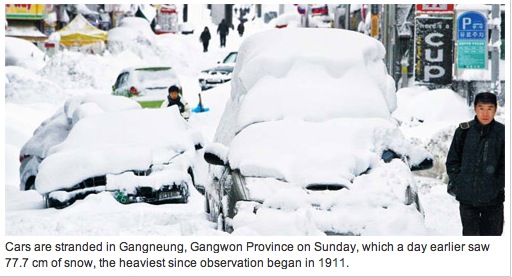
More than 1 metre (three feet) last weekend – 50 cm more coming

The heaviest snowfall in more than a century on South Korea’s east coast is causing widespread chaos. Hundreds of houses have collapsed under the weight of the snow. One newspaper described it as a snow bomb. The South Korean government has deployed 12,000 soldiers to rescue stranded residents.

Warmer than normal ocean temperatures are being blamed. This is similar to the warmer Arctic ocean temps in late Dec that contributed to the big snows and cold in North America, UK and parts of Europe.

[Update: Great sat pix from NASA showing the entire eastern half of Korea covered in snow. See also pix of Southern USA blanketed in more record-breaking snow last week]

NASA reports: “The heavy snowfall arrived on the heels of South Korea’s coolest January since the 1960s. The unusual cold might have been driven at least partly by the Arctic Oscillation (AO). A negative phase of the AO lowered temperatures in other parts of the Northern Hemisphere in January 2011.”

See also:

Arctic Defrost Dumping Snow on U.S. and Europe

The Great Groundhog’s Day Blizzard – Worst Winter Storm in 60 Years

Arctic Sea Ice Record – New Satellite Image

Cyclone Bingiza Hits Madagascar, Now Mozambique with Serious Flooding Pix

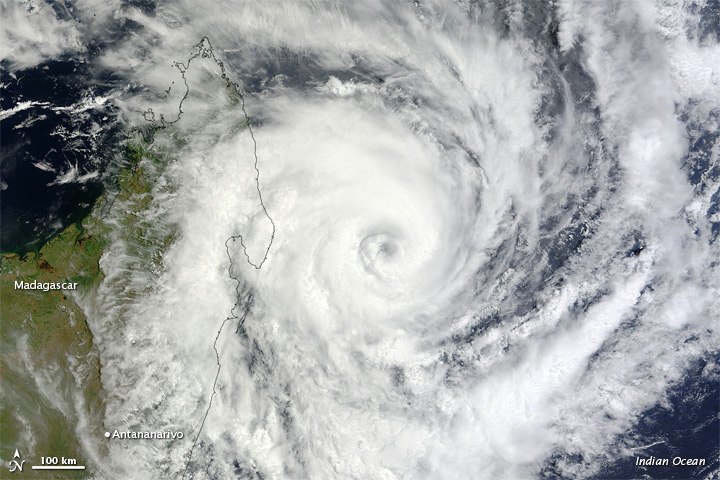
Bingiza off north east coast of Madagascar

Landfall Feb 14 Valentine’s Day

[Update 17 Feb:  Cyclone Bingiza to Worsen Mozambique, Madagascar Floods, UN Says see here for South African flooding NASA sat pix]

This is a big Cat 3 cyclone expected to affect 100,000’s of people. Sustained wind speeds of 160 kilometres per hour with gusts of up to 220 kilometres per hour, have been reported

NASA’s Terra satellite captured this image of Bingiza at 10:00 a.m. local time on Feb. 13, 2011. In the image, Bingiza’s eye approaches northern Madagascar, and a spiral arm grazes Antananarivo.

Related

Will Super Cyclone Yasi be Australia’s Katrina? Landfall Wed as Cat 5 Storm

The Yin and Yang of Climate Extremes We Will See More of

Hurricane Madness – 3 Hurricanes Spinning At One Time PIX